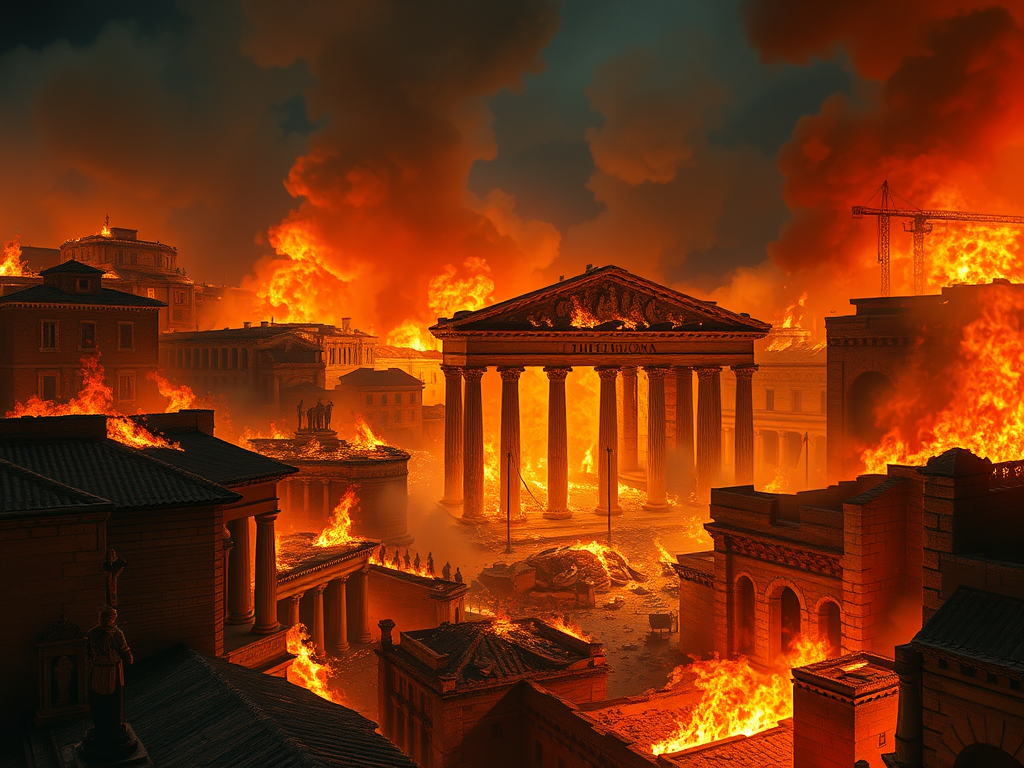
Today is the feast of the early Roman martyrs who suffered in Nero’s persecution along with the apostles Peter and Paul. The persecution began with an early morning fire on July 19, 64, that broke out in a small shop by the Circus Maximus and spread rapidly to other regions of Rome, raging for nine days through the city’s narrow streets and alleyways, where more than a million people lived in apartment blocks of wooden construction.
Only two areas escaped the fire; Trastevere, across the Tiber River, which had large Jewish population, was one.
Nero was at his seaside villa in Anzio when the blaze began, but he delayed returning to the city. They say that when he heard the news, he began composing an ode comparing Rome to the burning city of Troy. His absence caused resentment among the people. Rumors began that Nero himself set the fire in order to rebuild the city from his own plans.
To quell the rumors, Nero decided to blame someone else, and he chose a group of renegade Jews called Christians, who had caused trouble before, and had a bad reputation in the city. Earlier, about the year 49, the Emperor Claudius had banished some of them from Rome for starting upheavals in the city’s Jewish synagogues with their disputes about Christ.
“Nero was the first to rage with Caesar’s sword against this sect,” wrote the early-Christian writer, Tertullian. “To suppress the rumor,” the Roman historian Tacitus says, “Nero created scapegoats. He punished with every kind of cruelty the notoriously depraved group known as Christians.” Just how long the process went on and how many were killed, the Roman historian does not say.
The early Roman Christians came mostly from the 60,000 Jewish merchants and slaves with strong ties to Jerusalem. Even before Peter and Paul arrived in Rome, Jewish-Christians, clearly identified as followers of Jesus Christ, were counted among the city’s Jews.
At the time of the fire Jewish Christians had become alienated from the larger Jewish community and began separating from it. Where they lived and met was well known. The authorities, following the usual procedure, seized some of them, brought them to the Prefecture and forced them by torture to give the names of others.
“First, Nero had some of the members of this sect arrested. Then, on their information, large numbers were condemned — not so much for arson, but for their hatred of the human race. Their deaths were made a farce.” (Tacitus)
Instead of executing the Christians immediately at the usual place, Nero executed them publicly in his gardens and in the circus on Vatican hill. “Mockery of every sort accompanied their deaths. Covered with the skins of beasts, they were torn by dogs and perished, or were nailed to crosses, or were doomed to the flames and burnt, to serve as a nightly illumination, when daylight had expired.” (Tacitus)
Most thought Nero went too far. “There arose in the people a sense of pity. For it was felt that they (the Christians) were being sacrificed for one man’s brutality rather than to the public interest.” (Tacitus)
We celebrate the memory of the victims of Nero’s persecution, our ancestors in faith, on June 30th, following the feast of Saints Peter and Paul.
Further Reading
It would be good to have two New Testament writings in mind as we celebrate this feast– the Gospel of Mark and the First Letter of Peter.
Many scholars believe the Gospel of Mark was written in Rome following Nero’s persecution and before the destruction of Jerusalem in 70. Roman Christians, reeling from persecution and fearing troubles ahead, learned from this gospel.
Most belonged to a Jewish community that enjoyed extensive privileges under Rome’s emperors; they felt safe and secure– until Nero’s reign. There were brave martyrs, but there were others who betrayed their fellow Christians.
Mark’s Gospel presents the Passion of Jesus as a stark, brutal martyrdom that can’t be explained. How appropriate for Christians facing absurd, unmerited suffering meted out by a capricious emperor. At the same time, more than other gospels, Mark portrays Peter as a disciple who fails his Master and then receives mercy. He seems to remind Rome’s Christians that not only the strong, but the weak are part of their church.
Mark’s Gospel is meant for hard times. Jesus Crucified calls his disciples to follow him to the Cross.
First Letter of Peter
Another New Testament writing offered a similar message to the Roman community and Christians beyond the city. Like Mark’s Gospel, the First Letter of Peter, written in Rome, calls for courage in suffering, even unjust, absurd suffering.
“Christ suffered for you, leaving you an example that you should follow in his footsteps. He committed no sin and no deceit was found in his mouth. When he suffered he did not threaten; instead he handed himself over to the one who judges justly.” (1 Peter 2, 21-23)
The followers of Jesus should stay the course when suffering comes, Peter says. Stay where you are, the letter says, and “maintain good conduct among the Gentiles,” (1 Peter 2:12) “give honor to all, love the community, honor the king.”(1 Peter 2:17)
Following the Neronian persecution, many Jewish Christianss fled Jerusalem before Titus’ advancing legions. Seeing a sign of the last times, they prepared for the end. Rome’s Christians stayed where they were, it seems, and with their neighbors rebuilt their burnt city, waiting in hope for God’s kingdom to come.
They must have wondered whether to stay in this city, an evil city like Babylon. Should they go to a safer, better place? The Christians remained in the city. I wonder if the “Quo Vadis?” story was a story prompted by questions like these ?
The martyrs of Rome strengthen us to stand where we are and do God’s will, inspired by the Passion of Christ.


 The Victor's Place