In Today’s lenten reading Peter’s question about forgiveness (“How many times must I forgive my brother?”) isn’t just his question. It’s a question we all ask.
Jesus answers that we should forgive as God forgives–beyond measure –and he offers a parable about two servants who owe money (a big reason people fight among themselves). The first servant owes his master five thousand talents, a huge sum. His master forgives the entire debt In an unexpected display of mercy.
After being forgiven so much, however, that servant sends off to debtors prison another servant who owes him a few denarii, a mere pittance compared to his debt of ten thousand talents. He won’t forgive this small thing.
Now, isn’t the reason we don’t forgive others often just as small? So many grievances and grudges people have against one another are based on small slights they receive, real or imagined. And the small slights never stop. They’re constant and they need constant forgiveness.
In this holy season, we look at God’s immeasurable forgiveness found in the passion and death of Jesus and learn from him. “Father, forgive them for they know not what they do.” Seeing God’s forgiveness, the saints say, helps us to forgive. He’s forgiven us so much. Shouldn’t we forgive too?
We need to keep the example of Jesus always in mind, especially the example he gave from the Cross. The founder of my community always recommended that: “Always bring to prayer some mystery of the life and passion of Jesus Christ. If then, the Holy Spirit draws you into deeper recollection, follow the breath of the Spirit, but always by means of the Passion. You will thus avoid all illusion.” ( St.Paul of the Cross, Letter 791)
How many times must I forgive today, Lord, how many times must I be patient, kind, understanding, willing to carry on even if no one sees or cares? How many times did you? Bless me with the graces of your passion and death.
Many flocked to Jesus as his ministry began, but a growing number found him hard to understand. That’s what Mark’s Gospel indicates in our lectionary readings this week.
Scribes from Jerusalem say he has a demon, the Pharisees begin to plot with the Herodians, the followers of Herod Antipas, about putting him to death. (Wednesday) When they hear about him in Nazareth, his relatives say, “No, he doesn’t have a demon. He may be out of his mind,” They come to bring him home. (Saturday. 2nd week)
Besides leaders and people from his hometown, ordinary people begin to distance themselves too. They may be people we hear in Mark’s Gospel, (Monday) who question him “Why do the disciples of John and the disciples of the Pharisees fast, but your disciples do not fast?” (Mark 2, 18-22) Jewish leaders, his own family and ordinary people of Galilee found his message, especially his message of the Cross, hard to understand.
They weren’t ready for new wine, they preferred the old. Nor were they ready for the death he would meet.
Commentators see Mark’s gospel as a Passion Narrative with a prelude. Mark’s early stories predict the Passion of Jesus who will die alone, forsaken by many who flocked to him at first. Forsaken even by his friends.
The Passion of Jesus is a mystery beyond human understanding, Mark’s gospel teaches. Mark wrote his gospel, commentators say, to help the Christians of Rome caught in an unexpected, brutal persecution by Nero in the mid 60s.. A senseless, arbitrary persecution left Rome’s Christians confused and wondering what it all meant. Many abandoned their faith or, like the three small figures in our illustration above, seem lost before the one hanging before them. They were shocked by the tragic suffering they did not see coming. Why? They couldn’t understand.
It was so before you, Mark teaches the Romans then. It was so before you, Mark teaches us today.
Mark’s account of Jesus’ ministry in Galilee is succinct. John has been arrested and Herod, who rules in Galilee, is ready to behead him. Not a good time, in human thinking, to begin a ministry. Better wait, we say.
But this is God’s time, different from ours. The Good News is God’s message, not ours. God will act according to his plan, not ours. (Mark 1:14-20)
The call of the four fisherman, Peter, Andrew, James and John occurs by the Sea of Galilee in Mark’s gospel. For the Jews the sea, like the wilderness, was a dangerous place; storms unsettled it; unpredictable winds made it fearful. Even an inland body of water twelve miles long and six miles wide was something to be wary of. They made a living on it, but still the sea was a dangerous place.
Mark’s gospel wants us to understand the call of disciples takes place by the sea.
Jesus says simply, “Come after me and I will make you fishers of men.” Mark’s Gospel sees the four fishermen with a lot to learn to be fishers of men. They slowly understand his call. Later on, twelve would be called, (Mark 3,13-19), still later their ministry would be explained. (Mark 6,7-13)
They keep learning, not something you learn in a book, or by yourself. “I will make you fishers of men,” Jesus said. “Come away by yourselves and rest awhile,” he said to his disciples who returned to him with reports of all they had done. (Mark 6,30ff) Every disciple has to learn what the call means for him and for her, and a great deal of it we learn with others. And a great t deal of that learning comes from prayer
November 30th is the Feast of St. Andrew. On the lakeshore in Galilee Jesus called him and his brother Simon Peter to follow him. We only know a few details about Andrew. What are they?
He’s a fisherman, of course. Andrew is a Greek name. Why would a Jew have a Greek name? The area around the Sea of Galilee was then multi-cultural, and Andrew’s family were originally from Bethsaida, a trading town in the upper part of the Sea of Galilee with a substantial Greek population. Would that explain why they may have spoken some Greek? Afterwards they located in Capernaum, another trading town close by.
Could that explain why later in John’s gospel, Andrew and Philip bring some Greek pilgrims to Jesus before his death in Jerusalem. Jesus rejoices, seeing them as signs that his passion and glorification will draw all nations to him. One sees why the Greek church has Andrew as its chief patron: he introduced them to Jesus.
Bethsaida, on the northern shore of the Seas of Galilee, has been recently excavated.
Bethsaida: Winegrowers house
Bethsaida: Ruins
Bethsaida: Ruins
Andrew seems to have an interest in religious questions. He’s described as a disciple of John the Baptist, who points Jesus out to him. Jesus then invites Andrew and another disciple to stay for a day with him. “Come and see.” Afterwards, Andrew “found his brother Simon and said to him ‘We have found the Messiah.’” (John 1,35-41)
I notice too that Andrew bring the little boy with the bread and fish to the attention of Jesus.
The Greek Church sees Andrew as the first of the apostles because he’s the first to follow Jesus; then he calls his brother. Western and eastern Christian churches together celebrate his feast on November 30th.
The letter to the Romans, the first reading for his feast in the Roman Catholic liturgy, stresses there is no distinction between Jew and Greek, and praises messengers who bring God’s word to others. Tradition says Andrews brought the gospel to the Greeks, and also claims that Andrew was crucified on the beach at Patras in Greece. Besides Greece, Andrew’s also the patron of Russia and Scotland.
We ask you, O Lord, that, just as the blessed Apostle Andrew was for your Church a preacher and pastor, so he may be for us a constant intercessor before you.
Troparion (Tone 4) (Greek Orthodox)
Andrew, first-called of the Apostles and brother of the foremost disciple, entreat the Master of all to grant peace to the world and to our souls great mercy. Kontakion (Tone 2)
Let us praise Andrew, the herald of God, the namesake of courage, the first-called of the Savior’s disciples and the brother of Peter. As he once called to his brother, he now cries out to us:
“Come, for we have found the One whom the world desires!”
Finally, from John Chrysostom in our Office of Reaadings today, we learn how to read the scriptures:
After Andrew had stayed with Jesus and had learned much from him, he did not keep this treasure to himself, but hastened to share it with his brother. Notice what Andrew said to him: We have found the Messiah, that is to say, the Christ. Notice how his words reveal what he has learned in so short a time. They show the power of the master who has convinced them of this truth. They reveal the zeal and concern of men preoccupied with this question from the very beginning. Andrew’s words reveal a soul waiting with the utmost longing for the coming of the Messiah, looking forward to his appearing from heaven, rejoicing when he does appear, and hastening to announce so great an event to others. To support one another in the things of the spirit is the true sign of good will between brothers, of loving kinship and sincere affection.
Notice, too, how, even from the beginning, Peter is docile and receptive in spirit. He hastens to Jesus without delay. He brought him to Jesus, says the evangelist. But Peter must not be condemned for his readiness to accept Andrew’s word without much weighing of it. It is probable that his brother had given him, and many others, a careful account of the event; the evangelists, in the interest of brevity, regularly summarise a lengthy narrative. Saint John does not say that Peter believed immediately, but that he brought him to Jesus. Andrew was to hand him over to Jesus, to learn everything for himself. There was also another disciple present, and he hastened with them for the same purpose.
When John the Baptist said: This is the Lamb, and he baptizes in the Spirit, he left the deeper understanding of these things to be received from Christ. All the more so would Andrew act in the same way, since he did not think himself able to give a complete explanation. He brought his brother to the very source of light, and Peter was so joyful and eager that he would not delay even for a moment.
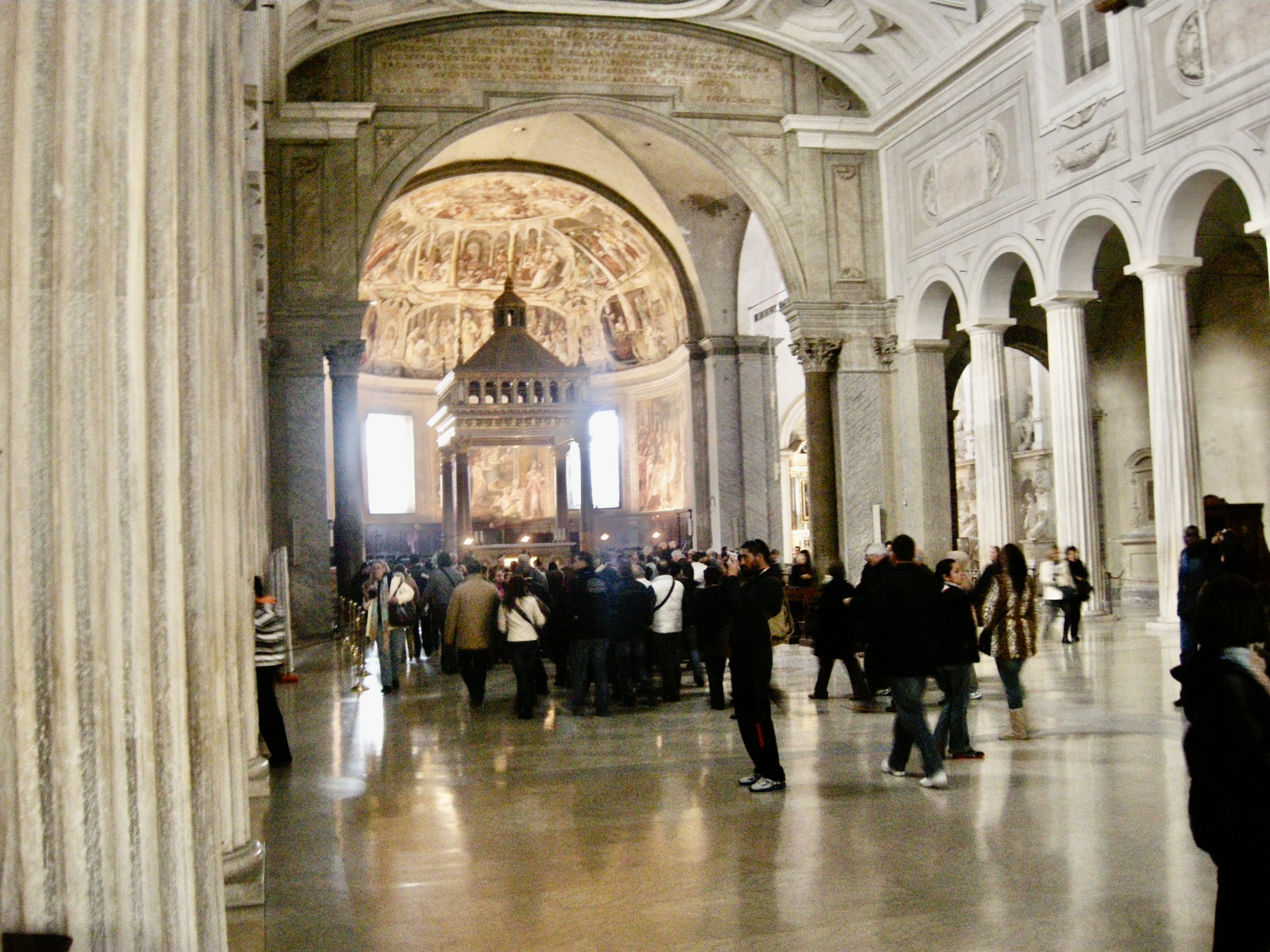
The Vatican Basilica where Peter the Apostle is buried is a prime destination for pilgrims to Rome today, but another important place dedicated to the memory of the apostle is the Church of St. Peter in Chains. It was built in the 5th century by the Empress Eudoxia on the western slope of the Esquiline Hill, next to the site of the early Roman Prefecture, not far from the Colosseum and the Roman Forum.
Justice was still being dispensed at the Roman Prefecture in Eudoxia’s day. Rome’s main prison was also nearby, where suspected criminals were tortured, questioned and judged. Not far away, just outside the city, those condemned were beheaded or strangled.
I would guess that Eudoxia was inspired to build this church next to the Roman Prefecture by the dramatic story we read today from the Acts of the Apostles of Peter being freed from his chains from a Jerusalem prison. (Acts 12:1-11) I imagine she saw the Prefecture as the place where judgment was carried out for so many Christians, even Peter and Paul.
Eudoxia gathered chains from the prisons in Jerusalem and Rome and placed them under the altar of this church she built, according to reports. Modern visitors usually turn to Michelangelo’s famous statue of Moses, located in the same church, but they should keep the chains in mind. They represent the imprisonment of Christian martyrs like Peter and Paul, and so many others.
A strong tradition among early Christian communities — affirmed today by many historians and archeologists — says that Peter met his death at Nero’s circus on the Vatican and Paul was beheaded along the Via Ostia near the place where Constantine later built a church in his honor. The apostles Peter and Paul, were martyred late in the persecution. Many details of their martyrdom are unknown, but like others they must have been arrested, put in chains, questioned, and sentenced before being executed.
Were Peter and Paul and many of the Christian martyrs who died in Nero’s persecution arrested, enchained and sentenced here?
There are later legends, of course. One says Peter and Paul were imprisoned in the Mamertime Prison, near the Capitoline Hill, where they converted and baptized their jailers. Peter, freed from his chains, escaped and fled along the Via Appia until he reached the place where the chapel, Domine, Quo Vadis? now stands. There he met Jesus coming into the city. “Where are you going, Lord?” Peter asked. When Jesus told him he was going to join those suffering, the apostle turned to embrace the same fate.
In the apse of the church of St Peter in Chains there’s a 16th century painting of Eudoxia presenting the chains to the pope. According to some 8th century homilies, one is from a Jerusalem prison. The other is from a Roman prison, possibly the one nearby? Eudoxia was a woman who listened to the scriptures with her imagination and saw connections. Good example for us who listen to the scriptures today.
Basilica di s.pietro in vincoli, A.P.Frutaz, Rome ?
The Roman Catacombs and Their Martyrs, l. Hertling SJ and E.Kirschbaum,SJ, Milwaukee, USA 1956
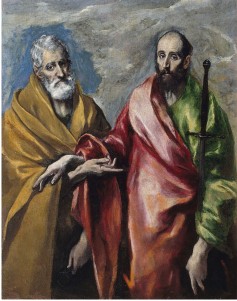
The church of Rome considers Peter and Paul, who came to the city and preached and died there during the persecution by Nero in the early 60s, her founders. Their burial places are marked by great churches, St. Peter at the Vatican and St. Paul Outside the Walls.
They could not be more unlike: Paul, the educated Pharisee from Tarsus was a latecomer to Christianity but like a runner raced from place to place in the Roman world to plant the faith. In the end, he believed God would give him “a crown of righteousness” for his efforts.
Peter, the fisherman from Galilee, was named by Jesus the Rock on whom he would build his church. Denying Jesus three times, he was called by Jesus three times to shepherd the flock. Warily, he went to baptize a Roman soldier, Cornelius, in Caesaria; then he went to the gentile cities of Antioch and Rome to tell of the One he had seen with his own eyes.
The church today prays for Paul’s zealous faith to bring the gospel to the world and for Peter’s deep love for Jesus Christ which he proved by his preaching and death.
Commenting on Jesus’ threefold call to Peter. St. Augustine says it conquered the apostle’s “self-assurance.”
“Quite rightly, too, did the Lord after his resurrection entrust his sheep to Peter to be fed. Not that he alone was fit to feed the Lord’s sheep, but when Christ speaks to one, he calls us to be one. And he first speaks to Peter, because Peter is the first among the apostles.
“Do not be sad, Peter. Answer once, answer again, answer a third time. Let confession conquer three times with love, because your self-assurance was conquered three times by fear. What you had bound three times must be loosed three times. Loose through love what you had bound through fear. And for all that, the Lord once, and again, and a third time, entrusted his sheep to Peter.”
“Today we celebrate the the passion of two apostles. These two were as one; although they suffered on different days, they were as one. Peter went first, Paul followed. We are celebrating a feast day consecrated for us by the blood of the apostles. Let us love their faith, their lives, their labors, their sufferings, their confession of faith, their preaching.”
Saints share their gifts, and recognize the gifts of others. That’s what St. Barnabas did. He was a gifted teacher of the Gospel; he also recognized the gift of Paul of Tarsus. His feast is June 11.
After his dramatic conversion on the way to Damascus, Paul preached the gospel in Damascus and then in Jerusalem, but his past caused some in Jerusalem to be suspicious of him. “They were all afraid of him, not believing that he was a disciple.”
“Then Barnabas took charge of him and brought him to the apostles, and he reported to them how on the way he had seen the Lord and that he had spoken to him, and how in Damascus he had spoken out boldly in the name of Jesus.” (Acts 9, 25-27) Barnabas recognized the grace of God in Saul.
Then, as gentiles in Antioch became increasingly interested in the gospel, the leaders of the Jerusalem church sent Barnabas to see what to do. “When he arrived and saw the grace of God, he rejoiced and encouraged them all to remain faithful to the Lord in firmness of heart, for he was a good man, filled with the holy Spirit and faith. And a large number of people was added to the Lord. Then he went to Tarsus to look for Saul, and when he had found him he brought him to Antioch. For a whole year they met with the church and taught a large number of people, and it was in Antioch that the disciples were first called Christians.” (Acts 11,23-26)
Barnabas recognized Paul’s gifts once again and sought him out to bring the gospel to the gentiles. Previously, the Apostle Peter encountered the gentile Cornelius in Ceasaria Maritima and baptized him and his friends. Now, Barnabas chooses Paul to come to Antioch, and the two embark on a mission to the gentiles. The Acts of the Apostles refer first to “Barnabas and Saul”, then gradually it becomes “Paul and Barnabas.”
Paul emerged as a gifted apostle. The Acts of the Apostles follows him all the way to Rome, while Barnabas is hardly mentioned at all. There are indications he returned to Cyprus where he came from. Did he get sick, or was he too old to embark on something new?
Whatever it was, Barnabas first recognized Paul and his gifts. I noticed on his feast, Paul is quoted in his letter to the Corinthians. “I handed on to you what I myself received…” Part of that was from Barnabas.
Our reading at Mass from the Acts of the Apostles (Acts 15, 7-21) brings us to a critical moment in the life of the early church– the Council of Jerusalem, which decided whether and on what terms gentiles would be accepted into the new Christian movement. Its decision to admit the gentiles led to a rapid expansion of the church as non-Jews from all parts of the Roman world embraced the faith.
Luke Timothy Johnson has a fine commentary on this crucial event. (Acts of the Apostles: Sacra Pagina, Liturgical Press 1992)
Did a meeting really take place? Johnson writes “we can state with considerable confidence that in the first decades of the Christian movement an important meeting was held concerning the legitimacy and basis of the Gentile mission; that participants included Paul and Peter and James and Barnabas; that certain agreements were reached which, in one way or another, secured the basic freedom of the Gentile initiative. The most striking agreement between the sources comes, in fact, at the religious level. With only very slight variation, both Luke and Paul agree that the basis of the mission to the Gentiles was a matter of God’s gift, (Acts15,11. Gal 2,9) and that God was equally at work in the Apostle Paul as he was in the Apostle Peter. (Acts 15,7-8.12; Gal 2,8)”
Notice the hesitancy of the original Jewish followers of Jesus to accept gentiles into their ranks. That’s evident in Peter’s strong reluctance to meet the Roman centurion Cornelius as he visits believers of his own kind around Joppa. Not only are the disciples slow to recognize their Risen Lord, they’re slow to accept his plans for expanding their ranks. Peter must see signs of God at work in Cornelius before baptizing him and his household. Paul, James and Barnabas also must see God’s gifts in the outsiders they meet before they recognize that God is calling them to believe.
God sows seeds of faith, but we’re as slow to recognize the action of God in others as the first disciples were. We have trouble seeing God’s action in the stranger and in the unexpected. We need enlightenment.
Johnson notes that the Church’s journey through time is marked by conflict and debate. We must accept those conditions today too. Those who follow Jesus will not always agree with each other; there are strong opinions and differences among believers.
One thing I would add. Besides conflict and debate, our reading today speaks of the “silence” that comes as they debate. We’re in the presence of our transcendent God, whose ways and thoughts are above ours. We need silence to discern God’s will. Too much talk can get in the way.
Like the apostles we’re slow to understand the mystery of the death and resurrection of Jesus. The two disciples going to Emmaus are not the only ones slow to understand– we’re slow too.
Peter, who preaches to the crowds in Jerusalem at Pentecost, certainly was slow to understand. He speaks forcefully at Pentecost, forty days after the Passover when Jesus died and rose from the dead, but the days before he’s speechless. It took awhile for him and for the others who came up with Jesus from Galilee to learn and be enlightened about this great mystery..
Mark’s accounts of Jesus resurrection appearances, read on the Saturday of Easter week, stresses the unbelief of his disciples. They were not easily persuaded.
For this reason, each year the Lord refreshes our faith in the resurrection, but it’s not done in a day. We need time to take it in, like the first followers of. Jesus, and for that we have an easter season of forty days. Just for starters.
The disciples are slow to understand the mission they’re to carry out because it’s God plan not theirs, a plan that outruns human understanding. A new age had come, the age of the Holy Spirit, and they didn’t understand it. The fiery winds of Pentecost had to move them to go beyond what they see, beyond Jerusalem and Galilee to the ends of the earth.
The Holy Spirit also moves us to a mission beyond our understanding. Luke says that in the Acts of the Apostles. “The mission is willed, initiated, impelled and guided by God through the Holy Spirit. God moves ahead of the other characters. At a human level, Luke shows how difficult it is for the church to keep up with God’s action, follow God’s initiative, understand the precedents being established.” (Luke Timothy Johnson, The Acts of the Apostles)
“You judge things as human beings do, not as God does,” Jesus says to Peter elsewhere in the gospel. We see things that way too.
Peter’s slowness to follow God’s plan remained even after Jesus is raised from the dead. He doesn’t see why he must go to Caesaria Maritima to baptize the gentile Cornelius and his household. (Acts 10,1-49) It’s completely unexpected. Only gradually does he embrace a mission to the gentiles and its implications. The other disciples are like him; God’s plan unfolds but they are hardly aware of it.
One thing they all learned quickly, though, as is evident in the Acts of the Apostles. Like Jesus, they experience the mystery of his cross, and in that experience they find wisdom.
Readings
The gospels from Monday to Thursday in Holy Week take us away from the crowded temple area in Jerusalem where Jesus spoke before many of his avowed enemies. These days he eats at table with “his own.” In Bethany six days before Passover he eats with Martha , Mary and Lazarus, whom he raised from the dead. Mary anointed his feet with precious oil in a beautiful outpouring of her love.
The gospels for Tuesday and Wednesday bring us to the table in Jerusalem where he eats with the twelve who followed him. Love is poured out here too, but these gospels describe a love with great cost. “I tell you solemnly, one of you will betray me,” Jesus says to them. Friends that followed him abandon him. Judas dips his hand into the dish with him and then goes out into the night. Peter will deny him three times; the others flee. Jesus must face suffering and death alone.
Are we unlike them?
Does a troubled Jesus face us too, “his own,” to whom he gave new life in the waters of baptism and Bread at his table. Will we not betray or deny? Are we sure we will not go away? The gospels are not just about what’s past; they’re also about now.
We think the saints exaggerate when they call themselves great sinners, but they know the truth. That’s the way St. Paul of the Cross described himself in his account of his forty day retreat as a young man:
“I rejoiced that our great God should wish to use so great a sinner, and on the other hand, I knew not where to cast myself, knowing myself so wretched. Enough! I know I shall tell my beloved Jesus that all creatures shall sing of his mercies.” (Letter 2)
Almighty ever-living God,
grant us so to celebrate the mysteries of the Lord’s Passion








 The Victor's Place