Tag Archives: Passionists

The Son of Man

We can make Jesus Christ too small sometimes and thus limit his mission and power. That’s what his disciples seem to do in Mark’s  gospel.

“John said to Jesus,

‘Teacher, we saw someone driving out demons in your name,

and we tried to prevent him because he does not follow us.’”(Mark 9,38)

Someone is doing good, but the disciples don’t know him. He doesn’t belong to their “church.” He’s doing what Jesus would do–in this case casting out demons. We might say he’s acting like a Christian, but he’s not Christian.

“Whoever is not against us is for us,” Jesus says. In other words, anyone acting as I would, thinking as I would, belongs with me, and “they will surely not lose their reward.”

Is this a reminder today for us  who so often fail to recognize the goodness and truth in others because they don’t belong to our church, or nation, or political party, or school, or are just not like us?  It’s seems so, especially in our polarized world, where we increasingly define others by differences instead of what we have in common.

Jesus tells us, as he did his disciples, to see how others are with us, rather than against us.  Look for the truth we share, even in someone we may oppose, for we  share a common nature and a common humanity. We’re human beings made in the image and likeness of God.

That’s what Jesus did. He welcomed others, even those people shunned– lepers, tax-collectors, sinners– outcasts in their day. He was open to all, even his enemies. He welcomed them and was at home with them.

It’s interesting to notice in the gospels how often Jesus seems to shy away from titles that could distance him from others.  “Who do people say I am?” he asks his disciples at one point. “They said in reply, ‘John the Baptist; others, Elijah; still others, ‘One of the ancient prophets has arisen.’ Then he said to them, ‘But who do you say that I am?’ Peter said in reply, ‘The Christ of God.’” (Luke 9,18-22)

Yet, Jesus is hesitant to accept these titles for himself publically.  The one title he seems to prefer is “the Son of Man.”

“The Son of Man must suffer greatly and be rejected by the elders, the chief priests, and the scribes, and be killed and on the third day be raised.” (Luke 9,22)

“ The birds of the air have their nests, the foxes have their dens, but the Son of Man has nowhere to lay his head.”

Scholars can’t say exactly what Jesus means when he calls himself “the Son of Man,” only a couple of references are found in the Old Testament (Daniel) and in Jewish literature, but not enough to indicate its precise meaning. There seems to be no doubt, however, that Jesus did indeed refer to himself as “the Son of Man.”

Some say the best approach is to look at what the words obviously say. “I’m the son of man,” Jesus says;  in other words “I’m a human being.” Can we say that Jesus preferred to present himself in his humanity, rather than his divinity? He came to live among us, not as a divine being, but as a human being, someone like us. Human, he experienced life as we do; he knows suffering and death as we do. To restore our humanity, to show what it means to be human, Jesus became “the Son of Man.”

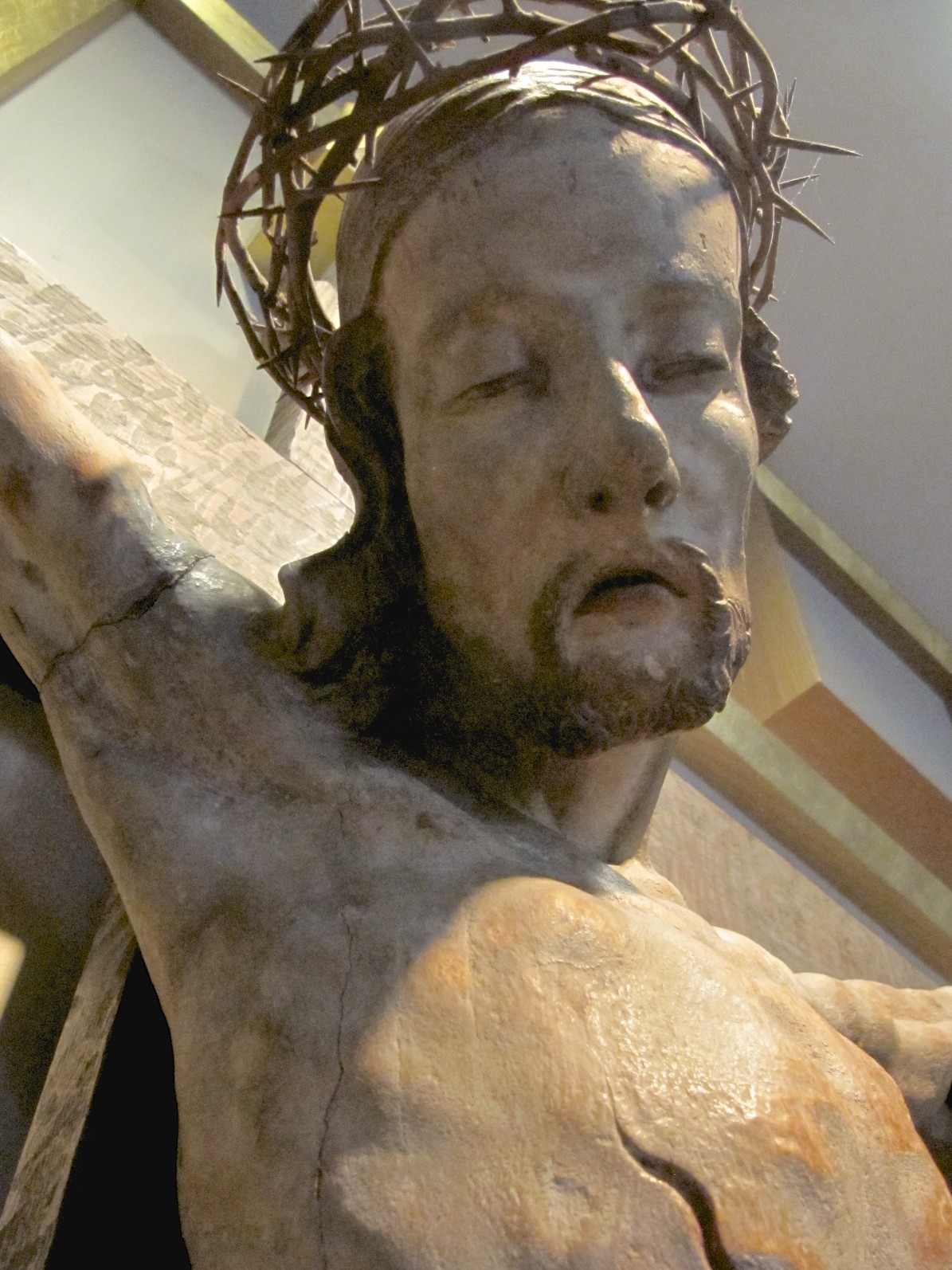
There’s a beautiful crucifix in the chapel where I live now, in Jamaica, New York, a five foot wood carving of Jesus from 15th century Germany.  It bears the wear and tear of the years. Jesus is clearly human, stripped of any sign of his divinity, his head bowed in death. It’s hard to see if he’s white, or black or Asian. He could be any of them. To me he’s the “Son of Man.”

The crucifix has an interesting history. It was given to one of our priests by the Catholic bishops of Germany and Austria after the 2nd World War when Germany was in shambles, its cities in ruins and its people crushed. They were our enemies. The crucifix was from the ruins of a German church.

The priest was in charge of Catholic Relief, one of the agencies that helped get that country on its feet again, and to me the crucifix seems to represent the bishops’ thanks for this recognition of our common humanity. The Son of Man came to reconcile and restore, not to destroy.  That’s what Jesus did.

Words Heal

Just read a review by Gary Wills of a book by Peter Brown about St. Augustine and other early saints. Augustine was someone who couldn’t live outside a community. He needed friends around him from his earliest years and later as a bishop lived in a community, because he appreciated  the help he got from others. It wasn’t that he needed an audience. He needed others to carry him along, to put up with him, because he was a sinner.

In a sermon in today’s liturgy of the hours, Augustine scolds the shepherds of the church for not befriending their flock. Their sheep want good pasture; they’re looking for healing. “You have failed to strengthen the weak,” the Lord says to them. They need shepherds, but do they also need friends?

Augustine turns to the  paralyzed man in the gospel. He needed friends to carry him to be healed, friends with faith in him, friends to bear his burden. They carry him up the roof and lower him down into the presence of Jesus. Yet, before Jesus says a word to the paralytic, did he hear from his friends, “Don’t be afraid?”


A Pilgrimage to Italy

Venice

A number of us are going on a pilgrimage to Italy, October 17-27. I spoke about the trip to some of my companions a few days ago.

“When you discover the world around you, you discover the world within you.”

We’ll be soon on our pilgrimage to northern Italy and Rome. If you have access to the internet, look up the places we’ll be visiting–Venice, Padua, Siena, Florence, Lucca, Rome, Pompei. There’s a wealth of free information available,

But let me recommend some resources.  We’ll begin our pilgrimage in Venice, the ancient maritime republic on the Adriatic Sea. Like other small powerful maritime states– England, Holland and Portugal– Venice, which is now part of Italy, was once an independent global power skilled in using the sea. Even today, the region around Venice is economically better off than other regions of Italy, largely because of Venetian economic acumen.

For centuries, the Venetian republic was linked to the Byzantine and Muslim worlds through the sea and many of its treasures, like the relics of St. Mark, come from those parts of the world. Its buildings and its art are also strongly influenced by the building and art of its trading partners.

An excellent new book on the history of Venice,  (City of Fortune: How Venice Ruled the Seas,  by Robert Crowley,  2012) offers a vivid description of the part Venice played in the Crusades and its relations to the Muslim and Byzantine empires. It’s a history that can throw light on our relationship with the Middle East today.

The best commentary on the art of Venice and Padua I’ve found is John Ruskin’s, The Stones of Venice and Giotto and his Works in Padua, both available free at Apple’s iTunes on the internet. Ruskin has a beautiful description of the art in St. Mark’s Cathedral in Venice, one of the great wonders of the world. We’ll celebrate Mass in the cathedral begun in 976 after fire destroyed an earlier building.

Padua, once the capital of Venice and also its rival, is still one of Italy’s intellectual centers.  The brilliant Italian scientist Galileo Galilei, a towering figure of the scientific world, was born in the 17th century in Pisa, in Tuscany, and studied, taught and lectured in Pisa and Padua as well as in Florence, where he and his family made their home. He’s called the father of experimental science; his work in astronomy drew criticism from the church of his time and made him a symbol of the conflict between faith and science.

However, he was a deeply religious man, Catholic to the core. Two of his daughters entered the convent outside Florence and one of them, Sister Maria Celeste, carried on a long, tender correspondence with her brilliant father.

Galileo believed that nature was a teacher along with the bible, and he wanted the church to accept scientific knowledge, otherwise it could be called an enemy of truth and human progress. Like others then and now, he believed that the bible taught you how to go to heaven and not how the heavens go.

His story is beautifully and carefully told in a recent book:

(Galileo’s Daughter: A Historical Memoir of Science, Faith and Love, Dava Sobel,  New York 1999). There’s a television version:  Galileo: Battle for the Heavens, that you can find on Nova’s internet site.

I admire the author’s even-handed description of the relations between the scientist and the churchmen who condemned him for what they considered heretical ideas. “A tragic mutual incomprehension has been interpreted as the reflection of a fundamental opposition between science and faith, “ Pope John Paul said with regret   in 1992.

Galileo was a believing scientist. I think believing scientists like Galileo and artists like Giotto (+1336) are going to be important figures in our church and our society in the future. Scientists and artists help us to know God through truth and beauty. Giotto revived people’s imagination by the treasures he left in Padua, Assisi, Florence and Rome.

Saints also strengthen our hope for the future, so we’ll keep our eyes open for the saints in the cities we’re visiting. Anthony of Padua, Catherine of Siena, Fra Angelico of Florence. We’ll celebrate Mass in their shrines in Padua and Siena.

At Lucca we’ll visit the shrine of St. Gemma. (1878-1903} Lucca is a lovely old Italian city near the Mediterranean Sea. Gemma is an “Unsuccessful Saint,” a beautiful young woman of the 19th century who in one way never achieved her dreams, yet God touched her in ways deeper than she could have ever imagined. Her life contradicts so many visions of success that our society holds. We’re going to look into her world and her life. She’s a sign that God still raises up “the lowly.”

A friend of mine offered me some wonderful notes on life and times in Lucca in Gemma’s day. Among other interesting facts, Giacomo Puccini (1858-1924), the opera composer, was from Lucca. He composed “La Bohème” which premiered in 1896. “Although Puccini did not write an opera about Gemma, he was considered incomparable in delineating frail, simple heroines like her.”

Gemma seems so unlike Catherine of Siena (1347-1380), whose shrine we will visit in Siena. Named a “Doctor of the Church” in 1970, she’s the patron saint of Italy along with Francis of Assisi.  The “Black Death” claimed one third of the population of the cities of Italy during her lifetime, at the same time the church was sunk in scandals and corruption. Catherine wasn’t afraid to scold popes, bishops, priests and politicians, and by reconciling feuding Italian cities she sparked new life into the soul of Italy.

Saints have different missions and model God’s grace in different ways, and so both Catherine and Gemma exemplify how God’s grace works in us.

Here’s some material on Gemma. http://www.cptryon.org/compassion/75/gemma.html

On Catherine, there’s a fine interview with a Dominican writer at: http://www.youtube.com/watch?v=EvlA9FBAk24

In Rome we’ll visit St. Peter’s, of course, and also Pompei, where modern archeology got its start in the 18th century. There’s a novel by Paul Harris called “Pompei” that’s worth reading; a story of that city’s last days that’s carefully researched. We’ll say hello to the pope at his Wednesday audience and celebrate Mass in St. Peter’s.

We’re going to visit  the motherhouse of my community, the Passionists, while in Rome. Saints John and Paul is located in one of Rome’s oldest areas, on the Coelian Hill, not far from the Colosseum.  Nero’s gardens were here; much of the present monastery is built over the ruins of the Temple of Claudius, another Roman emperor.  Under the Church of Saints John and Paul are the remnants of a house where Christians met around the 4th century. Early Christian saints are buried here. It’s a tight squeeze to get a large group into the underground ruins, but I’ll see if we can get there. We’ll also visit the chapel that holds the remains of the founder of my own community, St. Paul of the Cross.

You get an overview on the Coelian Hill of the history of Rome and the Catholic church. Cardinal Egan, the retired archbishop of New York, is the titular head of this old Roman church.

I wrote about this place here.

https://vhoagland.wordpress.com/2008/11/24/house-church-on-the-celian-hill/

http://www.cptryon.org/compassion/sum01/index.html

Distractions

Gloria Ziemienski kindly gave me a copy of her new book of poems the other day: There are Times:Pages from a Poet’s Journal. This is one of them.

Distractions

I sit in the quiet, praying.

a name comes to my mind.

As I pray for her,

I’m reminded of someone

or something else

and my mind takes off in

unplanned directions

which lead me toward

another someone or something,

until I gather my thoughts

and rein them all in,

trying to collect myself,

trying not to feel guilty

about my wandering mind.


Then I recall that St. Paul urges us

to pray without ceasing,

so I decide to take You with me

in my mind’s wanderings,

and offer you this day as my prayer.


January 21,2008

Blessed are the poor in spirit

There is no doubt that the poor find it easier than the rich to receive the blessing of humility; for gentleness goes with poverty just as pride more commonly goes with riches. Nevertheless,  many rich people find that their wealth does not swell them up with pride: rather, they do good and benevolent things with it. For these people the greatest treasure is what they spend in relieving the distress and hardship of others.

  In the virtue of humility people of every kind and every standing meet together, because though they differ in their means they share a common purpose. Their inequality of wealth makes no difference if they are equal in spiritual blessings.
  What kind of poverty, then, is blessed? The kind that is not in love with earthly things and does not seek worldly riches: the kind that longs to be filled with the blessings of heaven.
Pope Leo the Great

To the Sun


 O let your shining orb grow dim,

Of Christ the mirror and the shield,

That I may gaze through you to Him,

See half the miracle revealed,

And in your seven hues behold

The Blue Man walking on the sea;

The Green, beneath the summer tree,

Who calles the children; then the Gold,

with pams; the Orange, flaring bold

with scourges; Purple in the garden

(As Greco saw); and then the Red

Torero (Him who took the toss

And rode the black horns of the cross –

But rose snow-silver from the dead!)

Journey with Weakness

Our readings at Mass can often tell us about ourselves and our situation. The reading  from the Book of Joshua for this Sunday is an example. It’s worth reflecting on.

If you remember  your bible history, Joshua succeeded Moses as the leader of Jewish people when they came out of Egypt. A soldier, he led the people across the Jordan River into the Promised Land, a disputed land then and a disputed land now.

The Book of Joshua is a litany of the battles this great general fought, beginning with the battle for Jericho. As the spiritual says, “Joshua fit the battle of Jericho and the walls came tumblin down.”

Today’s reading concludes the Book of Joshua. Joshua’s an old man now, over a 100 years old the bible says, and he’s getting ready to die, so the old soldier calls together the different tribes and families of Israel to Shechem to speak to them for the last time.

Your work isn’t finished, he reminds them. Our journey isn’t over. The old soldier doesn’t speak of military matters or plans for new wars. Something more important is on his mind. He reminds the people that they’ve been called by God. “Are you going to listen to that call or not?” he says to them. You can ignore that call or drift away.

“But as for me and my household, we will serve the Lord,” Joshua says. And the people heartily join him in renewing their convenant with God.

“Far be it from us to forsake the Lord for the service of other gods. For it was the Lord who brought us and our ancestors out of the land of Egypt, out of a state of slavery. He performed those great miracles before our eyes and protected us along our entire journey and among the peoples through whom we passed. Therefore we also will serve the Lord, for he is our God.”

Notice that Joshua and the people see God’s call not just as a personal call. They’re called by God as a people. When God called them from Egypt, he called them all, the old and the young, the strong and the weak, the rich and the poor, to make the journey together and they did.

That’s the way the bible describes it and that’s the way it should be, even today. No matter how sophisticated our society gets, no matter how difficult our circumstances are, God calls us to make the journey together.

This isn’t just the wisdom of the bible. A French geophysicist,  Xavier Le Pichon, says that the world evolves the way it should when we respect the fragility of the earth and the fragility of our human community. We advance as a people when we take care of our weakest members; our earth community advances when we respect its fragile nature.

According to Le Pichon, who’s quoted at length on a recent NPR program, one important way we differ from the animals is the care we take of our weakest members. He adduces recent studies of our earliest ancestors, the Neanderthals, in whom this surprising trait appears over one hundred thousand years ago.

One study of a Neanderthal burial ground in Iraq revealed the skeleton of a 40 year old severely malformed male, who evidently had been carried from place to place by this group of hunters and buried with them. He was surely a burden to them, he must have slowed them down, but they carried him with them just the same. He meant something to them.

Unlike animals who cast aside their weak to die on the way, humans have developed a feeling for the weak, Le Pichon says. Like animals, they nourish and care for their young, but they reach further to the weakest. This sense of compassion separates humans from animals. It makes us humane.

Le Pichon disputes Darwin’s all embracing principle of the “survival of the fittest.” That principle, when applied to human evolution, does not take into account the spirit of compassion, he says.

Jesus, of course, taught the importance of this spirit of compassion when he told us that what we did for “one of these, the least,” you did it to me. You grow in love through your care of the least.

The thought of Xavier Le Pichon is worth following. Take a look at all the material on him at NPR.

The Silent Self

The silent self


Silence is

sitting still

standing still

lying still

consciously

gratefully

breathing

inspiring-

being inspired with life

and love

from him from whom these

gifts do come-

the Lord of life and love-

the living Lord Jesus.

And in the stillness

knowing

and joyfully acknowledging

that in Jesus alone

the silence of life and love is found.

Then to humbly rest

sit

stand

lie

to bow the knee

in all that satisfying silence-

and be fulfilled.

Harry Alfred WIGGETT, The silent self, in: Nigel Watts, Most this Amazing Day, Fount , 1998

Tell Us

We have had names for you:

The Thunderer, the Almighty

Hunter, Lord of the snowflake

and the sabre-toothed tiger.

One name we have held back

unable to reconcile it

with the mosquito, the tidal wave,

the black hole into which

time will fall. You have answered

us with the image of yourself

on a hewn tree, suffering

injustice, pardoning it;

pointing as though in either

direction; horrifying us

with the possibility of dislocation.

Ah, love, with your arms out

wide, tell us how much more

they must still be stretched

to embrace a universe drawing

away from us at the speed of light.

R.S.THOMAS, from: The SPCK Book of Christian Prayer, London, 1995

Grace Before Meals

“Not only in Israel, but among the ancient peoples generally, a meal was much more than a meal, understood as an occasion of eating and drinking. A meal was a sacred occasion, something that is hard for us to understand in these days of ‘fast food’, when eating is little more that  a biological function. Even a few decades ago, when  grace before meals was quite common in Western countries, there was some sense that eating and drinking are not merely biological occasions, but carry ( or may carry) many connotations.

The fact that grace before meals has become something of a rarity nowadays is symptomatic of the change that has taken place. Even when people sit down together at table they are often in a hurry to get away so that they can get to some other matter, whether business or pleasure, that seems to them more important. Even when graces are said nowadays, it is often on the least appropriate occasions, lavish banquets in city halls, colleges, or similar institutions.

But the point I want to make is that the disapperance of grace points to the fact that there has been a loss of any sense of the sacred ina meal, any sense of gratitude to God who has provided for the maintenance of life in his creation, or even to those human beings whose labor brought the fruitfulness of earth to a form in which it can nourish the human race.”

John Macquarrie, A Guide to the Sacraments, 102