Tag Archives: Passionists

Palm Sunday Procession

The gospels of Mark, Matthew and Luke report that Jesus began his entry to Jerusalem on Palm Sunday at Bethphage and Bethany on the Mount of Olives. From here he went into the city of Jerusalem seated on a donkey and those who followed him threw olive branches before him, crying, “Hosanna to the Son of David, blessed is he who comes in the name of the Lord, hosanna in the highest.”

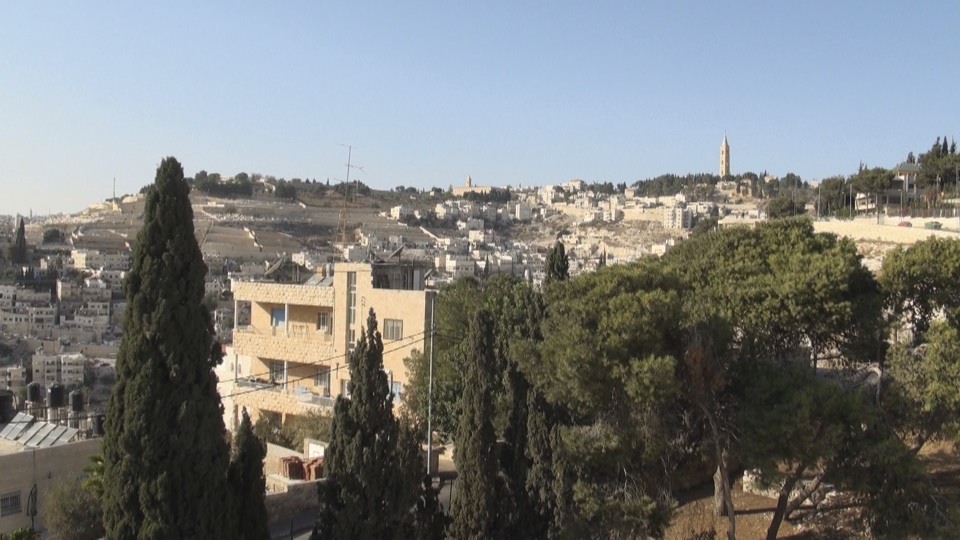
From the roof of the Passionist house in Bethany you can see the eastern slopes of the Mount of Olives looming ahead; the road winds over the crest of the mount down the other side past the Garden of Gethsemani and into Jerusalem. We walked part of the road last week.

The area around  Bethany was probably sparsely populated at the time of Jesus and into the Christian era. During great feasts, the poorer pilgrims would stay in the area, probably pitching tents up in the olive groves, and walk to the city. Here are two pictures from the 1940‘s when the area was less populated, today it is Muslim.

After Constantine established the church in Jerusalem and built churches like the Church of the Holy Sepulcher in the 4th century, vast crowds came here on Palm Sunday to reenact the gospel. They probably began near here to go their way into the city to the empty tomb .

Fr. Roberto tells me the procession today for the Latin church goes through St. Stephen’s Gate and ends in the Church of St. Ann.

Our Palm Sunday celebration today in the Roman rite imitates the ancient practice of the Church of Jerusalem, as well as many other of its Holy Week rites as well. We follow our ancestors in faith in sign. Before our Palm Sunday procession we hear these words:

“Let us remember with devotion this entry which began his saving work and follow him with  lively faith. United with him in his suffering on the cross, may we share his resurrection and new life.”

Don’t forget, however, that the little procession we have in our churches today once stretched over some tough hills and went for a distance.

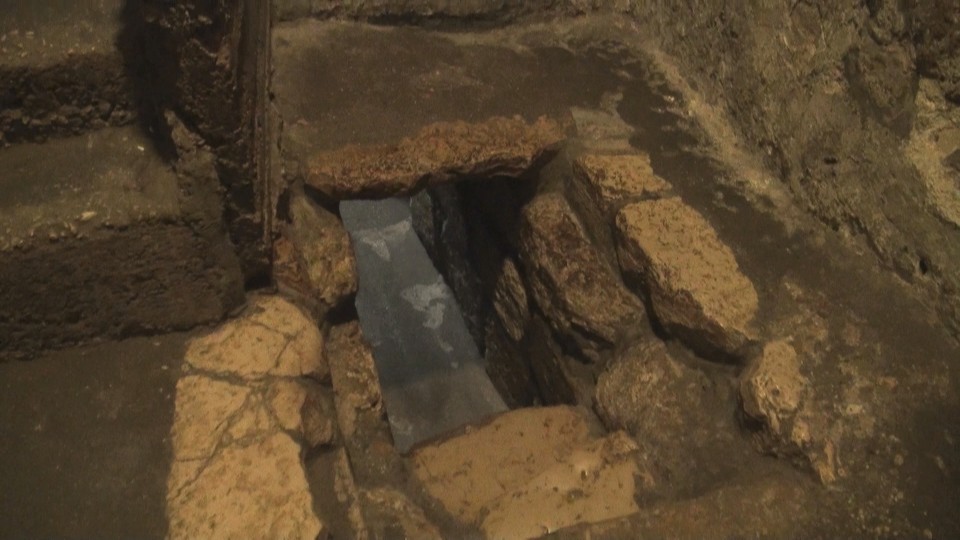
In the garden behind the Passionist house are some first century ruins of a few Jewish houses from the time of  Jesus. Outside one is  a mikvah for purifications. Not far away is the Franciscan church next to the traditional site of the tomb of Lazarus. Who knows? Could they have lived here? It looks like its part of the ancient village of Bethany.

In back of the site is the famous security wall which runs through the Passionist property. More about that later.

Palm Sunday Procession

The gospels of Mark, Matthew and Luke report that Jesus began his entry to Jerusalem on Palm Sunday at Bethphage and Bethany on the Mount of Olives. From here he went into the city of Jerusalem seated on a donkey and those who followed him threw olive branches before him, crying, “Hosanna to the Son of David, blessed is he who comes in the name of the Lord, hosanna in the highest.”

From the roof of the Passionist house in Bethany you can see the eastern slopes of the Mount of Olives looming ahead; the road winds over the crest of the mount down the other side past the Garden of Gethsemani and into Jerusalem. We walked part of the road last week.

The area around  Bethany was probably sparsely populated at the time of Jesus and into the Christian era. During great feasts, the poorer pilgrims would stay in the area, probably pitching tents up in the olive groves, and walk to the city. Here are two pictures from the 1940‘s when the area was less populated, today it is Muslim.

After Constantine established the church in Jerusalem and built churches like the Church of the Holy Sepulcher in the 4th century, vast crowds came here on Palm Sunday to reenact the gospel. They probably began near here to go their way into the city to the empty tomb .

Fr. Roberto tells me the procession today for the Latin church goes through St. Stephen’s Gate and ends in the Church of St. Ann.

Our Palm Sunday celebration today in the Roman rite imitates the ancient practice of the Church of Jerusalem, as well as many other of its Holy Week rites as well. We follow our ancestors in faith in sign. Before our Palm Sunday procession we hear these words:

“Let us remember with devotion this entry which began his saving work and follow him with  lively faith. United with him in his suffering on the cross, may we share his resurrection and new life.”

Don’t forget, however, that the little procession we have in our churches today once stretched over some tough hills and went for a distance.

In the garden behind the Passionist house are some first century ruins of a few Jewish houses from the time of  Jesus. Outside one is  a mikvah for purifications. Not far away is the Franciscan church next to the traditional site of the tomb of Lazarus. Who knows? Could they have lived here? It looks like its part of the ancient village of Bethany.

In back of the site is the famous security wall which runs through the Passionist property. More about that later.

The Tomb of Lazarus

I visited the tomb of Lazarus in November 2010 while in the Holy Land. It’s only a few hundred yards from the Passionist house, St Martha, in Bethany, where I was staying, but because of the Israeli security wall you now have to drive about 13 miles around the wall to get there.

Some sisters from the nearby Comboni convent drove me there on their way to go food shopping one day. As I approached the tomb a group of about 30 pilgrims from one of the slavic countries were entering the tomb, so I stayed outside till they left. During the 2nd World War over 40 million people were killed by Hitler and Stalin in what’s been called “The Bloodlands,” parts of Eastern Europe that were fought over so viciously. Were these people going down to the tomb from that part of the world, bringing memories of “The Bloodlands,” I wondered?

They started to sing in harmony their beautiful eastern chants and the haunting, glorious music came up from the dark rock cavern below. Lazarus was being celebrated again and his tomb rang with their joyful song.

“Lazarus, come out!”

And not only were they celebrating the raising of Lazarus but our hope of resurrection too.

The dark tomb was still ringing with their singing when I went in. Joyful song from a tomb. Lazarus represents us all. That’s the powerful message from our gospel today which prepares us for the life-giving death of Jesus.


People Who Go Back And Forth

Our gospel today (John 7, 1-2,10,25-30) recalls Jesus’ visit to Jerusalem for the feast of Tabernacles, a popular autumn feast drawing crowds of visitors to the city. News of his teaching and the wonders he worked in Galilee had already reached the center of Judaism. John describes the reaction of the Jewish leaders: “the Jews were trying to kill him.” Along with them, his coming also draws the attention of “the inhabitants of the city.”

Who are they?

“The inhabitants of the city” are not the leaders who later put him to death. They’re the ordinary public who watch the leaders, who know what’s happening in the city, who follow trends and pass gossip. They watch Jesus with curiosity as he enters the temple area and teaches.

“Do our leaders now believe he’s the Messiah?” “How can he be, because he’s from Galilee and no one will know where the Messiah is from?” They’re people who go back and forth, the undecided who wait to see who wins before taking sides. Like Pilate, they would rather wash their hands of blame, but they’re involved just the same.

Jesus does not absolve them from responsibility. In John’s gospel, though immediate blame for rejecting him and putting him to death falls on the Jewish leaders, the “inhabitants of Jerusalem” are also responsible for their blindness to the Word in their midst.

In the larger perspective, then, aren’t we all “inhabitants of Jerusalem” who bear responsibility for not recognizing Jesus and putting him to death? Our Christian tradition sees the sins of us all responsible for the Passion of Jesus.

The Paralyzed Man

Let’s compare the paralyzed man at the pool at Bethesda, whom we hear about in today’s gospel, with the official in our previous story from John’s gospel. The official came to Jesus in Cana in Galilee looking for a cure for his son. Obviously, he was important. He knew how to get things done and came to get Jesus to do something for him. He’s a resourceful man.

The paralytic at Bethesda, on the other hand, seems utterly resourceless. For 38 years he’s come to a healing pool– archeologists identify its location near the present church of St. Anne in Jerusalem– and he can’t find a way into the water when it’s stirring. Paralyzed, too slow, he can’t even get anybody to help him. He doesn’t approach Jesus; Jesus approaches him, asking: “Do you want to be well?”

Instead of lowering him into the water, Jesus cures the paralyzed man directly and tells him to take up the mat he was lying on and walk. The man has no idea who cured him until Jesus tells him later in the temple area. He’s slow in more ways than one.

“God chose what is weak in the world to shame the strong; God chose what is low and despised in this world, things that are not, to reduce to nothing things that are, so that no one might boast in the presence of God,” St. Paul tells the Corinthians.
Here’s one of the weak, the lowly, the nobodies God chooses, and he wont be the only one. But are we far from him?

Lord Jesus,
like the paralytic I wait for you,
not knowing when or how you will come.
But I wait, O Lord,
however long you may be.

The Tax-Collector’s Prayer

In Luke’s gospel Jesus often sides with those who are so let down by life that they hardly dream of anything better– tax collectors, widows, sinners like the prodigal son. He was criticized frequently by others for associating with people like that, so he must have done it often enough.
The tax collector in the parable we read today, who’s praying in the back of the temple, is an example. Luke recalls earlier in his gospel that Jesus sat down at table with Matthew and some of his tax collector friends in Capernaum. Was he telling their story in this parable?
Staying at a distance, eyes down, the tax collector says only a few words:“O God, be merciful to me a sinner.”
The Pharisee’s prayer is so different, so full of himself; he seems to ask only for applause and approval. The tax collector asks only for mercy.
His prayer is heard so shouldn’t we make it our own? Tax-collectors,  widows and sinners stand closest to where all humanity stands. We all need God’s mercy. We come to God empty-handed.
“O God come to my assistance. O Lord make haste to help me.”

“O God, be merciful to me, a sinner.”

Following Jesus through the Lenten Gospels

Don’t forget we’re following Jesus through lent and the lenten gospels are our guides. During the first weeks we read from the gospel of Matthew, a favorite of the early church, which took us to the mountain in Galilee where Jesus at the beginning of his ministry taught his followers that they are children of God, how to pray, how to forgive, how to live together.

We follow Jesus our teacher.

Today’s gospel is from Luke’s account of Jesus’ journey to Jerusalem.(Lk 11,14-23) Gathering disciples to accompany him, he teaches them through parables and performs miracles, like healing the man who is mute. Driving out the demon who holds the man makes it more than a physical healing; the miracle is a sign that the kingdom of God has come. The Evil One is powerless before Jesus.

The miracles signify that Jesus is the Messiah. When he heard about them, John the Baptist asked, “Are you he who is to come, or shall we look for another?” Jesus replied they were indeed a sign he was the expected Messiah:

“Go and tell John what you have seen and heard: the blind regain their sight, the lame walk, lepers are cleansed, the deaf hear, the dead are raised, the poor have the good news proclaimed to them.
And blessed is the one who takes no offense at me.” (Luke 7,18-23)

Jesus is the Messiah.

Next week, the 4th week of Lent, we begin the gospel of John, which take us to Jerusalem where Jesus performs great signs, like the healing of the paralytic and the raising of Lazarus from the dead, but he also engages in extensive arguments about his identity with the Jewish leaders in the temple area.

Jesus is the Son of God.

All that we learn of him leads to the mystery of his cross and resurrection.
There he is our teacher, our Messiah, our Lord.

Wednesday, 3rd Week in Lent


Mt 5, 17-19

Jesus ascends a mountain and gathers his disciples to teach them, according to Matthew’s gospel, chapters 5-7.  Moses before him brought God’s word to the Israelites from a high mountain.  Now, Jesus teaches as the New Moses. He does not abolish what the great patriarch taught; he brings it to fulfillment.

Lent gathers us again to listen to the Sermon on the Mount.  Sublime promises of a Kingdom are made to us; our God is gracious and near. But this part of the gospel reminds us of little things, the small steps, the “least commandments,” we must keep to enter the Kingdom of heaven.

This is a season–our reading reminds us– for remembering that small things like a cup of cold water, a visit to the sick, feeding someone hungry, clothing someone naked, speaking a “word to the weary to rouse them” are important commandments of God.

Yes, lent calls us to think great thoughts and embrace great visions of faith, But the law of God often comes down to small things, and the greatest in the kingdom of God are the best at that.

“The most important things for you are: humility of heart, patience, meekness, charity toward all, and seeing in your neighbor an image of God and loving him in God and for God.” ( Letter 1114)


What small step do you want me to take today, O Lord?

What can I do to help the neighbor I meet,

Who is made in your image?

The Resurrection of Jesus

photo copy

We’re concluding our parish mission in Shelter Island, NY, today with some reflections on the Resurrection of Jesus.

People today wonder about life after death. That’s because we want to live. We wonder about ourselves, first of all. Do we live after we die? A couple of books on the subject are popular these days: one by a scientist who claims he’s come back from death, the other is an account of a little boy who supposedly died and went to heaven and come back to life. Both are best sellers.

Our questions about life beyond this one also surface in  popular culture; the media is big into life in space and dark alien forces that invade our ordinary world. Must be life out there, but it looks scary, according to the media.

As Catholics we believe this world is connected to a world beyond. We believe in “the communion of saints, the resurrection of the body, and life everlasting.” Big beliefs. We believe there are tangible signs of our connection with this world, for example, apparitions of the Blessed Mother at Lourdes and Fatima.

Besides wondering about ourselves, we wonder too about our universe. Will it go on forever?

A couple of years ago I followed Harold Camping on television, who predicted the end of the world was coming on May 21, 2011 at 6 PM. The world was going to explode in fire, he said, destroying everything and everyone except those who read the bible; he didn’t have much hope for the world or most of the people in it.

A lot of people wondered if his crazy calculations were accurate. They weren’t. The world is still here and most of us are too, but at a time when many have lost confidence in our institutions, including our churches, people listened to him.

We  believe in Jesus Christ, who came into our world to teach, heal and offer the promise of eternal life. His death and resurrection answer our questions about death and life beyond this one; he also offers hope for our created world.

“On the third day, he rose from the dead,” we say in our creed. At first, his startled disciples spoke of their experience of Jesus risen from the dead in short statements like that, because his risen presence was unlike anything they had experienced before or knew from the past. They knew he was real, but his new existence was something they could hardly put into words. Their initial confusion is evident in the New Testament.

Jesus did not come from the tomb the same as he was before. He was not like Lazarus who came from the tomb and was easily recognized by all as he rejoined his sisters and went back to his own home in Bethany and took up his daily routine. Lazarus would die again.

Risen from the dead Jesus would not die again. He did not a return to the normal biological life he had before, but entered a new level of being; he experienced an evolutionary change that not only enhanced his humanity but ours too. Death would not affect him. He was changed, yet his love and care for his own in this world remained.

The Resurrection of Jesus, Pope Benedict XVI wrote, is “an historical event that nevertheless bursts open the dimensions of history and transcends it. Perhaps we may draw upon analogical language here, inadequate in many ways, yet still able to open a path towards understanding…we could regard the Resurrection as something akin to a radical ‘evolutionary leap,’ in which a new dimension of life emerges, a new dimension in human existence.”

Pope Benedict’s book, Jesus of Nazareth, is a good source for understanding the mystery of the Risen Jesus.

The gospels of Matthew, Mark, Luke and John are later statements about the resurrection of Jesus meant for particular churches and situations, so we should read them with their world in mind. Each gospel offers its own unique insight into mysteries of Jesus.

At our mission today we read from Luke’s account of the resurrection of Jesus, which centers on the two disciples on the road to Emmaus. Like the other gospels, Luke begins with the women at the tomb on Easter morning, but they don’t find  Jesus at the tomb. The Lord enters the world at large to share his risen life with his disciples and all creation.

In his gospel and the Acts of the Apostles, Luke sees God’s plan of salvation realized in Jesus who brings God’s salvation to all humanity through his church as it goes out from Jerusalem to Rome, then considered the center of the world.

The two disciples on their way to Emmaus represent the church on it’s journey through time,  one of the themes of Luke’s gospel.  As he did with the two disciples, the Risen Lord walks with his church on its mission through the ages.

Not an easy journey. Like the journey of the two disciples, it’s no triumphant march. Disillusionment, questions and gradual enlightenment are part of their journey. If the Risen Lord were not with them, they would continue in  hopelessness. The church ends up hopeless too, if Jesus were not with her.

Like the two disciples we find the Risen Christ slowly in the scriptures and in the breaking of the bread. Like them, he makes our hearts burn within. He is always with us.

The resurrection narrative from Luke is a good corrective to a triumphalist view that sees the church as perfect. It isn’t. It’s also a good corrective to a perfectionistic view of ourselves. We aren’t.

Like the two disciples, we have questions and  disappointments, but the Risen Christ walks with us. He engages  our questions and helps us understand, slowly. He is present in the breaking of the bread, the Holy Eucharist. We don’t see him; the Risen Lord has vanished from our sight, but he’s with us, guiding us to his kingdom.

Jesus also brings all creation into the mystery of the resurrection. “He took flesh and now retains his humanity forever, he who has opened up within God a space for humanity, now calls the whole world into this open space in God, so that in the end God may be all in all and the Son may hand over to the Father the whole world that is gathered together in him. (cf. 1 Cor 15,20-28) (Benedict XVI)

Harold Camping didn’t understand this.

Shelter Island

photo

I’m preaching a parish mission at Our Lady of the Isle in Shelter Island, NY today till Tuesday evening and I’ll be commenting each morning after Mass and in the evening at 7PM on parts of Luke’s gospel, the gospel we’re reading most Sundays this year in church.

Tonight it will be on the Journey of Jesus to Jerusalem, which Luke begins in Chapter 9 and continues to the 19th chapter, when Jesus reaches the Holy City.  “When the days for him to be taken up were fulfilled (Jesus) resolutely determined to journey to Jerusalem.” (Luke 9,51-19,28) In preceding chapters, Luke recalled Jesus’ ministry in Galilee. (Luke 4,13-9, 50)

Luke isn’t concerned with a neat catalogue of miles traveled or places reached in describing Jesus’ journey. This is the time he gathers and instructs disciples, who accompany him on the way to Jerusalem and, after his ascension into heaven, bring his message to the ends of the world. Not only the twelve go with him, but “great crowds” follow him besides “a further seventy-two.” (Luke 14,25; 10,1-14); Luke doesn’t forget that women are among them. (Luke 23,49)

Jesus meets opposition throughout his journey. His own town of Nazareth opposed him as he began his Galilean ministry. Now the Samaritans turn back his messengers at the start of this journey. (Luke 9,53-56) Opposition continues as he goes on his way.  The Pharisees ensconced in their synagogues pour their criticism on him. (Luke 11, 37-43)  Others are too preoccupied with riches or too caught in their own interests to pay him any attention. (Luke 12,16-21)

Some of his new disciples surprise us, like Zacchaeus the chief publican of Jericho, who welcomes Jesus into his house on his journey. (Luke 19,1-10) The poor, like the blind man outside Jericho, are also likely to follow him up the road. (Luke 18,35-43) Luke describes a merciful Jesus on this journey, who searches for the lost sheep and welcomes the prodigal son. (Luke 15,1-32)

Sure to follow Jesus into the kingdom of heaven are the childlike, who don’t cling to power and rank.  Luke sees Jesus praising the childlike both in his Galilean ministry (Luke 9,46-48) and on his journey to Jerusalem. (Luke 10, 21;  18.15-17)  It’s also a common theme in the gospels of Matthew and Mark who have Jesus pointing to his disciples the example of the child. (Matthew 18.1-5; Mark 9,35-37)

It’s essential that a disciple of Jesus be childlike. (Luke 18,15-17) Is childlikeness the secret of Zacchaeus, the chief tax collector from Jericho, the little man who climbed a sycamore tree to see Jesus passing by?

St. Leo the Great, an early pope, said that becoming like a child does not mean becoming a child physically. We can’t go back. But the childlike can go forward to the kingdom of God, because they’re small enough to pass through the narrow gate.

Becoming a child means to be free from crippling anxieties, to be forgetful of injuries, to be sociable, and look in wonder at all things.

Tomorrow I’m going to comment on the Passion narrative from Luke’s Gospel. On the journey to God, Jesus must pass through death. His disciples will accompany him.

Tuesday evening, I’ll talk on the Resurrection narrative from Luke.