Tag Archives: Passionists

And Don’t Look Ahead

Strange thing to say, isn’t it? We want to see what’s ahead. But in Luke’s account of Jesus’ journey to Jerusalem–which we read from this Sunday– Jesus warns his disciples as he nears the Holy City to be wary about what they see coming.

First, some disciples like James and John thought the journey would bring about the kingdom of God on earth and they wanted a big place in it. Their dream didn’t come true. Then, other disciples as they entered the city saw the temple itself, “adorned with costly stones and votive offerings,” and believed something so beautiful would go on forever. They were wrong too.

Jesus said, “All that you see here–
the days will come when there will not be left
a stone upon another stone that will not be thrown down.”

We have to be wary of messianic claims from those who claim to know the future. “Many will come in my name, saying, ‘I am he,” and “The time had come.’ Do not follow them!” Jesus says. The future is in God’s hands, not in ours.

The journey Jesus makes does not end in Jerusalem, according to Luke, it’s completed in his resurrection, and that will surprise us. Luke’s account of Jesus’ death in Jerusalem offers the surprising promise he makes to the thief crucified on his right, whose only hope is in him. “Today, you will be with me in paradise.”

That’s the future we trust in.

I Will Bless The Lord At All Times

I’m reading a biography of Woodrow Wilson, the 28th president of the United States from 1913 till 1921, who led the country through the brutal years of the First World War, which we remembered yesterday, November 11, Armistice Day.

Wilson was a deeply religious man, the son of a Presbyterian pastor, a wonderful writer and an eloquent speaker. Biographers today tend to use the tools of psychology to explain their subjects but the biographer of this book explains Wilson mostly through his religious beliefs– a refreshing approach.
{ Woodrow Wilson, A Life for World Peace, Jan Willem Shulte Nordholt, Berkeley. Ca. 1991}

Wilson believed that God was good, that people were good, that God was calling all nations to live in peace, and that God had given our country, the United States, a providential role among the family of nations, as a beacon of goodness and righteousness.

He was too much of an optimist, his biographer says. He didn’t see the dark side of humanity or the dark side of our own country. He thought that if you appealed to the better nature of people they would do the right thing. He couldn’t believe people would throw themselves into an awful war, or America could exploit other nations. He saw the world as the beautiful world described by Wordsworth in his poems, not a world devastated by storms (like the one that just struck the Philippines}. He was too optimistic, a Christian without the cross.

And that caused him to underestimate evil and to overestimate political solutions and possibilities. He saw the world incompletely. How many Christians are like him today?

“I will bless the Lord at all times.” (Psalm 34) The psalm is the response to our reading from the Book of Wisdom at today’s Mass; God is with us at all times, good and bad, it says. No need to be blind to evils like death and destruction, the psalm continues. “The Lord has eyes for the just, and ears for their cry… The Lord confronts the evildoers…The Lord is close to the brokenhearted and those who are crushed in spirit he saves.” The Lord is with us in bad times as well as good.

We can “bless the Lord at all times.”

An Electrifying Image

photo

Last Wednesday in St. Peter’s Square, the Pope embraced and kissed a man suffering from a rare disease called neurofibromatosis, which causes his skin to be covered with awful tumors and sores. Most people would find it hard to look at him; much harder to embrace him.

A writer in the New Yorker Magazine said “The image was electrifying, in a way that mercy can be.”

That phrase is also true of the image at the center of our faith.

Feast of the Dedication of the Church of St. John Lateran

Today, is the feast of the Dedication of Church of St. John Lateran in Rome. It seems to me you can see much of the history of the Roman Catholic Church here in this building, one of the great pilgrim churches of Rome.I wrote about this ancient 4th century church, the “mother of all churches” elsewhere.

In a homily for this feast, St. Caesarius of Arles says that this church, like all churches, reminds us we’re temples of God. “And if we think more carefully about the meaning of our salvation, we shall realize that we are indeed living and true temples of God. God does not dwell only in things made by human hands, nor in homes of wood and stone, but rather he dwells principally in the soul made according to his own image and fashioned by his own hand. Therefore, the apostle Paul says: The temple of God is holy, and you are that temple.”

The ancient baptistery at the Lateran church, pictured above, is an entrance to this church. Through baptism we belong to the great church whose Lord, Jesus Christ, shares his life with us.

The beauty of a church reminds us of the beauty of our souls, Caesarius says: “Whenever we come to church, we must prepare our hearts to be as beautiful as we expect this church to be… Just as you enter this church building, so God wishes to enter into your soul, for he promised: I shall live in them, I shall walk through their hearts.”

The Bread of Christ

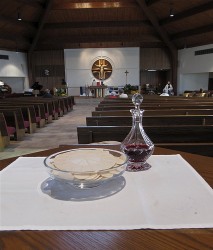
bread wine
Besides being one body, the Body of Christ, we are also one Bread in him. When we celebrate the Eucharist, we listen first to God’s word and then offer bread and wine. The prayer over the bread points to its meaning:

“Blessed are you, Lord God of all creation, for through your goodness we have received the bread we offer you; fruit of the earth and work of human hands, it will become for us the bread of life.”

We receive the bread, “fruit of the earth and work of human hands,” from our Creator. St. Augustine calls the bread we pray for in the Lord’s Prayer and the bread we offer at Mass “the bread of everything.” The gift of everything is acknowledged at Mass through the bread and wine; we’re blessed with everything, we’re reminded, and through them, we give thanks to the God of goodness for it all. “What do you have that you have not received?”

The greatest of God’s blessings is Jesus Christ who, on the night before he died took bread into his hands, the “bread of everything,” and gave himself to his disciples through this sign. “Take and eat, this is my body which will be given up for you.” In a similar way, he gave them the cup of wine that signifies his blood “poured out” for us.

“Do this in memory of me,” he said.

A mystery of faith, we say in our prayer. We believe through these signs. We can’t let their humble circumstances– the place, the people, the simple acts and words dissuade us. We’re called to wonder at what’s hidden here.

LOST, ALL LOST IN WONDER
Godhead here in hiding, whom I do adore,

Masked by these bare shadows, shape and nothing more,

See, Lord, at thy service low lies here a heart

Lost, all lost in wonder at the God thou art.


Seeing, touching, tasting are in thee deceived:

How says trusty hearing? that shall be believed;

What God’s Son has told me, take for truth I do;

Truth himself speaks truly or there’s nothing true.


On the cross thy godhead made no sign to men,

Here thy very manhood steals from human ken:

Both are my confession, both are my belief,

And I pray the prayer of the dying thief.

I am not like Thomas, wounds I cannot see,

But can plainly call thee Lord and God as he;

Let me to a deeper faith daily nearer move,

Daily make me harder hope and dearer love.

O thou our reminder of Christ crucified,

Living Bread, the life of us for whom he died,

Lend this life to me then:
feed and feast my mind,

There be thou the sweetness
man was meant to find.

Bring the tender tale true of the Pelican;

Bathe me, Jesu Lord, in what thy bosom ran—

Blood whereof a single drop has power to win

All the world forgiveness of its world of sin.

Jesu, whom I look at shrouded here below,

I beseech thee send me what I thirst for so,

Some day to gaze on thee face to face in light

And be blest for ever with thy glory’s sight. Amen.

(translation of Gerard Manley Hopkins, S.J.)

The Body of Christ

body of Christ
“We, though many, are one Body in Christ
and individually parts of one another.” {Romans 12,5-16}

St. Paul often uses the term “Body of Christ” to describe the union of Jesus with his followers. Those who follow Jesus are never isolated, self-sufficient individuals, sent off on their own. They’re united with him and with one another, and the gifts each has are to be shared with all.

Paul offers a lists of these gifts in the Letter to the Romans, read today at Mass:

“if prophecy, in proportion to the faith;
if ministry, in ministering;
if one is a teacher, in teaching;
if one exhorts, in exhortation;
if one contributes, in generosity;
if one is over others, with diligence;
if one does acts of mercy, with cheerfulness.”

We may see one or other of these gifts in ourselves, but we also need to see them in others too. The danger in our individualistic age is to not recognize our dependence on others and look at someone and think: “I don’t need you,” or “I’m more important than you.” Being in the “Body of Christ” means we need each other.

Zacchaeus, Come Down

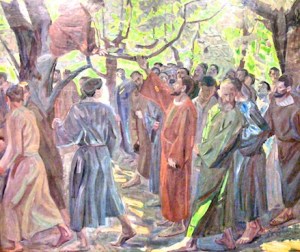
Zachaeus
We celebrate two days at the beginning of November that look beyond this world to the world to come: the Feast of All Saints and All Souls Day, November 1st and 2nd. The Feast of All Saints is not just a feast of canonized saints, like Mary the Mother of Jesus, Peter and Paul, Mother Teresa. It celebrates our belief that a great number– beyond counting according to St. John– are with God now. Each of us knows some good and faithful people who must be among them.

What about All Souls Day? I wonder if on that day we recognize there’s human weakness, as well as human goodness, in those God calls for judgment. They need God’s purifying mercy for their sins, their misuse of God’s gifts, their meanness, their lack of faith and hope and love. We know people like that too, maybe we can see ourselves in them.

The more important of these two November days is the Feast of All Saints, which proclaims the God’s mercy to be stronger than our sinfulness. It’s beyond what we expect. We hope and pray for it.

Our readings for this Sunday are about God’s mercy, a mercy that pursues us through this life and into the next. (Wisdom 11, 22-12,20) Our gospel story about the call of Zacchaeus is a special lesson in God’s mercy. Zacchaeus, the chief tax-collector in Jericho, is a wealthy man whom Jesus called down from a tree and then stayed in his house on his way to Jerusalem. (Luke 19, 1-10)

As Jericho’s chief-tax collector, Zacchaeus was an agent for Herod Antipas, the ruler of Galilee and Perea in Jesus’ day. Archeologists are still uncovering ruins of a good many of Herod’s building projects in Galilee and elsewhere. He built on a grand scale and he built lavishly, to impress his allies, the Romans.

Of course, you need money for his kind of building, and that’s where tax-collectors come in. There was no dialogue or voting on government spending then. Herod told his army of tax-collectors, “Here’s how much I need; you go out and get it. Go to the fishermen along the Sea of Galilee and the farmers near Nazareth and get what I need; I don’t care how you squeeze it out of them.” And the tax collectors went out and got him the money, and kept some for themselves.

You needed to be tough and relentless for the job. It had to leave you hard headed and hard hearted. People bitterly resented the tax collectors. Zacchaeus, chief tax collector in Jericho, led them all, and he was the one whom Jesus called down from a tree and stayed with on his way to Jerusalem.

The only words Jesus said to Zacchaeus, according to the gospel, are these: “Today salvation has come to this house because this man too is a descendant of Abraham. For the Son of Man has come to seek and to save what was lost.” No thunderous warnings or stern corrections. Jesus declares that salvation has come and they sit down for a feast. In this story you can hear echoes of the Parable of the Prodigal Son, also from Luke’s gospel.

Zacchaeus encountered the goodness and mercy of God in Jesus and it changed him. Goodness and mercy changes people. When we encounter the goodness and mercy of God we’re changed too.

We have to ask: Is God’s mercy a thing of the past, or limited only to this life? Will it also pursue us in death? Jesus will judge us at that moment. Will his judgment of us be like his judgment of Zacchaeus? When he calls us home, will he be merciful as he was to the tax-collector?

We see now in signs; we hear promises. Then we will see him face to face, and his goodness will change us, the sight of him will purify us.

God’s mercy pursues us, now in signs, then face to face. As we look upon the Bread come down from heaven at Mass we hear, “Behold, the Lamb of God, behold him who takes away the sins of the world. Happy are those who are called to his supper.” God’s mercy is proclaimed, as it was for Zacchaeus, at a supper.

Daily Prayer

Pope Francis seems to be giving us a new model of the papacy. He has the common touch, to be sure, and the spontaneity of the man is refreshing.

I wonder if his spontaneity is partially explained by the investment he makes in daily prayer. He’s made the daily Mass in the chapel at St. Martha at the Vatican an important part of his day and his ministry. The daily Eucharist seems to be a “daily bread” that provides him with the spontaneous wisdom and insight he has.

I, for one, usually go each day to the Vatican Radio site on the internet to see what he’s up to and what he has to say. By the way, there’s a new app called ThePope that gives you all he’s doing and saying each day.

In his Letter to Proba, St. Augustine says that when we say “Give us this day our daily bread” everything is included. The bread we bring for the Eucharist is the bread of everything; all creation is there, but in particular we bring this day’s creation to God to be blessed through Jesus Christ, who enables us to interpret and find meaning in the world at hand.

Is Pope Francis giving us a new appreciation of the role of daily prayer? Everything is there at Mass. Besides putting us in touch with God, it puts us in touch with the world we live in.

The World to Come

There was an evangelist on TV a couple of years ago, Harold Camping, who was predicting the end the world. He calculated from the Bible that the world was going to end on May 21, 2011 at 6 PM. It was going to be an awful, terrifying event–fires, earthquakes; everything was going to be blown up and destroyed.

Harold had no use for any the churches. They were taken over by the devil, he said. Read the bible, hold on to it; it was the only thing that would save you, he said.

I remember signs on the buses and on billboards announcing judgment day. It was surprising how many people were paying attention to him. Harold not only had the date wrong; he also had God’s plan for our world wrong.

Paul’s Letter to the Romans, which we’re reading at Mass today, sees such a different picture. (Romans 8, 18-25) Paul speaks of a glory that will be revealed. The resurrection of Jesus has changed the way we look at our death and also the way we see the future of creation itself.

The destiny of the created world is linked to our destiny. It wont be destroyed. “Creation awaits with eager expectation the revelation of the children of God.” It “groans in labor pains” until that day comes, when there will be a “new heaven and a new earth.”

Just as we hope to share in the resurrection of Jesus, we also hope that creation share in it. We ready ourselves now for the future we’ve been promised by a life of loving and caring, a love and care that should extend to the created world. Loving and caring for creation is so urgently needed today, when it suffers from so much human abuse.

“I look forward to the resurrection of the body and the life of the world to come.” Those words of the creed are so important. I look forward, not in fear but in hope. I look forward to sharing in the glory of the resurrection of Jesus. I look forward to a world to come, when the creation we know now shares in the glory we know then.

Faith Like The Mustard Seed

27th Sunday of the Year C

Like the apostles, we would like a stronger faith. “Increase our faith,” they ask Jesus. Give us faith that understands everything immediately and sees everything clearly–right away! We can hear ourselves asking for faith like that too.

In response, Jesus offers the image of a mustard seed. Look at this tiny seed, he says. With faith like this, you can accomplish the most impossible things. What does he mean?
A mustard seed is so small that you hardly can see it in the palm of your hand, Yet once in the ground it grows into a full sized tree, through cold and heat, nights and days, all kinds of weather. But it takes time.

Faith is like that. It grows, but its growth takes place over time, day by day, through the common experiences that come our way. God dwells in the ground of daily life and it’s there we meet him most of all. That’s why the psalm for today’s Mass insists: “If today you hear his voice, harden not your hearts.”

Today in countless little things, in unassuming moments, God speaks to us. And even as the moments slip by, God’s plan unfolds. We need a daily faith, a patient faith, a faith like the mustard seed, to wait until it reaches its completion. “The vision still has its time, presses on to fulfillment, and will not disappoint. If it delays, wait for it, it will surely come, it will not be late.”

A daily faith that watches God’s plan unfold in the course of things.