Tag Archives: Passionists

Be Little Children

363px-Virgin_salus_populi_romaniOn Tuesday at Cedarbrake Retreat Center in Belton, Texas, I gave a presentation on the icon of Mary in Saint Mary Major in Rome, the oldest icon of Mary in Rome. Mary is a disciple of Jesus, as the Cross that marks her forehead indicates. She hold in her arms her Child who is our teacher.

He calls us to be children. According to St. Leo the Great, a child of God is free from crippling anxieties, forgetful of injuries, sociable and stands wondering at all things.

Her story is told in this great pilgrim church.

Mary, Mother of Ordinary Time

Mother and ChildThe pope raised some eyebrows a month or so ago when he saw a little baby crying in its mother’s arms as he was going through the crowds in St. Peter’s Square in his pope mobile. “Give the baby something to eat, Madam,” he was reported to have said to the baby’s mother. Breast feeding in St. Peter’s Square! It seems he did the same thing last week on the Feast of the Baptism of Jesus in the Sistine Chapel when he baptized 35 infants. “If your baby is hungry, don’t be afraid to feed it,” he said to the mothers there according to reports.

In one of the magazines, an art historian wrote asking why should we be surprised at the pope’s words. Catholic artists have pictured nursing Madonnas for centuries. That’s what Mary did.

I spoke about Mary to priests on retreat from the Austin diocese this morning. We easily forget Mary’s fundamental role in the life of Jesus.

“Blessed is the womb that bore you and the breasts that nursed you.” “Blessed is the fruit of your womb, Jesus.”

Her role meant more than giving him birth. The apocryphal gospels often picture Jesus as showing signs of divine powers growing up, but the church condemned them because they negate the role of Mary and Joseph and the whole extended family that raised him in Nazareth.

Mary especially raised him as his mother. She did all those things a mother does for an infant, a young child and an adolescent. She fed him and took care of his basic needs. Her motherly care embodied a spirituality that’s still fundamental for the advance of human life.

The church makes her motherly spirituality its own.

If you extrapolate Mary’s spirituality to a wider arena, as I think Pope Francis does, you have to be concerned with the children of God in our world who hunger. We have to feed them. We can’t let poverty weigh them down with worries and cares. We have to relieve global poverty.

In Mary’s image, the church is a mother.

The Long Christmas Season

1 Jn 5:5-13
Lk 5:12-16

The Christmas season closes with the Feast of the Baptism of Jesus on Sunday. The season’s already ended for most people, however. The decorations are away. Valentine’s Day is coming up.

But it takes time to celebrate mysteries of God; more than a day or an hour or two. It takes time for the mysteries of God to sink in. And so we prepare for the celebration through the days of Advent. Then on Christmas Day the poor shepherds come from the dark hills to see the Child announced by the angels. A Savior is born for us, a Child is given to us. Yet, as the ancient carol says, “We scarce can take it in.”

The Feast of the Epiphany is a further reminder that the Child is the savior of all nations. He came, not just for one people, but for all. The Magi represent people far away and they bring him their greetings and gifts. Then, they leave to bring back the good news of his birth. That colorful story isn’t over; it’s still unfolding.

The Feast of the Baptism of Jesus may seem like a poor way to end the Christmas season, so far removed from the days and events of Jesus’ birth as it is. But baptism is about birth too, a birth that conquers death.

Jesus Christ “came through water and Blood,” St. John says in his First Letter today. His Spirit is given to us. It’s not enough to just look upon the mystery of the Incarnation. We’re meant to share his life, and baptism is a sign of our union with him.

We need time to understand all this, however. So the Christmas season is a long season. And we’ll celebrate again next year.

A Holy Banquet

EucharistGod’s shows his love for his people by calling them to a banquet. During the Advent season, the Prophet Isaiah offers that promise of God to his people Israel. On Wednesday in Advent’s first week, he speaks of a holy banquet of rich food and drink that God will provide on his holy mountain in Jerusalem for all people. (Isaiah 25,6-10)

In the days after the Epiphany, the evangelists describe a holy banquet in Galilee. There Jesus, whose heart is moved with pity for those who follow him, feeds a vast crowd bread and fish, “And they all ate and were satisfied.” (Mark 6, 34-44) There in “the Galilee of the Gentiles” God’s promise is fulfilled. “All” people eat and are satisfied. We recall that sign of God’s love in our gospel reading today from Mark.

The love of God should fill us with wonder and praise. Yet Mark’s gospel goes on to say that the people who ate the loaves “did not understand” the mystery they had experienced. Still true? Do we understand the mystery of God’s love and the signs we experience here and now? One of these signs is the Holy Eucharist.

I Wonder As I Wander

Nativity

 “I Wonder As I Wander.” The American folklorist John Jacob Niles wrote that haunting Christmas carol. You may remember the words:


I wonder as I wander out under the sky

How Jesus the Saviour did come for to die

For poor on’ry people like you and like I;

I wonder as I wander out under the sky

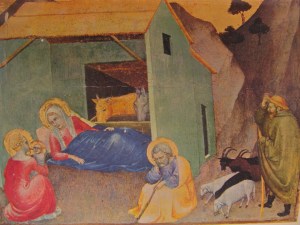
When Mary birthed Jesus ’twas in a cow’s stall

With wise men and farmers and shepherds and all

But high from God’s heaven, a star’s light did fall

And the promise of ages it then did recall.

If Jesus had wanted for any wee thing

A star in the sky or a bird on the wing

Or all of God’s Angels in heaven to sing

He surely could have it, ’cause he was the King

I wonder as I wander out under the sky

How Jesus the Saviour did come for to die

For poor on’ry people like you and like I;

                                                                                                                     I wonder as I wander out under the sky


Niles heard a young girl sing a fragment of that song in a little town in North Carolina in 1933. “Her clothes were unbelievably dirty and ragged, and she too, was unwashed,” he wrote in his autobiography, “but she was beautiful, and in her untutored way, she could sing. She smiled as she sang, smiled rather sadly, and sang only a single line of the song.”

I wonder. Like so many great Christmas carols this song calls us to reflection, to wonder about the deepest questions of life, questions you only think about as you wander out under the sky. Big questions.

So where do we come from? And where are we going? And what does it all mean? Does God who is beyond our sight, see us? Is Jesus our Savior God’s Son?  Has he really come among us?

I wonder how he came. He could have had anything, our song says, “a star in the sky, or a bird on the wing”…he could have had anything, “cause he was a King.” But he came “for to die.”

I wonder about this fallen world of ours. Why does death still seem so strong?  Why were those innocent children slaughtered by Herod at his birth? And why do innocent children still die, I wonder today? And why in the end did he die such a death?

“When Mary birthed Jesus, twas in a cow stall.” Wise men and ordinary people came to a manger, his first throne on earth. I wonder how God should dwell in so simple a place, where animals were fed. Is it in  simple places like this, in bread and wine, in the simple ways we love each other, that God still feeds us, who wander out under the sky, “poor on’ry people like you and like I?”

To Believe Is To Live

According to Luke’s gospel, you live when you believe and faith always sends you on a mission.

After the angel announces the coming of Jesus in Nazareth and then leaves her, Mary’s not alone. The Spirit remains with her, and the Word of God dwells in her womb. Unlike Zechariah struck dumb, Mary’s faith grows stronger. She does not lapse into silent darkness but seeks light.

She sets out “in haste” for the hill country of Judea to visit Elizabeth, the wife of Zechariah, who also was with child. It’s not an ordinary visit. She hurries on because she’s filled with a sense of her mission. She hurries to Judea, where her relatives serve in the temple of God.One woman will speak to another.Visitation

“Blessed are you who believed,” Elizabeth says to Mary.

“You too, my people, are blessed,” comments St. Ambrose, “ you who have heard and who believe. Every soul that believes — that soul both conceives and gives birth to the Word of God and recognizes his works.

“Let the soul of Mary be in each one of you, to proclaim the greatness of the Lord. Let the spirit of Mary be in each one of you, to rejoice in God. According to the flesh only one woman can be the mother of Christ but in the world of faith Christ is the fruit of all of us.”

Approaching Christmas we ask that our souls be like the soul of Mary.”Lord,grant that enlightened by the Holy Spirit and encouraged by the example of the Blessed Virgin Mary, our hearts may always seek out and treasure the things that are yours.”

Readings here.  Homily here.

The Road Through the Wilderness

Sometimes the best view you get of the world is from above. Here’s a picture taken from a plane in the 1930s or so of the road up to Jerusalem from Jericho and the Jordan Valley. I add another from the ground of the road outside Jericho from more recent times.


Jericho Rd  3

Jericho road modern


Both pictures tell us the road to Jerusalem is a climbing, winding road. It wasn’t easy to take when prophets like Isaiah and John the Baptist knew it. Of course today it’s easily managed by car or bus. But in those days, walking or on a donkey, you didn’t always know what to expect when you went through deserts and mountains and some fertile areas where crops were grown.

Isaiah and John the Baptist knew this road very well and they used it to explain our way to God. First, it’s an image that says life will never be easy.  On that road you’re going to get hungry, tired, even wonder whether you will make it or not. Unexpected things can happen: you may get robbed like the man did in the parable of the Good Samaritan. That happened on the road up from Jericho to Jerusalem, remember. You might be blind, like the two blind men from Jericho who couldn’t find their way.

But if you want to get to Jerusalem and enter the house of God, you have to take that road. Jesus took it when he went up to the Holy City. He began in the wilderness.

The message of Isaiah and John the Baptist, so beautifully expressed in our first reading for today (Isaiah 35,1-10), is that God will bring us there.

Keeping Awake

sf-efrem-sirul
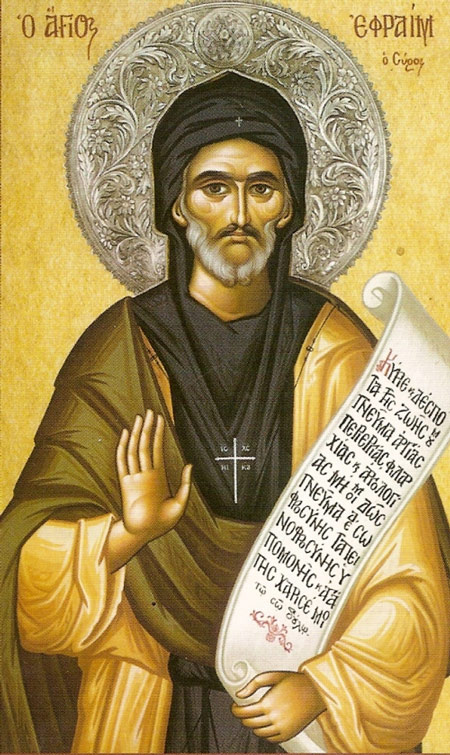
Keeping awake is one of the themes for Advent. St. Ephrem the Syrian, a voice from the early 4th century, offers some insights into the sleep we need to fear.

“To prevent his disciples from asking the time of his coming, Christ said: About that hour no one knows, neither the angels nor the Son. It is not for you to know times or moments. He has kept those things hidden so that we may keep watch..

Keep watch; when the body is asleep nature takes control of us, and what is done is not done by our will but by force, by the impulse of nature. When deep listlessness takes possession of the soul, for example, faint-heartedness or melancholy, the enemy overpowers it and makes it do what it does not will. The force of nature, the enemy of the soul, is in control.

When the Lord commanded us to be vigilant, he meant vigilance in both parts of man: in the body, against the tendency to sleep; in the soul, against lethargy and timidity. As Scripture says: Wake up, you just, and I have risen, and am still with you; and again, Do not lose heart. Therefore, having this ministry, we do not lose heart.

Black Friday and Christmas

photo
Now that Black Friday is over maybe we can get down to thinking about Christmas. For four weeks we prepare for that feast in the season of Advent.

The best place to look for the meaning of Christmas is the scriptural readings for these next four weeks. A timely source I suggest we add to them is the recent Apostolic Exhortation of Pope Francis, “The Joy of the Gospel.”

The Old Testament readings for today and all through the 1st Week of Advent are from Isaiah. Even if you can’t get to Mass, take a look at them, they make wonderful readings for Advent.

Isaiah promises salvation for all people, and one of his favorite images to describe God’s promise is found in this Sunday’s reading: Isaiah 2:1-5. All nations will stream to God’s mountain for instruction. “They will beat their swords into plowshares and their spears into pruning hooks.” Wars are no more; a fragmented humanity becomes one.

Quite a claim, considering that Assyrian armies were laying waste the towns and cities of Israel and Judea as Isaiah spoke. But God’s promise trumps all human conquests.

For Isaiah, the mountain of the Lord is Jerusalem, on which the Jewish temple is built. All nations will come there; they will be fed a rich banquet (Wednesday), the poor will be welcomed there (Thursday), the blind will see there (Friday); it’s the rock where people will dwell safely, where children play around the cobra’s den, and the lion and the lamb lie down together (Tuesday). The prophet’s imagery in these readings is strikingly beautiful.

The Gospels for the 1st week point to the fulfillment of the Isaian prophecies in Jesus Christ. The Roman centurion humbly approaching Jesus in Capernaum represents all the nations that will come to him. (Monday) Jesus praises the childlike, who will enter the kingdom of heaven. (Tuesday) He feeds a multitude on the mountain.(Wednesday) He affirms that his kingdom will be built on rock. (Thursday) He gives sight to the blind. (Friday)

Remember, too, that Matthew’s gospel, source of many of our Advent readings, portrays Jesus teaching on a mountain (Isaiah’s favorite symbol) and working great miracles there that benefit all who come. He is the new temple, the new Presence of God, Emmanuel, God with us.

Prophets like Isaiah were brave people, brave enough to speak when all seemed lost. They’re strong people, strong enough to hope when hope seems gone. And something of that prophetic spirit is in Pope Francis, I believe, who last week issued an important exhortation to the church.

He says that we can’t bring the gospel to the world if we don’t know what our world needs. We can’t bring greater human life to our world if we don’t realize what disfigures human dignity now.

What disfigures human dignity today is social inequality. Money had become our god. He speaks of the “tyranny of the financial markets.” We pay attention to a 2% drop in the stock market and ignore the death of a homeless man who dies in the cold. We’re a throw-away society. Not only do we discard things, we discard people. We tend to exploit immigrants and then throw them away. We ignore the economically unproductive, who may be without jobs or skills or socially deprived through sickness or being displaced.

The pope’s message is a hard-hitting restatement of traditional Catholic social teaching. It’s interesting to see a papal document quoted so freely on Tweeter, Facebook and the social media. It’s because he’s touched on something we need to hear.

The front page of the Asbury Park Press this morning seemed to echo the picture the pope painted in his recent address. There’s the big picture of smiling shoppers fresh from the stores on Black Friday holding their precious treasures. Next to it is a story of a homeless man who died in the cold yesterday.

No picture of him at all.

Salvation Comes To Our House

If you follow Pope Francis– and many people are following him these days–you notice that since the pope has moved downstairs to the guest house in the Vatican he’s making the daily Eucharist there one of his most important sources for learning and teaching God’s word. Some of his best insights are found in his daily homilies at morning Mass.

These are not elaborate sermons but simple remarks that usually come as he reflects on the scripture readings or the feast that’s being celebrated. He’s reflecting on the “daily bread” God gives him, and all of us.

This morning we read the story of Zacchaeus, the tax-collector in Jericho, whom Jesus calls to salvation as he makes his way to Jerusalem. How many times we’ve heard his story from Luke’s gospel, yet I noticed today something I didn’t see before: Jesus doesn’t call Zacchaeus to follow him, as he told another tax-collector, Matthew.

Jesus doesn’t tell Zacchaeus to give up his job and go somewhere else. No, salvation comes to his house, Jesus says. As far as we know, when Jesus left, the chief tax-collector stayed in Jericho, doing what he was doing, probably still wealthy, but now a changed man.

Does salvation come to us too like that? Does it come to our house, where we live and for what we do? Does it make us see things differently? Does it help us do things more justly and lovingly? Does it enable us to be the presence of Jesus where we are?