Tag Archives: Passionists

Rest in Peace

Two friends of mine have died and their funerals will take place in the next few days. “Eternal rest grant to them, O Lord, and let perpetual light shine upon them. May they rest in peace. Amen.”

What do we mean when we pray that those who die “rest in peace?”

The Book of Genesis says that God “rested” on the seventh day after completing the work of creation. God’s rest was a time of delight in what was done, and so we wish that those who die experience delight for the life they led on earth and the new life they share with God. The Letter to the Hebrews, read in the last weeks of January, also speaks of the rest of delight that those who go before us share with Jesus, our High Priest.

That doesn’t mean they will forget those they leave behind or the world they no longer live in. When Jesus rose from the dead he entered into his rest, but his work was not done on earth. God’s Kingdom must still come. As our High Priest, who shared our human life and its weakness and death, he continues to intercedes for us on earth. He is a compassionate and loving  High Priest.

Like Jesus, those whom God calls into his rest still love this world and those still journeying here. They don’t forget us. Resting in God, they’re restless  till God’s kingdom come. Given clearer sight as they commune with God, they accompany us on our way.  They’re in blessed communion with us, a communion of saints.

3rd Sunday of Advent: Who are You?

To listen to the audio of today’s homily, please select play on the audio bar below:

According to today’s gospel, Jewish officials and Pharisees from Jerusalem sent representatives to John the Baptist as he was baptizing in the Jordan River near Jericho asking “Who are you?” “Are you the Messiah, Elijah, the Prophet?” “Why are you baptizing?”

John the Baptist is an interesting figure in the gospels. He’s a strong figure who knew who he was and who he was not and wasn’t afraid to be the person God wanted him to be. “I’m not the Messiah, or Elijah, or the Prophet,” John answers. “I am the voice crying out in the desert, ‘Prepare the way of the Lord. ’”

John knew who he was. He could have said he was the son of Zechariah and Elizabeth, the cousin of Mary, the mother of Jesus. Zechariah, John’s father, was a priest in the temple of Jerusalem who surely expected his son to follow him as a priest. That was an important religious role in Judaism which was handed down from father to son.

But John chose a different course. God led him another way. He didn’t follow his father into the temple as a priest. We don’t know when, but John went down to the Jordan Valley where the road ascended to Jerusalem, and preached and baptized the crowds going up to Jerusalem to the temple of the Lord. The clothes he wore, his style of life set him apart from everyone else.

John doesn’t seem to care how he looked or what people thought of him. He certainly didn’t choose an easy place to be, a desert place. There’s a strength and determination in John that later Jesus himself praised.

John was what God called him to be, and he wasn’t afraid to speak the truth. He had a voice for God, even if he sounds at times like a drill sergeant getting people ready for the battle of the last days. He said unpopular things to powerful people and faced the consequences. Herod Antipas, who ruled Galilee and Perea, arrested him and put him to death.

Jesus admired John the Baptist for being who he was.

It’s so important to be who we are and who God calls us to be, isn’t it? I suppose that’s one of the graces of our Advent season. It reminds us that Jesus Christ came into this world for a reason, but we are reminded too that we came into this world for a reason. We have our unique gifts and should recognize them. We have been given a voice to speak as God would have us speak, and we should use it.

Who are you? Why are you doing the things you’re doing? Those are wonderful questions. “Who am I? And what am I doing with my life?”

Watch! 1st Sunday of Advent

To listen to the audio for today’s homily please select file below:

Every once in awhile I watch Jeopardy on television. At one point the host poses a question and waits a few seconds for a contestant to get the answer. Here’s my question. What’s the last of the seven capital sins?

If you got the answer, Sloth, you’re right. Sloth is the last of the capital sins and that’s where you would expect to find it, at the end of the list. It’s sleeping there, because that’s what sloth is. It’s laziness; it’s complacency. It can be spiritual or intellectual or physical laziness or complacency. It could be one or all of them together.

The passage in St. Mark’s gospel we’re reading today begins on the Mount of Olives. Jesus and his disciples have just visited the temple in the city of Jerusalem and one of his disciples points out the majestic  temple across the Kidron Valley.  “Look, teacher, what stones and what buildings!” Jesus said to him, “Do you see these great buildings? There will not be one stone left upon another that will not be thrown down.”

Can we hear complacency in the disciple’s voice. “ We have everything here, a great place, what more could we want.” Sloth is complacency in that it thinks there nothing more to do; we’ve made it and we don’t need anything more. The Advent season warns us about complacency.

You can see laziness,too, another characteristic of sloth, in the servants Jesus mentions in today’s gospel. The Master goes away and they seem to breathe a sigh of relief. “He’s gone, now we can do whatever we want. We can take it easy.”

The message we hear at the beginning of Advent is the same message Jesus spoke to his disciples on the Mount of Olives. “Watch! Stay awake!” You don’t know when I will knock on your door.

Our first reading  today from the Prophet Isaiah is filled with similar warnings  about not paying attention to God. You’re like dirty rags, withered leaves, he says to them. You’ve become like mud, hard clay that stuck and hardened in place. You need a potter to come along and water the hardness in you and mold you again. You need the potter’s hands to soften you and give you new life.

That’s what the Advent season is about. We asking God to awaken us from complacency, from  laziness, from sloth. The psalm response in our today’s liturgy sums up that prayer so beautifully.

“Lord, make us turn to you, let us see your face and we shall be saved.”

What is the face of God we are to turn to  in this season? It’s the face of Jesus Christ, first as a child, born in Bethlehem. Then as a man, who speaks God’s words to us, who reaches into our lives and shares our sufferings. Then, as our Risen Lord whom we hope to see and who promises us life everlasting.

Advent, the season we begin today, is filled with the grace of God. Let’s watch for it.


Christ, the King

Audio for the homily below:

In one of his songs, Bruce Springteen sings,

“Poor man wanna be rich,

Rich man wanna be king.

And a king ain’t satisfied

Till he rule over everything.”

That’s the normal road power takes, isn’t it? But it wasn’t the road Jesus Christ took. He ended up a poor man on a cross who had nothing. On either side of him were two criminals who also had nothing– except the prospect of death.

Jesus becomes the king of the poor, the God of the needy, our gospel today says. He speaks in their behalf and he judges others by what they have done to them. What’s more, he claims that when we help those in need, we meet him.

“I was thirsty, I was hungry, I was sick, I was in prison, I was a stranger.”

“When did we see you thirsty, hungry, sick, in prison, a stranger?” those who come before him ask–and we are among them. “When you did it to the least, “ Jesus says.

Mother Teresa had a beautiful response for those who wondered how she kept doing so much for the poor. “We must see Christ in disguise,” she said. Her words are good advice for us who wish to do what this gospel says we should.

We have to see Christ in disguise, not simply a figure from some far off past, or a heavenly presence beyond our reach. He is close to us, as close as the one beside us at home or just outside our door, who needs one of the simple gifts we can give.

The Sacrament of Penance

Prodigal son

Penance is a neglected sacrament in our church today. Few Catholics receive it. It was among the last sacramental rites to be revised after the Second Vatican Council and little catechesis accompanied its introduction. The Mass, with its changes in language and form, got most attention after the council. It seems to me that Penance needs to be better known and better celebrated.

Like the Mass, this sacrament has different names. It’s called the Sacrament of Reconciliation, the Sacrament of Penance and also Confession. Each term describes something about it.

It’s called the Sacrament of Reconciliation because God shows us mercy here, a mercy that reconciles us to him and to our world. The prayer the priest prays after the penitent confesses sin explains the sacrament:

“God the Father of mercies through the death and resurrection of his Son has reconciled the world to himself and sent the Holy Spirit among us for the forgiveness of sins. Through the ministry of the church may God grant you pardon and peace. I absolve you from your sin in the name of the Father, and of the Son and of the Holy Spirit. Amen.”

Reason can point to a God all-powerful and infinitely wise, but faith says God is “the Father of mercies.” God reveals himself as merciful in Jesus Christ who died and rose again from the dead. Appearing to his fearful disciples on Easter Sunday evening he said to them:

“’Peace be with you.’ When he had said this, he showed them his hands and his side. The disciples rejoiced when they saw the Lord. Jesus said to them again, ‘Peace be with you. As the Father has sent me, so I send you.’ And when he had said this, he breathed on them and said to them, ‘Receive the Holy Spirit. Whose sins you forgive are forgiven them, and whose sins you retain are retained.’” (John 20,19-23)

God is merciful and mercy brings “pardon and peace.” The mercy of God is a favorite theme Pope Francis stresses today in his preaching and ministry. It is a prominent theme in the recent Synod on the Family. We need to believe in it.

Besides the Sacrament of Reconciliation, the sacrament is called the Sacrament of Penance. To do penance is to try to heal the wounds and damage we have caused through what we have done or left undone in life. The penance given the penitent by the priest in confession is part of a life-long way of penance. We’re also part of a church that must be always penitential, a church always needing to be reformed.

The sacrament is called Confession because we look at ourselves in the light of God’s word and try to uncover and express what are our sins and how they prevent us from loving God and neighbor as we should.

Reconciliation, Penance, Confession. The simple steps taken in this sacrament are concrete expressions of these themes. We can confess individually, probably the most familiar way, or as part of a group. There are two ways for celebrating the sacrament in groups, one ending with individual absolution, the other with general absolution.

Briefly, individual confession before a priest can be done either kneeling or face to face. It begins with the Sign of the Cross, a sign of God’s blessing and God’s presence. Then there is a short reflection on God’s word so that we might know our sins and be encouraged to confess them to our God. This step should also take place in our preparation for confession.

We express our sins to the priest, receive a penance from him and pray that God forgive us.

The priest then declares the mercy of God and the grace of pardon and peace in the prayer mentioned above.

The sacrament concludes with an expression of thanksgiving to God, who is merciful.

A fuller treatment of the Sacrament of Penance can be found in The United States Catholic Catechism for Adults,  now free online.

Love Without Calculation

I’ve started reading “Love Without Calculation: A Reflection on Divine Kenosis” by David N. Power, OMI, an Irish Oblate priest who taught for many years at Catholic University in Washington, DC. He wrote this book, a reflection on his own life and times, while teaching after his retirement from CU at a small seminary in French Polynesia.

The faraway island with its colonial history and disturbing past gave Power some metaphors for looking at the world he has experienced as a western Christian theologian, a world that has known two world wars and a number of other hostilities, the Holocaust, increasing poverty, threats to its environment, the failure of international institutions, as well as Vatican II and its aftermath.

As a theologian who talks about God, Power wonders how we can do that today in the midst of so much turmoil and indifference. Our talk about God gets “ disrupted by terrifying memories and by a knowledge of a world situation that deifies all that has been said about the divinity. We are really pressured by too much evil to be coherent.”

Power ends his book, I see, advocating prayer and participating in the liturgy as “the ground of theology” for our time. “Grounding one’s thoughts in prayer and the movement of the liturgy is turning once more to interest in the forms of language used to express faith, to the play of imagination and so to cultural and hermeneutical issues.”

We just celebrated the feasts of Martin of Tours and Leo the Great. Today we have the feast of Mother Cabrini, the fierce defender of poor Italian immigrants who came to the United States at the beginning of the 20th century. The Lord gave us these saints that we might learn from them as we try to make sense of life today. The prayers we say and the rites we celebrate also give us light in dark times.

We all need the learning that comes from prayer and the liturgy. Good advice from Fr. Power.

Memories of a Baptism

I was celebrant at the funeral Mass for Jack Olsen last Saturday morning in Sacred Heart Church in Bay Head, NJ.

My memories of Jack go way back to when the Olsens lived in the house on the corner of Lord Avenue and 3rd Street in Bayonne, NJ. My mother was a friend of Jack’s mother and when we were young she took my sister and me regularly to see the Olsens. We played with their 9 kids. Just down the street from their house was a football field where some of the best local teams played. During the 2nd World War Italian prisoners of war were held in barracks there and many Bayonne Italians went down to talk to them and pass them food. It put a human face to war.

Just beyond the Olsen’s house was the Kill Van Kull, the busy three mile waterway between Bayonne and Staten Island. Bill Olsen, Jack’s father, was a tugboat captain. As a kid, I couldn’t think of a better job in all the world than pushing and pulling big ships and barges around New York harbor.

My mother told me she met my father when she was washing the dishes after a baptism at the Olsens–maybe it was Jack’s baptism, or Fr. Tom’s, or Rita’s. My father was a friend of Jack’s uncle, Dinny, who probably invited him to the baptismal celebration that day.

“What’s your name?” my father said to her. “Rose O’Donnell,” she replied. “I’m Victor Hoagland,” he said. So my sister and I are here 80 or so years later. How connected our lives are by small things, like washing dishes or going to a baptism.

I mentioned at Jack’s funeral some of the small things that took place at his baptism 86 years ago. He was brought to church and signed with the sign of the Cross. That simple sign meant that he was blessed by the mystery of the death and resurrection of Jesus, who would bless him through the course of his life, even the hard months that marked his final sickness.

At his baptism, the priest poured water, the source of life, on his forehead and said (in Latin then) “John, I baptize you in the name of the Father, and of the Son, and of the Holy Spirit.” Life was God’s gift to him, a life that begins at conception and continues beyond the years here on earth.

Jack was a strong believer in God, the Creator, who gives life and Jesus, our Redeemer, who saw life so precious that he gave his life that we might live. He was a firm believer in the Right to Life.

Baptism is a sacrament of family life, which means, first of all, that we’re members of the family we belong to in this world. Jack, a bachelor, played a big part in his large family of brothers and sisters, nieces and nephews and all their wives and husbands, never missing celebrations, births, deaths and holidays. He was proud of his family and loyal to his own.

Baptism calls us into other families too– the family that’s our neighborhood, our city, our country. Jack was a good neighbor who loved the place where he lived and the people who lived there.

Baptism also calls us into the family of the church. Jack was a true believer; he loved the church. No doubt about his loyalty; the church was his home. He belonged to its societies, like the Holy Name and the Knights of Columbus. He made retreats with the Passionists. The Mass and the sacraments were not formalities, they were real for him. He loved his church in good times and bad.

At Jack’s funeral the other day, it seemed right to remember his baptism. The sacrament is at the heart of our funeral rites, when you think about it. We blessed him with water, the sign of life and made the sign of the cross over him again as his remains were carried into the church and then carried out. A white cloth, a reminder of the white garment he received long ago, was placed over him. The great words of faith were proclaimed: “The souls of the just are in the hands of God.” We heard the account of Jesus’ death and the message of the angel, “He is risen.” We celebrated the mystery of the Bread and Wine, which Jesus said are the food of eternal life.

“Life is changed, not ended,” our prayer said. Rest in peace.

The Lost Sheep

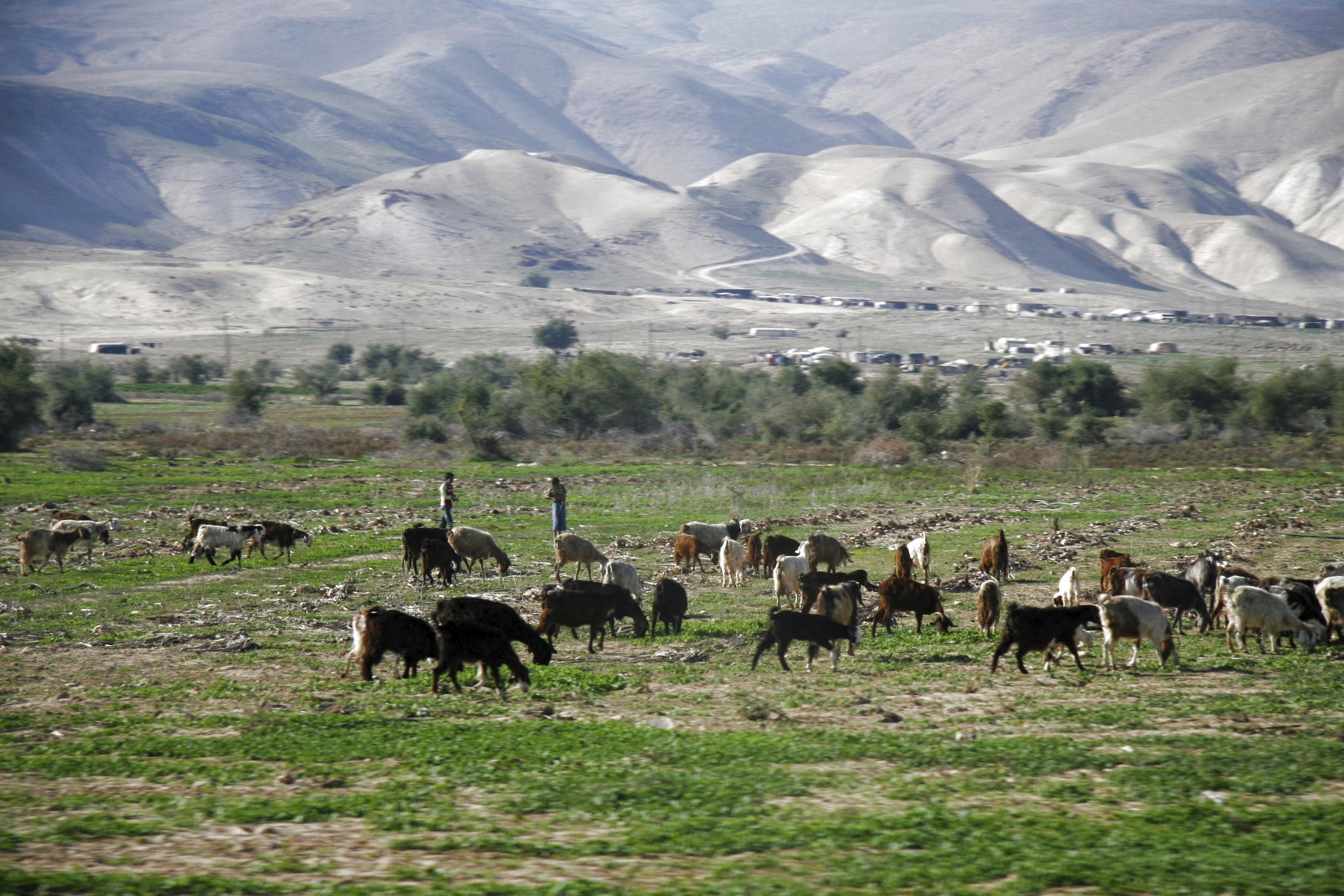
Jordan Valley

A few years ago a woman sent me some pictures from her pilgrimage to the Holy Land. The one above is a picture of some sheep in the Jordan Valley. In the background are mountains that trail off into the dark distance. In his day, Jesus would have passed this way from Galilee to Jerusalem. Probably sheep were grazing in the green pastureland then as they do now.

I think of this picture whenever I hear his parable of the lost sheep, which we heard in Luke’s gospel today at Mass.

Can you imagine searching for one sheep in those mountains? Just looking at them might cause us to say, “Well, that one’s gone,” and give up. But the Good Shepherd doesn’t say that or give up. He searches the mountains till he finds what was lost, then he puts it on his shoulders and rejoices with his friends and neighbors.

“Rejoice with me because I have found my lost sheep.”

The lost sheep is not only each one of us; it’s also a lost world.

The Passion of Christ

passion site

Monday on the Feast of St. Paul of the Cross we launched a new website on the Passion of Christ.

http://passionofchrist.us/

The website has a commentary on the Passion Narratives by Fr. Don Senior, CP, and information on Passion sites, devotions, prayers, spirituality and recent studies.

In recent studies, for example, there’s a review by Fr. Paul Zilonka, CP. of Bill O’ Reilly’s recent book “Killing Jesus.”

It’s a work in progress. A lot more material will be added in days to come, so drop in every once in awhile. The Passion of Jesus is at the heart of the mission of the Passionists, the community I belong to. It’s a mystery that can feed your soul.  I would be grateful for any suggestions you may have.

The site will play on any computer, iPad or smart phone. We hope eventually to develop the website into a multi-lingual site that will literally reach the whole world.

I’m very grateful to the person who did such a beautiful job in formatting the site. A work of art in itself. A special grace brought this site about.

The Pope in Albania

Pope Francis made a one day trip on September 21, 2014 to Albania, a small mountainous country on the Adriatic Sea. One newspaper said “Francis’s decision to choose tiny, poverty-ridden Albania instead of one of the continent’s big Catholic powers for his first European trip as pontiff is in keeping with a papacy that wants to give priority to the poor and the neglected.”

He had other reasons too. Albania, with a Muslim majority, has Catholics and Orthodox Christians among its citizens. The pope praised the respect and trust between these groups as a powerful sign in today’s world. Other countries in Europe and the rest of the world, experiencing the effects of immigration and resettlement, need to emulate its example.

“May no one use religion as a pretext for actions against human dignity and against the fundamental rights of every man and woman, above all to the right to life and the right of everyone to religious freedom,” Pope Francis said.

“This is especially the case in these times where an authentic religious spirit is being perverted by extremist groups and where religious differences are being distorted and instrumentalised.”

Here’s a great story of Albanian inter-religious cooperation from ABCnews.