Tag Archives: Passionists

Knowing Yourself

NEW YORK TIMES columnist David Brooks has gotten a lot of attention lately for his suggestion that we need more humility in our society today. We need to know ourselves. We need to look to those who knew themselves and learn from them, Brooks say.

We may thing that humility stops you from doing anything, except hide in a corner away from the storm. Just the opposite, the humble take on large challenges, because they recognize another power at work besides themselves.

St. Gregory the Great, a 6th century pope, was called great for his humble service to the Roman world that was falling down around him. Gregory ends one of his finest commentaries on scripture, called the Moralia, a Commentary on the Book of Job, with words that reveal someone not afraid to honestly know himself.

“Now that I have finished this work, I have to look at myself. We are so complex, even when we try speaking the truth. Let me go from the forum of words to the senate house of my heart, to take council about myself.

I don’t want to speak anything evil or speak poorly about what is good.

I wish my words please the One is good.  Yet, can I claim I have spoken no evil at all? Have I spoken less well than I should, perhaps? When I look within, pushing aside leafy words and branches of arguments, and examine my deepest intentions, I know I intend to please God, but has some desire for human praise crept in? Has it intruded into my simple desire to please God?

Later, much later, I may realize this. Often, our intentions to please God are joined by a secret yen for human praise. Self-righteously, we even use God’s gifts to please others.

So in my commentary I reveal God’s gifts, but let me confess my wounds too. Let me instruct the little ones by my words, but let others take pity on my weakness. I offer help to some and seek help from others. As I tell some what to do, I open my heart to others to admit what they should forgive.  I give medicine to some, but do not hide my wounds from others. My reader will have more than paid me back if, for what he hears from me, he offers his tears for me.”

A humble man.

Bread and Wine

The Easter season is a time of sacraments, the way the Risen Jesus comes to us today. It’s the time for First Communions, when little children are initiated into this mystery and we adults are reminded of it again.

I often think how impoverished we moderns are compared to generations long ago who experienced bread and wine so much more concretely than we do today. They watched bread made in their own homes and  probably helped pressing grapes for wine.

You can see that experience in the old commentaries on the Eucharist, like this one from St. Gaudentius of Brescia.(+410) Bread-making and wine-making help to understand the mystery:

“ Daily this mystery is before our eyes as a representation of the passion of Christ. We hold it in our hands, we receive it in our mouths, and we accept it in our hearts.

“It is appropriate that we should receive the body of Christ in the form of bread, because, as there are many grains of wheat in the flour from which bread is made by mixing it with water and baking it with fire, so also we know that many members make up the one body of Christ which is brought to maturity by the fire of the Holy Spirit.

“Christ was born of the Holy Spirit, and since it was fitting that he should fulfil all justice, he entered into the waters of baptism to sanctify them. When he left the Jordan he was filled with the Holy Spirit who had descended upon him in the form of a dove. As the evangelist tells us: Jesus, full of the Holy Spirit, returned from the Jordan.

“Similarly, the wine of Christ’s blood, drawn from the many grapes of the vineyard that he had planted, is extracted in the wine-press of the cross. When we receive it with believing hearts, like capacious wineskins, it ferments within us by its own power.”

The Passionist Nuns from Erlanger, Kentucky, make Communion wafers for many churches and they made a video of how it’s done, for children making their First Communion.

The Homelessness of Faith

“When Paul had finished speaking he knelt down and prayed with them all. They were all weeping loudly as they threw their arms around Paul and kissed him, for they were deeply distressed that he had said that they would never see his face again. Then they escorted him to the ship.”

As the gospel spread to all nations, we seldom see scenes in the scriptures like Paul’s farewell to the presbyters at Ephesus, described in our reading for today, but there must have been others like it. Peter biding farewell to his family at Capernaum; James and John parting from the mother who wanted so much for them; others who left the places and people they knew for the sake of the gospel. Goodbyes are hard, even when they happen for noble purposes.

There’s a homelessness in every human life. The Carmelite poet, Jessica Powers describes it so well in one of her poems:

“It is the homelessness of the soul in the body sown

it is the loneliness of mystery;

of seeing oneself a leaf, inexplicable and unknown

cast from an unimaginable tree;

of knowing one’s life to be a brief wind blown

down a fissure of time in the rock of eternity.”

This is the homelessness that touches us all, even as we believe.

The elders of Ephesus would miss Paul who had been with them for three years and become part of their life, and he would miss them. The disciples of Jesus at the Last Supper must have been touched as he told them he was going away. They had to feel loss.

Only the promise of a spiritual union and a homecoming tempered their sense of loss. Only the promise of reunion of another day.

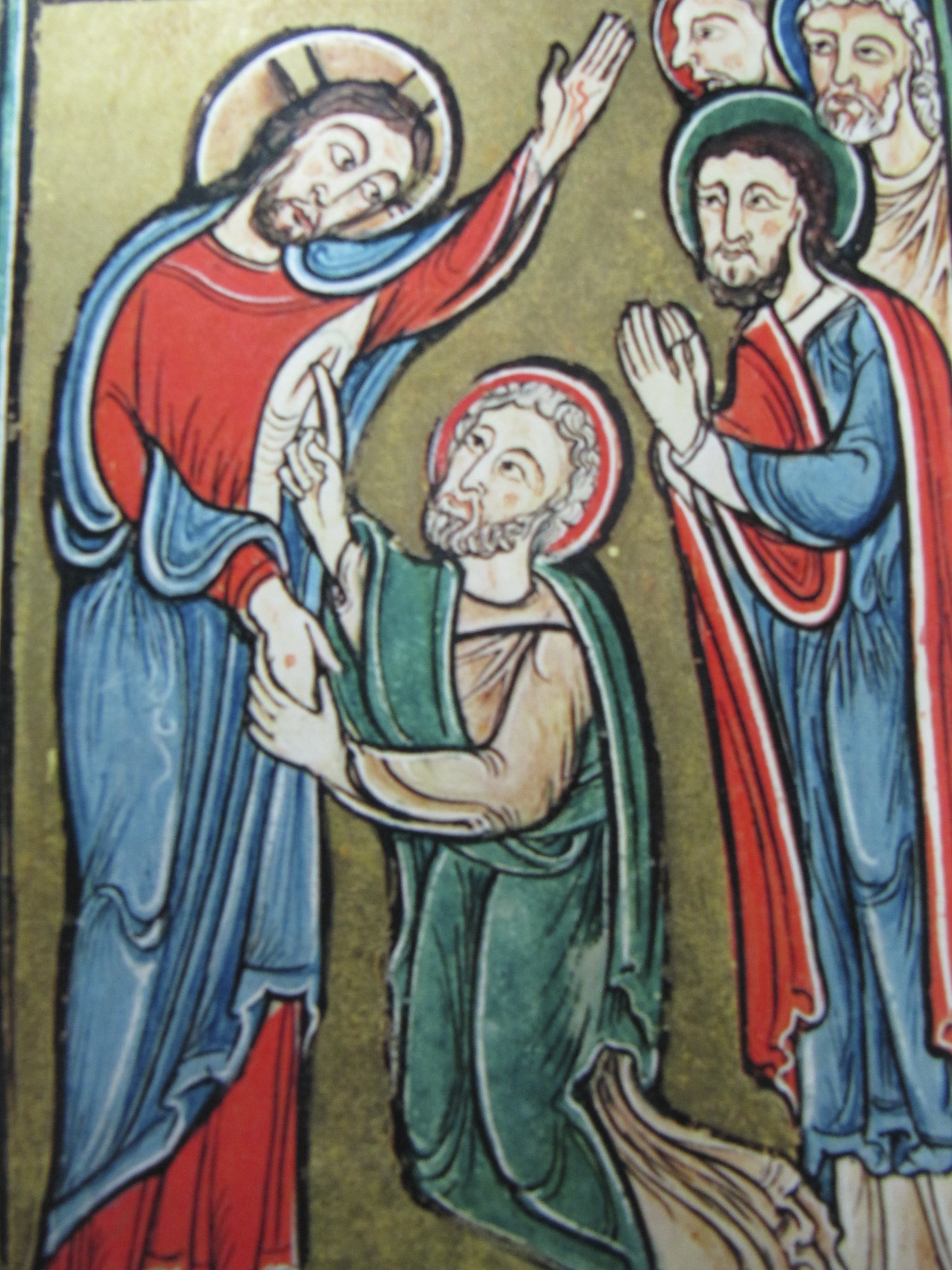
Ist Sunday of Easter: The Thomas in Us All

Audio of the homily below:

The yearly feast of Easter is a celebration, not of one day, but of fifty days, from Holy Saturday till the feast of Pentecost. We also celebrate Easter each Sunday of the year.

Why this extensive celebration? Because we’re so slow to realize what it means, and need reminding over and over.

Some things — like telling time or tying our shoes — we learn once, but the resurrection of Jesus is a mystery not learned at once. Never grasped completely, it unfolds as life unfolds, day by day.

That’s why Thomas, the apostle, whom we remember on the 2nd Sunday of Easter, is such an important figure. Far from being a lonely skeptic, an isolated dissenter, he represents the slowness of heart and mind, the recurrent skepticism, that affects us all.

Yet, Thomas is still a sign of hope. He reminds us that the Risen Jesus offers, even to the most unconvinced, the power to believe.

Lord Jesus,
the Thomas in us all
needs the wounds in your hands and side,
to call us to believe
you are our Lord and God.

Risen, present everywhere,
bless those who have not seen,
blind with doubts
and weakened faith.

Bless us, Lord,
from your wounded hands and side,
give us faith
to believe in you.

Spanish
El Tomás Dentro de Todos Nosotros
Juán 20, 19-31, Segundo Domingo de Pascua

La fiesta anual de Pascua florida es una celebración, no de un día, sino de cincuenta días, desde el Sábado Santo hasta la fiesta de Pentecostés. También celebramos el Domingo de Pascua cada domingo del año.

¿Por qué esta extensa celebración? Porque somos tan lentos en realizar lo que significa, y también necesitamos ser recordados una y otra vez.

Algunas cosas – como leer el reloj o amarrarnos los zapatos – las aprendemos una sola vez, pero la resurrección de Jesús es un misterio que no se aprende de una vez. Nunca comprendido completamente, se revela gradualmente mientras la vida se despliega día por día.

Por eso es que Tomás, el apóstol a quien recordamos el Segundo Domingo de Pascua, es una figura tan importante. Lejos de ser un escéptico solitario, un disidente aislado, él representa la lentitud de corazón y mente, el esceptisismo recurrente, que nos afecta a todos.

Sin embargo, Tomás sigue siendo un signo de esperanza. Él nos recuerda que el Jesús Resucitado nos ofrece hasta el menos convencido de nosotros, el poder de creer.

Señor Jesús, el Tomás en todos nosotros
necesita las heridas de tu costado y manos,
llamándonos a creer que eres nuestro Señor y Dios.
Resucitado, presente en todas partes,
bendice a los que no han visto,
ciegos con dudas y fé debilitada.
Bendícenos Señor; a través de tus heridas manos y costado,
danos fé para creer en Tí.

Easter Sunday

Lent 1
John 20,1-9

The gospels and other New Testament writings say that many of his followers saw the Risen Jesus after he came from the tomb. He appeared to many at once and to individuals like Mary Magdalene early Easter morning. Mary Magdalene is a key witness to the resurrection of Jesus. Her story is told in John’s gospel which speaks of their meeting in the garden where Jesus was buried. For the rest of her years Mary would remember those moments by the tomb.

In the morning darkness she came weeping for the one she thought lost forever. Then, she heard him call her name, “Mary”. She turned to see him alive and the garden became paradise.

She was sent by Jesus like a new Eve to bring news of life to all the living. She was his apostle to the apostles. The belief of Christians in the resurrection of Jesus rests in part on this woman’s word. Today in its liturgy the church questions her:
“Tell us, Mary, what did you see on the way?
’I saw the tomb of the now living Christ.
I saw the glory of Christ, now risen.
I saw angels who gave witness;
the cloths, too, which once covered head and limbs.
Christ my hope had indeed arisen.
He will go before his own into Galilee.'”

The Easter mystery has brightened the vision of Christians ever since. Here Paul of the Cross reflects on its wonder:
“O True God, what will our hearts be like when we swim in that infinite sea of sweetness! What will it be like when we are all transformed by love in God, and we will be happy with that infinite goodness with which our God is happy! We will sing in eternity the divine mercies, the triumphs of the Immaculate Lamb and of Mary, our most holy Mother! What will it be when we sing “Holy, Holy, Holy,” and when with all the saints we sing Alleluia! When we are united to God more than iron is united to fire, for without ceasing to be iron, it seems all fire, so we are transformed into God that the soul will be completely divinized. Oh, when will that day come! When, when will death come to break the wall of this prison!”
(Letter 162)

Give thanks to the Lord for he is good,
for his mercy endures forever
The stone that the builders rejected
has become the cornerstone.
By the Lord has this been done,
it is wonderful in our eyes. Ps 118

Spanish

Domingo de Pascua Florida
Juan 20, 1-9

Igualmente que Pedro, María Magdalena es testigo clave de la Resurrección de Jesús. Su historia es relatada en el Evangelio de Juan que habla de su encuentro en el jardín. Por el resto de su vida María recordaría esos momentos al lado de la tumba. En la obscuridad del amanecer ella vino sollozando por El que creía perdido para siempre. Ella lo oyó llamando su nombre, “María.” Se volteó y al verlo vivo el jardín se convirtió en paraíso.

Como una nueva Eva ella fué enviada por Jesús para traer noticias de Vida a todos los que viven. Ella fué su apóstol a los apóstoles. La creencia de los cristianos en la Resurrección de Jesús se basa parcialmente en la palabra de esta mujer. Hoy nuestra iglesia le pregunta:
” ¿ Dinos, María, qué vistes en el camino?
‘ Yo ví la tumba del Cristo vivo.
Yo ví la gloria del Cristo levantado.
Ví ángeles que dieron testimonio;
los lienzos, también, que cubrieron su cara y su cuerpo.
Cristo mi esperanza en verdad resucitó.’
Él va ir frente a los suyos en Galilea.’ ”

El misterio del día de Pascua ha iluminado las almas cristianas desde entonces. Aquí, Pablo de la Cruz reflexiona sobre esta maravilla:

” O Verdadero Dios, cómo serán nuestros corazones cuando nademos en ese mar infinito de dulzura! Cómo será cuando todos somos transformados por el amor en Dios, y seremos felices con esa infinita bondad con la que nuestro Dios es feliz! Cantaremos en la eternidad las mercedes divinas, los triunfos del Cordero Inmaculado y de María nuestra más Santa Madre! Cómo será cuando cantamos ‘ Santo, Santo, Santo,’ y cuando con todos los santos cantamos Aleluya! Cuando estamos unidos a Dios más que lo que el hierro se puede unir con el fuego, que todo parece fuego, y así somos transformados en Dios y el alma será completamente divinizada. O, cuándo llegue ese día! Cuándo, cuándo, vendrá la muerte a romper las paredes de esta prisión! ”

Den gracias al Señor, porque él es bueno,
porque su merced es eterna.
La piedra que los constructores despreciaron
se ha convertido en la piedra principal.
Esto lo ha hecho el Señor
y estamos maravillados (Salmo 118).
Amén.

5th Sunday of Lent: Strengthening Signs


To listen to today’s homily select the audio below:


Our gospel today (John 12,20-33) is part of the Palm Sunday event, when crowds acclaimed Jesus by casting palm branches before him as he entered Jerusalem, crying “Hosanna to the Son of David.” We will celebrate that aspect of his entrance into Jerusalem next Sunday.

But this Sunday we enter into the mind of Jesus as he enters the city. He’s troubled as he enters the city, as well may he be. “My soul is troubled now, yet what shall I say, “Father, save me from this hour. But it was for this hour I have come.”

He understands what’s going to happen to him. It’s a critical moment. Jerusalem’s religious establishment, resenting his words and actions, want to dispose of him. He has just raised Lazarus from the dead; his popularity is growing; he could easily topple the uneasy balance at a volatile time and place for the Jewish nation.

So he enters Jerusalem a marked man. But as he enters the city, he’s given a sign to strengthen him, a very simple sign. Some Greeks, pilgrims for the feast no doubt, approach Philip and Andrew and say, “We would like to see Jesus.” In their request and eagerness to meet him, Jesus sees the lasting fruitfulness of his mission on earth. “Like a grain of wheat I will fall to the ground and die,..”

The gospel of John is known for signs like this, signs that point to glory. They are signs that say it is not the end, but the beginning. The Greeks who come as Jesus approaches his death are like the Magi at his birth. They are people from afar, we don’t see what will happen by the coming, but they are the first of many. There will be consequences of their coming, People will come from the east and the west; they will come from centuries beyond his own.

Like a grain of wheat, he falls to the ground and dies, but his life and his death bring much fruit .

We ask the Lord to help us see signs like he saw, signs so small, like a grain of wheat, they may be missed.
Yes, signs are there in our lives, especially as we struggle. Sometimes it’s an outsider whom we never expected help from at all. Sometimes it’s something unexpected we never thought about before. Sometimes it’s as small as Bread, the Bread of the Eucharist, which tells us we shall be fed.
God works great wonders, but we know them most through simple signs: words, things, moments that seem like nothing but they tell us all will be well.

The Greeks who came to Jesus were like that. They told him all will be well.

The Passionists: Who are They?

Sign

I’ll be preaching this Wednesday evening, March 18, at 7:30 at Mary, Mother of Jesus Church in Brooklyn. Their mission series this year is inspired by the Year of the Consecrated Life, in which the Catholic Church remembers the role of its religious communities. On Wednesday I’ll be speaking about St. Paul of the Cross and the Passionists.

I’ll talk about the life of St. Paul of the Cross and his impact on the world of his time and then lead the group in a meditation on the Passion of Jesus. Paul was one of the great spiritual figures of the 18th century; I’ve written about him on my blog. He’s worth knowing today.

Paul thought the world was falling into a forgetfulness of the Passion of Jesus, the great sign of God’s love, the mystery that reveals the wisdom and power of God. He carried a large cross with him from place to place where he preached and pointed to it as a book that opened up to us the mysteries of God.

The community he founded, the Passionists, are among those groups who embrace the consecrated life in the church today. We strive to follow Paul of the Cross in holding up the Passion of Jesus to a forgetful world as a sign of hope and God’s love.

4th Sunday of Lent B: Unbelief and Skepticism

Audio version below:

Today there’s a great deal of unbelief and skepticism about God and Jesus Christ in our society. I’m watching the CNN series on Jesus on Sunday nights during Lent called “Finding Jesus.” If the remaining segments are like the two I’ve seen so far, I think you will have to find Jesus elsewhere than on CNN. You may end up wondering whether you can find him at all or– just as unfortunate– wondering whether finding him is worthwhile.

Last Sunday’s segment was about John the Baptist. To tell you the truth, as they dramatized John’s life, I found him peculiar and unstable. I don’t think I would follow him and I certainly wouldn’t want him to dunk me into a river of water. The segment suggested that John was the teacher of Jesus, his mentor. I’m wondering what the next episodes are going to be like. Is Jesus going to be portrayed like John? If he is, I wouldn’t want to follow him either.

The mainstream media by nature is skeptical, so it keeps asking questions like: Did Jesus really exist? What did he look like? What are the facts about his birth, his life and his death? Are other gospels out there that contradict the four we know? Have the archeologists found out anything more about him? Was he married? Is there anything new about him?

Nothing wrong with most of those questions except that questions alone wont get you the truth. You can  get buried under facts. You can try to know too many facts. Knowing the facts isn’t necessary to start a friendship, get married, to begin a business, to make a medical decision, or to believe.

But we shouldn’t be surprised– there’s always been unbelief and skepticism. Our first reading this Sunday from the Old Testament tells us that:. “In those days, all the princes of Judah, the priests, and the people added infidelity to infidelity…Early and often did the LORD, the God of their fathers, send his messengers to them”… “But they mocked the messengers of God, despised his warnings, and scoffed at his prophets.” Their unbelief led to destruction and exile. (2 Chronicles, 36,14-16) Skepticism and unbelief are nothing new.

In the New Testament passage from John, Nicodemus meets Jesus, but he only comes at night. He’s someone who’s reluctant to believe. He is a Pharisee, a member of the Sanhedrin, the ruling body of Jews at the time of Jesus. He’s interested in what Jesus has to say but he’s hesitant, perhaps because he’s in the minority, so it’s not the popular thing to do. Or perhaps he can’t understand the dimensions of what Jesus reveals. Jesus speaks of a greater life, a new birth, and Nicodemus can only grasp life as he sees it and lives it.

Some today are reluctant to believe for the same reasons, so they keep asking questions, or give up seeking altogether. You might be in the minority if you believe, for example. You wont be popular with everybody if you believe. You may be confused or uncertain or wondering about the faith you are asked to hold onto.

The interesting thing is the God doesn’t give up on the unbeliever or those like Nicodemus who are uncertain or confused or questioning. God meets you in the night. So come to God with the faith you have. Why doesn’t God give up on us? Listen again to our reading from John’s gospel.

Jesus said to Nicodemus:
“Just as Moses lifted up the serpent in the desert,
so must the Son of Man be lifted up,
so that everyone who believes in him may have eternal life.”

For God so loved the world that he gave his only Son,
so that everyone who believes in him might not perish
but might have eternal life.
For God did not send his Son into the world to condemn the world,
but that the world might be saved through him.

God so loved the world. And the great sign of God’s love is the death of Jesus on the Cross. What greater sign of love could God give?

Ist Sunday of Lent: The Human Jesus


To listen to today’s homily please play the audio selection below:

Mark’s gospel gives a short, straightforward account of Jesus facing temptation after his baptism in the Jordan by John the Baptist. In just four lines he says that

“The Spirit drove Jesus out into the desert,

and he remained in the desert for forty days,

tempted by Satan. He was among wild beasts,
and the angels ministered to him.” (Mark 1, 12-13)

Matthew’s gospel (Matthew 4,1-11) gives a more extensive account of the temptations Jesus faced, as does Luke who follows Matthew rather closely. (Luke 4,1-13)

In John’s gospel we have no account of the temptation of Jesus in the desert, but in chapter 1, 10-11 he says “He was in the world, and the world came to be through him, but the world did not know him. He came to what was his own, but his own people did not accept him.” A strong indication of the opposition that Jesus, the Word of God, received when he came into this world.

He was opposed. He did not come among us as a kind of superman, immune from human hurt or human frailty. He was tempted, the gospels say, opposed by “Satan” by “the world” and even by “his own.” So strong was the opposition that it eventually put him to death.

It’s so important to see the human Jesus, his vulnerability, how like us he was. Yes, he was God’s Son, but the Word became flesh, St. John says. Equal to God, he emptied himself, St. Paul says, and took the form of a slave, and became obedient even to death on the cross.

When we look at Jesus in his humanity, we wonder, first of all, at God’s love coming to a world of weakness and frailty, our world. We can also see ourselves in his humanity, in the temptations and opposition he faces as a human being in his lifetime, and particularly as he enters his Passion.

Of all the gospels, Mark’s gospel gives us the most realistic picture of the human Jesus. Mark doesn’t describe the temptations Jesus faces in the desert at the beginning of his gospel because he will describe them as Jesus makes his way through the towns of Galilee where he gathers disciples and meets opposition from the scribes and Pharisees. The growing opposition he meets there leads to Jerusalem, where he’s put to death.

Mark’s account of the Passion of Jesus shows us Jesus fearful in the garden and crying out on the cross, “My God, my God, why have you forsaken me!”

When we see Jesus we see ourselves. We live in a world where we face temptation. When we look to him, however, we see where our wisdom and strength and courageous patience can come from. Following Jesus, we will live.

Friday after Ash Wednesday

Lent 1
Mt 9, 14-15

The 30 or so years that Jesus Christ lived on earth are brief on the timeline of human history. Hardly visible at all. But we believe Jesus, “in the fullness of time,” changed the way we look at life and time itself in those years. He’s God’s revelation to us.

His first disciples saw him, listened to his words, followed him and told us about him. They tell us very little about his birth and early years. The part of his life they tell us most about is the story of his death and resurrection. It’s the longest story in the gospels and we believe it’s the key to understandi the One “who is, who was and is to come.”

How can we understand that story best? Shall we study it academically, maybe read a popular book like Bill O”Reilly’s “Killing Jesus”? Shall we ask historians or scholars what it means?

My community, the Passionists, always begins Lent by celebrating on the day before Ash Wednesday the Feast of the Prayer of Jesus in the Garden. The feast points out the best way to share in the mystery of Jesus’ death and resurrection– enter the Garden of Gethsemane and pray there with Jesus.

Gethsemane is more than a place, it’s an experience humanity shares. Jesus came to the garden in his humanity and faced there the mystery of death, the fears and helplessness it brings, the questions about God’s care, God’s love and God’s will that humanity faces.

He shares our humanity. We enter the garden–not to fall asleep or simply observe Jesus at prayer–but to face death as he faced it, to face our fears and questions about God’s will and care that he faced then, and to draw divine support as he did.

In his spiritual diary, St. Paul of the Cross said that sharing the humanity of Christ leads to sharing his divinity; meditating on his death and resurrection leads us to new life.

“I also had knowledge of the soul united in a bond of love to the Sacred
Humanity and, at the same time, dissolved and raised to a deep, conscious, and
felt knowledge of the Divinity. For since Jesus is both God and Man, the soul
cannot be united in love to the Sacred Humanity without being at the same time
dissolved and brought to a deep, conscious, felt knowledge of the Divinity.” (Diary)

Thank you, Father, for the gift of your Son, Jesus Christ,
the Word who made the universe,
the Savior you sent to redeem us,
who came as one like us
to make us one with you.