Tag Archives: Passionists

Elijah On the Run

Our first readings this week and next are from the Book of Kings–the story of Elijah, the prophet, and his interaction with Ahab the King of Israel and his notorious wife Jesebel.

Elijah is a powerful prophet, one of the greatest of the prophets; he raises people from the dead and brings fire from heaven on his enemies. Yet he leaves no writings, which means we know him mainly from the life he leads.

According to the First Book of Kings, Elijah is on the run most of the time, fleeing from Ahab and his wife in pursuit. We follow him from water hole to water hole, hiding in mountain caves and isolated wadis in the desert, with scarcely enough to eat. Most of our readings for the coming days are about a fleeing prophet.

It’s a difficult, humbling flight. A popular icon of Elijah pictures him hand to his head, wondering if he will make it, as a raven hovers behind him bringing bread for the day. He’s living through a desperate drought that the king and his enemies see him responsible for. He scrounges for food, even relying on a poor widow with almost nothing of her own.

The powerful prophet is helpless. He’s living through a drought, which God alone can lift. He needs food, which God alone can give. He has to wait for God to act.

Yet Elijah learns from this experience. It trains him to see. From experience, the prophet learns to see what others may not see, and so he sees God’s redeeming presence in the far-off tiny cloud that promises rain and the whisper of a wind that says God is here.

In Jesus’ time, people were hoping for a Messiah. Elijah was one type of Messiah some hoped for. He’s closest to the kind of Messiah Jesus was.

Isn’t Elijah in the drought like Jesus in the mystery of his Incarnation and Passion? “He humbled himself, taking on the form of a slave.” That humbling led to death on a cross. He was a rejected prophet, yet God raised him up in power.

Following him into the mystery of his Incarnation and Passion do we also gain a wisdom to see grace in weakness and death? In the small whisper where God can be found?

The Thomas in us all

Thomas

Some things — like telling time or tying your shoes — you learn once, but we know Jesus Christ gradually, day by day. Human and divine, he makes himself known to us as he promises and as we are ready to receive him.

That’s why Thomas, the apostle, whose feast is today, is such an important figure. Far from being a lonely skeptic, an isolated dissenter, he represents the slowness of heart and mind, the recurrent skepticism, that affects us all.

Yet, Thomas is a sign of hope. He reminds us that the Risen Jesus offers, even to the most unconvinced, the power to believe.

Lord Jesus,
the Thomas in us all
needs the wounds in your hands and side,
to call us to believe
you are our Lord and God.

Risen, present everywhere,
bless those who have not seen,
blind with doubts
or weakened faith, or no faith at all.

Bless us, Lord,
from your wounded hands and side,
strengthen our faith
to believe in you.

Is It Possible To See God?

Can we, poor creatures we are, know God and enter God’s presence, the inaccessible God? Can our hearts be pure enough to see God? St. Gregory of Nyssa asks that question in his commentary on the beatitude “Blessed are the pure of heart, for they shall see God.”

The “Hand of the Word” help us attain it.

“Does the Lord really encourage us to do something that is beyond our nature and our powers to accomplish? Surely not. Look at the birds: God has not created them without wings. Look at sea creatures: God has not designed them as land animals. Wherever we look, the law of each creature’s being does not demand that it should do something that it is beyond its own nature to do.

“Let us reflect on this and not despair of the purity of heart that the Beatitude speaks of. John, Paul and Moses did not, in the end, lack the sublime blessing of seeing God. Paul said There is laid up for me a crown of justice, which the Lord, the just judge, will render to me; John lay on Jesus’ breast; and Moses heard God say to him, I have known you above all. It is certain that those who said that the contemplation of God was beyond human power were themselves blessed. But blessedness comes from the contemplation of God, and seeing God is something that comes to those who are pure of heart. It follows logically that purity of heart cannot be an unattainable thing.

“So if some, with Paul, truly say that the contemplation of God is beyond human power, yet the Lord himself contradicts them by promising the sight of God to those who are pure of heart.”

We shouldn’t set our sights low.

A Love like God’s

What Paul the Apostle praises in our 1st reading today at Mass and Jesus urges in the gospel is a love that reaches out beyond our friends and those close by. Paul sees this love in the collection taken up by the Macedonians for the poor in Jerusalem. It’s a graced love, Paul says, expanding your care and your vision. Your love is like God’s.(2 Corinthians 8,1-9)

Jesus urges the same kind of love in the gospel. God’s love is like the sun that shines on everyone, life the rain that falls on the just and the unjust. It’s not an easy love, but if you wish to be perfect “Be perfect just as your heavenly Father is perfect. (Matthew 5,43-48)

A couple of years ago CNN carried a story of that kind of love. Paula Cooper was released from the Rockville Correctional Facility in Indiana yesterday, a free woman. In 1985 as a young girl of 15 she decided to steal some money from a 76 year old bible teacher, Ruth Pelke. After smoking marijuana and drinking wine, she went to her home, hit Pelke with a vase and stabbed her in the stomach thirty times–for $10.

Leading the pleas for Cooper’s release, was Pelke’s grandson, Bill Pelke, who said he forgave her shortly after Cooper was sentenced to death.

Here’s the CNN story:

“’I became convinced beyond a shadow of a doubt that my grandmother would have had love and compassion for Paula Cooper and her family,’ Pelke told CNN. ‘I felt she wanted someone in my family to have that same sort of love and compassion. I didn’t have any but was so convinced that’s what she would have wanted, I begged God to give me love and compassion for Paula Cooper and her family and do that on behalf of my grandmother.’”

“He said it was ‘a short prayer,’ but it was answered.
“’For a year and a half, whenever I thought about my grandmother, I always pictured how she died. It was terrible,’ he said. ‘But when my heart was touched with compassion, forgiveness took place. I knew from that moment on when I think about her, I would no longer pictured how she died, but I would picture how she lived, and what she stood for, what she believed in — the beautiful, wonderful person she was.’”

“Pelke tried to visit Cooper in 1986, but the two didn’t come face to face until eight years later. The two struck up an unlikely friendship over the years, exchanging messages through the prison e-mail system every week. And in 1989, the Indiana Supreme Court reduced Cooper’s death sentence to 60 years in prison.”

“Pelke said he would like to help Cooper with her transition to life outside of prison.
‘I hope that we’re able to go out and have a meal. I’ve told her when she got out of prison I’d like to buy her a computer and I have a friend that would like to buy her some clothes. Hopefully we’ll get together within the next few days and go shopping,’ he said.”

“Pelke said he’s never asked Cooper to explain her actions – ‘There’s not a good answer for that’ — but said she has shown remorse for the killing.
‘She would take it back in a heartbeat if she could, but she knows she has to live with it for the rest of her life,’ he said. ‘She knows she took something valuable out of society. She wants to try to give back. She wants to help work with other young people to avoid the pitfals she fell into.’”

There’s an example of perfect love.

You Never Know

FullSizeRender

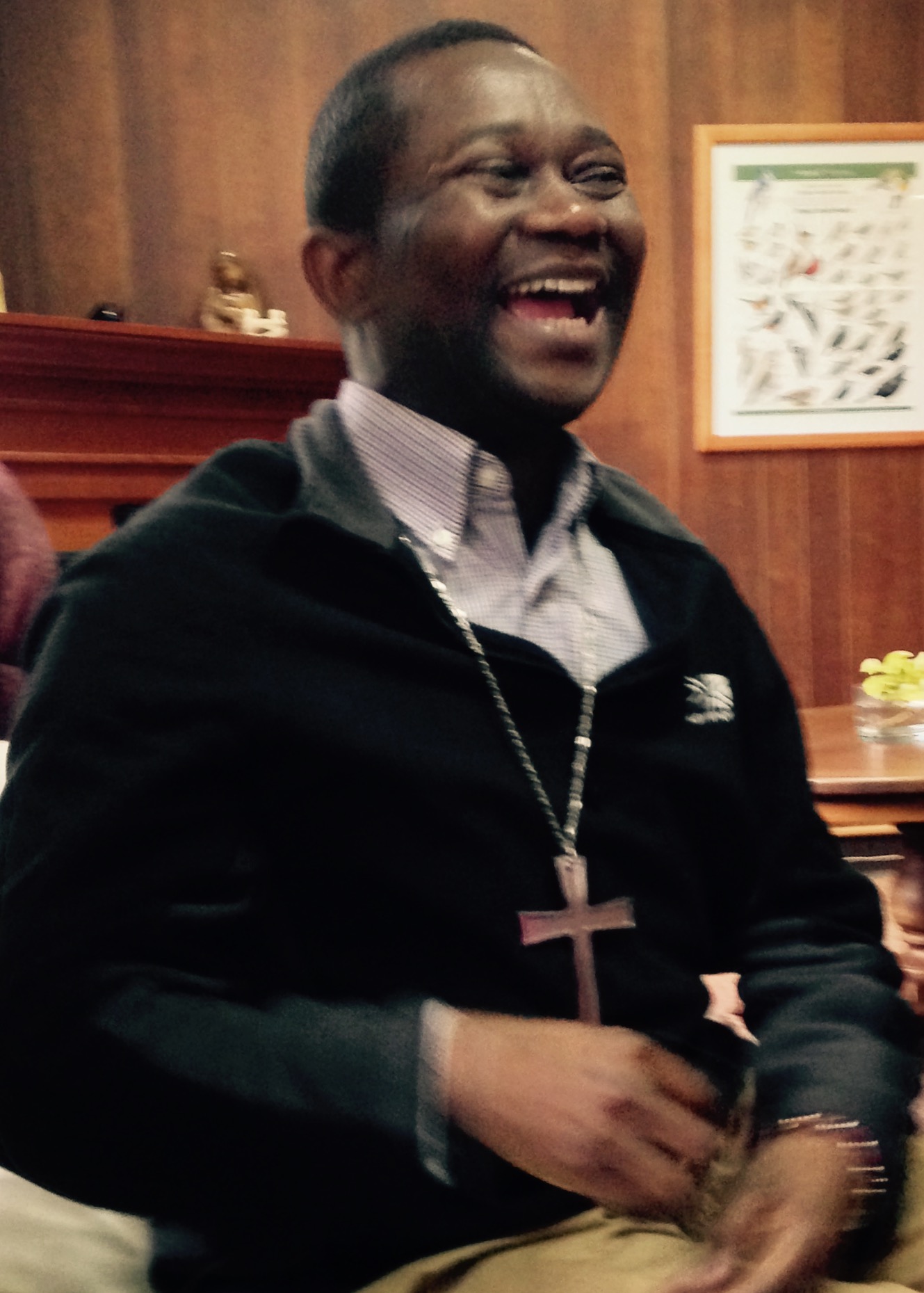
You never know what the day will bring. Father Emery Kibal is a Passionist priest from the Democratic Republic of Congo who’s staying with us this year here in Jamaica, New York and serving as chaplain at Mercy Hospital in Rockville Center, Long Island. A few weeks ago as he was coming down the hospital stairs his mobile phone rang. It was the Apostolic Delegate from the Congo.

“Pope Francis wants you to be the bishop of the Diocese of Kole in the Democratic Republic of Congo.” “Can I have some time to think it over,” Father Emery said. “When Mary was asked by the angel to be the Mother of God, she answered immediately,” the Apostolic Delegate said.

“What could I say to that?” Father Emery said afterwards. He will be ordained bishop in the Congo in July.

You never know what the day will bring. The diocese Bishop Emery will lead faces hard times. Some months ago the Archbishop of Kinshaha in the Congo was visiting our community on his way to Washington to ask the American government to stop arms shipments to his country where armed bands are causing hardship and widespread disruption.

Yet as you see, the new bishop laughs. In today’s readings for Mass, St.Paul says “ I do not shrink from proclaiming to you the entire plan of God.” He’s convinced the Spirit of God is his guide and support in the ministry God gives him.

In the gospel today, Jesus prays for those who follow him

“I pray for them.
I do not pray for the world but for the ones you have given me,
because they are yours, and everything of mine is yours
and everything of yours is mine,
and I have been glorified in them.
And now I will no longer be in the world,
but they are in the world, while I am coming to you.”

In one sense, we never know what’s before us. Yet, faith doesn’t flinch before the unknown. The psalm verse for today says:

“Blessed day by day be the Lord,
who bears our burdens; God, who is our salvation.
God is a saving God for us;
the LORD, my Lord, controls the passageways of death.”

God bless you, Bishop Emery.

Walk’in All Over God’s Heaven

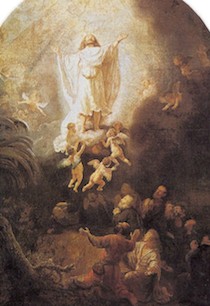
Jesus did not just come out of the tomb; he ascended to heaven. He rose from the dead and disappeared from our sight to return to his Father and our Father, his God and our God. The mystery of his ascension completes the Paschal Mystery. In his victory over death we’re promised a life beyond this one.

When I was a boy, I remember my father buying a record player. It was the mid 1940’s and times were hard; I’m sure he broke the family bank to pay for it. For a good while he only had a couple of those old vinyl records he would play over and over.

One of them was a haunting black spiritual sung by Marian Anderson called “Heaven.”

“I got shoes, and you got shoes, all God’s children got shoes.

When I getta heaven gonna put on my shoes

and gonna walk all over God’s heaven, heaven.

Everybody’s talking bout Heaven ain’t goin’ there.

heaven, heaven.  Gonna walk all over God’s heaven.”

I still feel the hope in that great singer’s voice as she sang that song. She was singing the song of barefooted slaves who were looking for something more. It wasn’t just a pair of shoes that would wear out after awhile. These were shoes God gave you in heaven, a place of completed dreams. Once you put on those shoes you could walk freely and walk everywhere.

The Feast of the Ascension describe heaven as our final home, where all our dreams are realized, where tears are wiped away, where sadness is no more, where wrongs are righted, where reunion with those we love takes place, where we enjoy the presence of God and all the saints.

For now, we only have hints of heaven. We only have assurances of faith. However, it’s not enough to just talk about it, as the spiritual says, we must walk in the steps of Jesus. Walking in his steps brings us, not to a grave, but to the place where he is. That’s heaven.

Sharing the Resurrection of Jesus

I like the richness and simplicity of the 5th century Catecheses of Cyril of Jerusalem, which he preached in the Church of the Holy Sepulcher after Easter.

“When we were baptised into Christ and clothed ourselves in him, we were transformed into the likeness of the Son of God. Having destined us to be his adopted sons, God gave us a likeness to Christ in his glory, and living as we do in communion with Christ, God’s anointed, we ourselves are rightly called “the anointed ones.” When he said: Do not touch my anointed ones, God was speaking of us.

“We became “the anointed ones” when we received the sign of the Holy Spirit. Indeed, everything took place in us by means of images, because we ourselves are images of Christ. Christ bathed in the river Jordan, imparting to its waters the fragrance of his divinity, and when he came up from them the Holy Spirit descended upon him, like resting upon like. So we also, after coming up from the sacred waters of baptism, were anointed with chrism, which signifies the Holy Spirit, by whom Christ was anointed and of whom blessed Isaiah prophesied in the name of the Lord: The Spirit of the Lord is upon me, because he has anointed me. He has sent me to preach good news to the poor.

“Christ’s anointing was not by human hands, nor was it with ordinary oil. On the contrary, having destined him to be the Saviour of the whole world, the Father himself anointed him with the Holy Spirit. The words of Peter bear witness to this: Jesus of Nazareth, whom God anointed with the Holy Spirit. And David the prophet proclaimed: Your throne, O God, shall endure for ever; your royal sceptre is a sceptre of justice. You have loved righteousness and hated iniquity; therefore God, your God, has anointed you with the oil of gladness above all your fellows.

“The oil of gladness with which Christ was anointed was a spiritual oil; it was in fact the Holy Spirit himself, who is called the oil of gladness because he is the source of spiritual joy. But we too have been anointed with oil, and by this anointing we have entered into fellowship with Christ and have received a share in his life. Beware of thinking that this holy oil is simply ordinary oil and nothing else. After the invocation of the Spirit it is no longer ordinary oil but the gift of Christ, and by the presence of his divinity it becomes the instrument through which we receive the Holy Spirit. While symbolically, on our foreheads and senses, our bodies are anointed with this oil that we see, our souls are sanctified by the holy and life-giving Spirit.”

And so, we are not just observers of Christ’s resurrection, St. Cyril says. We are transformed into the likeness of the Son of God, becoming like him in his glory.  Our outward appearance may resemble the appearance of the Risen Christ, as the  gospels describe him. We may look like the humble gardener Mary Magdalen saw, or the  stranger walking with the disciples towards Emmaus, or the figure at dawn on the shore of Galilee, or one with wounds in our hands and feet.

But if the Holy Spirit anointed us with chrism after our baptism, we have been empowered to bring good news to the poor; we have been anointed with the oil of gladness. We have been given a spiritual joy and a share in the life of Christ.

A Community of Believers

The church is a community of believers–that’s the way the Acts of the Apostles, which we’re reading after Easter, describes it. We look so often at church leaders, like Peter and Paul, and we miss the crucial part ordinary believers play. They’re more than passive spectators.

Some time ago visiting a parish, the director of religious education was getting the young people ready for confirmation and first communion. “The parents are the ones who make these things stick,” she said. “If they don’t bring the young people to church; if they don’t think it’s important, neither will they. You can have the best preparation program around, but if parents don’t back it up with their own example, the young people wont be back.”

Families and friends still turn out for First Communions, I notice. Good they do. But in some way the community– families, friends, all of us– have to communicate our belief that sacraments are important signs of the presence of the Risen Christ.

We’re a community of believers.

Creation Redeemed


creation
Pope Francis is soon to issue an important encyclical on the environment. Some say that’s none of the church’s business, but creation is the church’s business, In his great treatise “On the Incarnation of the Word ” St. Athanasius says Jesus Christ came to save it.

“The Word of God, incorporeal, incorruptible and immaterial, entered our world. Yet it was not as if he had been remote from it up to that time. For there is no part of the world that was ever without his presence; together with his Father, he continually filled all things and places.

“ Out of his loving-kindness for us he came to us, and we see this in the way he revealed himself openly to us. Taking pity on our weakness, and moved by our corruption, he could not stand aside and see death have the mastery over us; he did not want creation to perish and his Father’s work in fashioning humanity to be in vain. He therefore took to himself a body, no different from our own, for he did not wish simply to be in a body or only to be seen.

“ If he had wanted simply to be seen, he could indeed have taken another, and nobler, body. Instead, he took our body in its reality.”

Jesus Christ, the Word of God, entered into the world of real time and place, Athanasius says.  The world was not a stage he used, to be dismantled and thrown away.  it was a reality he embraced and redeemed. “He is the Word through whom you made the universe; the Savior you sent to  redeem us.” “He became flesh and dwelt among us.”

God’s plan of salvation, then, was not restricted to human beings: “he did not want creation to perish and his Father’s work of fashioning humanity to be in vain.”

4th Sunday of Easter: The Lord is my Shepherd


To listen to today’s homily, select the audio file below:

I wanted to find out on the internet recently how many people are watching the new series on Sunday night on NBC entitled AD: The Gospel Continues. Looks like a lot of people are watching it. But another story caught my eye in the Hollywood Reporter, where that information is found. It was an article entitled “Jesus in Film and TV: 13 Devilishly Handsome Actors Who’ve Played the Son of God.”

The article showed the pictures of all the devilishly handsome actors who played Jesus in the movies or on television in recent years. To tell the truth, none of them looked like Jesus to me. In his Letter to the Philippians St. Paul says that Jesus took on the form of a slave. That seems to mean that if we met him on the street, we wouldn’t recognize him. He would look like one of the crowd. Jesus may not have been particularly handsome, but of course Hollywood finds that hard to believe. We’re so sure that looks, appearances, image are everything.

“I am the good shepherd,” Jesus says in today’s gospel. Now, I don’t know too much about shepherds or what they look like, but from the little I know I don’t believe they’re a particularly handsome group. They’re men who spend most of their time outside in the cold or the heat; weather-beaten, scruffy looking, with few opportunities for grooming themselves, not much to look at. It’s a tough job, being a shepherd.

But the good shepherd cares for his sheep. That’s what Jesus does; he cares for his sheep. He cares for his sheep no matter what the weather, cold or hot. He makes the journey with them, no matter how hard it is. He doesn’t abandon his sheep, no matter what. He searches for the ones who are lost and he looks for others to enter his flock.

That’s the way Jesus, the Risen Jesus, describes himself in John’s gospel today:

“I am the good shepherd.
A good shepherd lays down his life for the sheep.”

He’s not doing it for pay, he’s not someone hired, putting in his time, caring little for his sheep, ready to run away when the wolf comes and the sheep are scattered.

“I am the good shepherd,
and I know mine and mine know me,”

He knows his sheep, Jesus says, not in an impersonal way. He speaks and they hear his voice. ‘Just as the Father knows me and I know the Father,” he says, and “I will lay down my life from them.”

Some years ago I was on a plane from St. Louis to Kennedy Airport in New York City. I opened my prayer book to say a prayer before takeoff and just then an African-American woman sat down next to me; at first, I thought she was a young teenager. “Sir,” she said, “Could I read a psalm?”

“Sure,” I said, “Let’s read the 22th Psalm together, which is the Good Shepherd psalm. So together we said that beautiful psalm. “The Lord is my shepherd, I shall not want….”

“That’s my favorite prayer,” she said, and she told me she was going overseas to Germany to rejoin her husband in the army there. They had lost a child in childbirth some months before and she had gone home to see her mother after the loss.

When we got up in the air above the clouds, she told me that after her baby’s death she had a dream. She saw Jesus, the Good Shepherd, walking in clouds like this and he was carrying her little baby. “ I love that psalm and I say it all the time, “ she said.

The LORD is my shepherd; I shall not want.

In green pastures he makes me lie down; to still waters he leads me, he restores my soul.

He guides me along right paths for the sake of his name.

Even though I walk through the valley of the shadow of death, I will fear no evil,

for you are with me; your rod and your staff comfort me.

You set a table before me in front of my enemies;You anoint my head with oil; my cup overflows.

Indeed, goodness and mercy will pursue me all the days of my life; I will dwell in the house of the LORD for endless days.