Tag Archives: Passionists

Palm Sunday: The Passion from Luke’s Gospel

Palm Sunday this year we read St. Luke’s passion narrative, which sees Jesus’ death and resurrection as the culmination of his earthly journey. From Galilee, Jesus makes his way to Jerusalem, to his death on Calvary, his resurrection and finally he ascends into heaven. It’s more than a journey to death, Jesus rises and is welcomed into heaven.

He does not journey alone. In Luke’s gospel, from Galilee to Jerusalem Jesus gathers disciples to accompany him. He does not face death alone–  disciples are with him, though he’s abandoned by twelve of them in the Garden of Gethsemane. Simon of Cyrene, coming in from the fields, takes up his cross and carries it behind him. Simon is a symbol of humanity, along with the ” large crowd of people” including “many women who mourned and lamented him,” Though unaware, disciples are with Jesus on the way.

Jesus says to all in Luke’s gospel, “ If anyone wishes to come after me, he must deny himself, take up his cross daily, and follow me. For whoever wishes to save his life will lose it, but whoever loses his life for my sake will save it.’”(Luke 9,23-24} Simon represents all the followers of Jesus who go with him on his journey. It’s not only the cross of Jesus Simon carries, it’s “his cross,” his daily cross, his own cross.

Jesus’ words in Luke’s gospel to the women “who mourned and lamented him” are puzzling. Some say he comforts them as he goes to his death. Others say his words are a prophetic announcement of the judgment that inevitably follows injustice. Jerusalem will be destroyed as a consequence. Every unjust act, every sin has consequences that cannot be waived away.

Two criminals accompany Jesus to Calvary, the place of execution just outside the city gates where many people passed. For the Romans it was the perfect place to display their fierce justice. Jesus would die at this hellish place of torture and death, not a place one wished to be or to see.

Yet Luke, like the other evangelists, sees light in this place of death. Instead of harsh justice, suffering and death, God’s mercy and new life are revealed here: “Father, forgive them, for they know not what they do.”

God’ mercy is revealed here to a criminal crucified with Jesus. Another criminal mocks him from his  cross. “Are you not the Messiah. Save yourself and us.” But his companion rebukes him and turns to Jesus with a plea to be remembered. “Jesus, remember me when you come into your kingdom.”

More than a remembrance, Jesus promises to take him with him on his journey to God. “Amen I say to you, today you will be with me in paradise.” As he does so often in Luke’s gospel,  Jesus reaches in tender mercy to one without hope.

Like Simon of Cyrene, the thief represents humanity. He’s been promised life and safe passage through the mystery of death. He dies with Jesus. The thief reminds us that eternal life is never denied to anyone.

The thief is a sign for us all. We die, but we die with the Lord. The best place for us to understand the mystery of death is on Calvary.
Immigration, Now and Then

Immigration is a hot political topic today. It’s not just an issue here in America; it’s a world issue. Millions of people all over the world are on the move today because of wars, violence and because they can’t make a living on lands affected by climate change.

Our first reading today at Mass is about Abraham, the “wandering Aramean” whom God blessed as he went from place to place. May God bless those wandering from place to place today.

Today also is St. Patrick’s day. This was a big day in the place where I was born and raised, Bayonne, NJ, a city of immigrants, many from Ireland. The Irish went to church today to thank God for the faith brought to them by St. Patrick and for being able to live in a country where they could make a living and bring up their families, hoping for a better life.

Years ago, I visited the place where some of my relatives came from in Donegal, in northern Ireland. I saw the little abandoned farm house, with no roof, where some of them lived. An old man in the neighborhood remembered the day they left for America, three young people carrying away their simple belongings. It was all they had. There was no work for them there anymore.

When they came to America they took whatever jobs they could get. It had to be hard for them making their way in a new land and another way of living. But they helped one another, and that’s one of the things I remember about that immigrant generation. They helped one another.

I took a picture of that abandoned house in Donegal and gave it to my relatives. I see it’s still hung proudly in their house when I visit. We have to remember where we come from. We’re children of Abraham, on our way to a place that’s still before us. We have to stick together.

4th Sunday of Lent C: The Prodigal Son

To listen to today’s homily, please select the audio bar below.

The story of the prodigal son is one of the longest in the gospel and it’s also one of the most important. It’s not just about a boy who goes astray, of course, it’s about the human race gone wrong.

“Give me what’s mine,” the son says boldly to his father. We all tend to say that. And he takes off for a faraway country, a permissive paradise that promises power and pleasure, in fact, it promises him everything, where he can do anything he wants.

But they’re empty promises, and soon the boy who had so much has nothing and ends up in a pigsty feeding pigs, who eat better than he does.

Then, he takes his first step back. He “comes to himself,” our story says; he realizes what he has done. “I have sinned.”

How straightforward his reaction! Not blaming anybody else for the mess he is in: not his father, or the prostitutes he spent so much of his money on, or society that fooled him. No, he takes responsibility. That “coming to himself” was the first gift of God’s mercy.

He doesn’t wallow in his sin and what it’s brought him, either. He doesn’t let it trap him. He looks beyond it to the place where he belongs, to his father’s house. It wont be an easy road, but he keeps his eyes on it and starts back home.

There he’s surprised by the welcome he receives. More than he ever expected. The father takes into his arms and calls for feast.

His story is our story too.

In these days of Lent, many of us approach the sacrament of reconciliation.  That sacrament is very much like the journey the son takes back to his father. First of all, we look for the mercy of God to come to ourselves, to know our sins and to look for our place in our Father’s house.

Bless me, Father, for I have sinned. we say beginning our confession. The prayer of the son has become our prayer. We acknowledge our sins.

Then the priest who represents Jesus, who speaks for his Father in heaven, says.

God, the Father of mercies, through the death and resurrection of Jesus Christ, has reconciled the world to himself and sent the Holy Spirit among us for the forgiveness of our sins.

Through the ministry of the church, may God grant you pardon and peace, and I absolve you in the name of the Father and of the Son and of the Holy Spirit. Amen.

We receive pardon and peace, the gift of God’s mercy.

How easily we leave your side,

Lord God,

for a place far away.

Send light into our darkness,

and open our eyes to our sins.

Unless you give us new hearts and strong spirits,

we cannot make the journey home,

to your welcoming arms and the music and the dancing.

Father of mercies and giver of all gifts,

guide us home

and lead us back to you.

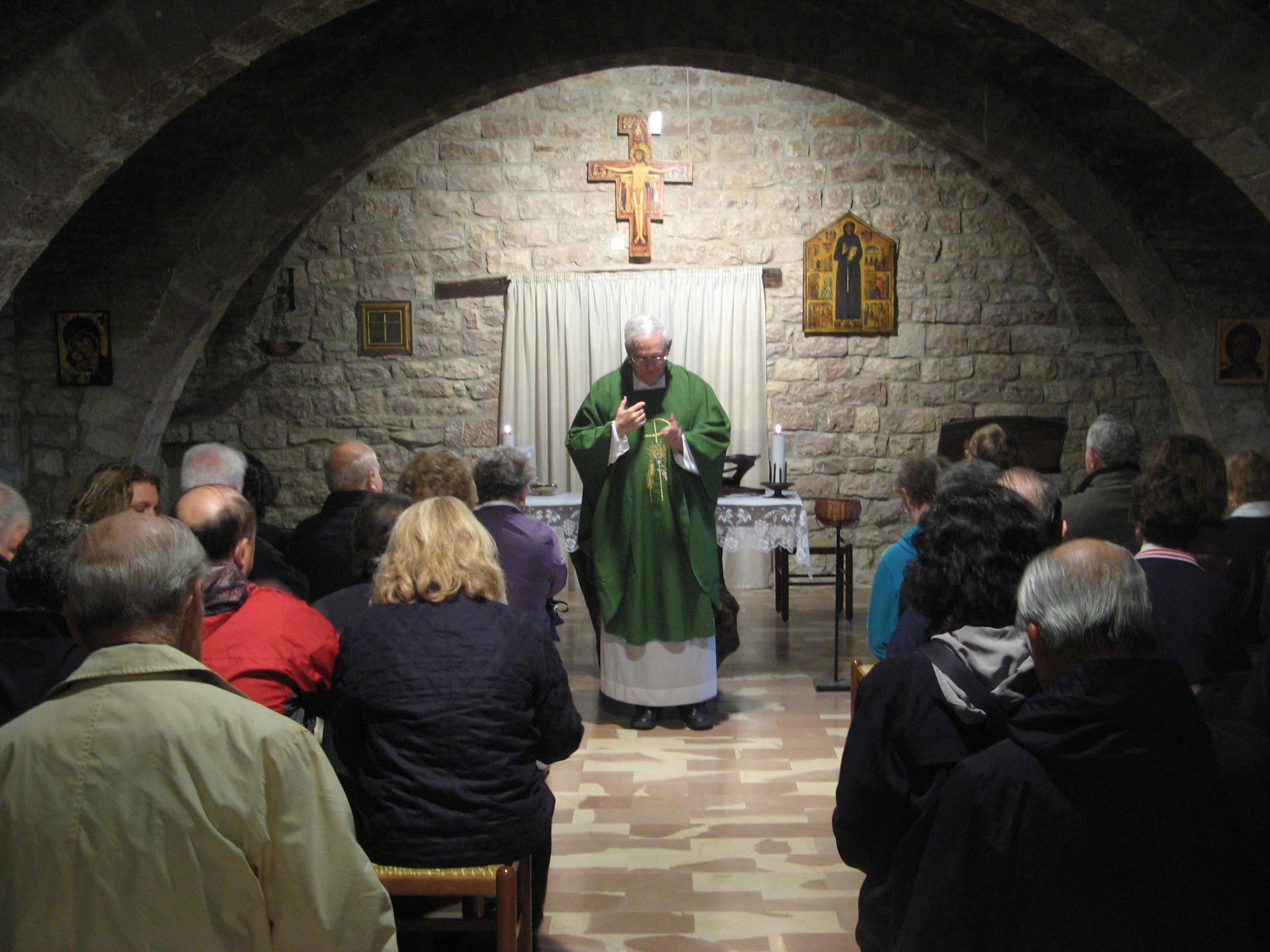
Praying at Mass

IMG_1517

Catholics are not going to Mass as much as they did.  People are busy, of course. Some say they don’t get much out of it. Whatever the reasons, US Catholics aren’t going to Mass as they did before.

We have new texts for Mass, will they turn things around?  I don’t know. Better preaching? That would help. But there’s more. We need to look at the way we pray and participate at Mass.  The Mass is the central act of our faith, and we need to bring everything we have– our bodies, our minds, our memories, ourselves– to it.

We’re there to pray, from the moment we enter the church to the moment we leave. Only by praying at Mass will we appreciate it.

The way we pray at Mass is simple. It begins as we enter church and make the Sign of the Cross. It’s a key to a world of faith. Taking  holy water  we bless ourselves “In the Name of the Father and of the Son and of the Holy Spirit. Amen.” We are reminding ourselves  that we’re blessed by God with the gift of life and everything it means through Jesus Christ. Water is a sign of that life. 60% of the human body is made up of water, and so it’s a reminder we are being blessed by the God of life.

Water, like bread, is a sign of life.The signs of water and bread stand for the totality of blessings we receive , and we acknowledge our blessings and give thanks through them.

Jesus said “If anyone is thirsty come to me.” He also said “I am the bread of life.” As we make the Sign of the Cross,  we’re reminded we’re at the source of life now and of life everlasting, Jesus Christ. We’re blessed by his life, death and resurrection. We trace his sign on ourselves, on our foreheads, our hearts and our shoulders. We’re blessed in mind and heart and all our being.

So, as Mass begins, the priest leads us into this great  act of blessing and thanksgiving by inviting us to make the Sign of the Cross.

Notice we bless ourselves  a number of times at Mass besides its beginning.  We bless ourselves as the gospel is proclaimed, asking that our minds and hearts be blessed to hear God’s Word. We bless ourselves as we leave the church at the end of the Mass, because we carry God’s blessings to our world.

Besides the Sign of the Cross,  simple acclamations at Mass  draw us into this blessed mystery. So,  as the priest concludes a prayer or action, we often say “Amen” an ancient Hebrew word, which means “Yes” we agree. The “Amen” at Mass calls us into the blessing of God. Simple word like “Amen”  draw us to the prayer of the church.

“The Lord be with you.” “Lift up your hearts.” “Let us give thanks to the Lord our God.”

Listen carefully to those words and the readings, the songs and the music at Mass. Say them and mean them. Sing them when they’re sung, for“Someone who sings well prays twice.” So we join our voices in song. At Mass we pray together.

We pray with our eyes, too, as we see the actions and signs of Mass. Walking, kneeling, standing are prayers. Simple actions, like bowing and offering our hand to receive the Host are prayers. At Mass we pray with our whole being. Our walking, seeing, listening, speaking become acts of prayer that bring us into the presence of God.

Of course, we often come to Mass with a lot of things on our mind that distract us from this great mystery. So often we’re on overload. Our faith may not be the strongest. We have our doubts. We get sunk in the everydayness of our own lives.

But God’s grace is here in this great mystery and God will draw us–weak as we are–into this great mystery.  God will give us– all of us– the gift to pray and find blessings here. God draws us here to bless us.

Thursday, 3rd Week of Lent

Lent 1
Readings
Talk of devils and demons and miracles by God, so common in the bible, sounds strange to people today, especially in the western world. We think other forces are at work when something remarkable happens, as it did to the man in today’s gospel who couldn’t speak.(Luke 11,14-23) Must be a natural explanation–maybe the power of suggestion; whatever it was, we’ll discover it. We find it hard to see “the finger of God” causing miracles today.

Miracles of healing were among the signs that pointed out Jesus to his early hearers, but they weren’t the most important. After Pentecost, Peter describes Jesus of Nazareth as “a man attested to you by God with deeds of power, wonder and signs that God did through him among you, as you yourselves know,” But the culmination of signs, the apostle says, is his own death and resurrection.

No one can explain this mystery, surpassing all others. Taking on himself all human sorrows– the sorrow of the mute, the deaf, the paralyzed, the possessed, the dead, the sinner far from God– Jesus gave himself into the hands of his heavenly Father on the altar of the cross. And he was raised up and gave his life-giving Spirit to the world.

Some deny this sign too. but it’s the great sign that we celebrate in this holy season.

“You have signs clearer than day that God loves you and he’s at work in you. Humble yourself, nothing as you are, and let your nothingness disappear in the Infinite All that is God. Then lose yourself and take your rest adoring the Most High in spirit and truth.” (Letter 954)

I see the great Sign you have given, O God,
the mystery of the death and resurrection of your Son.
Place it in my mind and heart,
let it guide my thoughts and draw me to love.

3rd Sunday of Lent

Some of the biggest  questions we have about God are found in the scripture readings at Mass today. Is God  punishing us through tragedies like earthquakes, or accidents or  acts of violence that suddenly happen. Does God care?

Those question were asked of  Jesus in today’s gospel. (Luke 13,1-9)  His listeners wonder why 18 people were killed in a recent construction accident in Jerusalem. A tower fell on them? Why did those people  die in a riot that the Roman procurator, Pontius Pilate, put down  by slaughtering everyone in sight?

Jesus answers that  God’s not punishing those involved in those tragedies. Tragedies are part of life; they’re sharp reminders that life on earth isn’t permanent or without risk. Jesus says  be ready for the moment that God calls you.

There’s another question, though. Does God care about it at all? And here we can turn to the 1st reading from the Old Testament about Moses and his vision of God on Mount Horeb. (Exodus 3, 1-15) Moses at the time was a man on the run. He’d killed an Egyptian and had fled from Egypt to hide as a shepherd in the Sinai desert. His people, the Jews, were slaves in Egypt.

As he ascends the mountain tending his sheep, he sees a burning bush and suddenly hears a voice. “Don’t come any nearer. Take the shoes off your feet; you’re on holy ground…I’m the God of your ancestors, of Abraham, Isaac and Jacob.” Moses was afraid, a normal reaction to God who is beyond anything we know.

But then God begins to speak words of love and concern.

“I know the affliction of my people in Egypt; I hear their cries of complaint against their slave drivers; I know well what they are suffering.
So I’ll rescue them from the hands of the Egyptians and lead them out of that land into a good and spacious land, a land flowing with milk and honey.”

“I am the God of your ancestors, Abraham, Isaac and Jacob,” God says. “I have ties with the world before you were born and I will care for the world when you are long gone.”

The encounter that Moses has on the mountain is our encounter with God too.

We know what followed Moses vision on Mount Horeb.  He returns to Egypt and with God’s help brings his people out of Egypt. God’s presence isn’t always obvious as they journey through the desert for 40 years. But God is faithful and he brings them to “a good and spacious land, flowing with milk and honey.”

Does God care for us. Yes, he does.

As we go further into the lenten season, we come to another mountain that’s burning with fire too. We’ll see  a Cross and a man hanging there. He knows our sorrows and shares them too. He’s God  come to us, to lead us and all the world from slavery to freedom, in a good land where sorrow and pain are no more, where we will be with our good God forever.

I’m preaching a mission at  the Sacred Heart Cathedral in Raleigh, North Carolina this week. It begins at all the Masses this weekend. Each evening at 7 I’m preaching during an hour service and at Mass 12.15 each day, Monday to Thursday. I’ll put some material from the mission on this website. Pray for the mission.

First Sunday of Lent: The Temptations of Jesus


The temptation of Jesus in the desert, after his baptism in the Jordan River, shows his human side as much as any other gospel story. Yes, He is the Son of God, a voice from heaven proclaimed him God’s Son in the waters of the Jordan. He died and rose from the dead, he is “God from God, true God from true God,” but Jesus was also human.

We may tend to see him only as divine,  unlike us: a miracle worker, an assured teacher, a master of circumstances, someone above it all, but we’re told in scripture that Jesus was “like us in all things except sin.” An earthly life was challenging for him as it is for us. Life was always challenging for him as it is for us.

Luke’s gospel, following Matthew’s gospel, shows us the humanity of Jesus in the temptations he faced in the desert, and these same temptations were there throughout his life. The Spirit led Jesus into the desert, a challenging place for human beings, where you can get tired and hunger, where you struggle for footing and wonder where you are. The desert is the place where human weakness shows.

Jesus faced three temptations in the desert, our gospel says. One temptation was to think you’re the master of creation. “Turn these stones into bread,” Satan says to him, the Son of God can do that. But if you are truly human–and we say the Jesus was truly human–you can’t turn stones into bread. You can’t control nature. That means that Jesus, like anyone human, got tired and hungry, could get sick and get old. He needed human support and friendship. Yes, for a short period Jesus worked some miracles, but much of his life, the long years he lived in Nazareth, he accepted the limitations of humanity. He did not escape from being human. He was like us.

The second temptation in the desert was a temptation to control people, to dominate them, to be in charge of them, to make them serve you. “The devil took him up and showed him all the kingdoms of the world in a single instant and said to him, “I shall give to you all this power and glory; for it has been handed over to me, and I may give it to whomever I wish. All this will be yours, if you worship me.”

I’ll make people your servants, the devil said. Jesus said, “You shall worship the Lord your God, and him alone shall you serve.” Instead of people serving him, Jesus lived for others and gave his life for others. “I did not come to be served, but to serve.”

The third temptation is a temptation to control God. That’s what the devil suggests when he takes Jesus up to the temple and tells him to throw himself down and God’s angels will save him. You can tell God what to do, said the devil. Use God’s power to become powerful yourself. Jesus told him: “You shall not put the Lord your God to the test.”

In the temptations of Jesus, symbolically recalled in our gospel today, we recognize the humanity of Jesus. He is like us. In his temptations, we can see our own temptations. Just look at how Jesus was tempted and the temptations we face. “Turn these stones into bread.” We would love to snap our fingers and change our lives when they’re not working out to our liking. We would love to be miracle-workers, untouched by sickness or death, having perfect lives, having it all.

“I’ll give you power over people so that they’ll do whatever you want,” the devil tells Jesus. They’ll please you, they’ll agree with you, they’ll like you. How tempting that suggestion is us too.

“I’ll see that God does what you want,” How sweeping that temptation is, but it’s a real danger we face too, that instead of we serving God, doing God’s will and working for God’s kingdom to come, we see God working for us and the kingdom we would like to come.

This gospel is a very symbolic gospel. It not only shows the humanity of Jesus, it shows the temptations all of us, human beings,  meet in life. But the gospel wants us to see something more. Jesus did not come just to show us what it means to be human, he came to help us to be human. He did not give into temptation, the human temptations he faced. He delivers us from temptation. He lives in us and works with us and sustains us and helps us regain our strength again and again.

Just as the people of Israel were sustained on their way through the desert, Jesus sustains us.


5th Sunday C Deep Waters


To listen to the audio for today’s homily, select the audio file below:

I usually go out fishing a couple of times a year at the Jersey Shore with a friend of mine who has a boat equipped with radar that tracks fish. I notice, though, he also has some old maps he has marked where the fish usually are; he also looks around to check where the party boats are. They’re the fishermen who are out there day after day and night after night. They make their living off the sea and so if they aren’t catching anything, nobody is.

In our gospel, Peter and his friends are professional fishermen, night and day, everyday fishermen. If they don’t know the waters, nobody does. One recent archeological investigation on the Sea of Galilee, at Magdala on its northwestern shore, close to Capernaum where Peter docked his boats, seems to confirm that at the time of Jesus, the fishing industry in Galilee was quite sophisticated. They had elaborate methods for storing and preserving fish in order to bring them to market at the right time. They had developed a dark blue netting for night fishing. They were good at it.

And so, when Peter tells Jesus, “We have worked hard all night and caught nothing,” he’s a professional talking. Experience is behind him; reason and human skill are behind him. “But at your word I will lower the nets.” Because he accepts the word of Jesus he gets a reward bigger than he could ever expect– a catch so great that their boats were in danger of sinking.

Later on in Mark’s gospel, Jesus asks Peter: “Who do people say I am?” “You are the Messiah,” Peter answers. But when Jesus goes on to say he will be arrested and put to death and rise again, Peter doesn’t want to hear it. That’s not reasonable. “Don’t think about that,” he says. And Jesus calls him Satan. “You’re not thinking like God, you’re thinking like human beings do.”

As he did on the Sea of Galilee, Jesus asks Peter to go beyond human thinking. When God speaks and reveals things we have to go beyond our reasonableness and calculations.

Peter is not the only one who has to go beyond human thinking. We’re also asked to do that too, if we want to be people of faith. In our 2nd reading today the Apostle Paul asks us to believe.

“Brothers and sisters,

I handed on to you as of first importance what I also received:

that Christ died for our sins

in accordance with the Scriptures;

that he was buried;

that he was raised on the third day

in accordance with the Scriptures;

that he appeared to Cephas, then to the Twelve.

Last of all, as to one abnormally born,

he appeared to me, and

so we preach and so you believed.”

Paul wants his hearers to believe in God, the creator of this world. This world did not just happen. Jesus Christ is God’s Son, born of Mary, suffered under Pontius Pilate, died and rose again.

We’re called to follow him, to be with him, to be his companions, his friends, to listen to his words, to hope in his promises, to love others as he has loved us.

“Put out into the deep water and lower your nets for a catch,” That’s what we do when we come to Mass. This is the deep water where we lower our nets to catch those graces God wishes to give us. Surprising graces, more than we imagine, greater than we could expect. This is the sea where believers are blessed.


Dorothy Day

When Fr. William Bausch ended his service as pastor of St. Mary’s, Colts Neck, NJ, some years ago, he gave the parish a gift– a statue of Dorothy Day, which is outside the main entrance to the present church. She’s an elderly woman sitting quietly on a bench.

Her quiet appearance may throw you off. The Jesuit poet Daniel Berrigan wrote at the time of her death in 1980: “Those of us who knew her in her later years were tempted to regard her, I think, rather thoughtlessly…She seemed to always have been as she was: serene, graced with her aura of piety and pity.”

Actually, Dorothy Day who dedicated herself to championing the poor was one of the most dynamic and challenging figures in the Catholic Church in recent times. In 2013 the Catholic bishops of the United States voted unanimously to push her cause for canonization as a saint.

Some might not consider her a candidate for sainthood. She was born in Brooklyn in 1897. Her father was a journalist and her family  moved from place to place– the West Coast, Chicago– and she became of journalist too.

As a young woman in the 1920s she was part of the bohemian scene in New York City, a rebel with “a passion for freedom to the point of waywardness.” (Daniel Berrigan) She had a failed marriage, attempted suicide, had an abortion. After the birth of her daughter, she became a Catholic and then founder of the Catholic Worker Movement, which worked for the poor and social justice, was critical of capitalism and against war. With that kind background, I wonder how many Catholic parishes would invite her as a speaker today.

I’m delighted the bishops are pushing for her canonization. Saints are antidotes to the poison of their time. Dorothy counteracts a lot of poison. There’s the poison in the way we look at the poor and the weak in our society, for example; in our trust in war, in our belief in our political systems. She questioned those positions.

What’s more, she’s an example of the power of faith. Many today, of course, write off the Catholic Church and religion in general, as irrelevant. As a young woman she read a lot, from the Communist Manifesto to the bible. She wanted to reform the world, but as a young woman the church put her off. Christians looked like everyone else, she said:

“I did not see anyone taking off his coat and giving it to the poor. I didn’t see anyone having a banquet and call in the lame, the halt and the blind…I wanted everyone to be kind. I wanted every home to open to the lame, the halt and the blind…Only then did people really help their neighbor. In such love was the abundant life, and I did not have the slightest idea how to find it.”

Yet, remarkably, through the disguise, in the dirt that so often hides it, Dorothy found the pearl of great price. She embraced the Catholic Church.

I think Dorothy Day also contradicts the belief that people no longer search for God, that God is irrelevant. She writes in her autobiography “The Long Loneliness” “All my life I have been haunted by God…A Cleveland Communist once said, ‘Dorothy was never a Communist; she was too religious.’ How much did I hear of religion as a child? Very little, and yet my heart leaped when I heard the name of God. I do believe every soul has a tendency toward God. ‘As soon as someone recalls God, a certain sweet movement fills his heart…Our understanding never has such great joy as when thinking of God.’” (St. Francis de Sales)

She reminds us the “long loneliness”–that’s the title she gave to her autobiography–  is the search for God that goes on in us all.

There’s a lot poisoning our times; Dorothy offers an antidote to it. “It is a great pity that there are not many more like Dorothy Day among the millions of American Catholics. There are never enough such people, somehow, in the church. But, without a few like her, one might well begin to wonder if we are still Christians, her presence is in some ways a comfort, in some ways a reproach.” (Letter from Thomas Merton)


Her autobiography “The Long Loneliness” is worth reading and rereading.  The Catholic Worker has a blog at http://www.catholicworker.org .  Here a short video from CNS

Jesus and the Elderly

Presentation
Jesus drew all people to himself, men and women, rich and poor, old and young. The gospels show that even at his birth he gave life to all.

In our readings these days at Mass, St. Luke tells of two old people, Simeon and Anna, who recognize the Child Jesus when he’s brought by Mary and Joseph into the temple after his birth. They give thanks to God and speak about him to those “waiting for the redemption of Israel.” (Luke 2, 36-38

The artist  describes their meeting in the portrait above. The two elderly people are transformed with wonder as they meet Jesus and Mary and Joseph.

We are living in an aging society; our elderly population is increasing. The temptation is to see old age as a stage in life when all is over, but this gospel story gives us pause. The Lord comes at every moment of life. He draws us to himself our whole life long.Not only did Simeon and Anna wonder at the child they saw and held in their arms, but they spoke about him to those “waiting for the redemption of Israel.”

The old have an important role in the Christmas story.

Readings here. .