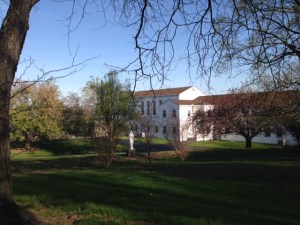
I visited Laurita Winery in New Egypt, New Jersey, some years ago. Some of us wanted to see how wine was made. Ray Shea, one of the owners, and Nicholaas Opdam, the Oenologist or Vineyard Manager, gave us a tour.
“ I am the vine, you are the branches” Jesus says in today’s gospel. He saw the vineyard as an image of the play between heaven and earth. Growing grapes is as challenging as sowing seed, which can fall by the wayside, or on hard ground, or among thorns, and the birds of the air can eat it up.
Vines are similar. At the very least, the vine needs pruning. But there’s more.They depend on the right climate, they need the right amount of water, the soil in which they’re planted needs feeding and watchful adjusting. Blackbirds can swoop down on the ripening grapes. Better than protecting nets is a circling red-tailed hawk, the vineyard keepers say.
“We need good weather and other things beyond our control,” they told us. Twice a year the vineyard is blessed, in the cold of January and during the harvest in October.
They’re using the latest technology and the wisdom of wine-makers from all over the world at this vineyard. Solar panels circling the fields harvest the energy of the sun and a man made lake collects vital water. Yet it’s no sure thing. It’s a risky business.
“I am the vine; you are the branches.” I must admit, I hardly thought of the patience, the risk, the dimensions behind this image, which is so richly incarnational. A loaf of bread or a bottle of wine came to the table from nowhere, I thought.
Not so.
At the Eucharist, bread and wine just come to the table, from nowhere. Not so.
The gospel readings for the remainder of the Easter season are from the Farewell Discourse of Jesus from John’s gospel. (Chapters 13-17) At Passover, Jesus’ hour arrives when “he had to pass from this world to his Father.” (John 13,1) The mystery of his death and resurrection is here.
At his announcement, uncertainty and questions disturb his disciples. They’ve known and loved him intimately; now he tells them he’s leaving, for awhile, and they will no longer see him, for awhile. They seem to hear only the word “death.” During the farewell discourse, the disciples, like Mary Magdalene in the garden, try to cling to him. “Do not cling to me. I have not ascended to my father and your father, to my God and your God.”
They’ll be living in the “in-between-time.” They wont see him again as they’ve known him physically; nor will they see him in glory, unless it’s the glory reflected from his cross. Jesus promises not to leave them orphans, but he won’t be with them as he was with them before in the flesh. He will be with them as God is with them.
The “in-between-time” is the time of the Paraclete, the Spirit of truth, who will teach them all things. Jesus too will be present, but in sacramental signs and words and deeds they remember.
The “in-between-time” is our time too. Like the disciples, we want to see, to touch, to know more, to have what’s promised us fulfilled. But this is the “in-between-time.”
In today’s gospel, Jesus promises his disciples the gift of peace. He calls it his peace, a particular kind of peace, a believer’s peace, peace for the “in-between-time” when we don’t see yet and the mystery of the cross only hints at glory.
Jesus’ words appear in the prayer we hear before Communion at Mass. “Lord Jesus Christ, you said to your apostles, ‘Peace I leave you, my peace I give you.’ Look not on our sins, but on the faith of your church, and grant her peace and unity in accordance with your will. “
We sin against this peace by cynicism, lack of patience, weak faith– sins of the “in-between-time.” We wish this peace to each other; we pray that God grant us this peace as we receive the Eucharist.
Monday Acts 14, 5-18
John 14, 21-26
Tuesday Acts 14, 19-28
John 14, 27-31
Wednesday Acts 15, 1-6
John 15, 1-8
Thursday Acts 15, 7-21
John 15, 9-11
Friday Acts 15, 22-31
John 15, 12-17
Saturday Acts 16,1-10
John 15, 18-21
Through the Easter season until the Feast of Pentecost our first reading at Mass on ordinary days is from Luke’s Acts of the Apostles. The lesson we learn from Acts is that the Risen Jesus creates and guides his church through time through the ministry of his followers.
From chapter 13 onward Luke concentrates on the missionary activity of Paul the Apostle and those associated with him. A sharpened Jewish reaction to Paul’s preaching develops at this time, as well as a greater acceptance of his message by the gentiles.
Paul’s experience is that “It is necessary for us to undergo many hardships to enter the Kingdom of God.” (Tuesday) The church must take the same path its Lord took.
At the same time, church order– how the church functions– has to be looked after. “They appointed presbyters for them in each Church and, with prayer and fasting, commended them to the Lord in whom they had put their faith.” (Tuesday)
“No little dissension and debate” goes on in the church of any age. (Wednesday) We need to go back to Jerusalem to get our bearings. The church is always bigger than some of its members may think. (Thursday and Friday) No matter what, the Spirit guides the church. (Saturday)
At the Last Supper–the gospel from John is read this week– Jesus promises his disciples peace. (Tuesday) He is the vine, we are the branches. (Wednesday) “Remain in my love,” he says. We are his friends (Friday) and if his friends then we have to follow the path he did. (Saturday)
On this Friday in the Easter season the poetic St. Ephrem the Syrian has this beautiful description of Christ conquering death:
“Death trampled our Lord underfoot, but he in his turn treated death as a highroad for his own feet. He submitted to it, enduring it willingly, because by this means he would be able to destroy death in spite of itself. Death had its own way when our Lord went out from Jerusalem carrying his cross; but when by a loud cry from that cross he summoned the dead from the underworld, death was powerless to prevent it.
” Death slew him by means of the body which he had assumed, but that same body proved to be the weapon with which he conquered death. Concealed beneath the cloak of his manhood, his godhead engaged death in combat; but in slaying our Lord, death itself was slain. It was able to kill natural human life, but was itself killed by the life that is above the nature of man.
“Death could not devour our Lord unless he possessed a body, neither could hell swallow him up unless he bore our flesh; and so he came in search of a chariot in which to ride to the underworld. This chariot was the body which he received from the Virgin; in it he invaded death’s fortress, broke open its strong-room and scattered all its treasure.
For the last 7 days I have been with some of the Little Sisters of the Poor on retreat at their place in Flemington, NJ. We’ve been reflecting, for the most part, on the scripture readings from the lectionary for these days in the easter season, and I put some of my reflections down in previous blogs.
The Little Sisters of the Poor are currently engaged in a dispute on health care with the United States government and the case is before the Supreme Court. Here’s a website explaining their stand. They’re not an advocacy group; they take care of the elderly poor in residences in this country and throughout the world. Holy women, they’re doers, not talkers.
I didn’t mention the case in my talks these days; they were days of prayer and reflection. But the easter readings from the Acts of the Apostles do seem to offer them a template for this experience. As the teacher of the law Gamaliel said about the Jewish-Christians arranged before the Sanhedrin,, “If it comes from God, you will not be able to destroy them; you may even find yourselves fighting against God.” Acts 5, 39
Another lesson we learn from the Acts of the Apostles is that the mystery of the passion and resurrection is always present in our lives and the journey we make together as a community. No matter how dark it seems, God brings us to life and light. That’s the way the Kingdom of God comes.
The Little Sisters know a lot about caring for the elderly, especially the elderly poor, something our government may not know much about, if truth be told. Instead of prosecuting them for breaking a law, wouldn’t it be better to get their advice how to treat the frail elderly? Care for an aging population is a growing challenge for our society.
We think of the easter season from Easter to the Ascension of Jesus into heaven as a period when little happens, but St. Leo the Great thinks otherwise.
“Those days which intervened between the Lord’s Resurrection and Ascension did not pass by in uneventful leisure, but great mysteries were ratified in them and deep truths were revealed.
In those days the fear of death was removed with all its terrors, and the immortality not only of the soul but also of the flesh was established. In those days the Holy Ghost is poured upon all the Apostles through the Lord’s breathing upon them, and to the blessed Apostle Peter, set above the rest, the keys of the kingdom are entrusted and the care of the Lord’s flock.
It was during that time that the Lord joined the two disciples as a companion on the way, and, to sweep away all the clouds of our uncertainty, reproached them for the slowness of their timid and trembling hearts. Their enlightened hearts catch the flame of faith, and lukewarm as they have been, they are made to burn while the Lord unfolds the Scriptures. In the breaking of bread also their eyes are opened as they eat with him. How much more blessed is that opening of their eyes, to the glorification of their nature, than the time when our first parents’ eyes were opened to the disastrous consequences of their transgression.
Dearly beloved, through all this time which elapsed between the Lord’s Resurrection and Ascension, God’s Providence had this in view, to teach his own people and impress upon their eyes and their hearts that the Lord Jesus Christ had risen, risen as truly as he had been born and had suffered and died. Hence the most blessed Apostles and all the disciples, who had been both bewildered at his death on the cross and backward in believing his Resurrection, were so strengthened by the clearness of the truth that when the Lord entered the heights of heaven, not only were they affected with no sadness, but were even filled with great joy.”
Peter and the other disciples confidently walk among the needy, bringing them life and healing in the name of the Risen Jesus. “Thus they even carried the sick out into the streets and laid them on cots and mats so that when Peter came by, at least his shadow might fall on one or another of them.” (Acts 5, 15) Healing is a sign of the resurrection.
Our readings from The Acts of the Apostles for the next few days are about the cure of a crippled man in the temple. (Acts 3, 1-4, 37) Peter and John meet the man begging at the temple gate. “In the name of Jesus Christ the Nazorean, get up and walk,” Peter says, and the man got up and “went into the temple with them, walking and jumping and praising God.”
Jesus began his ministry in Galilee with dramatic healings like that. Peter’s mother in law was among the first he healed on the momentous day he came to Capernaum. (Mark 1, 29-32) Wonder and excitement quickly spread, people flocked to him, but soon opponents began to question and finally try to stop the Nazorean.
His followers continue his healing mission after his resurrection. “In the name of Jesus Christ the Nazorean” Peter and the rest move others to believe and join them by signs of healing; they also face the reaction Jesus faced when he healed. They face opposition.
An important witness of God’s presence in the early church, is healing still important in our age which trusts so much in modern medicine and the latest drugs and treatments? Pope Francis recently called the church a “field hospital.”A reminder that the church must never abandon it’s mission to be a healing church, witnessing to the resurrection of Jesus, praying for and caring for and sustaining those in need.
The Acts of the Apostles is a template for looking at our church today as well as the church of the past.
To listen to today’s homily, please select the audio file below:
Many followers of Jesus saw him risen after he came from the tomb, the New Testament writers say, but Mary Magdalene’s witness is especially significant. She was a key witness to his death as well as his resurrection. We remember her testimony on Easter Sunday.
First, she was a witness to the death of Jesus. She was among those who saw him die, the gospels say. She witnessed his last excruciating hours on the cross. She saw the soldier pierce his side with a lance. She was with Mary his mother, standing there looking on. She helped them in the grim ritual of taking his body down from the cross. She was one of the women who brought some ointments and cloths for his burial. That was a woman’s role then, to bury the dead. She watched them lay him in a tomb, about a stone’s throw from where he was crucified. There would be no doubt in her mind that Jesus was dead.
She waited till the Jewish feast was over to come to the tomb. She came early in the morning, not hoping to see him alive, but just to complete his burial. What was done when he died was done hurriedly, the gospels tell us. Like Martha, the sister of Lazarus, Mary Magdalene believed in the resurrection on the last day. It was important for her that the body of Jesus be properly anointed with perfumed oil, because he had been someone most pleasing to God. He would certainly be among those God would raise up on the Last Day.
Mary would not be at the tomb alone. Other women would be with her. The question they had coming to the tomb was: Can we get some help moving the stone away from the entrance to the tomb? It was large. Maybe the guards who were stationed there, maybe some workers, some people passing by. The tomb was not far from the road going into the city.
But Mary saw that the stone had been rolled away and the tomb was empty, the burial cloths were there, the cloth that covered his head, but his body was not there. (John 20,1-9) She ran to tell Peter, who came with John and found it as she had said.
In our first reading today we hear Peter’s description of what happened next. “This man God raised on the third day and granted that he be visible, not to all the people, but to us, the witnesses chosen by God in advance, who ate and drank with him after he rose from the dead.” (Acts 10, 37)
John’s gospel goes on to tell Mary’s story of her meeting with Jesus in the garden where he was buried. She thought he was the gardener until she heard him speak her name, “Mary.” He was alive. He told her he was going to his Father and her Father, his God and her God. On that dark morning she came to finish burying him. Now he was alive, risen, and the world was changed.
“Tell us, Mary, what did you see on the way?” the church asks her in our liturgy today. “ ’I saw the tomb of the now living Christ. I saw the glory of Christ, now risen. I saw angels who gave witness; the cloths, too, which once covered head and limbs. Christ my hope had indeed arisen. He will go before his own into Galilee.'”
He is risen from the dead, the witnesses say. He died and he rose again. Believe in him, follow him, they tell us. He lives and promises life to those who follow him. He is God’s Son, believe in him.
Something strange is happening – there is a great silence on earth today, a great silence and stillness. The whole earth keeps silence because the King is asleep. The earth trembled and is still because God has fallen asleep in the flesh and he has raised up all who have slept ever since the world began. God has died in the flesh and hell trembles with fear.
He has gone to search for our first parent, as for a lost sheep. Greatly desiring to visit those who live in darkness and in the shadow of death, he has gone to free from sorrow the captives Adam and Eve, he who is both God and the son of Eve. The Lord approached them bearing the cross, the weapon that had won him the victory. At the sight of him Adam, the first man he had created, struck his breast in terror and cried out to everyone: “My Lord be with you all.” Christ answered him: “And with your spirit.” He took him by the hand and raised him up, saying: “Awake, O sleeper, and rise from the dead, and Christ will give you light.”
I am your God, who for your sake have become your son. Out of love for you and for your descendants I now by my own authority command all who are held in bondage to come forth, all who are in darkness to be enlightened, all who are sleeping to arise. I order you, O sleeper, to awake. I did not create you to be held a prisoner in hell. Rise from the dead, for I am the life of the dead. Rise up, work of my hands, you who were created in my image. Rise, let us leave this place, for you are in me and I am in you; together we form only one person and we cannot be separated. For your sake I, your God, became your son; I, the Lord, took the form of a slave; I, whose home is above the heavens, descended to the earth and beneath the earth. For your sake, for the sake of man, I became like a man without help, free among the dead. For the sake of you, who left a garden, I was betrayed to the Jews in a garden, and I was crucified in a garden.
See on my face the spittle I received in order to restore to you the life I once breathed into you. See there the marks of the blows I received in order to refashion your warped nature in my image. On my back see the marks of the scourging I endured to remove the burden of sin that weighs upon your back. See my hands, nailed firmly to a tree, for you who once wickedly stretched out your hand to a tree.
I slept on the cross and a sword pierced my side for you who slept in paradise and brought forth Eve from your side. My side has healed the pain in yours. My sleep will rouse you from your sleep in hell. The sword that pierced me has sheathed the sword that was turned against you.
Rise, let us leave this place. The enemy led you out of the earthly paradise. I will not restore you to that paradise, but I will enthrone you in heaven. I forbade you the tree that was only a symbol of life, but see, I who am life itself am now one with you. I appointed cherubim to guard you as slaves are guarded, but now I make them worship you as God. The throne formed by cherubim awaits you, its bearers swift and eager. The bridal chamber is adorned, the banquet is ready, the eternal dwelling places are prepared, the treasure houses of all good things lie open. The kingdom of heaven has been prepared for you from all eternity.
We use the simplest signs on Holy Thursday, Good Friday, Holy Saturday and Easter to celebrate the death and resurrection of Jesus Christ. On Holy Thursday Jesus knelt before his disciples and washed their feet–a sign he was a servant, come to serve and not to be served. Then, he gave himself to them in bread and wine – signs of his love for us all.
On Good Friday we take another sign, the cross, a powerful sign of death, which Jesus carried to his crucifixion on Calvary. The cross struck fear into the hearts of Jesus’ disciples, but God turned it into a sign of life. After the Risen Jesus appeared to them, his disciples saw the cross in another way–as a sign of his victory over death.
Our liturgy today begins in silence, the only attitude to have before a mystery like this. “See my servant” God says through the Prophet Isaiah. “so marred was he in appearance…so shall he startle many nations and kings shall stand speechless before him…He was spurned and avoided by people, a man of suffering accustomed to infirmity.” Yet he became our High Priest, the Letter to the Hebrews reminds us, “able to sympathize with our weaknesses” and ” a source of salvation for all who obey him.”
The story of Jesus’ Passion from the the Gospel of John is read today. Like the other disciples, John followed Jesus from the Sea of Galilee to Jerusalem. There he stood on Calvary with Mary, the mother of Jesus, and watched him die. He recoiled before it then, but later after meeting the Lord risen from the dead, he saw signs of God’s power even in that grim story. His gospel carefully indicates the power of Jesus at work from his arrest in the Garden of Gethsemane, to his appearances before the Jewish leaders and Pontius Pilate, to his death on the cross. His power never fails, despite what it seems. Jesus lays down his life on his own, no one takes it from him.
Good Friday is a day of mercy, when graces flow from the wounds of Christ. We pray confidently this day when Christ became our High Priest for the needs of our world and our own needs. We venerate the wood of the cross that bore his love to us. We take the signs of communion he gave us.
“We adore you, O Christ, and we bless you, because by your holy cross you have redeemed the world.
On this day we remember the Lord’s goodness and follow his steps. The Stations of the Cross are among the treasured devotions for this day. Children can join by following the video prepared from “Stations of the Cross for Children” by Lucille Perrotta Castro




 The Victor's Place