Tag Archives: Passion of Jesus

Baptism and the Passion of Christ


Christ tempted


“It happened in those days that Jesus came from Nazareth of Galilee and was baptized in the Jordan by John.
On coming up out of the water he saw the heavens being torn open and the Spirit, like a dove, descending upon him.
And a voice came from the heavens, “You are my beloved Son; with you I am well pleased.”
At once the Spirit drove him out into the desert, and he remained in the desert for forty days, tempted by Satan. He was among wild beasts, and the angels ministered to him.” (Mark 1, 9-13)

We read Mark’s account of the baptism of Jesus this year and we will read from his gospel all this year.

Mark’s account of the baptism and temptation of Jesus in the wilderness is the most succinct of the four gospels. Only five sentences. The theophany at the Jordan is quickly over. The heavens are open, and the Spirit, like a dove, descends on him. “You are my beloved Son; with you I am well pleased,” a voice from heaven says.

But then, the Spirit drives him out into the desert “at once.” He’s tempted for forty days, and the forty days point to a lifelong experience Jesus has. Wild beasts will always be in the world he lives in, and angels will always minister to him. Mark does not name his temptations either, they’re varied throughout his life. Ours are too.

The heavens open at baptism, all the gospels say. But more than the others, Mark’s gospel says that baptism calls us to participate in the Passion of Christ. His account and his gospel are important for understanding what baptism means for us.

The Passion According to Luke

DSC00234

Last night at the mission in St. Augustine Church, Ocean City, NJ,  I read from St. Luke’s Passion narrative. (Luke 22, 26-49) Luke sees Jesus beginning his journey back to God from Galilee. After his condemnation by Pilate he goes to his death on Calvary, but his journey does not end here; it ends when he ascends into heaven.

Jesus did not make the journey from Galilee to Jerusalem  alone; he gathered disciples to accompany him. Now, as he goes to Calvary, he does not go alone into the mystery of death.  Simon of Cyrene and a large crowd of people including “many women who mourned and lamented him” go with him.

Luke notes that “after laying the cross on him, they made him carry it behind Jesus.” Simon, like all the other followers of Jesus, must be part of his journey. He must take up his cross and follow him, a theme emphasized in Luke’s gospel.

Jesus’ words to the women “who mourned and lamented him” are puzzling. Some say he offers them comfort, even as he goes to his death. But other commentators  see his words as a prophetic announcement of the judgment that must inevitably come from such an injustice as his condemnation and death. The great city Jerusalem will be destroyed as a consequence. He tells us every unjust act, every sin has consequences that cannot be waived away.

Two criminals accompany Jesus to Calvary, the place of execution just outside the Jerusalem city gates where so many people passed. The Romans saw it as an ideal place to display their fierce justice. Jesus would die at this hellish place of torture and death. Not a place one wished to be or to see.

Luke, like the other evangelists, sees this place of death in another light. Instead of harsh justice, injustice and death, Jesus offers forgiveness and new life here: “Father, forgive them, for they know not what they do.”

Here God is revealed, who does not just forgive but brings new life. The two criminals crucified with Jesus reveal God’s power at work.  One criminal mocks Jesus on the opposite cross. “Are you not the Messiah. Save yourself and us.” The other rebukes him and turns to Jesus with a plea to be remembered.  “Jesus, remember me when you come into your kingdom.”

More than simply remembering him, Jesus promises to take him on his journey to God. “Amen I say to you, today you will be with me in paradise.” As he did so often, in tender mercy Jesus reaches to one without hope.

Like Simon of Cyrene, the thief symbolizes humanity. He’s been promised life and safe passage through the mystery of death. He dies with Jesus. He’s the first, a reminder that eternal life is never denied to anyone.

The thief is a powerful sign of the promise made to us all. We will die, but we die with the Lord.

To the Sun


 O let your shining orb grow dim,

Of Christ the mirror and the shield,

That I may gaze through you to Him,

See half the miracle revealed,

And in your seven hues behold

The Blue Man walking on the sea;

The Green, beneath the summer tree,

Who calles the children; then the Gold,

with pams; the Orange, flaring bold

with scourges; Purple in the garden

(As Greco saw); and then the Red

Torero (Him who took the toss

And rode the black horns of the cross –

But rose snow-silver from the dead!)

Pilate Remembers


A friend from Belgium, Father Harry Gielen, has been collecting poems on the Passion of Jesus for years. He sent a selection of them to me recently and I hope to offer one each Friday.


Pilate Remembers

I wonder why that scene comes back tonight,

That long-forgotten scene of years ago.

Perhaps this touch of spring, that full white moon,

For it was spring, and spring’s white moon hung low

Above my garden on the night He died.

I still remember how I felt disturbed

That I must send Him to a felon’s cross

On such a day when spring was in the air,

And in His life, for He was young to die.

How tall and strong He stood, how calm His eyes,

Fronting me straight and while I  questioned Him;

His fearless heart spoke to me through His eyes.

Could I have won Him as my follower,

And a hundred more beside, my way had led

To Caesar’s palace and I’d wear today

The imperial purple. But He would not move

One little bit from His wild madcap dream

Of seeking truth. What wants a man with “truth”

When he is young and spring is at the door?

He would not listen, so He had to go.

One mad Jew less meant little to the state,

And pleasing Annas made my task the less.

And yet for me He spoiled that silver night,-

Remembering it was spring and he was young

William E. BROOKS, in: Chapter into Verse, Oxford University Press, 2000

Spy Wednesday

Matthew 26,14-25

Gospels offer little information about the twelve disciples of Jesus. Peter is best known among them, since Jesus gave him a special role and also lived in his house in Capernaum. Then, there’s Judas.

Matthew’s Gospel gives more information about him than any other New Testament source and so it’s read on “Spy Wednesday,” the day in Holy Week that recalls Judas’ offer to the rulers to hand Jesus over for thirty pieces of silver.

“Surely it is not I?” the disciples say one after the other when Jesus announces someone will betray him. And we say so too, as we watch Judas being pointed out. With Peter also we say we will not deny him.

But the readings for these days caution us that there’s a communion of sinners as well as a communion of saints. We’re also sinful disciples. We are never far from the disciples who once sat at table with Jesus. We come as sinners to the Easter Triduum, which begins the evening of Holy Thursday and ends on Easter Sunday. God shows great mercy; we hope for the forgiveness and new life that Jesus gave his disciples who left him the night before he died.

Palm Sunday

The Gospel of Mark, the first of the Gospels to appear in written form, presents Jesus going to his death in utter desolation, draining the cup of suffering given him by his Father.

His enemies viciously reject him; his disciples mostly betray him or desert him. Only a few remain as he goes on his way.

His cry from the cross is a cry of faith mingled with deep fear and sorrow: “My God, my God, why have you forsaken me?”

As we read this Gospel, taut and fast-paced, we share with Jesus the dark mystery of unexplained suffering that all of us face in life. Yet, this mystery leads to life, a risen life. The desolation Jesus experienced takes many forms, some quite hidden from what people see. Yes, the cross can mean physical pain, but suffering may also come from spiritual and psychological situations.

Jesus reveals that God can be found even here: “In Mark’s account, Jesus dies with a wordless scream that echoes from that dread hill, splitting the veil of the temple and igniting faith in the centurion’s heart. This unlikely witness sees in the manner of Jesus’ death for others the true revelation of God. The sight of the Crucified Jesus triggers in him the full first confession of faith expressed in the gospel: “Truly this man was the Son of God!” (15:39). A startling revelation–God’s power revealed not through staggering prodigies but in a selfless death motivated by love.” Donald Senior, CP

 Donald Senior’s beautiful account of Mark’s Passion narrative can be found here.

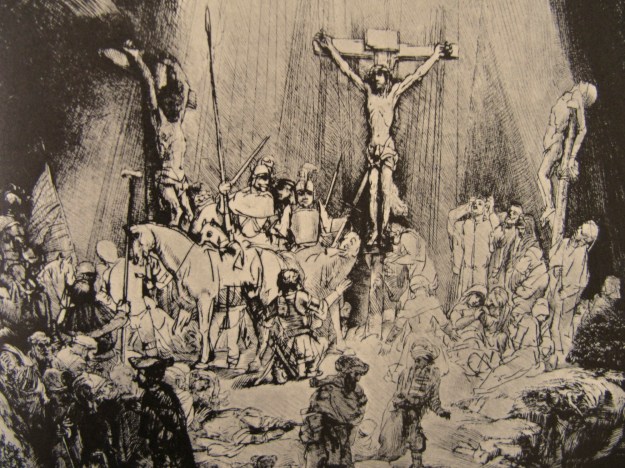
Here’s Rembrandt’s account of the Crucifixion.

Meditation on the Passion of Jesus

St. Leo the Great, in today’s Office of Readings, tells us why we meditate on the Passion of Jesus.

“True reverence for the Lord’s passion means fixing the eyes of our heart on Jesus crucified and recognising in him our own humanity…

Who cannot recognise in Christ his own infirmities? Who would not recognise that Christ’s eating and sleeping, his sadness and his shedding of tears of love are marks of the nature of a slave?

It was this nature of a slave that had to be healed of its ancient wounds and cleansed of the defilement of sin. For that reason the only-begotten Son of God became also the son of man. He was to have both the reality of  human nature and the fullness of the godhead.

The body that lay lifeless in the tomb is ours. The body that rose again on the third day is ours. The body that ascended above all the heights of heaven to the right hand of the Father’s glory is ours. If then we walk in the way of his commandments, and are not ashamed to acknowledge the price he paid for our salvation in a lowly body, we too are to rise to share his glory. The promise he made will be fulfilled in the sight of all: Whoever acknowledges me before men, I too will acknowledge him before my Father who is in heaven.”

Following Jesus Christ: Monday Night– Oct 3

Following Jesus Christ in St. Matthew’s Gospel into the days of his death and  resurrection, we hope to learn from him. In a previous post,  we considered lessons Jesus taught as he began his last days.

He recognized that God was with him, even as he faced death.  “Thy will be done,” Jesus taught his disciples to pray in Galilee. “Thy will be done,” Jesus cried trembling as he faced death before his arrest that dark night in Jerusalem. God’s with you, he says to us, even in life’s darkest moments.

It’s a lesson we hope to learn. We welcome God’s will when life’s good, but find it hard to accept when times are bad. “My thoughts are above your thoughts, and my ways above your ways,” God says. God’s plans are often hidden, like seed in the ground or treasure in a field. We find God’s plan especially hard to understand in suffering and death.

And so, many today deny a plan of God exists in our world. If God exists–and some would say he really doesn’t– God is uninvolved in our world in any way. Some say there are no plans at work in our world at all; life is random, without rhyme or reason; everything just happens.

Or some say life is what I want it to be. I can make it happen, and there’s no point in looking for God’s will. I decide.

We believe God has a plan and his plan is for our good. God’s wills our good, even though it may sometimes be hard to see.

“Thy Kingdom come, thy will be done, on earth as it is in heaven.”

Jesus before Caiaphas

After his arrest in the Garden of Gethsemane Jesus is taken to “Caiaphas the high priest, where the scribes and elders were assembled,”  Matthew’s Gospel continues. What shall we learn here?

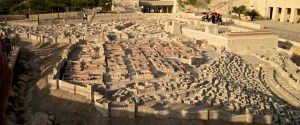
Caiaphas’ residence would be somewhere in Jerusalem’s Upper City where influential Jews lived. It was an area close by the Temple and Herod’s Palace, where Pontius Pilate, the Roman Governor also resided when he was in the city. Jesus would be taken to that well-to-do area of the city.

Recently, archeologists have excavated some of the homes of Jewish officials in the Upper City and they’ve found  Roman style villas with courtyards and elegant furnishings. They would be among the red-roofed buildings seen in the model below of Jerusalem at the Israel Museum.

Jesus would be judged and sentenced to death, scourged and crowned with thorns in the Upper City. His followers would be few there,  unlike Bethany where we said previously  he had strong support. 
Matthew presents Jesus’ appearance before the Jesus leaders in dramatic form. Caiaphas probes his identity thoroughly in what is more of a cross examination than a court trial.  At the same time Jesus is being questioned, Peter the Apostles is also  questioned.  Earlier in Matthew’s Gospel, Peter strongly professed that Jesus was the Christ, the Son of the living God, now just as strongly he denies he ever knew him.
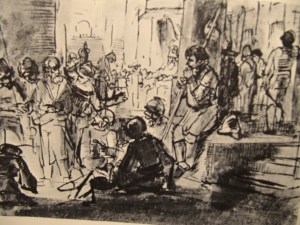
The gospel invites us into this story to ask what we say.  For Caiaphas Jesus is a trouble-maker or maybe a religious fanatic. He and his friends are worried that Jesus might start a revolution endangering all  they held dear.

Who do we say Jesus is? If he’s only a healer, a teacher, a social revolutionary with delusions of grandeur, then he’s only  another innocent person victimized by powerful enemies. Is he only another human being?

But if he’s God’s Son, the face of God to us, then he’s tremendously important to us and to our world.  “Who is he?” “Who is this who suffers and experiences such humbling?” “Why?”  are new questions before us.  God is here, and attention must be paid. Jesus, God in human form, not distant or untouched by human circumstances, suffers and dies and lives and loves as we do.

“Tell us under oath whether you are the Messiah, the Son of the living God.”   Caiaphas asks Jesus.

“You have said it,”  Jesus answers.

Jesus who prayed in fear in the garden, who feels abandoned and alone, whose sweat falls to ground as the dark engulfs him is the face of God before us. Jesus who gave himself to his disciples in bread and wine, who knelt before them in the Supper Room and washed their feet is the face of God. He comes humbly before us that we might meet him unafraid.

With Peter, we say “You are the Christ, the Son of the Living God.” With Thomas, we say, “My Lord and my God.”

Notice how Matthew’s gospel strongly asserts the reality of Jesus’ human experience  He really suffers, he really fears, he really knows our sorrows and pains, for he has borne them himself.   He does not “seem” to be human, he is human.

“Why did be come among us?” we ask. Because God who lives in light inaccessible, wishes to draw us into his light. Jesus who shares our human experience leads us into that light.

We remember the Passion of Jesus to grow in love of him. His Passion is a book to be read over and over,  always wise, always new, always true. It leads us to peace. From its pages we know a loving God wants to be near us.

St. Paul of the Cross, the founder of my community, called the Passion of Jesus the door into the presence of God. It invites us to approach God bravely, to enter God’s presence with confidence and then rest in the presence of the God who loves you.

Judas

As the Jewish leaders send Jesus off to Pontius Pilate, Matthew recalls the tragic end of Judas, who betrayed Jesus. “I have sinned in betraying  innocent blood,” the disciple says as he flings the 30 pieces of silver into the temple. What lesson can be draw from this event?

“His second tragedy,” Pope Benedict says of Judas,”is that he can no longer  believe in forgiveness. His remorse turns into despair. Now he see only himself and his darkness; he no longer sees the light of Jesus, which can illumine and overcome the darkness. He shows the wrong type of remorse; the type unable to hope, that see only its own darkness.” (Jesus of Nazareth, p 68)

Judas would not believe the story of the Prodigal Son. Such sadness hangs over the fate of Judas. We learn from the tragedy of Judas to believe in God’s forgiveness, even for the greatest sinner.

When you read Matthew’s  account of the Passion  notice the gradual silence of Jesus. As the hours go by, his words become fewer and fewer. He works no obvious wonders, no obvious cures. His own power seems to slip away leaving him more and more helpless, and his powerful enemies more in control.

In the garden, he prays a short troubled prayer, over and over: “Father, if it is possible, let this cup pass from me, yet not my will, but your will be done.”

He looks for the comfort of friends but finds none. They fall asleep and seem to not notice.  “Pray that you don’t enter temptation. The spirit is willing but the flesh is weak,” Jesus tells them.

His words are few before Caiaphas. Quick to answer false charges before, he says nothing to the false witnesses bringing charges against him.  Only when Caiaphas directly asks if he is the Messiah, the Son of God,  does Jesus answer: “ You have said so. I tell you from now on you will see the Son of Man seated at the right hand of the power and coming on the clouds of heaven.”

Similarly, Jesus is mostly silent before Pilate. “Are you the king of the Jews?” Pilate asks him. “You say so,” Jesus answers. Then, he says no more.

He’s silent when the crowd calls for Barrabas; he has no words but cries of pain when the soldiers scourge him. He makes no response to their mockery as they lead him away to be crucified.

The only words he says towards the end in Matthew’s gospel–Mark’s Gospel also reports these words–  are the final words from psalm 22, which the evangelists quote in Aramaic, as well as Greek:  “My God, my God why have you forsaken me.?”

“It is not ordinary cry of abandonment. Jesus is praying the great psalm of suffering Israel, and so he is taking upon himself all the tribulation, not just of Israel, but of all those in this world who suffer from God’s concealment. He brings the world’s anguished cry at God’s absence before the heart of God himself. He identifies himself with suffering Israel, with all who suffer under “God’s darkness”; he takes their cry, their anguish, all their helplessness on himself–and in so doing he transforms it.” (Jesus of Nazareth, )

In the Passion of Jesus we find God as a companion, as “one like us in all things but sin.”
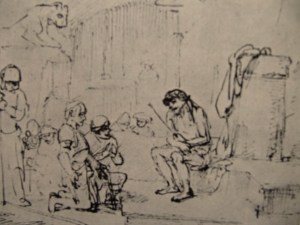
“My God, my God, why have you forsaken me?”
Parish Mission: New Brunswick, NJ

This afternoon I begin a parish mission at St. Mary of Mount Virgin Church in New Brunswick, NJ, preaching at the Palm Sunday Masses  and conducting mission services till next Wednesday evening.

These days of Holy Week speak with “a well-trained tongue;”  We celebrate the death and resurrection of Jesus, remembering the days when Jesus was arrested, judged unjustly, scourged and crowned with thorns, led to a cross and was crucified.

“He suffered under Pontius Pilate, was crucified, died and was buried. On the third day he rose again,”

We take into our hands palm branches this Sunday, as those who welcomed Jesus into Jerusalem did long ago. We listen to the story of his passion and death; they witnessed what happened to him long ago. They heard his call to faith as we do now. They promised to follow him, but the next days came. How many followed him then?

These are precious days when God’s graces are given and God calls again. The graces are given through Jesus Christ and his life-giving Cross; the call is made through his bruises and wounds and through his empty tomb.

Let us follow him, like those whom he invited into the supper room and received him in bread and wine. Like Simon of Cyrene, let us carry someone’s cross. Like the women who met him on the way, let us have compassion on those who are hurting or are in trouble. Let our hearts be open to the needs of our neighbor and the misery and hopes of our world. Like the thief, who called from his nearby cross, let us ask him for forgiveness. Like Joseph of Arimithea let us tend his body, like Mary his mother, let us hold him in our arms.  Like Mary Magdalen let us see him risen from the death; like Peter and James and John let us be enflamed with new dreams for our world.

From Monday to Wednesday, at 7 PM I will conduct of service of preaching and Benediction, followed by confessions.

The Passionists provide an excellent commentary on the gospel accounts of the Passion of Jesus and the devotions that arise from this mystery at Bread on the Waters. The commentary is by Fr.Donald Senior, CP. and can be found here.

We Only Hear Secular Sermons

The sermon by St. Peter Chrysologus I looked at yesterday was directed to people experiencing the barbarian invasions into the Roman Empire in the  5th century.  Notice he never mentions in his sermon the barbarians, or their leaders, or what places have been burned, or those from this village or that who had been enslaved or made hostages.

That’s all said through the images of Noah’s flood, of Abraham’s journey, of the exodus of Jews from Egypt, images forming the substance of his sermon. Through these images he offers meaning and comfort for what people of his time are experiencing.

Today it’s so different. We seem to get only the actual experiences, the bare facts of our time, the raw data of life, without the benefit of ultimate meaning and comfort. We’re flooded with facts and images about our worldwide economic, political and military disasters.  And it’s always more and more. If any interpretation is given at all by our media–the preachers of our time– it’s usually a political spin. “Liberals” or “conservatives” are responsible for it all.

We only hear secular sermons.

We’re missing God’s word offering meaning and comfort.

Later preachers after Peter Chrysologus, like St. Paul of the Cross, would tell us to make the Stations of the Cross if we want to know what’s going on. In the unjust judgment of Jesus, his falling and rising again, his meeting with his mother, his crucifixion, death and resurrection, we can find ourselves and our world. We were there. We are there now.