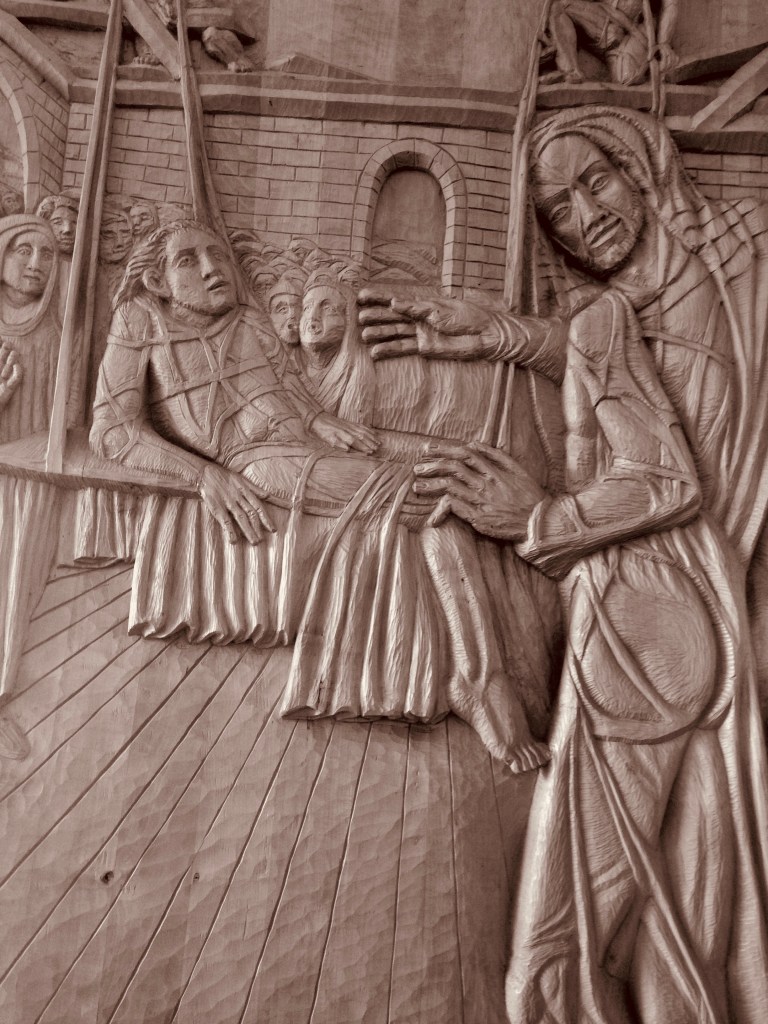
The healing of the paralytic told in today’s gospel from Mark is a great story.(Mark 2: 1–12) Four friends bring him to the door of Peter’s house in Capernaum but the crowds are so dense that they can’t get in to see Jesus so they climb up on the roof, cut a hole in it and lower him down before Jesus. Was the paralyzed man conscious, or half conscious? We don’t know.
What ingenuity! What nerve! What determination on the part of his friends! Think of the logistics involved in it all.
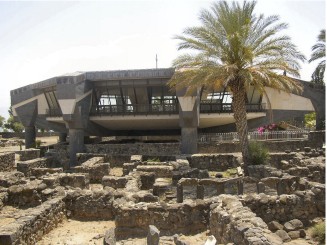
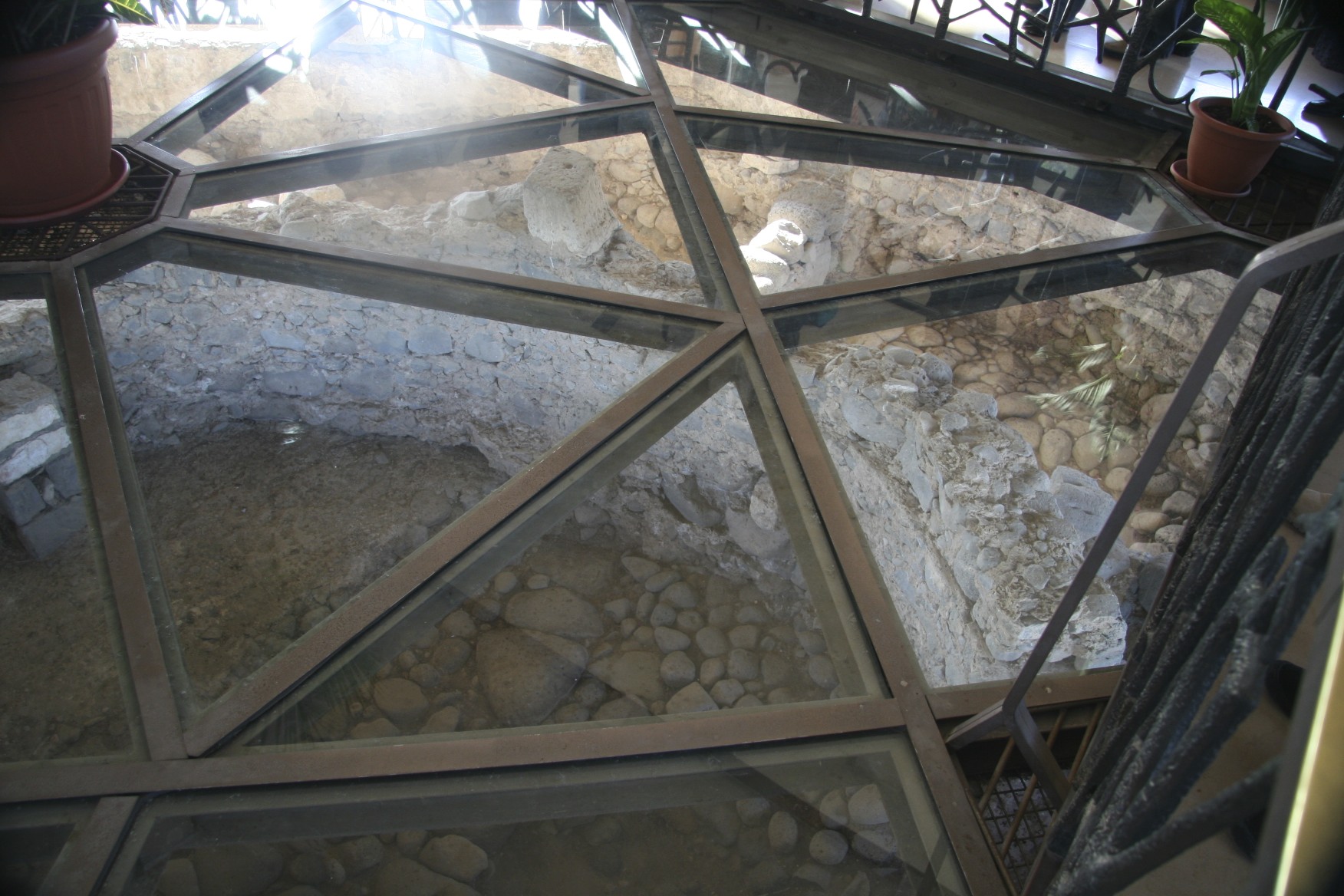
The picture above show the ruins of Peter’s house in Capernaum, now enclosed in a shrine. From a chapel above you can look down into Peter’s house below –possibly just where the man was lowered down. The picture at the beginning of our blog is also from that chapel.
We know Jesus forgave the man’s sins and then healed him completely, so he left the house carrying the mat that once bore him. The gospel story tells us that Jesus the healer is Jesus who forgives sins. Some who heard his words of forgiveness that day were shocked by this action which they rightly judged was divine.
But I’m led back to the four friends who had a part in this miracle. Let’s not forget them. They believe and their belief makes them go to extraordinary lengths to help someone . Faith reaches out; it doesn’t remain within. We believe for others as well as for ourselves. Believing prompts us to do daring things for others.
Back to Peter’s house. Did Peter look up that day and say, “Who’s going to pay for that hole in the roof?” The story of the paralyzed man is a wonderful story. But it also has an ominous part to it. Scribes, sitting in judgment, call Jesus a blasphemer for pronouncing sins are forgiven. Opposition to Jesus begins to build and it leads to his death.
After consulting local traditions, the Emperor Constantine and his successors built churches over important biblical sites in Jerusalem and the Holy Land in the 4th century. One of the churches, built near the ancient pool of Bethesda, just north of the Jewish temple in Jerusalem, was associated with Mary, the mother of Jesus.
It was built on a spot pointed out in John’s gospel: “Now there was in Jerusalem at the Sheep Gate, a pool in Hebrew Bethesda, with five porticoes. In these lay a large number of the blind, lame and crippled,” (John 5,2) Jesus healed a paralyzed man at this healing place, where pagan gods like Asclepius and Serapis were honored.
Third century traditions concerning Mary, the Mother of Jesus, were associated with the church built over the ancient healing site. The traditions claimed that Mary’s birth and early life took place in this area. By the 5th century, Mary’s birth was celebrated here September 8. Christian pilgrims, returning home, began ti celebrate the feast of her birth on this day.
Ruins of Bethesda and ancient church
In the last century archeologists uncovered the ancient healing pool with its porticoes, parts of an ancient church and ruins of a temple of Asclepius (2nd-4th century) ..
Ruins of the Temple of Serapis
The early traditions said that Mary’s mother was Anne and her father Joachim. He provided sheep for the temple sacrifices. They were looked down upon as old and childless, but angels came and told them they were to conceive a daughter. Like Abraham and Sarah, their faith was rewarded.
Stories of Mary’s birth and her childhood strongly influenced the spirituality and devotional life of the early Christian churches of east and west. The feast of her birth is still celebrated by all the ancient churches on September 8 . Her parents are honored September 9 by the Greek Church. The Roman Church celebrates their feast July 26th.
When the Crusaders conquered the Holy Land in the 11th century they rebuilt the small church over the healing pool, which had fallen into ruins, and also built a new, larger church honoring St. Anne, the mother of Mary, southeast of the pool.
The present Church of St. Anne is one of the most beautiful of Jerusalem’s churches today. A favorite destination for pilgrims, it stands overlooking the remains of the old church and the ancient healing pool.
Readings for today’s feast see Mary’s birth awaited by all her ancestors. The gospel, St.Matthew’s genealogy of Jesus, begins with Abraham whose hopes and the hopes of generations before him were fulfilled when Mary brought Jesus Christ into the world. “We commemorate the birth of the blessed Virgin Mary, a descendant of Abraham, born of the tribe of Judah and of David’s seed,” (Antiphon, 1st Vespers, Roman rite)
“This feast of the birth of the Mother of God is the prelude, while the final act is the foreordained union of the Word with flesh. Today, the Virgin is born, tended and formed and prepared for her role as Mother of God, who is the universal King of the ages…
Today the created world is raised to the dignity of a holy place for him who made all things. The creature is newly prepared to be a divine dwelling place for the Creator.”
(St. Andrew of Crete, bishop, Office of Readings, Roman rite)
The Birth of Mary is the first great feast in the Orthodox Church calendar which begins in September. Their calendar ends with the feast of Mary’s Dormition, on August 15th.
The Orthodox liturgy sees Mary as the mysterious ladder that Jacob saw in a dream reaching from earth to heaven. (Genesis 28,10-17) She is the way the Word came down to earth’s lowest point, death itself, and returns to heaven having redeemed humanity. The Orthodox liturgy also associates Mary with the miracle of the paralyzed man at the Pool of Bethesda. She has a role in healing our paralyzed humanity.
May your Church rejoice, O Lord, for you have renewed her with these sacred mysteries, as she rejoices in the Nativity of the Blessed Virgin Mary, the hope and the daybreak of salvation for all the world. Through Christ our Lord.
Today’s readings from the Old and New Testament complement one another, as the readings all through Advent do. Isaiah 35:1-10 speaks to Jewish exiles in Babylon, calling them to take a “holy way” through the wilderness to Jerusalem’s “holy mountain. Yet not just exiles in Babylon are called, God calls all nations to take the journey. All people, even the frailest, the weakest, are called to take it: the blind, the deaf, the lame, the fearful will take it, for God will strengthen them. The lame will leap “like a stag” and the “tongue of the mute will sing.”
The paralyzed man brought to Jesus in the gospel and sent away singing and dancing, (Luke 5:17-26), is a symbol of a paralyzed world that Jesus invites to take this journey, and humanity’s hopes are fulfilled as well as the hopes of prophets and peoples of the Old Testament are fulfilled. Our hopes as well. God wishes to heal our paralyzed world. Isaiah’s vision isn’t small.
Our vision shouldn’t be small either. When we hear ourselves saying “They’re not going anywhere.” “They’ll never change.” “The world’s never going to change.” we need to listen to ourselves. We’re living in a cynical world. We shouldn’t let our hope become too small.
Let’s not forget those in the gospel who lowered the paralyzed man from the roof down to where Jesus was. They were people of hope, willing to chance it with someone who looked like he would never move his limbs again. We need more of their kind today.
“They will see the glory of the LORD, the splendor of our God. Strengthen the hands that are feeble, make firm the knees that are weak, Say to those whose hearts are frightened: Be strong, fear not! Here is your God, he comes to save you.Then will the eyes of the blind be opened, the ears of the deaf be cleared; Then will the lame leap like a stag,then the tongue of the mute will sing… A highway will be there, called the holy way; No one unclean may pass over it, nor fools go astray on it. No lion will be there, nor beast of prey go up to be met upon it. It is for those with a journey to make, and on it the redeemed will walk.”
The Old Testament readings this week, mostly from Isaiah, describe our journey through the desert as a hard journey, but the desert will bloom and a highway will be there, a holy way. (Monday) We’ll hear tender, comforting words as we go. (Tuesday) Those who hope in God will renew their strength, soaring on eagle’s wings. (Wednesday) We’re as insignificant as a worm, the prophet says, but God takes us in hand and says: “Fear not; I am with you.” (Thursday) God teaches us the way to go. (Friday) We meet prophets like Elijah and John on our way. (Saturday)
Above all, Jesus is our way, the gospel readings say. The paralyzed man lowered through the roof in Caphernaum got up and was ready to make the journey. He symbolizes paralyzed humanity enabled to walk again. (Monday) Jesus the good Shepherd searches for and finds the stray sheep. (Tuesday) “Come to me all who are weary…” he says. (Wednesday) We’ll find prophets and guides like John the Baptist and Elijah. (Thursday) Though rejected like John the Baptist, Jesus still teaches. He will always teach. (Friday) He saves us, even though he goes unrecognized like John and Elijah. (Saturday)
Let’s compare the paralyzed man at the pool at Bethesda, whom we hear about in today’s gospel, with the official in our previous story from John’s gospel. The official came to Jesus in Cana in Galilee looking for a cure for his son. Obviously, he was important. He knew how to get things done and came to get Jesus to do something for him. He’s a resourceful man.
The paralytic at Bethesda, on the other hand, seems utterly resourceless. For 38 years he’s come to a healing pool– archeologists identify its location near the present church of St. Anne in Jerusalem– and he can’t find a way into the water when it’s stirring. Paralyzed, too slow, he can’t even get anybody to help him. He doesn’t approach Jesus; Jesus approaches him, asking: “Do you want to be well?”
Instead of lowering him into the water, Jesus cures the paralyzed man directly and tells him to take up the mat he was lying on and walk. The man has no idea who cured him until Jesus tells him later in the temple area. He’s slow in more ways than one.
“God chose what is weak in the world to shame the strong; God chose what is low and despised in this world, things that are not, to reduce to nothing things that are, so that no one might boast in the presence of God,” St. Paul tells the Corinthians.
Here’s one of the weak, the lowly, the nobodies God chooses, and he wont be the only one. But are we far from him?
Lord Jesus,
like the paralytic I wait for you,
not knowing when or how you will come.
But I wait, O Lord,
however long you may be.
Compare the paralyzed man at the pool at Bethesda, whose story we tell in today’s gospel, with the official in our previous story from John’s gospel, who came from Capernaum to Cana in Galilee looking for a cure for his son. Obviously, the official was important. He knew how to get things done and came to get Jesus to do something for him. He’s a resourceful man.
The paralytic at Bethesda, on the other hand, seems utterly resourceless. For 38 years he’s come to a healing pool– archeologists identify its location near the present church of St. Anne in Jerusalem– and he can’t find a way into the water when it’s stirring. Paralyzed, too slow, he can’t even get anybody to help him. He doesn’t approach Jesus; Jesus approaches him, asking: “Do you want to be well?”
Instead of lowering him into the water, Jesus cures the paralyzed man directly and tells him to take up the mat he was lying on and walk. The man has no idea who cured him until Jesus tells him later in the temple area. He’s slow in more ways than one.
“God chose what is weak in the world to shame the strong; God chose what is low and despised in this world, things that are not, to reduce to nothing things that are, so that no one might boast in the presence of God,” St. Paul tells the Corinthians.
Here’s one of the weak, the lowly, the nobodies God chooses, and he wont be the only one.
The mystics saw weakness differently that most do. It was a time for God to act, as St. Paul of the Cross once remarked
“Be of good heart, my good friend, for the time has come for you to be cured. Night will be as illumined as day. As his night, so is his day.” A great difference takes place in the Presence of God; rejoice in this Divine Presence. Have nothing, my dear one; allow yourself to be deprived of all pleasure. Do not look your sufferings in the face, but accept them with resignation and satisfaction in the higher part of your soul as if they were jewels, and so they truly are. Ah! let your loving soul be freed from all that is created and pay no attention to suffering or to enjoyment, but give your attention to your beloved Good. (Letter 41)
There was a feast of the Jews, and Jesus went up to Jerusalem.
Now there is in Jerusalem at the Sheep Gate
a pool called in Hebrew Bethesda, with five porticoes.
In these lay a large number of ill, blind, lame, and crippled.
One man was there who had been ill for thirty-eight years.
When Jesus saw him lying there
and knew that he had been ill for a long time, he said to him,
“Do you want to be well?”
The sick man answered him,
“Sir, I have no one to put me into the pool
when the water is stirred up;
while I am on my way, someone else gets down there before me.”
Jesus said to him, “Rise, take up your mat, and walk.”
Immediately the man became well, took up his mat, and walked.
Now that day was a sabbath.
So the Jews said to the man who was cured,
“It is the sabbath, and it is not lawful for you to carry your mat.”
He answered them, “The man who made me well told me,
‘Take up your mat and walk.’“
They asked him,
“Who is the man who told you, ‘Take it up and walk’?”
The man who was healed did not know who it was,
for Jesus had slipped away, since there was a crowd there.
After this Jesus found him in the temple area and said to him,
“Look, you are well; do not sin any more,
so that nothing worse may happen to you.”
The man went and told the Jews
that Jesus was the one who had made him well.
Therefore, the Jews began to persecute Jesus
because he did this on a sabbath.
Tuesday, 4th week of lent
It’s interesting to compare the paralyzed man at the pool at Bethesda with the official in the previous story from John’s gospel who came from Capernaum to Cana in Galilee seeking a cure for his son. Obviously, the official had standing in the community where he lived. He knew how to get things done and came intent on getting Jesus to do something for him. He’s a resourceful man.
The paralytic at Bethesda, on the other hand, seems utterly resourceless. For 38 years he’s come to a healing pool– archeologists identify its location near the present church of St.Anne in the city– and he can’t find a way to get into the water when it’s stirring. He’s paralyzed; too slow, and he doesn’t know how to get anybody to help him. He doesn’t approach Jesus, but Jesus approaches him.
“Do you want to be well?”
Instead of lowering him into the water, Jesus cures the paralyzed man directly and tells him to take up the mat he was lying on and walk.
Through it all, the man has no idea who cured him until Jesus makes himself known later in the temple area. He’s slow in more ways than one.
“God chose what is weak in the world to shame the strong; God chose what is low and despised in this world, things that are not, to reduce to nothing things that are, so that no one might boast in the presence of God,” St. Paul wrote to the Corinthians.
Here’s one of the weak, the lowly, the nobodies God chooses, and he wont be the only one..


 The Victor's Place
