After the Feast of the Baptism of Jesus we read at Mass from the first 8 chapters of the Gospel of Mark until Ash Wednesday.
Mark’s Gospel makes no mention of Jesus’ birth in Bethlehem but begins with his baptism in the Jordan River. Then he describes his miracles and teaching in the towns around the Sea of Galilee– the Jewish towns first, then in the gentile region. Then Jesus goes up to Jerusalem and his death and resurrection.
Until recently, Mark’s Gospel received little attention compared to the gospels of Matthew, John or Luke. It was hardly read in the liturgy. Earlier commentators thought Mark was simply a synopsis of Matthew’s Gospel. Commentators today, however, recognize Mark’s Gospel as the first to be written and appreciate the powerful way it tells the story of Jesus. It’s not just a simple portrayal of historical facts or a synopsis of Matthew. It’s rich in symbolism of its own.
Mark’s Gospel, for example, begins in the waters of the Jordan River, where Jesus is called God’s beloved Son on whom the Spirit rests. Water is a recurring image in Mark’s portrayal of Jesus’ ministry.
John Donahue SJ, a recent commentator on the Gospel of Mark (Liturgical Press, 2002) , points out the symbolic nature of the various events in Jesus’ ministry, beginning with his baptism in the Jordan River and then his ministry around the Sea of Galilee. As the Spirit rested on the waters of the Jordan, so does the Spirit stir the waters in Galilee, drawing more and more to Jesus, God’s Son. Crossing from the western to its eastern side of the Sea – from a side largely Jewish to a side largely gentile – Jesus and his disciples bring the gospel to gentiles as well as Jews.
The storms Jesus and his disciples face on waters of the Sea of Galilee are more than historic storms; they symbolize the fearful challenge and rejection to be faced in bringing the gospel to others. (Mark 6:45-52)
“As he passed by the Sea of Galilee,” Jesus calls some fishermen, Simon, his brother Andrew, James and his brother John. He makes them “ fishers of men.” (Mark 1, 16-19) Along the sea, Jesus teaches the crowds in parables.
The journeys of Jesus and his disciples to Tyre and Sidon, seaports on the Mediterranean Sea, are also more than historical markers. The Syrophoenician woman and the deaf man, both gentiles healed there, are signs that the gospel must be brought over the seas to the gentiles at ends of the earth. ( Mark 7:24-37)
Jesus multiplies bread on both sides of the Sea of Galilee in Mark’s Gospel. The gentiles are to be fed and blessed as well as Jews. (Mark 6:31-44; Mark 8:1-10)
The Spirit moves in the waters of the Jordan, the Sea of Galilee and the waters beyond yet, as Mark’s Gospel indicates repeatedly, the Jewish leaders, the pharisees, scribes, Herodians, members of his own family, his disciples, do not understand. Neither do we.
Still, the Spirit works through the waters, softening, cleansing, strengthening, giving new life.
I suspect Mark’s gospel had an important affect on the early community of Roman Christians as they survived the Neronian persecution in the 60s, when Peter and Paul were killed. A common opinion is that Mark, a disciple of Peter, wrote this gospel in Rome in part to support the Roman community after their experience. He reminded them of Peter’s words and example.
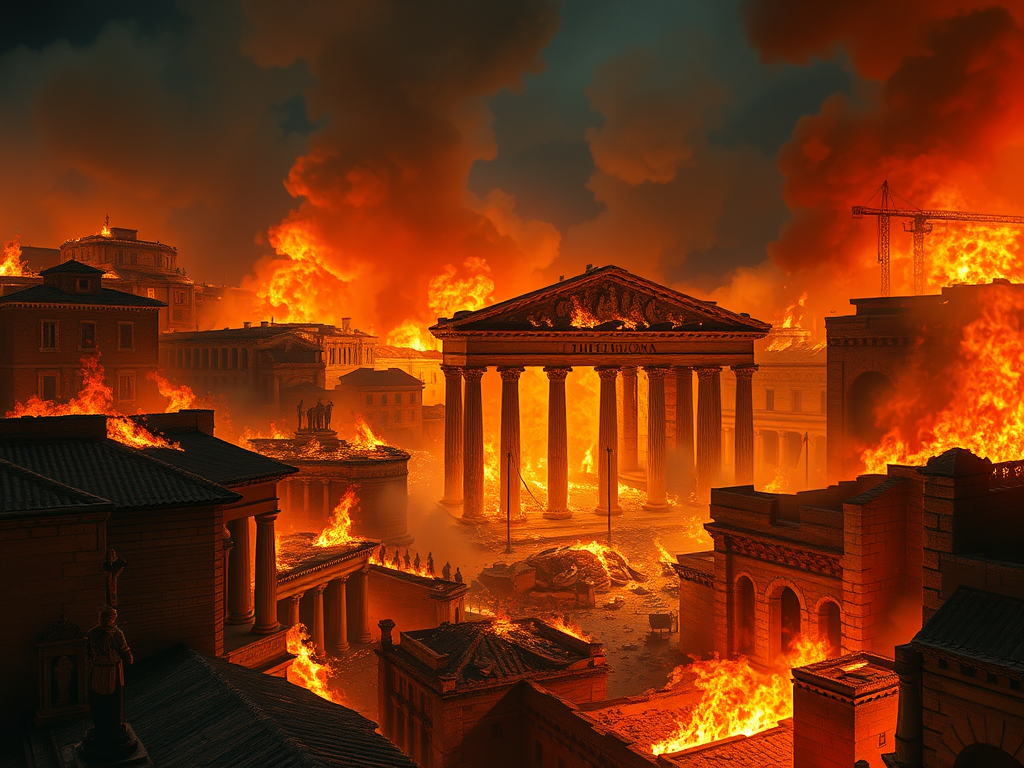
Today is the feast of the early Roman martyrs who suffered in Nero’s persecution along with the apostles Peter and Paul. The persecution began with an early morning fire on July 19, 64, that broke out in a small shop by the Circus Maximus and spread rapidly to other regions of Rome, raging for nine days through the city’s narrow streets and alleyways, where more than a million people lived in apartment blocks of wooden construction.
Only two areas escaped the fire; Trastevere, across the Tiber River, which had large Jewish population, was one.
Nero was at his seaside villa in Anzio when the blaze began, but he delayed returning to the city. They say that when he heard the news, he began composing an ode comparing Rome to the burning city of Troy. His absence caused resentment among the people. Rumors began that Nero himself set the fire in order to rebuild the city from his own plans.
To quell the rumors, Nero decided to blame someone else, and he chose a group of renegade Jews called Christians, who had caused trouble before, and had a bad reputation in the city. Earlier, about the year 49, the Emperor Claudius had banished some of them from Rome for starting upheavals in the city’s Jewish synagogues with their disputes about Christ.
“Nero was the first to rage with Caesar’s sword against this sect,” wrote the early-Christian writer, Tertullian. “To suppress the rumor,” the Roman historian Tacitus says, “Nero created scapegoats. He punished with every kind of cruelty the notoriously depraved group known as Christians.” Just how long the process went on and how many were killed, the Roman historian does not say.
The early Roman Christians came mostly from the 60,000 Jewish merchants and slaves with strong ties to Jerusalem. Even before Peter and Paul arrived in Rome, Jewish-Christians, clearly identified as followers of Jesus Christ, were counted among the city’s Jews.
At the time of the fire Jewish Christians had become alienated from the larger Jewish community and began separating from it. Where they lived and met was well known. The authorities, following the usual procedure, seized some of them, brought them to the Prefecture and forced them by torture to give the names of others.
“First, Nero had some of the members of this sect arrested. Then, on their information, large numbers were condemned — not so much for arson, but for their hatred of the human race. Their deaths were made a farce.” (Tacitus)
Instead of executing the Christians immediately at the usual place, Nero executed them publicly in his gardens and in the circus on Vatican hill. “Mockery of every sort accompanied their deaths. Covered with the skins of beasts, they were torn by dogs and perished, or were nailed to crosses, or were doomed to the flames and burnt, to serve as a nightly illumination, when daylight had expired.” (Tacitus)
Most thought Nero went too far. “There arose in the people a sense of pity. For it was felt that they (the Christians) were being sacrificed for one man’s brutality rather than to the public interest.” (Tacitus)
We celebrate the memory of the victims of Nero’s persecution, our ancestors in faith, on June 30th, following the feast of Saints Peter and Paul.
Further Reading
It would be good to have two New Testament writings in mind as we celebrate this feast– the Gospel of Mark and the First Letter of Peter.
Many scholars believe the Gospel of Mark was written in Rome following Nero’s persecution and before the destruction of Jerusalem in 70. Roman Christians, reeling from persecution and fearing troubles ahead, learned from this gospel.
Most belonged to a Jewish community that enjoyed extensive privileges under Rome’s emperors; they felt safe and secure– until Nero’s reign. There were brave martyrs, but there were others who betrayed their fellow Christians.
Mark’s Gospel presents the Passion of Jesus as a stark, brutal martyrdom that can’t be explained. How appropriate for Christians facing absurd, unmerited suffering meted out by a capricious emperor. At the same time, more than other gospels, Mark portrays Peter as a disciple who fails his Master and then receives mercy. He seems to remind Rome’s Christians that not only the strong, but the weak are part of their church.
Mark’s Gospel is meant for hard times. Jesus Crucified calls his disciples to follow him to the Cross.
First Letter of Peter
Another New Testament writing offered a similar message to the Roman community and Christians beyond the city. Like Mark’s Gospel, the First Letter of Peter, written in Rome, calls for courage in suffering, even unjust, absurd suffering.
“Christ suffered for you, leaving you an example that you should follow in his footsteps. He committed no sin and no deceit was found in his mouth. When he suffered he did not threaten; instead he handed himself over to the one who judges justly.” (1 Peter 2, 21-23)
The followers of Jesus should stay the course when suffering comes, Peter says. Stay where you are, the letter says, and “maintain good conduct among the Gentiles,” (1 Peter 2:12) “give honor to all, love the community, honor the king.”(1 Peter 2:17)
Following the Neronian persecution, many Jewish Christianss fled Jerusalem before Titus’ advancing legions. Seeing a sign of the last times, they prepared for the end. Rome’s Christians stayed where they were, it seems, and with their neighbors rebuilt their burnt city, waiting in hope for God’s kingdom to come.
They must have wondered whether to stay in this city, an evil city like Babylon. Should they go to a safer, better place? The Christians remained in the city. I wonder if the “Quo Vadis?” story was a story prompted by questions like these ?
The martyrs of Rome strengthen us to stand where we are and do God’s will, inspired by the Passion of Christ.
April 25th is the Feast of St. Mark, author of one of the gospels. We may forget that real people wrote the gospels, but the medieval portrait above shows the evangelist real enough as he adjusts his spectacles and pours over a book, surely his gospel. A lion looks up at him, the powerful voice of God.
He’s an old man, his eyes are going, He has to be old if he’s a disciple of Peter, as tradition claims. (cf. 1 Peter 5:14) Mark’s gospel appears shortly before or after the destruction of the Jewish temple in Jerusalem by the Romans in 70 AD. If he’s the author of the gospel, as it’s said, he’s in his 70s at least.
He may have written his account in Rome, where he came with Peter, who calls Mark in his 1st Letter “my son.” In 64 AD, Roman Christians experienced a vicious persecution at the hands of the Emperor Nero. Peter and Paul died in that persecution. For years afterwards, Christian survivors were still asking themselves, no doubt, why it happened.
They say Mark wrote his gospel in answer to that dreadful experience. He would have heard Peter’s witness to Jesus many times; he knows his story.
Yet Mark was not just a stenographer repeating Peter’s eyewitness account; he’s adapted the apostle’s story, adding material and insights he had gathered on his own. For a long time Mark’s gospel was neglected by the church, thought to be simply a synopsis of Matthew’s gospel. Today scholars admire it for its simplicity and masterful story telling. It’s the first gospel written and Matthew and Luke derive much of their material from it.
I like the wonderful commentary: The Gospel of Mark, in the Sacra Pagina series from Liturgical Press, by John Donohue,SJ and Daniel Harrington, SJ (Collegeville, Min. 2002). A great guide to this gospel and its rich message. We read Mark in the lectionary from the Feast of Baptism of Jesus up to Ash Wednesday, the beginning of Lent.
Mark’s Gospel offers a unique wisdom. It does not flinch before the mystery of suffering and does not try to explain it away. There’s a darkness about this gospel that makes it applicable to times like ours. We’re disciples of Jesus who must follow him, no matter what.
Our gospel for the feast is the final commission Jesus gives to his disciples, according to Mark. “Go into the whole world and proclaim the Gospel to every creature. Whoever believes and is baptized will be saved; whoever does not believe will be condemned. These signs will accompany those who believe: in my name they will drive out demons, they will speak new languages. They will pick up serpents with their hands, and if they drink any deadly thing, it will not harm them. They will lay hands on the sick, and they will recover.”
Like Jesus, his disciples will drive out demons and speak new languages. They’ll pick up serpents and drink poison, yet be unharmed. They will even believe, without understanding everything. In answer to Jesus’ command, tradition says Mark went to Egypt and founded the church in Alexandria.
Father, You gave St. Mark the privilege of proclaiming your gospel. May we profit by his wisdom and follow Christ more faithfully. Grant this, through Christ, your Son.
The Gospel of Mark, the first of the four gospels, written sometime between the year 65 to 70 AD. Each year it’s read on weekdays, from chapter 1-9, following the Feast of the Baptism of Jesus until Tuesday before Ash Wednesday. This year it’s also read on Sundays through the year.
Mark’s gospel begins. not with Jesus’ birth, but with his Baptism, announced by John the Baptist.After his temptation in the desert, Jesus immediately goes into Galilee proclaiming the kingdom of God is at hand.
In each weekday reading Jesus proclaims the Kingdom of God, first in Galilee and then in Jerusalem, by miracles and powerful signs. He also faces growing opposition that eventually brings him to death.
From its very beginning, Mark’s Gospel offers intimations of the tragic mystery of the Passion of Jesus. Coming from the Jordan River where he is baptized by John, Jesus is led “at once” by the Spirit into the wilderness to be tempted by Satan. “ He was among wild beasts, and the angels ministered to him.” (Mark 1,13) In Mark’s Gospel, Jesus constantly faces the forces of evil and death.
Almost half of Mark’s 16 chapters describe the final period of Jesus life, when he went up to Jerusalem and suffered, died and rose again. As chapter 8 ends, Jesus asks his disciples who people say he is. “You are the Messiah,” Peter answers, but Jesus announces he must go up to Jerusalem and be rejected and killed and raised up. Peter will have nothing to do with it. In response, Jesus calls him “Satan” and tells him he’s thinking as man thinks and not as God does.
In God’s thinking, Jesus, his Son, must die and rise again. All who follow him must do the same. Peter’s not alone in not understanding God’s thinking; all the disciples, including us, are slow to understand. Our lack of understanding is emphasized in Mark’s gospel, which some have called “A passion narrative with an extended introduction,”
Many commentators say that Mark’s Gospel was written in Rome for the Christians of that city who suffered in the first great persecution of the church by Nero after a fire consumed the city in 64 AD.
I lived in Rome for a few years in the Monastery of Saints John and Paul on the Celian Hill. The monastery was built over the Temple of Claudius; its gardens were once part of Nero’s gardens. From its heights you could see the Circus Maximus a short distance away where the great fire of 64 AD started and the extensive area that burned in the fire, up to Tiber River. Probably over a million people were affected by it.
The Roman historian Tacitus says that Nero blamed the Christians for the fire and had many of them arrested and put to death in his gardens and at the Vatican circus across the city.
I was living in the gardens where some of those early Christians were put to death, I believe. On the other side of the Colosseum, a short distance away, was the Roman prefecture and prison were many of them would likely have been held and sentenced. The Church of St. Peter in Chains stands there today.
I narrated a video about that church and the early persecution which may help you understand the church Mark wrote for. The persecution must have had a devastating affect on the Christians of Rome at the time, innocent people completely taken by surprise by this brutal injustice. They didn’t understand it at all. Neither did his first disciples understand, Mark’s gospel says.
Today we read a long narrative from Mark’s Gospel (Chapter 6) describing the death of John the Baptist at the hands of Herod Antipas. It’s been called a “Passion Account before the Passion of Jesus.”
Herod Antipas, ruler of Galilee, had his capitol in Tiberias a short distance from Capernaum where much of Jesus’ ministry took place. He certainly knew what Jesus was doing and what people were saying about him. Some said he was Elijah, or a prophet. But what caught Herod’s attention especially was talk that Jesus was John the Baptist raised from the dead.
Herod had arrested John and imprisoned him, probably in his fortress at Macherius near the Dead Sea. Then, influenced by his wife Herodias, who resented John’s criticism of their marriage– which violated Jewish law– Herod had John put to death.
The story told in great detail in Mark’s Gospel is an example of evil, oppressive power at its worst. Herodias’ daughter Salome dances at one of Herod’s bloated banquets and elicits his promise to do anything she asks for. “What shall I ask?” Salome asks her mother. “The head of John the Baptist,” is her answer.
Later in Mark’s gospel, Jesus identifies John the Baptist with Elijah. “I tell you that Elijah has come and they did to him whatever they pleased, as it is written of him.” (Mark 9, 13) Like Jesus, John suffers and is treated with contempt.
The story of John’s beheading by Herod prepares Mark’s readers for the story of the Passion of Jesus. Both stories were meant to help Mark’s first audience, Roman Christians, face the sudden, absurd persecution inflicted on them by the Emperor Nero in the mid 60s. Like Herod, Nero seemed supremely powerful. They could not see it yet, but evil would not have its way. The Son of Man would rise from the dead and be glorified. So would they.
That’s the lesson we should take from this story too. Evil doesn’t have its way.
June 30th, following the Feast of Saints Peter and Paul, we celebrate the early Christian martyrs put to death by Nero after the disastrous fire that burned down much of the city July 19, 64 AD. If I were in Rome today I would go to the church of Saint Peter in Chains or to the gardens of Saints John and Paul on the Celian Hiill to remember them.
The two apostles were put to death around this time and many (we don’t know how many) followed them.
There’s a blog and a video on the church of St. Peter in Chains here and here.And a video on the Stations of the Cross in the gardens of Saints John and Paul here. There’s also a video on the Quo Vadis story here.
The persecution and martyrdom in 64 throws light on the creation of the Gospel of Mark, which many think was written in Rome afterwards.
One thing I think this feast and the Gospel of Mark suggests: the Church of Rome did not flee from the uncertainty and persecution it faced then. I think the Quo Vadis story indicates that. It didn’t give up.
We pray today:
Father,
you sanctified the Church of Rome
with the blood of its first martyrs.
May we find strength from their courage
and rejoice in their triumph.
We ask this through our Lord, Jesus Christ, your Son.
The old churches of Rome are wonderful guides to its Christian past. As a student almost 50 years ago I went through them with books like Hertling and Kirschbaum’s The Roman Catacombs and Their Martrys, a book I still keep at hand along with newer ones.
The 5th century church of Saint Peter in Chains is a church I’ve always associated with the First Marytrs of the Church of Rome, a feast we celebrate today, right after the feast of the apostles, Peter and Paul.
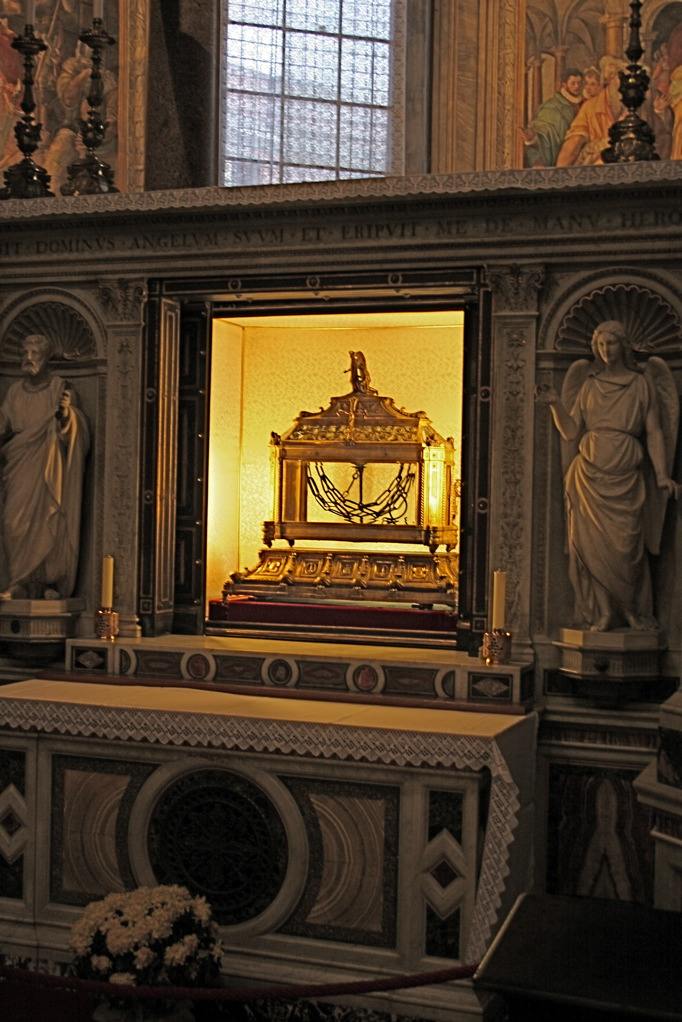
It was built near the Roman Prefecture, where people were dragged in chains to be interrogated, tortured, and made to face Roman justice. The Romans were sticklers for procedure. You had to be tried in court. Many Christians–we are not sure how many–were brought to justice near this church. Those chains above may actually come from the nearby Roman jail.
I wrote about it here , and I have a video you can see here.
I was happy to see the Vatican launch out onto Youtube. The digital generation spends a lot a time there, so why not reach out to them? Maybe we don’t have all the whistles and bells, but let’s start somewhere.
At the Travel Show in the Javits Center in New York City last Sunday, crowds of people were looking for places to go and see around the world. Some of them may end up in churches and shrines, which have wonderful stories to tell.
Here’s a church in Rome I’ve always liked, and it tells a powerful story. Saint Peter in Chains.
I have other clips on Youtube. Type vhoagland into the search box and see for yourself.
Tradition says that Peter, whom Jesus made the rock on whom he built his church, came to Rome and died there during a persecution by the Emperor Nero about 64 AD. He was buried in a cemetery on Vatican Hill after being crucified nearby. Tradition also says the apostle was crucified with his head to the ground, because he saw himself unworthy of dying like Jesus.
The Emperor Constantine built a majestic church over the apostle’s grave in the 4th century, one of the first he built for the Christians of the city.
From the beginning Christians honored the apostle’s grave and esteem for him grew as Christianity grew. He was an apostle of Jesus, along with Paul who also died in the same persecution. Like Romulus and Remus, twin founders of the city, they are considered twin founders of the Roman church.
Besides being honored at the Vatican, Peter is honored elsewhere in the city. His seizure and imprisonment are recalled at the Church of St.Peter in Chains near the Coliseum and at the Mamertime Prison in the Roman Forum. The small Quo Vadis chapel along the Via Antica recalls the poignant legend of the apostle fleeing from prison, only to meet Jesus going into the city to join his followers condemned by Nero. Turning back, Peter followed his Lord to martyrdom on Vatican Hill.
Christians cherish his memory. The popes resided at the Lateran from the 4th to the 14th century but moved to the Vatican, not only because the Lateran area had become unsafe, but also to be near Peter’s grave on Vatican hill, where great numbers of Christian pilgrims congregated.
What draws so many to Peter?
He was ordinary enough. Paul boasted that he was a citizen of Tarsus, no mean city. Peter came from Capernaum, an unimportant fishing village along the Sea of Galilee.
Paul had a fine educational and religious training. A fluent teacher and trained scholar, he dealt with the religious establishment of his day and spoke its language. Peter was unpolished, with little formal education; he spoke like a Galilean peasant. Whatever religious knowledge he had before he met Jesus came from the local rabbis in his synagogue. He was a fisherman at home on the sea.
Why did Jesus make him first among his followers? It wasn’t brains or talents that won him the place. Nor his loyalty. The simple explanation may be that God chooses the weak things of this world.
We know more about Peter than about any of the other early disciples of Jesus. He was a Jew who moved to Capernaum from Bethsaida, another village along the Sea of Galilee, where he fished with others. Historians say that fishing then offered a good enough living. Archeologists today think they can point out in Capernaum’s ancient ruins the house where Peter lived, along with his wife, his mother-in-law and whoever else belonged to his family.
He was forthright, direct and practical, not afraid to speak up or tell you what was on his mind. He wasn’t afraid to draw a sword or face prison. He saw his own faults and acknowledged them. An observant Jew, but not a professional religious man.
He met Jesus on a pilgrimage to Jerusalem, when he stopped at the Jordan River to hear John the Baptist preaching. His brother Andrew brought him to Jesus, after John had pointed him out.
The gospels say that he was a friend of Jesus as well as a disciple. Peter welcomed him to his house in Capernaum. He became Jesus’ companion as he preached in Galilee and journeyed to Jerusalem. He witnessed his miracles, heard his teaching and was intimately involved in the events of his death and resurrection. When Jesus was arrested, Peter denied three times that he knew him and fled into the night.
Peter saw and heard what Jesus did. He was an eyewitness. After he rose from the dead, Jesus chose him again to shepherd his flock, even though Peter had denied him.
As an eyewitness, he was the first to testify at Pentecost that Jesus had risen from the dead and was indeed the promised Messiah. The Jewish authorities in Jerusalem dismissed him and the rest of the disciples as unlearned men. From Jerusalem, Peter went to the coastal cities of Joffa and Caesarea, then to the main Syrian city of Antioch, and finally to Rome with his message.
When he reached the capital of the empire, he was probably in his 60s. Scientists who examined bones found at his gravesite underneath St. Peter’s in the late 1940s said they belonged to a man of rugged build about that age.
We don’t know what precisely brought Peter to Rome sometime in the 60s AD. Probably it had something to do with the Jewish-Christian controversies going on at the time in the city. Some twenty years earlier, the Emperor Claudius expelled Jewish dissidents–likely Jewish Christians– because of bitter disturbances in the synagogues of the city. Paul’s letters tell of similar disputes in places where he traveled.
There were about 60,000 Jews in Rome then, among a population of almost one million. Did Peter come to mediate between various Jewish factions? Was he invited as a peacemaker who valued his Jewish roots, yet saw that God had revealed something new in Jesus of Nazareth? Did some who heard him speak in Jerusalem at Pentecost while on pilgrimage from Rome persuade him to come to his people here and tell them what he saw and heard?
From what we know of Peter it was not an easy mission. Not only was he older now, but he was always more at home in his own land, among his own people, than he was in gentile cities. He was limited in his ability to speak their language and understand their customs. He would always be a simple man.
Most likely, he planned to return home before too long, or go to another place where he was needed. We don’t know how long he was there. But he was an apostle, one sent by Jesus to the whole world, and so he would speak of what he had seen and heard, as he had done many times before.
In Rome his memoirs were gathered by Mark and later formalized in one of the gospels. He also wrote a letter from here to other churches he had known, urging them in the face of persecution and alienation to hold fast to the hope they had as God’s people. (1 Peter)
But then, a fire swept through Rome in the early morning of July 19, 64 AD. Peter was among those identified as Christians caught in Nero’s dragnet and blamed for starting it. Probably his executioners never knew or cared who he was when they brought him to the Vatican hill and crucified him– one of the ways the Romans executed foreigners.
Some Christian women possibly arranged to bury him in a shallow grave in a cemetery nearby. Women often made sure even those condemned as criminals were buried. As time passed they put up a simple monument to mark the place and Christians came to honor him there. Around the year 200, a Roman priest named Gaius, writes that he has seen the gravesite and can take others to it.
A little over a hundred years later, the Emperor Constantine ordered a massive church built over the apostle’s grave; its main altar situated exactly above the grave itself. The emperor, they say, carried twelve loads of dirt to the building site to honor the twelve apostles.
By the 15th century, Constantine’s church was near collapse, so the popes of the time began building another in its place, which took over a hundred years to build. This is the church we enter today, honoring Peter, the fisherman from Galilee and a disciple of Jesus.



 The Victor's Place