Tag Archives: Mary

3rd Sunday of Advent: Who are You?

To listen to the audio of today’s homily, please select play on the audio bar below:

According to today’s gospel, Jewish officials and Pharisees from Jerusalem sent representatives to John the Baptist as he was baptizing in the Jordan River near Jericho asking “Who are you?” “Are you the Messiah, Elijah, the Prophet?” “Why are you baptizing?”

John the Baptist is an interesting figure in the gospels. He’s a strong figure who knew who he was and who he was not and wasn’t afraid to be the person God wanted him to be. “I’m not the Messiah, or Elijah, or the Prophet,” John answers. “I am the voice crying out in the desert, ‘Prepare the way of the Lord. ’”

John knew who he was. He could have said he was the son of Zechariah and Elizabeth, the cousin of Mary, the mother of Jesus. Zechariah, John’s father, was a priest in the temple of Jerusalem who surely expected his son to follow him as a priest. That was an important religious role in Judaism which was handed down from father to son.

But John chose a different course. God led him another way. He didn’t follow his father into the temple as a priest. We don’t know when, but John went down to the Jordan Valley where the road ascended to Jerusalem, and preached and baptized the crowds going up to Jerusalem to the temple of the Lord. The clothes he wore, his style of life set him apart from everyone else.

John doesn’t seem to care how he looked or what people thought of him. He certainly didn’t choose an easy place to be, a desert place. There’s a strength and determination in John that later Jesus himself praised.

John was what God called him to be, and he wasn’t afraid to speak the truth. He had a voice for God, even if he sounds at times like a drill sergeant getting people ready for the battle of the last days. He said unpopular things to powerful people and faced the consequences. Herod Antipas, who ruled Galilee and Perea, arrested him and put him to death.

Jesus admired John the Baptist for being who he was.

It’s so important to be who we are and who God calls us to be, isn’t it? I suppose that’s one of the graces of our Advent season. It reminds us that Jesus Christ came into this world for a reason, but we are reminded too that we came into this world for a reason. We have our unique gifts and should recognize them. We have been given a voice to speak as God would have us speak, and we should use it.

Who are you? Why are you doing the things you’re doing? Those are wonderful questions. “Who am I? And what am I doing with my life?”

Be Little Children

363px-Virgin_salus_populi_romaniOn Tuesday at Cedarbrake Retreat Center in Belton, Texas, I gave a presentation on the icon of Mary in Saint Mary Major in Rome, the oldest icon of Mary in Rome. Mary is a disciple of Jesus, as the Cross that marks her forehead indicates. She hold in her arms her Child who is our teacher.

He calls us to be children. According to St. Leo the Great, a child of God is free from crippling anxieties, forgetful of injuries, sociable and stands wondering at all things.

Her story is told in this great pilgrim church.

Mary, Mother of Ordinary Time

Mother and ChildThe pope raised some eyebrows a month or so ago when he saw a little baby crying in its mother’s arms as he was going through the crowds in St. Peter’s Square in his pope mobile. “Give the baby something to eat, Madam,” he was reported to have said to the baby’s mother. Breast feeding in St. Peter’s Square! It seems he did the same thing last week on the Feast of the Baptism of Jesus in the Sistine Chapel when he baptized 35 infants. “If your baby is hungry, don’t be afraid to feed it,” he said to the mothers there according to reports.

In one of the magazines, an art historian wrote asking why should we be surprised at the pope’s words. Catholic artists have pictured nursing Madonnas for centuries. That’s what Mary did.

I spoke about Mary to priests on retreat from the Austin diocese this morning. We easily forget Mary’s fundamental role in the life of Jesus.

“Blessed is the womb that bore you and the breasts that nursed you.” “Blessed is the fruit of your womb, Jesus.”

Her role meant more than giving him birth. The apocryphal gospels often picture Jesus as showing signs of divine powers growing up, but the church condemned them because they negate the role of Mary and Joseph and the whole extended family that raised him in Nazareth.

Mary especially raised him as his mother. She did all those things a mother does for an infant, a young child and an adolescent. She fed him and took care of his basic needs. Her motherly care embodied a spirituality that’s still fundamental for the advance of human life.

The church makes her motherly spirituality its own.

If you extrapolate Mary’s spirituality to a wider arena, as I think Pope Francis does, you have to be concerned with the children of God in our world who hunger. We have to feed them. We can’t let poverty weigh them down with worries and cares. We have to relieve global poverty.

In Mary’s image, the church is a mother.

To Believe Is To Live

According to Luke’s gospel, you live when you believe and faith always sends you on a mission.

After the angel announces the coming of Jesus in Nazareth and then leaves her, Mary’s not alone. The Spirit remains with her, and the Word of God dwells in her womb. Unlike Zechariah struck dumb, Mary’s faith grows stronger. She does not lapse into silent darkness but seeks light.

She sets out “in haste” for the hill country of Judea to visit Elizabeth, the wife of Zechariah, who also was with child. It’s not an ordinary visit. She hurries on because she’s filled with a sense of her mission. She hurries to Judea, where her relatives serve in the temple of God.One woman will speak to another.Visitation

“Blessed are you who believed,” Elizabeth says to Mary.

“You too, my people, are blessed,” comments St. Ambrose, “ you who have heard and who believe. Every soul that believes — that soul both conceives and gives birth to the Word of God and recognizes his works.

“Let the soul of Mary be in each one of you, to proclaim the greatness of the Lord. Let the spirit of Mary be in each one of you, to rejoice in God. According to the flesh only one woman can be the mother of Christ but in the world of faith Christ is the fruit of all of us.”

Approaching Christmas we ask that our souls be like the soul of Mary.”Lord,grant that enlightened by the Holy Spirit and encouraged by the example of the Blessed Virgin Mary, our hearts may always seek out and treasure the things that are yours.”

Readings here.  Homily here.

Ann and Her Daughter Mary

ann
A few years ago on pilgrimage to Jerusalem I visited the western wall that once supported the ancient Jewish temple where Jesus worshipped and taught. He announced that he would replace this temple through the mysteries of his death and resurrection. Some years later, in AD 70, the temple was destroyed.

The day I visited this holy place, Jewish mothers and their daughters were fervently praying at one section of the battered wall, all that’s left of the glorious buildings that once filled pilgrims with awe and pride. I wondered what they were praying for at this majestic ruin.

Tradition says that the parents of Mary, Ann and Joachim, whose feast we celebrate today, were closely connected to the temple of Jerusalem and may have lived near it or in a town close by. Joachim had a role in providing for the temple, tradition says. Like the Jewish women I saw, Ann and her daughter Mary must have prayed often in this holy place.

What did they pray for; what did they believe? God is here, the Prophet Isaiah said; all the peoples of the earth will stream toward this place when the Messiah comes. Pray even when dreams seem gone. God raises up the poorest to do great things. God’s kingdom will come, no matter how dim the present seems. God works even in ruins.

Ann was old when she conceived Mary, tradition says. Too old to conceive. “Nothing is impossible with God,” the angel said to her daughter when she conceived her Son.

We ask the grace to believe and pray as these two women did. I can’t help thinking that the Jewish mothers and their daughters I saw that day praying at the wall are their descendants too.

The Testament of Mary

Mary sorrows copy

A new book called The Testament of Mary by the Irish writer Colm Toibin presents a very unorthodox picture of Mary, the Mother of Jesus. She’s an old woman  living in Ephesus telling two of Jesus’ disciples about the life and death of her son. One reviewer said of the book, “This is not the Mary your mother knew.”

That’s because Toibin pictures Mary as an embittered, vengeful woman who’s still grieving and angry over her son’s death. She can’t accept it and sees nothing good about it. Her son had been taken away from her.

Some reviewers in the secular press praise the book because they say it’s so human. That’s the way a mother would deal with a son’s unjust death, they say. But is it human to live angry and embittered? Are we human when we end our lives disappointed and with no hope? Is that what God means human to be? Was that really the way Mary was?

Not according to the gospels. The Mary they present certainly bears her cross. Christian devotion calls her the Mother of Sorrows and says that seven great sorrows pierced her heart. She stood by the cross of her Son. But she saw something beyond the sorrows and apparent failure. God was there in it all and a larger plan promised resurrection and life.  Mary was a believer and that made the difference.

It seems to me that Toibin’s gospel presents Mary as our secular culture sees all human beings, as if all life’s meaning comes from the here and now, and then there’s death. A cold dreary picture of being human.

But Mary represents humanity redeemed, as God means it to be. The mystery of her Immaculate Conception–which we celebrate December 8th– far from isolating her from the rest of us, prepared her to be the first fruits of a new humanity, as she followed  the path of her Son. She was human as God meant human to be.

It I were writing a book like Toibin’s I think I would begin it in Jerusalem where St. Luke describes the disciples waiting after Jesus ascended into heaven. Among them were“…certain women, including Mary the mother of Jesus.” (Acts 1.14) They were wondering when the days of God’s restoration of the kingdom were coming, even though Jesus had told them “It’s not for you to know the days.”

Still, there and then in Jerusalem, the disciples were sure the kingdom was coming soon, even though Jesus tells them to witness to him further “in Jerusalem, Judea and all Samaria, and to the ends of the earth.” (Acts 1, 6-9) Luke charts that journey of the church in the Acts of the Apostles.

Did Mary at that time temper the expectations of the disciples by sharing her own experience of patient waiting, of her closeness to her Son, of God’s mysterious ways. “How can this be?” she once said to the angel. She knew what it meant to wait for God’s will to be done after the angel left her. God’s will is beyond our will and expectations.

There with the disciples in Jerusalem, Mary would be a thoughtful woman, who found answers to the questions she kept pondering in her heart in the scriptures and the feasts they celebrated in the temple. We can hear Mary’s voice in Luke’s Gospel, not a voice of anger or bitterness, but a voice proclaiming God’s goodness for the good things done through her. She was truly “blessed among women.”

“Full of grace,” she was full of humanity too.

Passing On The Faith

Basilica of St. Ann, Jerusalem, 11th century

Devotion to St. Ann began in Jerusalem, probably at a 5th century basilica near the pool of Bethesda, where Jesus cured the paralyzed man waiting to get into its healing waters. Ruins of the basilica can be seen today in the ruins of the Bethesda pool. The present basilica of St. Ann, begun in the 12th century, stands nearby.

Would the early basilica be near the place where Joachim and Ann lived in the city, or was its site chosen for convenience? The ancient stories of the Protoevangelium associate Mary’s family with the temple and describe Joachim participating in the temple sacrifices. I wonder if we dismiss these stories too quickly as “myths.”

The Protoevangelium says that Mary was presented in the temple and dedicated to God as a child. At the least, this indicates that Mary would be well acquainted with the temple, its worship and the teachings of Judaism. If we accept this reconstruction, Mary would be far from a peasant girl from Nazareth. She would be better formed in Judaism and particularly in temple worship than we sometimes think.

Mary’s family was related to the family of John the Baptist, whose father Zachariah is a priest in the temple. (Luke 1,3-25) They live in the hill country near Jerusalem. Mary’s visit before Jesus’ birth to Elizabeth, Zachariah’s wife, connects her closely with them.

Later, as a young boy Jesus engages the teachers of the law on a pilgrimage to Jerusalem. (Luke 2,41-52) He amazes them with his wisdom. Could some of that  wisdom have come from a mother’s teaching?

“And Jesus advanced in wisdom and age and grace before God and man,” (Luke 2,52)

Mary and Joseph, Ann and Joachim certainly contributed to his growth.

Today at the novena, I’m going to talk about how Mary and Ann may have taught Jesus about the temple and what to do there. Like them, we must pass on our faith to others, particularly to the next generation.

Basilica of St. Ann, Jerusalem

The Spirit of the Child

For most of our novena the gospel readings at Mass are from the 11th and 12th chapters of Matthew’s gospel, which deal with the growing opposition to Jesus as he preaches and performs miracles in Galilee. It’s a rather dark section of the gospel.

Jesus is opposed by the Pharisees, who now take “counsel against him to put him to death” (Matthew 12.14) and by “this generation” of Israelites, the towns “where most of his mighty deeds had been done.”  (Matthew 11,16-19). He meets little success.

Concluding this section, Matthew adds another source of opposition to Jesus that may surprise us. His own family from Nazareth seems to oppose him.

Yet, in this bleak section of the gospel, when so many turn against him, Jesus praises his Father, Lord of heaven and earth, “for although you have hidden these things from the wise and the learned you have revealed them to the childlike.”  (Matthew 11,25)

He praised those who have the spirit of the child and keep it. Certainly, St. Ann taught her daughter Mary that spirituality. On this day of the novena, we will  reflect on it.

St. Leo the Great, an early pope, said that becoming like a child– remember Jesus told his disciples to become like little children– does not mean going back to infancy physically. It means, like children, to be free from crippling anxieties, to be forgetful of injuries, to be sociable, and to wonder before this world.

The Visitation

Today is the  feast of the Visitation,  and in the readings Venerable Bede recalls Mary’s prayer in which she says, “My spirit rejoices in God my savior.” Like other great teachers of prayer, Bede likes to reflect on the  great prayers found in the scriptures.

“Above all other saints, she alone could truly rejoice in Jesus, her savior, for she knew that he who was the source of eternal salvation would be born in time in her body, in one person both her own son and her Lord.”

He would be born “in time” Bede says. We learn from Mary to believe in the One who “fills with greatness and strength the small and the weak who believe in him.” She calls on God, her savior who acts “in time.”

As he comments on the Magnificat, Bede offers a simple explanation for one of the night prayers of the church:  the Salve Regina.

“Hail Holy Queen,

mother of mercy, our life, our sweetness and our hope….”

“It’s an excellent and fruitful custom of holy Church to sing Mary’s hymn at the time of evening prayer. By meditating upon the incarnation, our devotion is kindled, and by remembering the example of God’s Mother, we are encouraged to lead a life of virtue, which needs strengthening in the evening. We’re weary after the day’s work and worn out by our distractions. The time for rest is near, and our minds look for contemplation.”

Meal at Bethany

John 12, 1-11

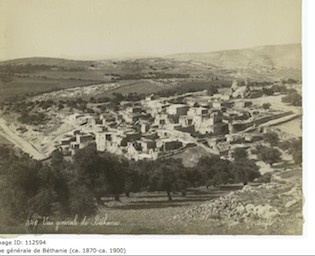
John’s Gospel read today calls us to a meal honoring Jesus in Bethany following the Resurrection of Lazarus. It’s the last meal before the Passover supper. The gift of life that Jesus gives his friend leads to a sentence of death.

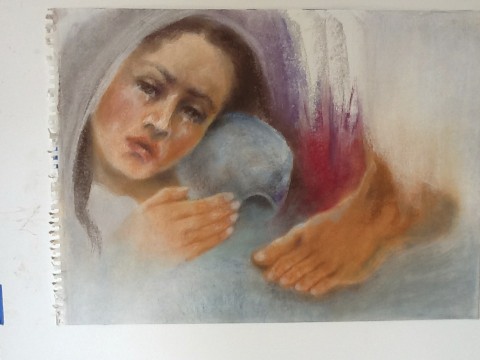
Faithful Martha serves the meal; Lazarus newly alive, is at the table. But the one drawing most of our attention is Mary, their sister who, sensing what’s coming, kneels before Jesus to anoint his feet with precious oil and dry them with her hair. “And the house was filled with the fragrance of the oil.”

The precious oil is an effusive sign of her love and gratitude; it also anoints Jesus for his burial. Only in passing does the Gospel mention that evil is in play here. Judas, “the one who would betray him,” complains that the anointing is a waste, but his voice is silenced. Believers are honoring the one they love.

How fitting that Holy Week begins with this Gospel when, like Mary, we kneel and pour out the precious oil of our love upon him who pours out his precious life for us.