Tag Archives: Mary

December 22: The Magnificat and the Benedictus

Mary concludes her visit to Elizabeth praising God, who is “mighty and has done great things to me.” Her Magnificat is part of St. Luke’s beautifully crafted narrative preparing for the Christmas feast.

After John the Baptist’s birth, his father Zechariah also praises God. “Blessed be the Lord, God of Israel. He has come to his people and set them free.”–his Benedictus. (Luke, 1:67-79)

We pray Mary’s “Magnificat” each day in the church’s evening prayer, thanking God for the blessings of the day. “My soul proclaims the greatness of the Lord and my spirit rejoices in God my Savior.God has come to the help of his servant Israel, remembering his promise of mercy, the promise he made to our fathers, to Abraham and his children forever.” Like Mary, we rejoice in God’s promises and wait for their fulfillment.

In the church’s morning prayers each day we pray Zechariah’s Benedictus, which ends the silence and darkness of night and welcomes a blessed day.  “In the tender compassion of our God, the dawn from on high shall break upon us, to shine on those who dwell in darkness and the shadow of death and to guide our feet in the way of peace.”

The gospel mysteries become our mysteries. No matter what the day, we end it singing God’s praises with Mary. No matter what the day, the Dawn which is Jesus Christ blesses our world and guides our steps, even if we come slowly to belief, like Zechariah.

Commentators on Luke’s gospel say that Luke probably uses Jewish Christian prayers, applying them to Zechariah and Mary. The New American Bible says: “ Because there is no specific connection of the canticle to the context of Mary’s pregnancy and her visit to Elizabeth, the Magnificat (with the possible exception of v 48) may have been a Jewish Christian hymn that Luke found appropriate at this point in his story.”

The Magnificat and the Benedictus, attributed appropriately to Mary and Zechariah, are our prayers too. Daily prayers.

Gracious God,

Let me not doubt your promises, your tender mercies, but let me rejoice in them as Mary and Zechariah did, and look for their fulfillment, through Christ, our Lord. Amen.

December 21: The Visitation

Visitation

We’re fortunate these last days of Advent to read St. Luke’s entire Infancy Narrative with its rich description of the birth of John the Baptist and the birth of Jesus.

Today  Mary visits her cousin Elizabeth after the angel’s great announcement. She travels to the hill country, to a town of Judah “in haste,” Luke says. She goes “in haste” not in panic or fear.  She visits Elizabeth to share the mysterious gift of God, hastening for joy.  The Visitation is one of the joyful mysteries of the rosary.

In the first reading for Mass today Mary speaks to the Child in her womb in the joyful words of the Song of Songs:

“Arise, my beloved, my dove, my beautiful one,
and come!
“For see, the winter is past,
the rains are over and gone.
The flowers appear on the earth,
the time of pruning the vines has come,
and the song of the dove is heard in our land.
The fig tree puts forth its figs,
and the vines, in bloom, give forth fragrance.
Arise, my beloved, my beautiful one,
and come!

“O my dove in the clefts of the rock,
in the secret recesses of the cliff,
Let me see you,
let me hear your voice, 
For your voice is sweet,
and you are lovely.”


As they come together to share what they have been given, Mary and Elizabeth are believers, rejoicing.  “Blessed are you who believed that what was spoken to you by the Lord would be fulfilled,” Elizabeth says to Mary.

The two women tell us about faith in their simple meeting. Faith is something to rejoice in. It’s meant to be shared and shared eagerly. The two women are pregnant and don’t yet see the life they carry within them. Like faith, the life within them is hidden from their eyes. And so it is with us.

Their meeting is a communion of saints. They share gifts of God not yet seen. 

“The women speak of the grace they received,” St. Ambrose says, “ while the children are active in secret, unfolding the mystery of love…”  As the women speak to each other, another meeting goes on within them as the infants in their wombs meet.

Is that true with us too? God works within us, beyond our understanding, as we live by faith.  St. Ambrose describes our share in this mystery:  “Christ has only one mother in the flesh, but we all bring forth Christ in faith,” St. Ambrose says, “You also are blessed because you have heard and believed. A soul that believes both conceives and brings forth the Word of God… Let Mary’s soul be in each of you to proclaim the greatness of the Lord.”

Pray for us, O Holy Mother of God, that we may be made worthy of the promises of Christ.

The Gospel of St. Matthew and the Virgin Birth

holy family

“This is how the birth of Jesus Christ came about,”  Matthew’s gospel  describes the birth of Jesus  through the experience of Joseph, the husband of Mary. It’s summarized  in the creed. “I believe in Jesus Christ, the only-begotten Son of God…who by the Holy Spirit was incarnate of the Virgin Mary.”

Is this true? Here’s Pope Benedict XVI:

“The answer is an unequivocal yes. Karl Barth pointed out that there are two moments in the story of Jesus when God intervenes directly in the material world: the virgin birth and the resurrection from the tomb, in which Jesus did not remain, nor see corruption.

“These two moments are a scandal to the modern spirit. God is “allowed” to act in ideas and thoughts, in the spiritual domain–but not in the material. That is shocking. He does not belong there. But that is precisely the point. God is God and he does not operate merely on the level of ideas. In that sense, what is at stake in both of these moments is God’s very godhead. The question that they raise is: does matter also belong to him?

“Naturally we may not ascribe to God anything nonsensical or irrational, or anything that contradicts his creation. But here we are not dealing with the irrational or contradictory, but precisely with God’s creative power, embracing the whole of being. In that sense, these two moments – the virgin birth and the real resurrection from the tomb–are the cornerstones of faith.

“If God does not have the power over matter then he is simply not God. But he does have this power, and through the conception and resurrection of Jesus Christ he has ushered in a new creation. So as the Creator he is also our Redeemer. Hence the conception and birth of Jesus Christ from the Virgin Mary is a fundamental element of our faith and a radiant sign of hope.”

(The Infancy Narratives: Jesus of Nazareth, Joseph Ratzinger, Pope Benedict XVI, pp 56-57 )

.

Our Lady of Guadalupe

December 12th is the feast of Our Lady Guadalupe, which recalls the appearance of Mary on a hilltop near Mexico City to Juan Diego, a humble Mexican laborer, in 1591, ten years after the Aztec Empire was crushed by the colonial armies of Spain. Mary appeared dark skinned, with native features and in native dress, not at all like someone from the colonial powers. In appearing like them, Mary helped many of the native peoples accept Christianity.

Keep this story in mind when the next discussion on immigration comes up.It’s a strong reminder of Isaiah’s ancient call in our Advent readings: God wishes all to be his children.

Pope John Paul II said this about St. Juan Diego Cuauhtlatoatzin, whose feast is celebrated December 9th:

“He has lifted up the humble. God the Father looked down onto Juan Diego, a simple Mexican Indian and enriched him not just with the gift of rebirth in Christ but also with the sight of the face of the Blessed Virgin Mary and a role in the task of evangelizing the entire continent of America. From this we can see the truth of the words of St Paul: those whom the world thinks common and contemptible are the ones that God has chosen – those who are nothing at all to show up those who are everything.

“This fortunate man, whose name, Cuauhtlatoatzin, means “the eagle that speaks,” was born around 1474 in Cuauhtitlan, part of the kingdom of Texcoco. When he was an adult and already married, he embraced the Gospel and was purified by the waters of baptism along with his wife, setting out to live in the light of faith and in accordance with the promises he had made before God and the Church.

“In December 1531, as he was travelling to the place called Tlaltelolco, he saw a vision of the Mother of God herself, who commanded him to ask the Bishop of Mexico to build a church on the site of the vision. The bishop asked him for some proof of this amazing event.

“On 12 December the Blessed Virgin Mary appeared to Juan Diego once more and told him to climb to the top of the hill called Tepeyac and pick flowers there and take them away with him. It was impossible that any flowers should grow there, because of the winter frosts and because the place was dry and rocky. Nevertheless Juan Diego found flowers of great beauty, which he picked, collected together in his cape, and carried to the Virgin. She told him to bring the flowers to the bishop as a proof of the truth of his vision. In the bishop’s presence Juan Diego unfolded his cape and poured out the flowers; and there appeared, miraculously imprinted on the fabric, the image of the Virgin of Guadalupe, which from that moment onwards became the spiritual centre of the nation.

“The church was built in honor of the Queen of Heaven. Juan Diego, moved by piety, left everything and dedicated his life to looking after this tiny hermitage and to welcoming pilgrims. He trod the way to sanctity through love and prayer, drawing strength from the eucharistic banquet of our Redeemer, from devotion to his most holy Mother, from communion with the holy Church and obedience to her pastors. Everyone who met him was overwhelmed by his virtues, especially his faith, love, humility, and other-worldliness.

“Juan Diego followed the Gospel faithfully in the simplicity of his daily life, always aware that God makes no distinction of race or culture but invites all to become his children. Thus it was that he enabled all the indigenous peoples of Mexico and the New World to become part of Christ and the Church.”

Pope John Paul II

Feast of The Immaculate Conception

Why does Mary, the Mother of Jesus, have such a big place in our church? The words of the angel in Luke’s gospel, words we often repeat in prayer, are an answer: “Hail, full of grace, the Lord is with you.”

Mary is filled with God’s grace, gifted with unique spiritual gifts from her conception, because she was to be the mother of Jesus Christ, God’s only Son.

She would be the “resting place of the Trinity,” and would give birth to, nourish, guide and accompany Jesus in his life and mission in this world. To fulfill that unique role she needed a unique gift. She would be free from original sin that clouds human understanding and slows the way we believe God and his plan for us.

“How slow you are to believe” Jesus said to the two disciples on the way to Emmaus. Jesus made that complaint repeatedly as he preached the coming of God’s kingdom. “How slow you are to believe!” “What little faith you have!” “Do you still not understand!” Human slowness to believe didn’t end in gospel times. We have it too.

Mary was freed from that slowness to believe. “Be it done to me according to your word,” she immediately says to the angel. Yet, her acceptance of God’s will does not mean she understood everything that happened to her. “How can this be?” she asks the angel about the conception of the child. “The Holy Spirit will come upon you.”  But the angel’s answer seems so incomplete, so mysterious.

Surely, Mary would have liked to know more, but the angel leaves, never to return. There’s no daily message, no new briefing or renewed assurance by heavenly messengers. The years go by in Nazareth as the Child grows in wisdom and age and grace, but they’re years of silence. Like the rest of us, Mary waits and wonders and keeps these things in her heart.

That’s why we welcome her as a believer walking with us. She is an assuring presence who calls us to believe as she did, without knowing all. She does not pretend to be an expert with all the answers. She has no special secrets she alone knows. “Do whatever he tells you,” is her likely advice as we ponder the mysteries of her Son.

The feast of the Immaculate Conception is celebrated 9 months before the feast of the Birth of Mary (September 8). The feast  was extended to the universal Church by Pope Clement XI in 1708.

 Pope Pius IX solemnly proclaimed the Dogma of the Immaculate Conception in 1854: “We declare, pronounce, and define that the doctrine which holds that the most Blessed Virgin Mary, in the first instance of her conception, by a singular grace and privilege granted by Almighty God, in view of the merits of Jesus Christ, the Savior of the human race, was preserved free from all stain of original sin” (Ineffabilis Deus, 1854)

Do Whatever He Tells you

The Presentation of Mary in the Temple

Mary temple
Mary, Presented in the Temple: Giotto

The Presentation of Mary in the Temple, November 21,  is an ecumenical feast originating in Jerusalem in the 6th century. A new church, honoring Mary, was built for pilgrims  by the Emperor Justinian near the ruins of the Jewish temple. Tradition said Mary was born nearby. Other early traditions place her birthplace in Nazareth or the neighboring city of Sepphoris.

Artists like Giotto supported the Jerusalem tradition by their popular portrayals of Mary introduced into the temple by Ann and Joachim, her mother and father. (above) 

Luke’s gospel may support the Jerusalem tradition by noting that Mary’s  cousin Elizabeth was married to Zechariah, a temple priest. Luke also says  Mary and Joseph were familiar visitors to the temple. Forty days after the birth of Jesus , they went there “when the days were completed for their purification,” (Luke 2,22) They  brought Jesus to the temple as a child to celebrate the feasts. For Jesus the temple is  “my Father’s house.” There is no direct scriptural support that says Mary was born and raised in Jerusalem, however.

This feast celebrates Mary’s gift for “listening to the word of God and keeping it.” (Luke 11:28) For Mary the temple was always a place of God’s presence. In the temple she learned to see that God was everywhere, in Nazareth, Bethlehem, even on Calvary.(cf. John 4, 22-26) “You are the temple of God and the Spirit of God dwells in you,” St. Paul reminds the Corinthians. (1 Corinthians 3, 16) 

St. Paul of the Cross, founder of the Passionists, was greatly devoted to this feast because he began his 40 day retreat to discern God’s will on this day. He experienced God’s call to found a community during those holy days. Afterwards, he dedicated the first retreat of his congregation on Monte Argentario to the Presentation of Mary and returned there year after year to renew the grace he received then. St. Vincent Strambi, his biographer, writes:

“Whenever possible, Paul kept the feast in the Retreat of the Presentation. How often, even when old and crippled, he would set out from the Retreat of St.Angelo, traveling over impassible roads in the harsh days of November, to Monte Argentario, where he would celebrate the feast with great recollection. It would be difficult to describe the days he spent there. His heart seemed to melt like wax in a fire because of his love for the Mother of God and his gratitude towards her.  As the feast drew near he was so full of joy that the air around Monte Argentario seemed to breathe a sweetness similar to what the prophet Joel describes: “On that day, the mountains will drop down sweetness and the hills flow with milk.” On the day of the feast, he seems totally penetrated with tender devotion.  Even on his deathbed, he recalled, “The day of the Presentation was always a holy and solemn day for me.” 

Please pray for the Passionists, the community he founded that, like Mary, the Mother of God, we may hear God’s word and kept it.

Today many young people are not baptizing their children or offering them much religious formation. “Let them decide for themselves.” Introduce your children to your religious tradition from their earliest years, this feast says. Get them familiar with their church. That’s what the parents of Mary did. They prepared her for the coming of the Angel and the presence of her Son.

“Where is the temple where you learn to hear God’s word?’ we have to ask ourselves.

Blessing Herbs, Medicines and Fields: August 15th

When I was a little boy, on August 15, the Feast of the Assumption of Mary into Heaven, my mother would tell me to go down to the Newark Bay, just a few blocks from my home in Bayonne, NJ, and go into the water. There’s a blessing in the water today, she told me. 

I learned later where that custom came from. In medieval Europe the Feast of the Assumption was the day the fields were blessed. The middle of August was harvest time, and on this day herbs were gathered from the fields and brought to the church to be blessed with water. After they were blessed they were brought home to be  medicines for the sick. We still get many if not most of our medicines today from herbs.

Customarily, a sprig was placed on the wall where children slept, asking God to keep them healthy and strong. 

We will have herbs, a small olive tree, fruits of the earth and flowers before our altar for the feast on August 15 and then we will have a procession to our Mary Garden to bless them..

Many important feasts of our church occur in one of nature’s cycles. The birth of Jesus Christ, December 25, is celebrated as darkness gives way to light in the Western Hemisphere. Easter, the celebration of the death and resurrection of Jesus takes place during the Passover celebration, which occurrs at the spring harvest. Mary’s Assumption, August 15th, falls as the summer harvest begins. 

You can see why Mary’s Assumption into heaven is a day to bless herbs and to bless the fields. It’s a feast of life. On this day Mary followed Jesus, her Son, into the mystery of his death and resurrection in a unique way. Mary’s body, her humanity, like the humanity Jesus assumed, like the humanity we all share, came from the earth.

We all come from dust, from creation, and to dust we shall return.“From dust you are, and to dust you shall return,” we are reminded on Ash Wednesday. But the promise we have from Jesus is that this dust will rise again to new life.

Mary witnesses to his promise in a unique was. Mary’s body, like the body of Jesus, never returned to the dust. She was assumed body and soul into heaven to become a sign of bodily resurrection. The promise of resurrection given to her is also given to us. Not only is it given to us, but to all God’s creation. Mary is the sign of a new creation, promised by God.

The first reading for her feast, from the Book of Revelation, describes Mary as a woman “ clothed with the sun, with the moon under her feet, and on her head a crown of twelve stars. She gave birth to a son, a male child, destined to rule all the nations.”  After his resurrection, Jesus was enthroned in heaven and Mary was taken up to heaven to join him.

The Assumption of Mary is a time to rejoice in “the resurrection of the body and life everlasting”, the whole created world also rejoices in the promise of a new creation. Listen to Psalm 96:

O sing a new song to the Lord, sing to the Lord all the earth. O sing to the Lord, bless his name. Let the heavens rejoice and earth be glad, let the sea and all within it thunder praise, let the land and all it bears rejoice, all the trees of the wood shout for joy at the presence of the Lord for he comes, he comes to rule the earth.

The Feast of the Assumption of Mary into Heaven offers a future so different than the bleak picture of life we’re tempted to see today. She visits us today as she did her cousin Elizabeth long ago announcing a great mystery. We are called, like Mary, to a heavenly place with Jesus her Son. Our world, so battered with the storms and disease, so threatened by a changing climate, wars and poverty, also sees a glorious future in her assumption into heaven.

Pray for us, O Holy Mother of God, that we may be made worthy of the promises of Christ.   

Traditions about St. Ann

In my part of the world, novenas to Saint Ann have begun in churches and dioceses, like Scranton, PA. Where did the story of Saint Ann come from? From earliest times Christians wondered who the parents of Mary were and, as you would expect, that interest was particularly strong in Palestine. Ann and Joachim were first honored there as the mother and father of Mary, the mother of Jesus Christ.

Around the year 550, a church in her honor was built in Jerusalem on the site where her home was said to be, near the Pool of Bethesda, where Jesus cured the paralyzed man. Since then, many churches honoring Ann and Joachim have been built throughout the Christian world; The saints appear frequently in Christian art.

Feasts of St. Ann

Feasts honoring Mary’s birth (September 8) and her presentation in the temple (November 21) – inspired by the Protoevangelium– were introduced into the liturgies of the Eastern churches in the 6th century. Feasts in honor of St.Joachim and Ann (September 9), the conception of St Ann (December 9), and St.Ann alone (July 26) have been celebrated from the 7th century in the Greek and Russian churches.

The western church, adopting the eastern traditions, has celebrated the feast of St. Ann on July 26 since the 16th century. In 1969 her feast was joined with her husband Joachim to become the Feast of Saints Joachim and Ann.

Why was the story of Ann and Joachim so popular?  Besides satisfying curiosity about the family background of Mary and Jesus, they supported traditional belief that Jesus is the Son of God, born of the Virgin Mary, a belief questioned by heretical elements in the church as well as outsiders of the faith from the beginning.

Ann and Joachim also offered inspiration to mothers and fathers, wives and husbands, grandmothers and grandfathers in their roles in family life.

Devotion to St. Ann in Europe

In the western church, devotion to St.Ann was fed by a popular belief that relics of her were brought to France by Mary Magdalen, Lazarus, Martha, and other friends of Jesus who crossed the stormy sea from Palestine to bring the Christian faith to the region around Marseilles.

Her relics were buried in a cave under the church of St.Mary in the city of Apt by its bishop, St. Auspice, the story goes. Barbarians invaded the area and the cave was filled with debris and almost forgotten, only to be unearthed 600 years later during the reign of Charlemagne. You can see why sailors and miners would be devoted to St. Ann.

Crusaders from Europe – many from France – went to the Holy Land in the 11th century, and they rebuilt the ancient church of St. Ann in Jerusalem. The date the crusader church was consecrated, July 26, is the day we celebrate the feast of Joachim and Ann in the western church today.

By the 14th century, devotion to St. Ann was on the rise throughout Europe as the Black Death struck the continent and raged everywhere for over 150 years, wiping out almost 30 percent of its population. Families bore the brunt of the catastrophe as they tended their sick and cared for the healthy.

They needed models like Mary and Joseph, Ann and Joachim, who supported their child and grandchild. Mothers and grandmothers were particularly important for raising children.

When the plague ended, Europe’s population expanded dramatically in the late 15th and 16th centuries; new towns and cities sprang up everywhere and families were uprooted from places and people familiar to them. Families needed help to stay together and survive.

Faith suggested Mary and Joseph, Ann and Joachim as models to be imitated.  Images of the nursing Madonna and the caring grandparents became important sources of Christian inspiration.

Christians joined Confraternities of St. Ann, dedicated to caring for widows, orphans and families under stress. Images of Mary and Ann, nursing their children, playing with the Christ Child and/or John the Baptist were more than pious pictures; they had a social purpose as well.

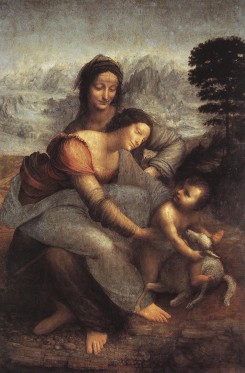
One picture from this era, still popular today, portrays St. Ann teaching her little daughter how to read.  Sometimes the words on the book are words of scripture; sometimes they’re basic numbers or letters of the alphabet: 1,2,3,4-A,B,C.

Playing with children, teaching them the ABC’s, passing on the mysteries of God to them are vital actions. Simple as they may seem, they’re holy actions and they can make those who do them saints.

The Visitation of the Blessed Virgin Mary: May 31


Faith gives you life and calls you to a mission. That’s what it did for Mary, the mother of Jesus. Mary believed in the message of an angel at Nazareth. She welcomed the Son of God to be born of her, and he brought life to her and to the world.

He gave her a mission, Luke’s gospel says today.  Mary set out “in haste” for the hill country of Judea to visit Elizabeth, the wife of Zechariah, who also was with child. Mary has a mission.                                                                                                                        

When Elizabeth heard Mary’s greeting, the infant leaped in her womb.” The infant who would be John the Baptist, leaped for joy, the gospel says.

Both of these women had exceptional faith. Mary, the younger woman, accepted what the angel asks, even as she questions how it will take place and the meaning of it all.                                                                                                                                 

Elizabeth, the older woman, conceives with her husband, Zechariah. But she’s an old woman, pregnant with a child. However miraculous her pregnancy was, she must have felt fear and uncertainty for having a child in her old age. Like Mary, she must have asked, “How can this be?” “What does this all mean?”

Mary’s visit took those fears away from her. The child in Elizbeth’s womb leaped for joy. Elizabeth’s fears were turned into joy. Faith gives you life and sends you on a mission. Exceptional faith, in the case of Mary and Elizabeth led to exceptional missions. 

In spite of what some people think, faith is not a burden that cripples you. Faith is a gift that empowers you. It takes you beyond your dreams and what you hope for. 

“Blessed are you who believed,” Elizabeth says to Mary.

“You too, my people, are blessed,” comments St. Ambrose, “ you who have heard and who believe. Every soul that believes — that soul both conceives and gives birth to the Word of God and recognizes his works.

“Let the soul of Mary be in each one of you, to proclaim the greatness of the Lord. Let the spirit of Mary be in each one of you, to rejoice in God. According to the flesh only one woman can be the mother of Christ, but in the world of faith Christ is the fruit of all of us.”

As with Mary so with us, faith gives life and sends us on a mission..

Belief and Unbelief

Mark’s gospel today describes the arrival of Mary his mother and some of his relatives from Nazareth. (Mark 3: 32-35) They’re outside a house crowded with people gathered around Jesus, some looking to be cured, some to listen to what he has to say. Jesus and his disciples don’t even have time to eat, Mark says.

His family come because they want to take him home; some think he is out of his mind . (Mark 3:20-21) When people tell him ‘Your mother and your brothers and your sisters are outside asking for you.’ Jesus said to them in reply, ‘Who are my mother and my brothers?’ And looking around at those seated in the circle he said, ‘Here are my mother and my brothers. For whoever does the will of God is my brother and sister and mother.’” (Mark 3: 32-35)

Jesus sees people of faith as his family, his mother, brother and sister. He considers us who believe in him his family. 

But we continue to ask: Why does his own family think he is out of his mind?

His mother Mary is with them. What does she think? 

The gospels, Matthew 13:54-58, Mark 6: 1-6, Luke 4:16-30 all point to Nazareth as a place where Jesus is rejected.  Luke’s gospel sees the rejection of Jesus at Nazareth in the harshest terms. They are ready to hurl him from the hill after the claims he makes in their synagogue. His visit to Nazareth is headed for violence, but a violence postponed, and no one takes his part. ( Luke 4:16-36 )

Mary lived there. What was it like for her?  What was it like to be with family members who thought her son was mad? What was it like to be day after day with people who didn’t believe in her son? No one from Nazareth is among the 12 disciples Jesus chooses. The rejection of Jesus by the people of his own town, his own family and relatives, was a sword that pierced her heart.

We might say Mary’s faith was strong and kept her secure, but was it a faith that knew everything? Did it save her from questioning?

I wonder if we can see Mary’s appearance at Lourdes and Fatima in some way related to her own experience at Nazareth. She appears in places when the faith of ordinary people is severely challenged by a world increasingly hostile to belief. 

She knows how to believe when everyone else does not. We welcome her today to be with us.