To listen to today’s homily please play the audio selection below:
Mark’s gospel gives a short, straightforward account of Jesus facing temptation after his baptism in the Jordan by John the Baptist. In just four lines he says that
“The Spirit drove Jesus out into the desert,
and he remained in the desert for forty days,
tempted by Satan. He was among wild beasts,
and the angels ministered to him.” (Mark 1, 12-13)
Matthew’s gospel (Matthew 4,1-11) gives a more extensive account of the temptations Jesus faced, as does Luke who follows Matthew rather closely. (Luke 4,1-13)
In John’s gospel we have no account of the temptation of Jesus in the desert, but in chapter 1, 10-11 he says “He was in the world, and the world came to be through him, but the world did not know him. He came to what was his own, but his own people did not accept him.” A strong indication of the opposition that Jesus, the Word of God, received when he came into this world.
He was opposed. He did not come among us as a kind of superman, immune from human hurt or human frailty. He was tempted, the gospels say, opposed by “Satan” by “the world” and even by “his own.” So strong was the opposition that it eventually put him to death.
It’s so important to see the human Jesus, his vulnerability, how like us he was. Yes, he was God’s Son, but the Word became flesh, St. John says. Equal to God, he emptied himself, St. Paul says, and took the form of a slave, and became obedient even to death on the cross.
When we look at Jesus in his humanity, we wonder, first of all, at God’s love coming to a world of weakness and frailty, our world. We can also see ourselves in his humanity, in the temptations and opposition he faces as a human being in his lifetime, and particularly as he enters his Passion.
Of all the gospels, Mark’s gospel gives us the most realistic picture of the human Jesus. Mark doesn’t describe the temptations Jesus faces in the desert at the beginning of his gospel because he will describe them as Jesus makes his way through the towns of Galilee where he gathers disciples and meets opposition from the scribes and Pharisees. The growing opposition he meets there leads to Jerusalem, where he’s put to death.
Mark’s account of the Passion of Jesus shows us Jesus fearful in the garden and crying out on the cross, “My God, my God, why have you forsaken me!”
When we see Jesus we see ourselves. We live in a world where we face temptation. When we look to him, however, we see where our wisdom and strength and courageous patience can come from. Following Jesus, we will live.
To listen to the audio for today’s homily, please select the audio player below:
Our gospel reading this Sunday, like most from the last four Sundays, is from the first chapter of Mark’s Gospel. It describes a day– one day in the life of Jesus–one commentator calls it a “paradigmatic day”– a day you can see everything you need to know about Jesus.
The evangelist prepares us for this day with an account of Jesus’ baptism and temptation in the desert by Satan. At the Jordan River the heavens open and a voice says, “You are my beloved Son; with you I am well pleased.” Immediately, Mark says, Jesus is led by the Spirit into the desert to be tempted by Satan for forty day.
This is God’s beloved Son, but he knows what it means to face evil. He came among us and faced evil.
“After John had been arrested,” Mark continues, “Jesus came to Galilee proclaiming the gospel of God: “This is the time of fulfillment. The kingdom of God is at hand. Repent, and believe in the gospel.”
Jesus goes into Galilee “after John has been arrested,” not the safest time to announce anything, but that doesn’t matter. God’s kingdom is stronger than the powers of this world. It wont be stopped.
Mark’s Gospel is fast paced. As Jesus passes the Sea of Galilee, he sees Simon and his brother Andrew casting their nets into the sea. Jesus says to them. “Come after me, and I will make you fishers of men.” They abandoned their nets and followed him.
He walked along a little farther, he sees James and John, the sons of Zebedee, getting ready to go out in their boat. He calls them and they leave their boat to follow him.
They can’t resist him, Mark’s gospel says. There’s something exciting and commanding about him. They have to follow him.
They come to Capernaum, the town where they all live. It’s the Sabbath Day. They all go into the synagogue and Jesus begins to teach. He amazes the people with his teaching. No one has taught like him before.
But then, as happens all through his life, the voice of evil is heard. A man with an unclean spirit cries out, “What have you to do with us, Jesus of Nazareth?
“Have you come to destroy us?
I know who you are—the Holy One of God!”
Jesus rebuked him and said,
‘Quiet! Come out of him!’ The unclean spirit convulsed him and with a loud cry came out of him.
All were amazed and asked one another,
‘What is this? A new teaching with authority.
He commands even the unclean spirits and they obey him.’”
Of course, when those people leave the synagogue, they tell everybody they meet. Capernaum was a trading center. The news gets out quickly.
“His fame spread everywhere throughout the whole region of Galilee.”
Next Sunday’s gospel from Mark will continue the story of this momentous day. Jesus leaves the synagogue goes into Peter and Andrew’s house in Capernaum and heals Peter’s mother in law. This same day is filled with excitement. Mark ends his account by saying that as the day ends, the whole town in at the door, anxious to hear him, with their sick and those who are disturbed.
I wish I could convey some of the excitement that this gospel wants to convey. When Jesus comes into your town he brings life. Peter and those he calls can’t resist him. They have to follow him to know more. That’s always what Jesus does. He draws us to himself; he sets our hearts on fire.
Of course, he’s always accompanied by the evil of this world. The man with the unclean spirit whom always be there too. “Stay away from us. Get away from us. We want to be left alone. Even if you are the Son of God we want to be left alone.”
“If today you hear his voice harden not your hearts.” What a tragedy that is. not to hear his voice, to harden our hearts.
To listen to the audio for today’s homily, select the file below:
One disadvantage in reading the scriptures as we do in our liturgies on Sundays and weekdays is that we can miss the overall picture an evangelist is trying to paint. By breaking up the scriptures in parts, as we do, we can miss the sweep of the gospel as it unfolds and as one detail leads to another.
That’s especially so for Mark’s gospel, I think. Mark wants to tell an exciting, fast moving story, but read slowly, part by part, Sunday after Sunday, we may miss the breathlessness of the whole account. This is God speaking, revealing himself, God who brings new power and excitement to the world. This is the “gospel of Jesus Christ, the Son of God,” Mark says.
Some years ago I went to a play on Broadway called The Gospel of Mark. It featured a famous English actor, Alec McCowen, who came onstage alone, put a copy the New Testament on a table– “just in case” he said– and then proceeded to tell the whole story of Mark’s Gospel, just as it was written, from memory. It was a wonderful experience, listening to the whole gospel story unfold.
It might be good to do something like that with our gospel today, about the call of the disciples, from the first chapter of St. Mark. Let’s look at it in its setting, what comes before it and what comes after it.
Before Jesus calls his disciples, Mark says as the other gospels do that Jesus was baptized in the Jordan River by John. “You are my beloved Son, with you I am well-pleased,” a voice from heaven says. The Spirit then drove Jesus “at once” into the desert to be tempted for forty days. Mark summarizes those events in few words. He moves quickly to bring Jesus into Galilee, into the world where the Good News is proclaimed.
After John had been arrested,
Jesus came to Galilee proclaiming the gospel of God:
“This is the time of fulfillment.
The kingdom of God is at hand.
Repent, and believe in the gospel.”
“John was arrested,” Mark says. A dangerous time. but the kingdom of God is stronger than dangerous times. With simple words Mark tells the story.
Jesus meets four fishermen along the Sea of Galilee, Peter and his brother Andrew, then James and his brother John. He calls them, promising to make them “fishers of men.” Immediately– there’s no delay– they leave their nets and families to follow him. They’re taken by him and they want to share what he does. (Mark 1, 14-20)
And the story doesn’t stop there. Right away after they’re called, Jesus and the fishermen go into Capernaum, a fishing village along the Sea of Galilee. It’s the Sabbath Day, the day of God’s blessing. They enter the synagogue and Jesus begins to teach. His teaching immediately amazes those who hear him, the same amazement the fishermen felt when he called them.
Then, a possessed man in the synagogue shouts out at Jesus. “What have you to do with us, Jesus of Nazareth? Have you come to destroy us? I know who you are—the Holy One of God!” Jesus rebukes him. “Quiet! Come out of him!”
“The unclean spirit convulsed him and with a loud cry came out of him.” They’re all amazed. This is different, his teaching, his silencing of evil.
Mark says: “His fame spread everywhere throughout the whole region of Galilee.” What would we expect? The people from synagogue that day go out and tell others what they saw and heard. There is someone here from Nazareth who teaches and works wonders we have never seen or heard before. (Mark 1,21-28)
They leave the synagogue; Peter and his brother Andrew take Jesus to their house, a compound not far from the synagogue. James and John, the other two disciples are with them. Peter’s mother in law is sick in bed and immediately they tell him about her. Going to her Jesus takes her by the hand and helps her up. The fever leaves her and she begins to wait on them. She is not only healed, she becomes a disciple. She’s serving people, helping them. She has become a disciple of Jesus, Mark is saying.
Of course, she not only waits on others, but Peter’s mother in law must have told her neighbors. The news spreads. By evening, after sunset “they brought to him all who were ill or possessed by demons. The whole town was gathered at the door. He cured many who were sick with various diseases, and he drove out many demons, not permitting them to speak because they knew him. (Mark 1,21-34)
Now, that’s one exciting Sabbath day. The next day, Jesus goes with his disciples to other synagogues and towns where he teaches and performs miracles. The excitement continues, but Satan who tempted him in the desert and the man possessed by a demon in the synagogue take on new forms. Jesus faces opposition, growing opposition, from the leaders of his people. Scribes question him for daring to forgive sins. They call him the devil himself. Pharisees accuse him of not keeping Jewish laws; enemies begin to plot to put him to death. Eventually they’ll do just that, they’ll put him to death.
His own family came down from Nazareth to take him home because they think he’s out of his mind. And Capernaum and other cities that received him with excitement will turn away from him. People who clapped their hands and ran to the synagogues where he taught turned away. They had better things to do.
What has that to do with us? Well, we might have the same experience we see before us in Mark’s Gospel. The kingdom of God has been promised to us. What greater promise can we receive?There’s a power and attractiveness to the person of Jesus. Who can deny the beauty of his teaching, to love one another? Forgiving one another? Caring for the poor and those in need?
Who can deny also that there is evil in this world, a powerful evil that makes us question and fear? Even Jesus fears, according to Mark’s gospel. It’s good to read the scriptures, especially the gospels. They describe Good News, real news.
“It happened in those days that Jesus came from Nazareth of Galilee and was baptized in the Jordan by John.
On coming up out of the water he saw the heavens being torn open and the Spirit, like a dove, descending upon him.
And a voice came from the heavens, “You are my beloved Son; with you I am well pleased.”
At once the Spirit drove him out into the desert, and he remained in the desert for forty days, tempted by Satan. He was among wild beasts, and the angels ministered to him.” (Mark 1, 9-13)
We read Mark’s account of the baptism of Jesus this year and we will read from his gospel all this year.
Mark’s account of the baptism and temptation of Jesus in the wilderness is the most succinct of the four gospels. Only five sentences. The theophany at the Jordan is quickly over. The heavens are open, and the Spirit, like a dove, descends on him. “You are my beloved Son; with you I am well pleased,” a voice from heaven says.
But then, the Spirit drives him out into the desert “at once.” He’s tempted for forty days, and the forty days point to a lifelong experience Jesus has. Wild beasts will always be in the world he lives in, and angels will always minister to him. Mark does not name his temptations either, they’re varied throughout his life. Ours are too.
The heavens open at baptism, all the gospels say. But more than the others, Mark’s gospel says that baptism calls us to participate in the Passion of Christ. His account and his gospel are important for understanding what baptism means for us.
Today we read a long narrative from Mark’s Gospel (Chapter 6) describing the death of John the Baptist at the hands of Herod Antipas. It’s been called a “Passion Account before the Passion of Jesus.”
Herod Antipas, ruler of Galilee, had his capitol in Tiberias a short distance from Capernaum where much of Jesus’ ministry took place. He certainly knew what Jesus was doing and what people were saying about him. Some said he was Elijah, or a prophet. But what caught Herod’s attention especially was talk that Jesus was John the Baptist raised from the dead.
Herod had arrested John and imprisoned him, probably in his fortress at Macherius near the Dead Sea. Then, influenced by his wife Herodias, who resented John’s criticism of their marriage– which violated Jewish law– Herod had John put to death.
The story told in great detail in Mark’s Gospel is an example of evil, oppressive power at its worst. Herodias’ daughter Salome dances at one of Herod’s bloated banquets and elicits his promise to do anything she asks for. “What shall I ask?” Salome asks her mother. “The head of John the Baptist,” is her answer.
Later in Mark’s gospel, Jesus identifies John the Baptist with Elijah. “I tell you that Elijah has come and they did to him whatever they pleased, as it is written of him.” (Mark 9, 13) Like Jesus, John suffers and is treated with contempt.
The story of John’s beheading by Herod prepares Mark’s readers for the story of the Passion of Jesus. Both stories were meant to help Mark’s first audience, Roman Christians, face the sudden, absurd persecution inflicted on them by the Emperor Nero in the mid 60s. Like Herod, Nero seemed supremely powerful. They could not see it yet, but evil would not have its way. The Son of Man would rise from the dead and be glorified. So would they.
That’s the lesson we should take from this story too. Evil doesn’t have its way.
The Gospel of Mark, the first of the Gospels to appear in written form, presents Jesus going to his death in utter desolation, draining the cup of suffering given him by his Father.
His enemies viciously reject him; his disciples mostly betray him or desert him. Only a few remain as he goes on his way.
His cry from the cross is a cry of faith mingled with deep fear and sorrow: “My God, my God, why have you forsaken me?”
As we read this Gospel, taut and fast-paced, we share with Jesus the dark mystery of unexplained suffering that all of us face in life. Yet, this mystery leads to life, a risen life. The desolation Jesus experienced takes many forms, some quite hidden from what people see. Yes, the cross can mean physical pain, but suffering may also come from spiritual and psychological situations.
Jesus reveals that God can be found even here: “In Mark’s account, Jesus dies with a wordless scream that echoes from that dread hill, splitting the veil of the temple and igniting faith in the centurion’s heart. This unlikely witness sees in the manner of Jesus’ death for others the true revelation of God. The sight of the Crucified Jesus triggers in him the full first confession of faith expressed in the gospel: “Truly this man was the Son of God!” (15:39). A startling revelation–God’s power revealed not through staggering prodigies but in a selfless death motivated by love.” Donald Senior, CP
Donald Senior’s beautiful account of Mark’s Passion narrative can be found here.
These Sundays at Mass we’re looking at the beginnings of Jesus’ ministry vividly described in Mark’s gospel. Jesus came from the Jordan River where he was baptized with Peter and his brother Andrew, and James and his brother John, fishermen from Capernaum.
He was invited to stay in Peter’s house in that town, which today you can see if you’re fortunate to visit the Holy Land. Archeologists have uncovered the town of Capernaum in recent years and you can see the remnants of its old houses made of black basalt, the foundations of the synagogue where Jesus prayed; and beyond the town are the low mountains where he taught. It’s a fascinating place.
Peter’s house was the center of his ministry there, it seems. Mark describes what happened after Jesus cured Peter’s mother in law: “When it was evening after sunset they brought to him all who were ill and possessed by demons, and he cured them. The whole town was gathered at the door.”
In recent times, Franciscan archeologists have identified Peter’s house among the closely packed houses of the town, and a shrine church is built over it now.
So many people crowded around that house that Jesus had to escape to the surrounding hills to pray. Afterwards he told his disciples that he had to visit other towns and places in Galilee.
Probably the leper approached him as he was going to one of those other towns. Our first reading from the Book of Leviticus gives a succinct account of how lepers were treated in those days. They were separated from family and hometowns and sent to live apart in abominable conditions. People were afraid to go near them.
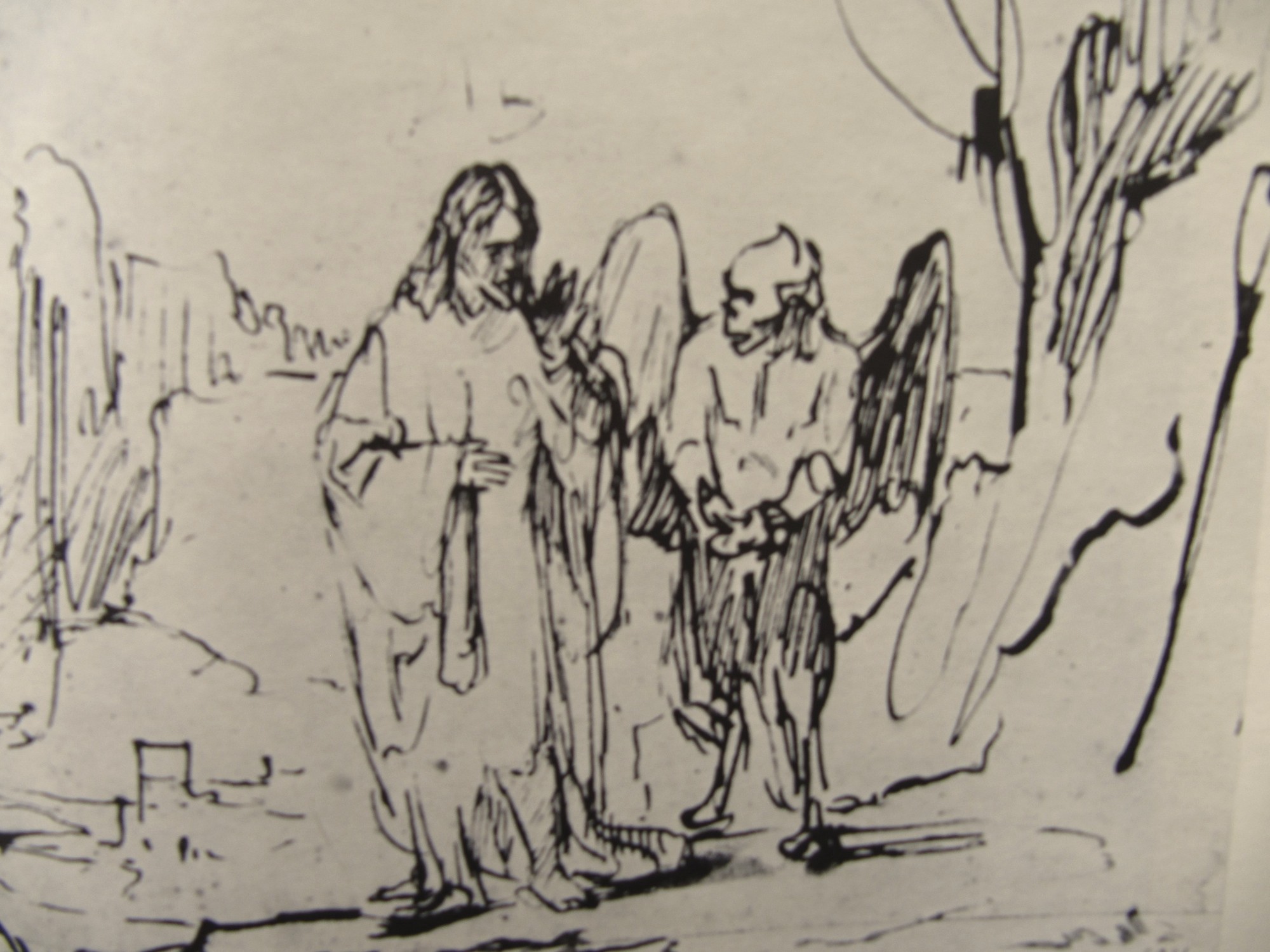
Rembrandt has a wonderful sketch of the lepers approaching Jesus.(above) It looks like Peter, who is behind him, is hiding in back of the Lord afraid to catch anything from the poor creatures who approach begging for help and healing.
Are we too afraid of people like the lepers, people suffering so much, people suffering from unexplained suffering, that we think we’re going to be overwhelmed by their suffering? We hide from the sufferings of the world. “None of that near me,” we say. But Jesus leads us to the leper. Let’s see suffering with him.


 The Victor's Place