Tag Archives: Letter of James

A World of Talking Trees: Mark 8:22-26

“Do you still not understand?” Jesus said this to his disciples in Mark’s gospel right after curing a blind man who only gradually gains his sight. He has to lay his hands on the man’s eyes a second time before he sees clearly. Is that the way we see and understand, gradually?

The cross Jesus says we all must bear takes many forms and I wonder if one form it takes in our time is the cross of confusion. We like clear sight for ourselves and everyone else, but in times of great change confusion is inevitable. Like the man in the gospel we’re living in a world of “talking trees” and that’s hard to take, reasonable, resourceful people that we are.  It’s humbling to live in confusing times like ours..

It makes us angry. There’s a lot of anger around us today, the anger that boils over and lashes out, or the anger that retreats into a fortress of resistence and isolation.

Pope Francis often speaks of patience. He said patience keeps the church going. It keeps the world going too. He spoke once of the music of patience, a patience that hears and waits, like the patient blind man who waits for the hand of Jesus to reach out again.

That’s one of the lasting teachings of the Gospel of Mark. We’re human, we think as humans do, and that means we learn gradually, by patience.

“When Jesus and his disciples arrived at Bethsaida,
people brought to him a blind man and begged Jesus to touch him.
He took the blind man by the hand and led him outside the village.
Putting spittle on his eyes he laid his hands on the man and asked,
“Do you see anything?”
Looking up the man replied, “I see people looking like trees and walking.”
Then he laid hands on the man’s eyes a second time and he saw clearly;
his sight was restored and he could see everything distinctly.
Then he sent him home and said, “Do not even go into the village.”
(Mark 8,22-26)

The Letter of James

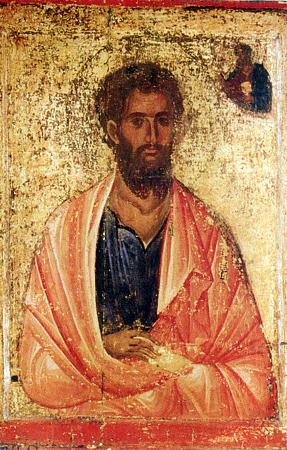
James,_the_Just1

We’re reading at Mass for the next few days from the Letter of James. Modern commentators aren’t sure who greets his hearers as “James, a servant of God and of the Lord Jesus Christ, to the twelve tribes in the dispersion.” He doesn’t seem to be James, the brother of John. Possibly he is a relative of Jesus and leader of the Jewish-Christians in Jerusalem as some say.

James was stoned to death in the mid 60s as the Jewish establishment turned against the followers of Jesus and forced many of them to flee. Jerusalem itself fell in 70 AD when Roman armies destroyed the city and crushed the Jewish revolt. Jewish-Christian exiles were exiled from their beloved city and would never return. Some commentators believe this letter contains an original letter of James sent to support the exiles and other material was later added to it.

The letter opens with words of support. It’s tough to be thrown into exile, but tough times test your faith, so be brave, your faith will become stronger. God will give you the wisdom to know what to do; keep asking for it. But be “doers of the word,” the author of the letter says. Be practically concerned for others.

What does it mean to be practically concerned? The letter couldn’t be clearer about it:

“If a brother or sister has nothing to wear and has no food for the day, and one of you says to them,’Go in peace, keep warm, and eat well,’ but you do not give them the necessities of the body, what good is it?

Though the letter speaks of “a brother or a sister” as the one in need, it isn’t just a family member or a friend you’re called to care for. Concern doesn’t end with your own; it’s impartial and extends to all in need, even our enemies.

The letter surely isn’t directed only to concern by individuals either. Don’t countries and communities have to look out for the needy? “Don’t worry, work hard, aim high and good luck.” Is that any answer to the poor among us?

The Letter of James says it isn’t.

Some consoling words are given to the exiles, but not many.  The letter is challenging;  no relaxing of standards, no permission for self-pity. Keep your standards high, the letter insists and as the old song says: “When you’re down and out, lift up your head and shout: There’s gonna be a great day.”

The Mystery of the Cross

We’re reading the Letter of James and the Gospel of Mark these weekdays at Mass, writings going back to the 60s, from Jerusalem and Rome respectively. Three important Christian leaders were put to death in that decade: James, Peter and Paul. We see their deaths now as the glorious death of martyrs; Christians then were probably more aware of losing three religious leaders they depended on for guidance.

The Letter of James and the Gospel of Mark (traditionally acknowledged as the spokesman for Peter) were voices for these disciples in the churches they left behind.

In the 60s a growing turmoil engulfed the church in Jerusalem, as Jewish Christians faced growing opposition in the city. The death of James, their leader, at the hands of Jerusalem’s Jewish leaders is evidence of this antagonism. Because of it, many Jewish Christians left Jerusalem and went into exile. The destruction of the city by the Romans in 70 AD canceled any plans they had for returning home.

In the 60s, the Christians of Rome experienced persecution of another kind. It was a sudden, unexpected persecution by the Emperor Nero that followed the fire that destroyed most of the city in 64 AD.

The Disciples' Unbelief

The Disciples’ Unbelief

It’s good to keep the background of these writings in mind when reading them. In today’s reading, Mark emphasizes a theme that runs through his gospel. “Do you still not understand?” Jesus asks his disciples. (Mark 8,21) What the disciples, led by Peter, don’t understand especially is the mystery of his passion and death.

Writing for the Christians of Rome, Mark wants them to see in the incomprehension of Jesus’ first disciples their own incomprehension before the vicious suffering inflicted on them at the hands of a powerful and unjust emperor.
They don’t understand. It’s a mystery slowly understood.

And they wont be the last to not understand the mystery of the cross. We’re seldom ready for it and slow to recognize all the forms it takes.