Tag Archives: Lake of Galilee

I Am The Bread of Life

Jordan satellite


The dark green around the Lake of Galilee in the upper part of this Google satellite picture of Palestine points to good farmland. It was good farmland at the time of Jesus. Herod the Great and his son Herod Antipas,  Galilee’s rulers then, appreciated the land and created a network of roads and cities – Tiberius, Sepphoris and Caesarea Maritime on the sea– for shipping goods from Galilee to the rest of the world. Here Jesus proclaims in John’s gospel: “I am the bread of life”,  

All four gospels say that Jesus fed a great crowd near the Sea of Galilee by multiplying a few loaves of bread and some fish. Like the Passover feast, the miracle and the teaching that follows occur over a number of days in the gospels. We will read .John’s account (John 6) at Mass on weekdays from the Friday of the 2nd week of Easter until Saturday of the 3rd week of Easter,

The Passover feast commemorated the Manna God sent from heaven to sustain the Jews on their journey to the promised land. Jesus claims to be the “true bread,” the “living bread” that comes down from heave

Jesus is a commanding presence during the miracle and the days that follow in John’s account. “Where can we buy enough food for them to eat?” he asks Philip as crowds come to him. Then he directs the crowd to sit down, feeds them with the bread and fish, and says what should be done with the fragments left over. The disciples have only a small role in this miracle.

A sudden storm occurs as Jesus and his disciples return to Nazareth after feeding the crowd. Jesus rebukes the wind and the sea; the forces of nature obey him. All four gospels have some version of Jesus power over the sea and the natural world occurring with this miracle. All obey him.

As Jesus reaches Capernaum after the miracle, the crowds want to make him king. Their faith is imperfect; they are limited in their understanding of this sign from heaven. The disciples are also tested; some walk with him no more.

The miracle of the loaves and the fish reminds us that Jesus is Lord and we are people of limited faith. “Master, to whom shall we go? You have the words of everlasting life,” Peter says to Jesus at the end of John’s account. We share His response.

In his commentary on Jesus as the bread of life, the early theologian Origen says that Jesus is bread because he is “nourishment of every kind.” He nourishes our minds and our souls; he also nourishes creation.  When we ask “Give us this day our daily bread,” we’re asking for all that nourishes the life of the world.

“Give us this day our daily bread.”

Bread from Heaven

The land around the Sea of Galilee where Jesus spoke told the crowds “I am the bread of life” was good farmland then, and it’s good farmland now. In Jesus’ day, Herod the Great and his son Herod Antipas, Galilee’s rulers then, appreciated this fertile land and created a network of roads and cities – Tiberius, Sepphoris and Caesarea Maritima on the sea– to export goods from Galilee to the rest of the world.

“I am the bread of life”,  Jesus says.. I am the source of your blessings and everything that is. God the creator works through me.  Moses asked for bread for his people journeying from Egypt.   “I am the bread of life” for all creation as it makes its journey in time, Jesus says.

Jesus makes a divine claim as he feeds a multitude. The crowd  wants to make him king, (John 6, 15) but the kingship they see doesn’t approach the kingship that’s his. It’s much too small; Jesus rejects their plan.

In a commentary on Jesus as the bread of life, the early theologian Origen says that Jesus calls himself bread because he is “nourishment of every kind,” not just nourishment of our bodies, but of our minds and souls and, beyond that, creation itself.

“Give us this day our daily bread.” We pray, not just for ourselves, but for creation.
Third Sunday of Easter: Forgiveness

audio homily here:

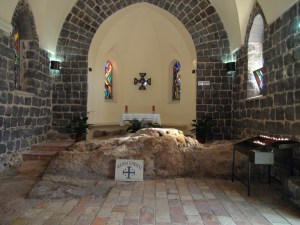
I think I know where this gospel took place– Tabgha, a quiet, wooded area on the Lake of Galilee just south of the ancient town of Capernaum. Easy walking distance from the town that was the center of Jesus’ ministry.

The name Tabgha comes from the seven springs of water flowing into the lake there. When I visited some years ago, flocks of birds were singing in the trees and drinking from the streams of water.

For centuries fishermen must have pulled in for fresh water from the springs, and perhaps fry some fish over a fire on the beach. It’s a likely place where Jesus would come to pray. Two centuries-old churches are on the site; tradition says he met his disciples here after his resurrection.
DSC00042

John’s gospel says that Peter and other disciples of Jesus came to Galilee after the Lord’s death and resurrection and went fishing. Through the night they caught nothing, but at dawn they heard a call from the shore to cast their nets out again.
“… Jesus was standing on the shore; but the disciples did not realize that it was Jesus.”

They caught a large catch of 153 fish. Jesus then called from the shore to come eat some fish at a fire he had started and he gave them bread and some fish to eat and revealed himself to them.

Peter has a leading role in this story. He jumped into the water to get to the shore. Then after they have eaten, Jesus takes him aside and three times asks the disciple who denied him three times, “Do you love me?” A beautiful statue marks that moment.
sinful man
Three times the apostle who cursed and swore in the courtyard of the High Priest that he did not even know Jesus answers “Yes, I do. I love you.” And Jesus tells him “Feed my lambs. Feed my sheep.”

A great example of forgiveness . No scolding words or recriminations. No “I told you so.” No warning, “You do that again and …” No demotion, no putting on parole. Rather, Jesus gives Peter new responsibility. “Feed my lambs” as I do. A beautiful picture of God’s mercy.

Instead of punishing him, God calls Peter to new things. The mercy of God always calls us to something new, some new life.

Tabgha, along the Lake of Galilee where Jesus met his disciples, is a wonderful place to visit. I wonder if Jesus prayed here during his days in Capernaum and called his disciples to rest awhile. Here he communed with God his Father; here he prayed and forgave. His memory lingers at this lovely place besides the Sea of Galilee.

Prayer and forgiveness go together Jesus taught. “Forgive us our trespasses as we forgive those who trespass against us.” Today’s gospel tells us to pray and forgive. Maybe someone has hurt us, maybe there’s some situation we’re facing now. A job we don’t like, a home situation we’re angry about, something in society that upsets us.

Pray and forgive.