Tag Archives: King David

Does God Get Your Vote?


Elections are going on today in the USA and  so how should people of faith engage in politics? The Book of Samuel tells us about politics in ancient Israel. “Appoint a king over us, as other nations have, to judge us,” the elders of Israel say to Samuel at Ramah. “We too must be like all the nations, with a king to rule us, lead us in warfare, and fight our battles.”

The Prophet Samuel is a reluctant king maker, however. He’s wary about kings and recognizes the dark side of political power.

“He will take your best fields, vineyards, and olive groves, and give them to his servants. He will tithe your crops and grape harvests to give to his officials and his servants. He will take your male and female slaves, as well as your best oxen and donkeys, and use them to do his work. He will also tithe your flocks. As for you, you will become his slaves.”

I suppose the advice we could take from this is: Don’t let people who govern have too much power. In a democratic society like ours that means being a well-informed and engaged citizen.  Know what’s going on and vote. It’s our duty as well as our right. As we go to cast a ballot–and how many will?– what about the common good? The good God wants?

There’s another piece of advice we can also hear in the Book of Samuel.  God complains to the prophet that the peoples’ demand for a king rejects God’s kingship. Some today might agree that politics is just for us humans; God has nothing to do with it.

But is God beyond the messy political world and has nothing to do with it?   Is it all about public opinion and counting heads? Or do we have to ask for God’s help with the way our world is run? The worse thing we can do is leave God out of it.

O God, come to our assistance. O Lord, make haste to help us.
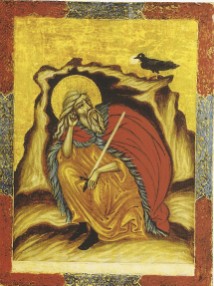
Elijah

Elijah
Jesus came into a Jewish world expecting a Messiah, but what kind of Messiah were they hoping for? Some Jews of the time expected a royal Messiah, the Son of King David. You see that expectation in the Gospel of Matthew which begins by tracing the human origins of Jesus back to David. “An account of the genealogy of Jesus the Messiah, the Son of David and Son of Abraham.”

Hope for a Messiah like the warrior King David who would free the land of Israel from its oppressors grew stronger among the Jews after the Roman occupation of Palestine by the Roman general Pompey in 63 BC. It can be seen in some of the Essene writings discovered from Qumran in recent times.

The Gospel of Matthew indicates that ordinary people too were hoping for a kingly messiah at the time of Jesus. “Can this be the son of David,” the crowd says after he cured a man who could not see or speak. (Mt 12,23) “Hosanna to the son of David,” the crowd says as he enters Jerusalem on Palm Sunday. (Mt 21,9) That causes the leaders in Jerusalem to become angry, because a claim like that could fire revolution and they feared what would happen because of it. (Mt 21.15)

Jesus never claims to be a political revolutionary, however. He refuses to fit neatly into that kind of messianic expectation. He will not lead an uprising against the Romans. He’s not John the Baptist come back from the dead. “Jesus is not confined to playing an already fixed role–that of Messiah– but he confers, on the notions of Messiah and salvation, a fullness which could not have been imagined in advance.” (Pontifical Biblical Commission)

If we ask what messianic expectation of his time Jesus comes closest to, we might find it in the hope for a prophetic messiah like Elijah, who is featured in our readings this week.

Like Elijah, he will speak the truth against the powerful, he will help the poor, he will suffer persecution; he will raise the dead.