Tag Archives: Jesus Christ

Are We There Yet?


A familiar question kids ask on a journey. So we give them games to play, tell them to go to sleep, or just shut up and wait. As we go through life, not only kids, but all of us ask: Are we there yet?

We are on a journey, a sacred journey, the Letter to the Hebrews says. Yet even on a sacred journey you can get tired. The Letter to the Hebrews– which we read in the next few weeks in the lectionary– is addressed to tired Christians. Would that be us?

Our ancestors, on their great journey from Egypt to the Promised Land, also experienced weariness, we’re reminded, and that led to discouragement and even rebellion. Despite the promises made to them and the signs of God’s power given them, they faltered. The desert journey got too much for them. Nothing big caused them to fail, just the weariness that came from being on the road day by day.

The Letter to the Hebrews is a letter of advice to tired Christians. Don’t ignore the danger that comes as you give yourself to life day by day, it says, but at the same time don’t let it get you down. Look to God who rested after the tiring journey of creation. God is your strength as you go along. Keep looking at people of faith, “the great cloud of witnesses” who pressed on through trials of every kind. Above all, look at “Jesus, who for the sake of the joy set before him, endured the cross, despising the shame, and has taken his place at the right hand of the throne of God.”

Are we there yet? No, but we’ll get there soon.


Christmas: A Call to Baptism

Matthew’s gospel was the gospel most used for catechesis in the early church. It also plays an important role in the creation of our Christmas season. It gives us the Feast of the Epiphany, for example. Jesus Christ came for the gentiles as well as for the Jews.

I think Matthew’s gospel is also an important source for our upcoming Feast of the Baptism of Jesus which closes the Christmas season. Matthew sees baptism as a way of repentance. That’s how John the Baptist describes it in Matthew’s gospel: “In those days, John the Baptist appeared in the wilderness of Judea, proclaiming: ‘Repent, the kingdom of God is near.’” (Mt 3,1-2)

When Pharisee and Sadducees come for baptism, John calls them “a brood of vipers” because they presume they are saved as “children of Abraham.” “God is able to raise up from these stones children of Abraham, “ John says to them.

Baptism is not an entitlement. Baptism is a commitment to repentance. That’s important for us to realize too.

But repentance is a difficult path. Can we do it alone?  John continues in Matthew’s gospel with the promise that one more powerful than he is coming. “He will baptize you with the Holy Spirit and fire.” When we are baptized into Christ, we are given the Holy Spirit and his fire to continue on the path of repentance.

Christmas is not just for looking at the Child in a manger; it’s a call  to enter into the mystery of Jesus Christ.


The Big Picture: The Magi

This is the time of the year when people make predictions about the future. It’s a time to look back and look forward.

Our local newspaper on Friday in Hudson County featured the predictions of a local psychic about the future of our mayor, our governor, our senator and a variety of local politicians. Psychics are big this time of year.

The host of PBS’s Newshour the other night asked his two experts to talk about the big picture ahead. “What does it look like?” They talked about the “Tea Party,” possible roll-backs in the health care program, the new Republican majority in Congress. That’s about as far as they went. I would guess the cable news channels talked about the same things from even a narrower perspective: politics and economics–American politics and the American economic picture.

Something’s missing. Our “big picture” is really a small picture. We seem to lack of larger vision of life.

We live in a secular age, an age of “expressive individualism.”(Charles Taylor) One of the drawbacks of the secular mind is its tendancy to be small-minded, to concentrate on the here and now, on what we see and do, on our personal interests. Even believers are part of a secular age and share its tendancies.

The secular age needs the spark of revelation.

What about the mystery of the Epiphany we celebrate today? Can it bring sparks to secular minds?

Let’s take the gospel story of the Magi out of its Christmas card setting and ask what its all about. The Magi were strangers, people coming from afar, bringing gifts. They recognized the Child whom others did not see. Then, we may surmise, they brought news of him back to their own people and part of the world.

The other day I was talking to a young priest from my community in Kenya, an African who’s studying now in Chicago. He was asking me about the new media and how to reach others through it. He wants to learn as much as he can from us, but he also thinks that Africa has something to offer the world, and his church in Kenya as something to contribute to the church beyond it.

Is he the Magi coming to us today?

Matthew’s gospel is the only gospel with the story of the Magi. The gospel was written for Jewish Christians in Galilee and the neighboring areas and it emphasizes that Jesus came first to them. “I was sent only to the lost sheep of the house of Israel,” Jesus tells the Canaanite woman, a gentile pleading for a cure for her daughter. (Mt 15;24)  “Go nowhere among the Gentiles, and enter no town of the Samaritans, but go rather to the lost sheep of the house of Israel,” Jesus instructs the twelve as he sends them out earlier in his gospel. (Mt 10, 5)

Were these stories Matthew’s way to bolster the faith of  Jewish Christians beset by a powerful Jewish orthodoxy that questioned their belief in Jesus Christ? Was Matthew’s story of the magi also a reminder that the gospel was meant for others besides them?

Jesus came to save all, even though his first ministry was to the Jews. God  saves the world and his gifts and graces are in many peoples and places. He doesn’t save the few.

We live in a big world that’s meant to be one. It’s not a world to be ignored. Great gifts and burdens are there, gifts and burdens meant to be shared. An earthquake in Haiti, for example,  is our tragedy too.  A worldwide depression is our problem too. More  and more, we tend to demonize the Muslim world. The Magi may have come from present day Iran or Yemen; two places we hardly view positively today.

We are tending to demonize immigrants in our own country today. Many of us are descendants of immigrants who came here with gifts and burdens. When they first arrived, those here often saw them only as burdens to this country. We know better.

The story of the Magi is not a sweet story about camels and men dressed in strange rich robes. It’s about the big picture, a picture we should see.
Looking Back, Looking Ahead

The Passionists have daily reflections on the Mass readings and I was the reflector for today:

The final days of the year are days for looking back and looking ahead.  It’s a favorite time for pundits and experts of all kind to take their seats on radio and television talk shows to measure the times.  They mostly see the past and future through the lens of politics and economics. Power and money explain it all, they say.  But do they?

Our readings for today advise measuring things differently. “Children, it is the last hour; ?and just as you heard that the antichrist was coming,? so now many antichrists have appeared.” A grim assessment isn’t it? St. John’s 1st Letter seems to paint the times dark and haunted by evil spirits.

Yet, the opening words of his gospel that follow look beyond the darkness, beyond time and space, to the beginning of it all.

“In the beginning was the Word, and the Word was with God, and the Word was God. He was in the beginning with God. All things came to be through him, and without him nothing came to be. What came to be through him was life, and this life was the light of the human race; the light shines in the darkness, and the darkness has not overcome it.”

The Word of God, Jesus Christ, brings to the world life and light, and darkness cannot overcome him. That’s something to remember as commentators throw up their hands trying to make sense of the world today. Or, more personally, when we hear ourselves thinking we’re going to be overcome by the dark.

The Word became flesh and has made his dwelling among us. “From his fullness we have all received, grace in place of grace.”

God in a Creche

In The New York Times the other day Maureen Dowd’s column was about a visit she and her brother made to see a collection of Christmas crèches in New Haven, Ct. She’s a columnist who makes fun of things, and in this column she made fun of those who compulsively collect crèches. In fact, she bought for herself a bizarre crèche to illustrate how wacky it can get. As I put down the paper, though, I wasn’t laughing.  I had the impression that a crèche doesn’t mean much to her at all.

Today I read a selection from an early Roman saint, Hippolytus,  “Against the Noetic Heresy” and I thought of her and the crèche.  The Noetics, if I remember, were Gnostics who looked down on Christianity because they thought they were smarter than anything it had to offer. They were smart, sophisticated people.

Hippolytus said something like this:

“When God speaks we better pay attention, and God has spoken to us in Jesus Christ.  Look at what the scriptures say about him. Learn from what they teach. Believe in what they tell us. You don’t decide the way God reveals himself. God decides that. Look at the way he reveals himself and learn from him.”

We learn so much from the mystery of the birth of Jesus Christ. Look at the humility of God, who comes to us as a tiny infant. Look at the way he invites the rough shepherds to be the first to see him as he lights up the dark hills with his glory. So he  welcomes the poorest among us. We are invited to see him too and share in his life and light.

We should pay attention to the revelation of God we celebrate these holy days. It tells us of a God who loves us.  It says that God wants to be near us, to be part of our lives, to lead us to a new life.

Window on the World

The window in my room faces west to a slice of Union City that includes the old monastery church and parking space, some city athletic fields, a crowded  block of houses along 21st Street and a few big oak trees that somehow have survived the urban sprawl.  It’s a wonderful window for taking in the world.

Earlier this morning, Jose reached into the van carrying some neighborhood people to work to bless them, anticipating the morning sun that blesses everything now. A  few minutes ago, a flock of pigeons momentarily touched down on the wires along the street, thenflew away. I can’t figure out their unpredictable ways.

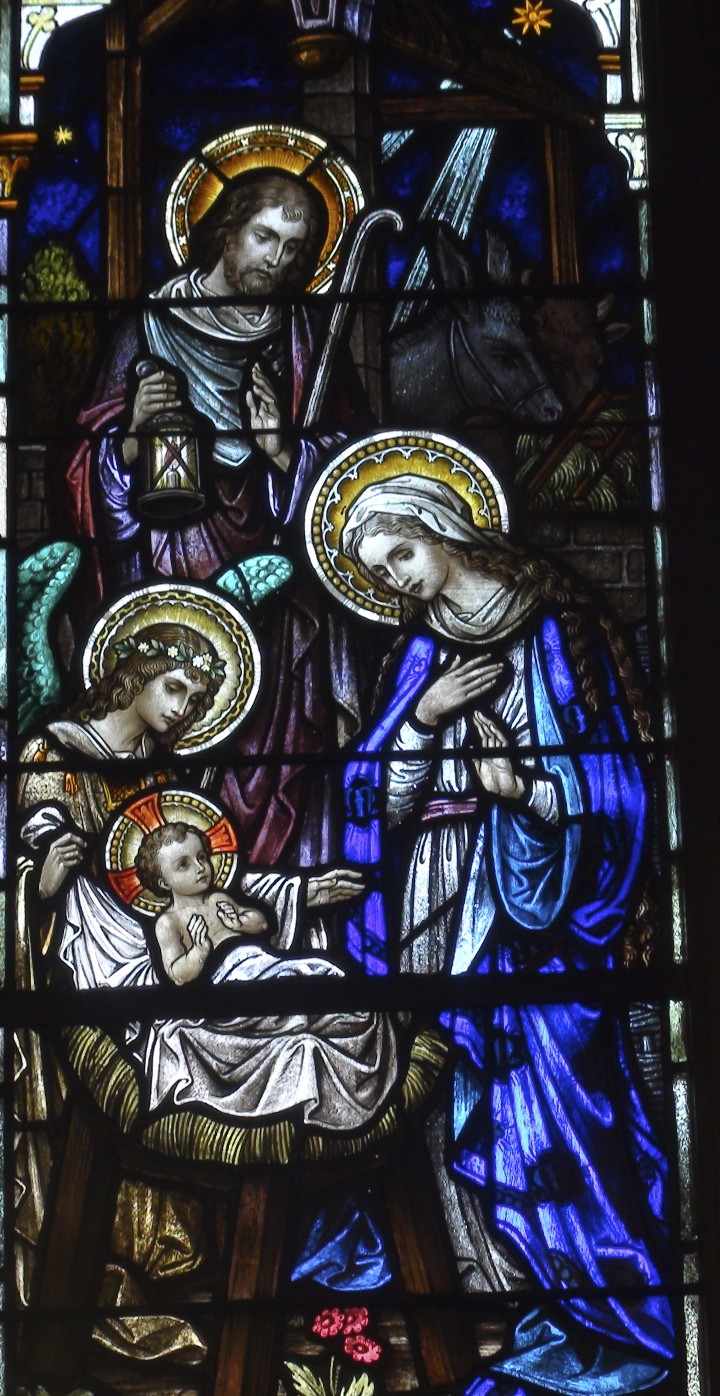
I leave the tiny figures of Mary and Joseph and the Child on the window sill all year because they seem to complete the picture.  Keep your eyes fixed on examples of faith, St. Ambrose said yesterday in his commentary on the Visitation.  Mary saw it in Elizabeth and Elizabeth saw it in Mary. Joseph certainly had eyes of faith too.  The Child is so small.  Only eyes of faith can see him–and everything else as well.

Fishing in the Text

One thing the Christian preachers from patristic times seem to do well is to lead you to the scriptures to search for God’s wisdom there. They seem to do it better than many preachers today who use the scriptures rather like “proof texts” to back up their own observations and ideas, good as they may be.

The patristic homilists  don’t just give you the dish of fish to eat. They teach you how to fish. Here’s St. Ambrose on Luke’s gospel about Mary visiting her cousin Elizabeth in today’s Office of Readings. He’s fishing in the text.

Notice in the third paragraph the beautiful way he uses the simple detail that Mary made haste to go to the hill country. It’s a place of grace revealed. “I lift up my eyes to the mountain, from whence shall come my help…”

“The angel Gabriel had announced the news of something that was as yet hidden and so, to buttress the Virgin Mary’s faith by means of a real example, he told her also that an old and sterile woman had conceived, showing that everything that God willed was possible to God.

When Mary heard this she did not disbelieve the prophecy, she was not uncertain of the message, she did not doubt the example: but happy because of the promise that had been given, eager to fulfill her duty as a cousin, hurried by her joy, she went up into the hill country.

Where could she hurry to except to the hills, filled with God as she was? The grace of the Holy Spirit does not admit of delays. And Mary’s arrival and the presence of her Son quickly show their effects: As soon as Elizabeth heard Mary’s greeting her child leapt in her womb and she was filled with the Holy Spirit.

See the careful distinction in the choice of words. Elizabeth was the first to hear the voice but her son John was the first to feel the effects of grace. She heard as one hears in the natural course of things; he leapt because of the mystery that was there. She sensed the coming of Mary, he the coming of the Lord — the woman knew the woman, the child knew the child. The women speak of grace while inside them grace works on their babies. And by a double miracle the women prophesy under the inspiration of their unborn children.

‘Blessed are you,’ said Elizabeth, ‘who believed’.

You too, my people, are blessed, you who have heard and who believe. Every soul that believes — that soul both conceives and gives birth to the Word of God and recognises his works. Let the soul of Mary be in each one of you, to proclaim the greatness of the Lord. Let the spirit of Mary be in each one of you, to rejoice in God. According to the flesh only one woman can be the mother of Christ but in the world of faith Christ is the fruit of all of us.”

Patron of Blended Families

The great old stories from the scriptures have a way of speaking to us today, if we  hear them right. Tomorrow’s gospel from Matthew is about the announcement of Jesus’ birth made by an angel to Joseph.

Joseph is ready to divorce Mary who is mysteriously pregnant, but prompted by the angel he takes her into his home and raises her Child as his own. Anything like that going on today?

How about all the blended families we meet now, where divorce or death have created other groupings not based on original marriage vows or blood relaltionships? The holidays will bring many of them together. Stepfathers and stepmothers, stepchildren.  Some of these families have known divorce, maybe once, or twice or three times. There are kids and relatives from family number one, number two, number three.

Joseph loved  Jesus and Mary with a love, not based on flesh and blood, a love that made him father, husband, and all the other relationships that blood or vows are supposed to bring. He showed us that love is what counts after all.

Later on, Jesus said in Capernaum, when they announced that his family were outside waiting to see him: “Who are my mother and my brothers? “  He was proclaiming a love higher than that based on flesh and blood. He saw it in Joseph.

How about naming Joseph, Patron of Blended Families?

Genealogies tell us who we are

We may stumble over the names in Matthew’s genealogy of Jesus, our reading for today’s liturgy, but  Pope Leo the Great says in our Office of Readings, the genealogies tell us who he is. “To speak of our Lord, the son of the Blessed Virgin Mary, as true and perfect man is of no value to us if we do not believe that he is descended from the line of ancestors set out in the Gospel.”

I reflected about this gospel elsewhere today, but here’s what Leo says about it:

“No doubt the Son of God in his omnipotence could have taught and sanctified us by appearing in a semblance of human form as he did to the patriarchs and prophets, when for instance he engaged in a wrestling contest or entered into conversation with them, or when he accepted their hospitality and even ate the food they set before him. But these appearances were only types, signs that mysteriously foretold the coming of one who would take a true human nature from the stock of the patriarchs who had gone before him. No mere figure, then, fulfilled the mystery of our reconciliation with God, ordained from all eternity…The divine nature and the nature of a servant were to be united in one person so that the Creator of time might be born in time, and he through whom all things were made might be brought forth in their midst.

For unless the new man, by being made in the likeness of sinful flesh, had taken on himself the nature of our first parents, unless he had stooped to be one in substance with his mother while sharing the Father’s substance and, being alone free from sin, united our nature to his, the whole human race would still be held captive under the dominion of Satan. The Conqueror’s victory would have profited us nothing if the battle had been fought outside our human condition.”

So that’s where the battle and the victory takes place today, in our human condition, where our names are found.

Seeing God

Here’s why I like St. Ireneaus:

“The prophets foretold that God would be seen by us; as indeed the Lord himself confirmed: Blessed are the pure in heart, for they shall see God.

But at the same time God is great and unspeakably glorious, so that no one shall see God and live, for God can never be completely understood. But God is loving and kind and omnipotent, and so he gives the sight of God, the greatest gift of all, to those who love him. Even this was foretold by the prophets: For those things that are humanly impossible, are possible with God.

We don’t see God by our own powers; but we see God when it pleases him that this should be so. God decides who should see him, and when, for God is powerful in all things. He was seen in the past prophetically, through the Spirit, and now by adoption through the Son; and in the kingdom of heaven he will be seen as a true father. The Spirit prepares humanity for the Son of God, the Son leads it to God, and the God gives it the gift of incorruptible eternal life, a life that everyone receives who sees God.”