Tag Archives: Jesus Christ

Lessons from Miracles

The miracle of the loaves and the fish is one of the most important miracles of Jesus mentioned in the New Testament. It’s in all four gospels: Mark reports it twice. Most people who know anything at all about Jesus know this story in some form or another. We read Matthew’s version at Mass last Sunday.

Miracles teach us many things. Defying reasonable explanations, they’re signs that God is present in our world and not distant or uninvolved in human affairs. They’re striking acts of divine love and mercy breaking the usual quiet and unseen presence of God among us. In the life of Jesus, miracles are one of the ways God confirms his divine mission.

Miracles teach us other things too. For instance, the story of the loaves and fish reminds us of  the Holy Eucharist, the sacrament in which Jesus through signs of bread and wine nourishes and supports us on our journey through life.  Just as God sent heavenly food,  manna, to the Jews as they made their way through the desert to the Promised Land, so Jesus gives this Bread as food on our way to eternal life.

Miracles invariably involve ordinary human beings as they unfold. Unfortunately, we sometimes overlook their human dimension.

A little boy had five loaves and two fish, John’s account of the miracle relates. (John 6, 9) He evidently gave them to Jesus. No one seems to remember his name. A small detail in the story, we may say. In this same miracle, it’s the disciples of Jesus who alert him to the hunger of the crowds and after the miracle distribute the bread and the fish to them. Minor details of the story, we may think.

Yet, it’s good to keep in mind that in every miracle Jesus seems to involve people,  who cry out their need, like the blind men along the road, or bring him a request for someone else, like the Roman soldier asking for his servant, or bring him the sick and the needy,  like the care-givers who followed him wherever he went.

The cure of the paralyzed man is one of the most colorful stories in the gospel. Those who brought him to Jesus  (how many were there anyway?) carry the helpless man  to the house where Jesus was and when they can’t get through the door because of the crowds, they climb onto the roof, cut a hole in it, and lower him down before Jesus.

The man was cured and walked out of the house carrying his mat with him. It was a miracle, truly,  but what about those who brought him? Some human cooperation like theirs is found in almost all of the miracle stories of the gospel.  A rare exception may be the story from John’s gospel of the paralyzed man who sat for 37 years near the Pool of Bethsaida and had no one to help him enter its healing waters. No one brought him to the attention of Jesus, it seems. so Jesus spontaneously heals him, because he’s so helplessly on his own.

God seldom acts alone, the miracle stories tell us; he invites human cooperation. Our challenge, then, is to respond and do our part in God’s work in this world.  That response may be as small as the little boy’s response who gave over his five loaves and two fish. But it’s important just the same.

How do we prepare ourselves for this role? I think  by daily prayer.

Martha

Martha and Mary were not just related  by blood, St. Augustine says, they were related by the same holy desire.  “ They stayed close to our Lord and both served him harmoniously when he was among them.”

Martha served him as the “Word made flesh,” who was hungry and thirsty, tired and in need of human care and support. She longs to share what Mary enjoys, his presence, his wisdom and his gifts. And she will find her desires fulfilled.

“You, Martha, if I may say so, will find your service blessed and your work rewarded with peace. Now you are much occupied in nourishing the body, admittedly a holy one. But when you come to the heavenly homeland you will find no traveller to welcome, no one hungry to feed or thirsty to give drink, no one to visit or quarrelling to reconcile. no one dead to bury.”

“No, there will be none of these tasks there. What you will find there is what Mary chose. There we shall not feed others, we ourselves shall be fed. What Mary chose in this life will be realized there in full.  She was gathering only fragments from that rich banquet, the Word of God. Do you wish to know what we will have there? The Lord himself tells us when he says of his servants, Amen, I say to you, he will make them recline and passing he will serve them.

Jesus in the Temple, 2

It’s important to remember that Jesus, as well as being a humble native of Nazareth, was also was a regular worshipper in the temple at Jerusalem and was nourished by the great ideas and vision that radiated from this holy place.

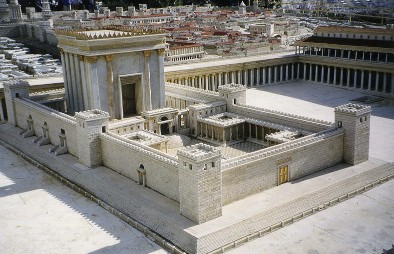
Indeed, the Second Temple was admired throughout the world of his time. Whatever the Jews thought of Herod the Great, the unpredictable ruler of Judea, most would be proud of the magnificent temple he built. It was one of the world’s wonders.

Yet, when some spoke to Jesus about its beauty, how adorned it was with gifts, he replied “As for these things you see,  the days will come when not one stone will be left upon another; all will be thrown down.” (Luke 21,6)

The temple was not just a cause for national pride for the Jews; it nourished their spirituality. God, who was honored here, was no household god with limited power, or a national god concerned with one people. The Divine Presence honored here was the Lord of heaven and earth, the God of the nations.

That belief was expressed in the psalms that Jesus and his disciples would have prayed. Two psalms we pray in the Liturgy of Hours Wednesday and Thursday of this week (week 1) are prayers from the temple and its worship:

Psalm 47

All you peoples, clap your hands; shout to God with joyful cries.

For the LORD, the Most High, inspires awe, the great king overall the earth,

Who made people subject to us, brought nations under our feet,

Who chose a land for our heritage, the glory of Jacob, the beloved.

God mounts the throne amid shouts of joy; the LORD, amid trumpet blasts.

Sing praise to God, sing praise; sing praise to our king, sing praise.

God is king over all the earth; sing hymns of praise.

God rules over the nations; God sits upon his holy throne.

The princes of the peoples assemble with the people of the God of Abraham. For the rulers of the earth belong to God, who is enthroned on high.

Psalm 48

Great is the LORD and highly praised in the city of our God:

The holy mountain, fairest of heights,

the joy of all the earth,

Mount Zion, the heights of Zaphon,

the city of the great king.

God is its citadel, renowned as a stronghold.

See! The kings assembled, together they invaded.

When they looked they were astounded; terrified, they were put to flight!

Trembling seized them there, anguish, like a woman’s labor,

As when the east wind wrecks the ships of Tarshish!

What we had heard we now see in the city of the LORD of hosts,

In the city of our God, founded to last forever.

O God, within your temple we ponder your steadfast love.

Like your name, O God, your praise reaches the ends of the earth.

Your right hand is fully victorious.

Mount Zion is glad!

The cities of Judah rejoice because of your saving deeds!

Go about Zion, walk all around it,

note the number of its towers.

Consider the ramparts, examine its citadels,

that you may tell future generations:

“Yes, so mighty is God, our God who leads us always!”

The temple proclaimed God who rules over creation and the nations, but as Jesus reminded his disciples a place can pass away but the God proclaimed there does not pass away. In fact, Jesus spoke of himself as the new temple, who replaces this building and who cannot be destroyed,

Isaiah offered a similar message, which we also read today (Thursday morning, week 1)

“Thus says the LORD: The heavens are my throne, the earth is my footstool. What kind of house can you build for me; what is to be my resting place?

My hand made all these things when all of them came to be, says the LORD. This is the one whom I approve: the lowly and afflicted man who trembles at my word.” (Isaiah 66,1-2)

After the destruction of Jerusalem, Jews who had been banished from the city by the Romans were allowed at set times to stand on the Mount of Olives and mourn for the temple and their great city. Christians also would go there to remember that cherished institutions and human  endeavors can pass away, but Jesus Christ does not pass away.

I was with the people in the picture above, who looked out  from the Mount of Olives to the temple mount and Jerusalem across the Kidron Valley. Good place to put things in perspective these days.

Jesus in the Temple

Where did Jesus teach and pray and live when he was in Jerusalem? That’s hard to figure out today because the city was thoroughly destroyed by the Romans in 70 AD, and since then earthquakes, wars, political and religious forces have hammered away at the old city.

Jerusalem destroyed: 70 AD

Archeologists try their best to reconstruct ancient Jerusalem and they’ve produced a wonderful model of the city from about the time of Jesus, which can be seen today at the city’s Israel Museum.  As the model indicates, the Second Temple built by Herod the Great dominated the city then. Jesus must have taught and prayed in this splendid place–still being built during his lifetime– as he came to celebrate the Jewish feasts.

His activity here triggered his condemnation to death.

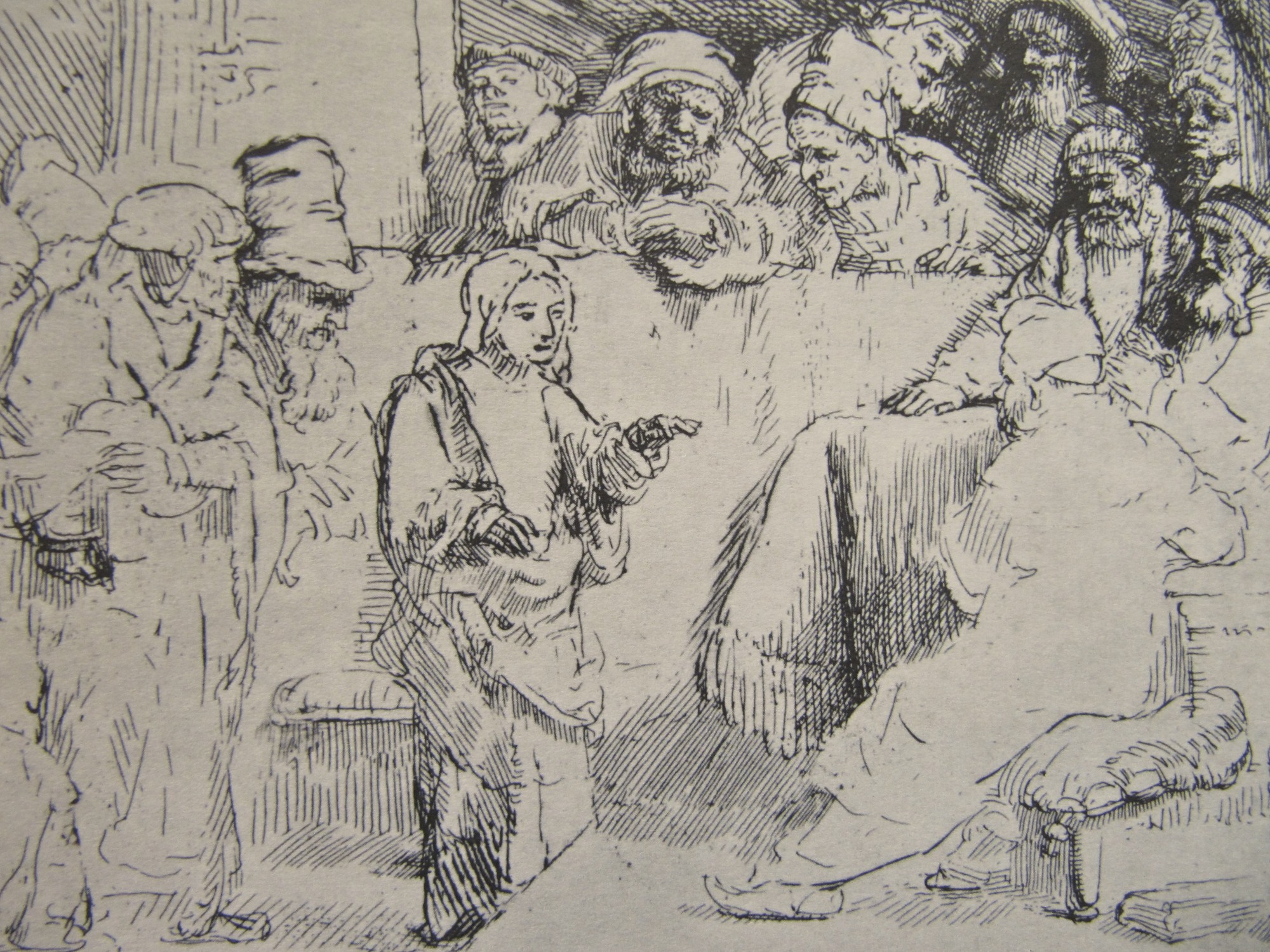
Can we say more precisely where he taught and when he began teaching there? Luke’s gospel offers the interesting story that his parents, after missing him on one of their usual visits to the Holy City,  “found him in the temple, sitting among the teachers, listening to them and asking them questions.” (Luke 2,46) This probably took place in the Court of the Gentiles, the extensive space that surrounded the temple itself, which we can see in the model. We can surmise that, as observant Jews, his family brought him to Jerusalem for the major feasts.

The name, Court of the Gentiles, indicates an area open to all, even though the temple building itself was open only to the Jews. In the Court of the Gentiles,  young Jewish children like Jesus and adults looking for a greater understanding of their faith were able to listen and ask questions of the Jewish teachers. At the same time, even those who did not share the Jewish faith were welcome here,  namely,  non-Jews, gentiles, who could speak to Jewish teachers, inquire about the Jewish faith and even pray to the unknown God.

The Court of the Gentiles was an important part of the temple area; it proclaimed Jewish openness to the world.  The psalms and the prophets spoke of the God of all nations and looked to the day when all peoples would be counted among the children of Abraham:

“In days to come the mountain of the Lord’s house

will be established as the highest mountain

and raised above the hills.

All nations shall stream toward it;

many peoples will come and say:

‘Come, let us climb the Lord’s mountain to the house of the God of Jacob,

that he may instruct us in his ways

and we may walk in his paths.” Isaiah 2,1-5

The Court of the Gentiles was the place where Jesus proclaimed a new age that would fulfill these promises.  As he grew “in wisdom and age and grace” Jesus continued to go to the temple with his family from Galilee to celebrate the Jewish feasts, still “listening to the teachers and asking them questions.”

But after his baptism by John, Jesus’ visits to the temple changed. During the feasts he made extraordinary claims about himself and his mission, as John’s Gospel records.  His claims, along with healings he worked in Jerusalem– his cures of  the man born blind and of the paralyzed man, above all his raising of Lazarus from the dead– alarmed the temple authorities.

The gospels all record the disturbing incident that took place in the temple during the final stages of his ministry. According to Mark’s gospel: “He entered the temple and began to drive out those who sold  and those who bought, and he overturned the tables of the money-changers and the seats of those who sold pigeons; and he would not allow anyone to carry anything through the temple. And he taught and said to them, “Is it not written, “my house shall be called a house of prayer for all the nations?’ But you have made it a den of thieves.” (Mark 11,15-17, Matthew 21,1017; Luke 19, 45-46; John 2,13-17)

Not only was the Court of the Gentiles a place for teaching and prayer, it was also a place for exchanging money, getting advice from priests about where and how to pray and make your offerings,  buying food and animals for sacrifice. In a prophetic gesture, Jesus upset this traditional apparatus and called for renewing the temple so that it could fulfill its destiny as “a house of prayer for all the nations.”

The Gentiles would no longer be excluded from experiencing the Divine Presence;  Jesus signified he came to break down the dividing wall between Jew and Gentile and reconcile both to God through his death. He himself would be the new temple and the sacrifice of reconciliation for all peoples.

No wonder that a major accusation made against him later at his trial before the Jewish leaders was based on what witnesses claimed were his threats to destroy the temple. “We heard him say ‘I will destroy this temple made from human hands and I will build another not made by human hands.” (Mark 14,58)

Some picture Jesus as a hapless Galilean peasant caught in a government net to catch and destroy potential revolutionaries, like Barabbas. Jesus went to his death for more reasons than that. His activity in the temple is an important part of his life and mission, and it led to his death.

Ignatius and Polycarp

Years ago I visited Izmir, Turkey, with a classmate of mine. We were searching the city, formerly Smyrna, for traces of St. Polycarp, one of its first Christian bishops, who was martyred there in AD 153. With difficulty, we found a small Catholic church named for him surrounded now by a large Muslim neighborhood, and also the ancient agora where he was condemned and put to death.

I think of him today because today’s Office of Readings offers St. Ignatius of Antioch’s  “Letter to the Magnesians,” which was written in Smyrna early in the 2nd century and mentions Polycarp, its bishop.  Under arrest on his way to Rome where he will be executed in the Colisseum , Ignatius writes to the Magnesians urging them to be faithful disciples of Christ and imitate him. Polycarp gave him support on his way to death.

One sentence of his letter caught my eye. “Be moved by his goodness,” he writes, “for if Jesus were ever to imitate the way we behave ourselves, we would be truly lost.”

For Ignatius, then, when the scriptures say Jesus “ was like us in all things except sin” they do not mean that he embraced our mediocrity, our compliance with evil, our pursuit of success and fame–all temptations he faced in the desert. He was uniquely human. A unique messenger from God.

Human goodness as we know it is weighed down by weaknesses in the best of us. Human behavior as we experience it suffers from their presence.

Christ came that we might imitate him, the “way, the truth and the life.” He offers an example of what we as human beings should be.

Ignatius’ letter indicates a certain forgetfulness of Jesus Christ taking place in his day. The apostles and other eyewitnesses have passed on, and other teachers are taking their place. They have rivals: some are traditional Jews, who are enticing Christians  back to the ancient wisdom and practices of Judaism. Others are from popular religious and philosophic groups, like the gnostics,  a rising power who taught then.

What Ignatius’ time needed were Christian leaders with links to the first followers of Jesus and could vouch for him and pass on their witness, especially through the gospel writings that reported what he said and did. “What was he like?” “What did he say?” “What did he do?” The gospels had recently been written.

“Be convinced of the birth and passion and resurrection which took place at the time of the procuratorship of Pontius Pilate; for these things were truly and certainly done by Jesus Christ, our hope, from which God grant that none of you be turned aside.”

Polycarp of Smyrna and Ignatius of Antioch are key figures in our Church. Both not only taught about Jesus Christ but imitated him in their deaths. Later Christian writers recognized their importance. In the late 2nd century, Irenaeus wrote:

“Polycarp was not only instructed by apostles, and conversed with many who had seen Christ, but was also appointed bishop of the Church in Smyrna by apostles in Asia…He always taught what he had learned from the apostles, and the Church has handed down that teaching which alone is true. His successors testify to this. ( Adversus Haereses. Book III, Chapter 4, Verse 3 and Chapter 3, Verse 4)

Tertullian wrote about AD 208:

“Heresies are novelties with no connection to the teaching of Christ. Some may claim they come from apostles. We say: where did your church come from? Give me a list of your bishops from now till the apostles or to some bishop appointed by him. The Smyrnaeans go back to Polycarp and John, and the Romans to Clement and Peter; let heretics come up with something to match this.” (De praescripione heret.)

It was a dangerous century, a transitional time, when big changes were taking place. Maybe we’re facing something like it today?

Rembrandt

Among the books we have in our library are some art books from the years when The Sign Magazine was published here and books were accumulated for their illustrations. One of them is “Rembrandt’s Drawings and Etchings for the Bible.”

Though he’s known best for his portrayal of the Dutch world of his time, Rembrandt was very interested in stories from the Bible, both from the Old and New Testament. Possibly one third of his work is devoted to biblical subjects, about 700  drawings among them.

What led him to paint and draw biblical events? It wasn’t mainly a patron’s commission, as was the case of  his contemporaries– Rubens, for instance.  Rembrandt seems genuinely attracted to the bible and felt compelled to draw something from the biblical narrative, not because he could make money on it, but because it said something to him and his situation in life.

“Rembrandt’s relation to the biblical narrative was so intense that he repeatedly felt impelled to depict what he read there. These sketches of Rembrandt have the quality of a diary. It is as though he made marginal notes to himself…The drawings are testimonies, self-revelations of Rembrandt the Christian”  ( p. 6)

It seems he got this interest in the bible from his mother, a devout woman, who had a Catholic prayerbook that featured  the Sunday gospels with illustrations on facing pages. As she prayed from this book, did she show them to her little boy growing up?

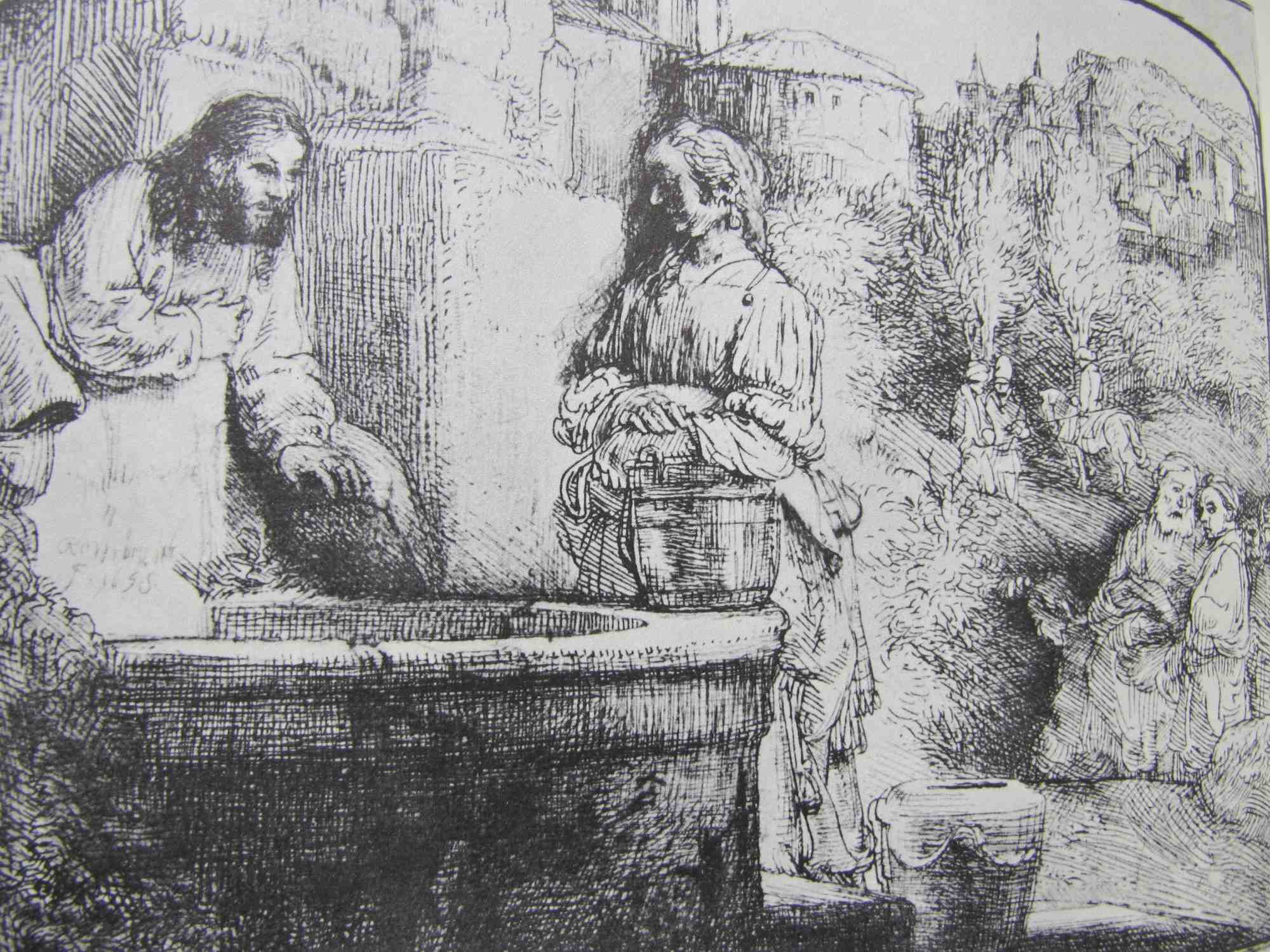
His portrayal of the scriptural stories are so insightful. Just look at his portrayal of Jesus at the well with the Samaritan woman, which is found in John’s gospel. Jesus deferentially asks for a drink of water, bowing to the woman as he points to the well. And she stands in charge, her hands firmly atop her bucket. She’s a Samaritan and a woman, after all. He wont get the water until she says so. Jesus looks tired, bent over by the weariness of a day’s long journey.

Certainly, this is no quick study of a gospel story. Obviously, Rembrandt has thought about the Word who made our universe and the Savior who came to redeem us. Perhaps he’s also thinking of the way Catholics and Protestants were clashing among themselves, their picture of Jesus a strong, vigorous warrior. There he stands humbly outside a little Dutch village that the artist’s contemporaries might recognize. Some of them may be pictured looking on at the two.

Artists have a powerful role in relating truth and beauty.

And what about Rembrandt’s mother? A 19th century French Sulpician priest, Felix Dupanloup, who had a lot to do with early American Catholic catechetical theory said,

“Till you have brought your children to pray as they should, you have done nothing.”

Looks like she did her job.

The Glory of God

I was surprised to see Harold Camping at his usual place on television the other night. The rapture didn’t happen May 21st, he explained, because God wanted to alert the world that the end was going to come this October. A caller wondered if we could do anything about helping this world of ours, but Harold was quite firm that God was going to destroy it completely. It’s an open sewer, according to him. Nothing’s worth saving.

How different from the Christian vision of St. Irenaeus, the 3rd century  bishop of Lyons, whose feast we celebrate June 28th. He condemned the gnostics– favorites of new age thinkers today– for their dismissal of creation as evil. The One God is the source of our created world and we know him through it, Irenaeus taught. We cannot know God if we depreciate or ignore the world God has made; it mirrors his glory.

“The glory of God gives life; those who see God receive life. For this reason God, who cannot be grasped, comprehended or seen, allows himself to be seen, comprehended and grasped by us, that he may give life to those who see and receive him…  God is the source of all activity throughout creation. He cannot be seen or described in his own nature and in all his greatness by any of his creatures. Yet he is certainly not unknown.”

The Word of God has a twofold role, according to Irenaeus, revealing God in creation and finally coming in the flesh to complete this revelation in Jesus Christ.  No  one has ever seen God, except the only-begotten Son, who is in the bosom of the Father; he has revealed him.

He revealed God to us and presented us to God. He safeguarded the invisibility of the Father to prevent us from treating God with contempt and to set before us a constant goal toward which to make progress. On the other hand, he revealed God to us and made him visible in many ways to prevent us from being totally separated from God and so cease to be.

“Life in us is the glory of God; in human life one can see the vision of God. If the revelation of God through creation gives life to all who live upon the earth, much more does the manifestation of the Father through the Word give life to those who see God.”

Harold should read that wonderful story from the Book of Genesis we read yesterday at Mass about Abraham bargaining with God for the salvation of Sodom and Gomorrah. The world’s worth saving.

We are His Flock


Last Saturday I celebrated Mass in a parish whose pastor was retiring and a new one was coming in to take over. It was the Feast of Corpus Christi, a vivid reminder of the presence of Jesus Christ among us. He is our shepherd and we are his flock.

We’re very conscious today of human leaders, whether they are politicians, business leaders, bishops or pastors. We want them to keep things going, to solve problems and to lead us into the future. When things go wrong, they’re the first we blame. Often they are all we see.

But there is another who leads us. “We are his people, the flock of the Lord.” St. Augustine comments on this verse from the psalms:

”  In this song we have declared that we are his flock, the people of his pasture, and the sheep of his hands… You are my sheep, he says. Even in the midst of this life of tears and tribulations, what happiness, what great joy it is to realise that we are God’s flock! To him were spoken the words: You are the shepherd of Israel. Of him it was said: The guardian of Israel will not slumber, nor will he sleep. He keeps watch over us when we are awake; he keeps watch over us when we sleep.

A flock belonging to a man feels secure in the care of its human shepherd; how much safer should we feel when our shepherd is God. Not only does he lead us to pasture, but he even created us.”The words we have sung contain our declaration that we are God’s flock: For he is the Lord our God who made us. He is our God, and we are the people of his pasture and the sheep of his hands.

Human shepherds did not make the sheep they own; they did not create the sheep they pasture. Our Lord God, however, because he is God and Creator, made for himself the sheep which he has and pastures. No one else created the sheep he pastures, nor does anyone else pasture the sheep he created.

“The Lord is my shepherd,” we say. And he shepherds the world as well.

Feast of Charles Lwanga and Companions


The martyrdom of St. Charles Lwanga and his twenty one companions in Uganda, Africa in 1885-86 was a decisive factor in the remarkable spread of Christianity in that continent that began in that century. The White Fathers reached that remote part of the world in 1879 and the Catholic missionaries succeeded in converting a number of native Africans, some of whom were servants of King Mwanga, a local Ugandan ruler. In 1885 King Mwanga began to persecute Christians.

Charles Lwanga was in charge of the pages in the king’s court. The king wanted some of the pages as sexual partners. When the Christian pages  refused he threatened them with torture and death.

Led by Charles, they rejected the king’s advances, and so the king summoned them to appear before him and asked if they were going to persist as Christians and deny what he asked. “Till death!” they answered.  “Then put them to death!” the king shouted.

On the road to their execution at Namugonga  three pages died. Many of the bystanders were amazed at the courage and calm of Charles and his companions.  On Ascension Day, 1886, they were wrapped up in mats of reeds and set afire for their faith. The following year an extraordinary number of Ugandans became Christian. The prayer for their feast  praises God for his graces to them:

Father, you have made the blood of martyrs the seed of Christians.

In today’s Office of  Readings, Pope Paul VI says their sacrifice opened a new page in the history of holiness in Africa. They join the 4th century Martyrs of Scilli (whose relics are now in the Passionist church of Saints John and Paul),  Cyprian, Felicity and Perpetua and other Christian martyrs and confessors from the past.  And he adds:

“Nor must we forget those members of the Anglican Church who also died for the name of Christ.” A recognition that holiness is found in other Christian churches too.

“These African martyrs herald the dawn of a new age. If only our minds might be directed not toward persecutions and religious conflicts but toward a rebirth of Christianity and civilisation!”


There’s Gonna Be a Great Day

6th Sunday of Easter

Last weekend in the New York area we were waiting for the end of the world. That’s what the signs in the buses and on billboards predicted. It was a message from Harold Camping, president of Family Radio, who calculated from clues he deciphered in the Bible that  May 21st was the day of judgment and later in October the world would finally come to an end.

Of course, it didn’t happen.

I must confess to being a long time viewer of Harold on his television program Open Forum, which comes on after the Evening News. Monday after the fateful day, I watched him respond to reporters asking for an explanation. The poor reporters didn’t have a chance. Harold has been dealing with questioners like them for years. They didn’t rattle him at all.

A spiritual earthquake occurred, Harold said. He hasn’t given up. The world’s going to end in October, just as he said.  He’s sure of it. I’m not.

I think my interest in Harold comes from his interest in the future when, according to traditional Christian belief,  Jesus “will come to judge the living and the dead.”

For Harold the last judgment is going to be like a scene from The Terminator and other grim science fiction movies that hold the popular imagination today.  The last days are dark days when God gets even with the human race for its sinfulness and unbelief. The world falls apart in scenes of horrible cosmic death and destruction. Not many will be saved.

We are living in tough times and some people think our world isn’t going to make it. That’s why they listen to people like Harold.

What we need to do is listen to the Easter message of Jesus. It’s so different. Listen to him speaking in the gospel today to his disciples who fear they will be abandoned and  wonder about their future. Their world was shaken too.

“I will not leave you orphans; I will come to you.”  “He will lead us to God,” St. Peter says. ( I Peter 3,18)  He gives us the Spirit of truth who will guide us from within. Jesus Christ is our Savior, a saving God.

Our first reading today describes a church experiencing a mysterious, unpredictable growth. From Jerusalem the gospel takes root in neighboring Samaria, an unlikely place to welcome it. From there it reaches to the ends of the Roman world. We believe that the mystery of the Resurrection of Jesus set in motion a great surge of grace.  God reaches out to creation, not to destroy it, but to bring it the blessing of life.

When we say Jesus will come to judge the living and the dead,  we’re not predicting death and rejection. God blesses all time with love. We don’t have to worry about the day or the hour for this to happen. God offers us signs that he is still with us and will stay with us all days. The Eucharist is one of them.

God is with us “now and ever shall be, world without end. Amen.”