Tag Archives: Jesus Christ

Seeing the Least


We know Jesus Christ in the Gospels, but today’s reading tells us to find him where it’s hardest to see him–in “the least.” They would be the hungry, the thirsty, the naked, the stranger, the sick, the prisoner. The least are hard to see. Mother Teresa called them “Christ in disguise.” Like the blind in the gospels, we ask that we may see.

Lord Jesus Christ,

may I see you in my neighbor,

especially in those in need, who seem so unlike you.

with little charm or response,

sometimes ungrateful for interest or care.

May I love you in my neighbor, the neighbor hard to love

and find you in the least of them.

The Temptations of Jesus

As supreme ruler in China from 1949-1976  Mao Zedong began the practice of sending young recruits for the Communist party on what was called the  “Long March.”  They retraced the 8,000 miles that Mao and his army took in 1935 through some of the toughest parts of western China to evade their enemies and eventually become the fighting force that conquered China. The recruits were expected to learn from people like Mao and his soldiers who made that difficult journey what made you into a good Communist.

Lent is our “Long March.”  For 40 days, we retrace the 40 years the Israelites journeyed through the desert from Egypt to the Promised Land and the great journey that Jesus Christ took to his death and resurrection.

This Sunday we begin that journey with Jesus in the desert after his baptism where he is tempted by the devil. Mark’s gospel describes it succinctly:

“The Spirit drove Jesus out into the desert,

and he remained in the desert for forty days,

tempted by Satan.

He was among wild beasts,

and the angels ministered to him.”

The experience of Jesus in the desert mirrors his experience in his life. At his baptism, God calls him his “Beloved Son” and tells us to “listen to him.” He is the Messiah, sent by God to save his people. But in the desert he is tempted by Satan to be a Messiah of another kind.

In his recent reflection on Lent, Pope Benedict said that in the desert Satan “offers Jesus another messianic way, far from God’s plan, because it passes through power, success, dominion and not through the total gift on the Cross. This is an alternative messianism of power, of success, not the messianism of gift and selfless love.”

Matthew and Luke’s gospels speak more than Mark’s gospel does about the temptations of Jesus in the desert. Jesus is hungry; “Turn these stones into bread,” Satan says. You’re above the ordinary laws of life.  From a mountain, Satan shows Jesus all the kingdoms of the world. “Here’s political power,” Satan says. From the pinnacle of the temple in Jerusalem, Satan says “Throw yourself down; you can have religious power.”

Mark’s gospel goes on from his account, saying simply:

“After John had been arrested,

Jesus came to Galilee proclaiming the gospel of God:

“This is the time of fulfillment.

The kingdom of God is at hand.

Repent, and believe in the gospel.’”

Instead of Satan’s suggestion, Jesus follows John the Baptist and the way of the prophets. He goes to Galilee, not Jerusalem, and proclaims the gospel of God.

Jesus’ ministry in Galilee has all the ambivalence of the journey of the Jews in the desert. He’s a sign of God’s presence. Like a cloud by day and a pillar of fire by night he teaches in the synagogues and along the seashore in Galilee.  He gives manna to the hungry and strengthens the poor and heals the sick. He pitches his tent among them and makes his home with them.

But he finds murmuring and rejection there too. You can hear it in the constant questions and doubts that he faces. Demons cry out against him. Finally, going up to Jerusalem, Jesus faces death; he becomes the sacrifice that saves his people from their sins. As he did in the desert, Jesus accepts his role as the Servant of God in his life–he “ renounces himself and lives for others and places himself among sinners, to take upon himself the sins of the world. “ (Benedict XVI)

So what do we learn from Jesus on our long march of 40 days? Our great temptations will be like his. We like to control things, we like the world to be on our side; we like to control God. His great wish was “ your will be done, your kingdom come.” Our temptation is “my will, my kingdom come.”

Our world is a lot like his. We wish God were more visible, not hidden in signs or limited to believing eyes. We wish for a world more supportive of good values, not a desert where Satan’s voice is strong and wild beasts roam.

This Lent we make the Long March with Jesus Christ who is with us today and all days. He has pitched his tent with us. We’ll have manna to eat and rocks will give water for our thirst. A fire goes before us in darkness and a pillar of cloud marks our path in the day. Angels still minister to us.

Reflecting on the Gospels


People came up yesterday after I gave my homily on the paralyzed man in church and said they liked to hear the scriptures, especially the gospels, explained in the light of archeology and the other historical sciences. I think this approach is a way of doing what older meditation methods called the “composition of place,” using one’s imagination and senses to enter the gospels and the scriptures.

Formerly, we would set a gospel scene as best we could, sometimes using the descriptions of mystics or artists who imagined the time and place as they would, often using the topography, the dress, the world they saw around them. Their depictions are still helpful, not so much because they accurately described things, but from the lessons they drew from their meditations.

The picture above from the 1500s or so of the beheading of John the Baptist is an example. Nothing like 1st century Palestine, but the little light in the distant sky tells us what the gospels say: God sees it all and will vindicate his prophet in the end.

Two engineers were listening to my talk yesterday. One said “There were two miracles in that story. Those fellows and the paralyzed man on the roof should have fallen through. No roof I know could have sustained that weight!”

And someone who knows insurance told me: “Peter wouldn’t have any worries if he had a good policy!”

I think we are on to something.

A Lenten Journey

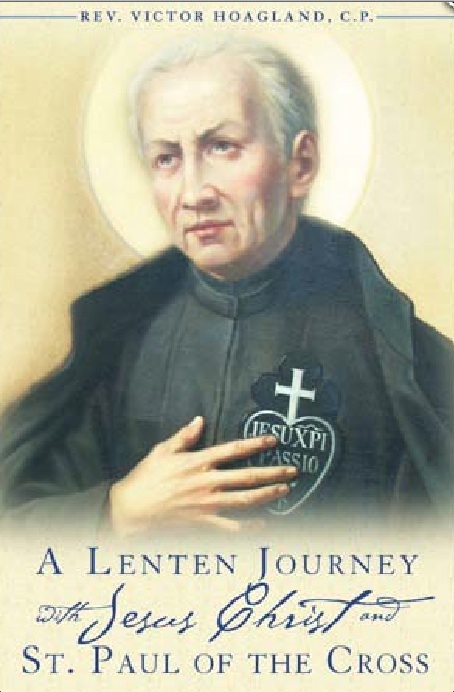
Last year I wrote “A Lenten Journey with Jesus Christ and St. Paul of the Cross” for Christus Publishing. It was a little late for last Lent but Lent is almost upon us and it’s available now on Amazon and Crossplace.com.

The book attempts to link St. Paul of the Cross with the Lenten season, an obvious connection for someone who loved the mystery of the cross. His spirituality responds well to the gospels we read during Lent.  Saints feed on the Word of God and he not only fed on it but preached it too. This book takes a look at his life and  spirituality and offers a daily reflection for each day of Lent based on the gospel of the day.

I hope to follow St. Paul of the Cross as he follows Jesus Christ in this season of grace and to use some excerpts from the book on this blog.

Lent is a journey that’s blessed. The church and the whole communion of saints take part in it.  Let’s make it together.

Lord, open my lips

We begin to pray with words like this. St. Ambrose explains what they mean in one of his explanations of the psalms. We are not asking just for help to pray:

“We must always meditate on God’s wisdom, keeping it in our hearts and on our lips. Your tongue must speak justice, the law of God must be in your heart. Hence Scripture tells you: You shall speak of these commandments when you sit in your house, and when you walk along the way, and when you lie down, and when you get up. Let us then speak of the Lord Jesus, for he is wisdom, he is the word, the Word indeed of God.
  It is also written: Open your lips, and let God’s word be heard. God’s word is uttered by those who repeat Christ’s teaching and meditate on his sayings. Let us always speak this word. When we speak about wisdom, we are speaking of Christ. When we speak about virtue, we are speaking of Christ. When we speak about justice, we are speaking of Christ. When we speak about peace, we are speaking of Christ. When we speak about truth and life and redemption, we are speaking of Christ.
  Open your lips, says Scripture, and let God’s word be heard. It is for you to open, it is for him to be heard. So David said: I shall hear what the Lord says in me. The very Son of God says: Open your lips, and I will fill them. Not all can attain to the perfection of wisdom as Solomon or Daniel did, but the spirit of wisdom is poured out on all according to their capacity, that is, on all the faithful. If you believe, you have the spirit of wisdom.”

The Approach of the Leper

These Sundays at Mass we’re looking at the beginnings of Jesus’ ministry vividly described in Mark’s gospel. Jesus came from the Jordan River where he was baptized with Peter and his brother Andrew, and James and his brother John, fishermen from Capernaum.

He was invited to stay in Peter’s house in that town, which today you can see if you’re fortunate to visit the Holy Land.  Archeologists have uncovered the town of Capernaum in recent years and you can see the remnants of its old houses made of black basalt, the foundations of the synagogue where Jesus prayed; and beyond the town are the low mountains where he taught. It’s a fascinating place.

Peter’s house was the center of his ministry there, it seems. Mark describes what happened after Jesus cured Peter’s mother in law: “When it was evening after sunset they brought to him all who were ill and possessed by demons, and he cured them. The whole town was gathered at the door.”

In recent times, Franciscan archeologists have identified Peter’s house among the closely packed houses of the town, and a shrine church is built over it now.

So many people crowded around that house that Jesus had to escape to the surrounding hills to pray. Afterwards he told his disciples that he had to visit other towns and places in Galilee.

Probably the leper approached him as he was going to one of those other towns. Our first reading from the Book of Leviticus gives a succinct account of how lepers were treated in those days. They were separated from family and hometowns and sent to live apart in abominable conditions. People were afraid to go near them.

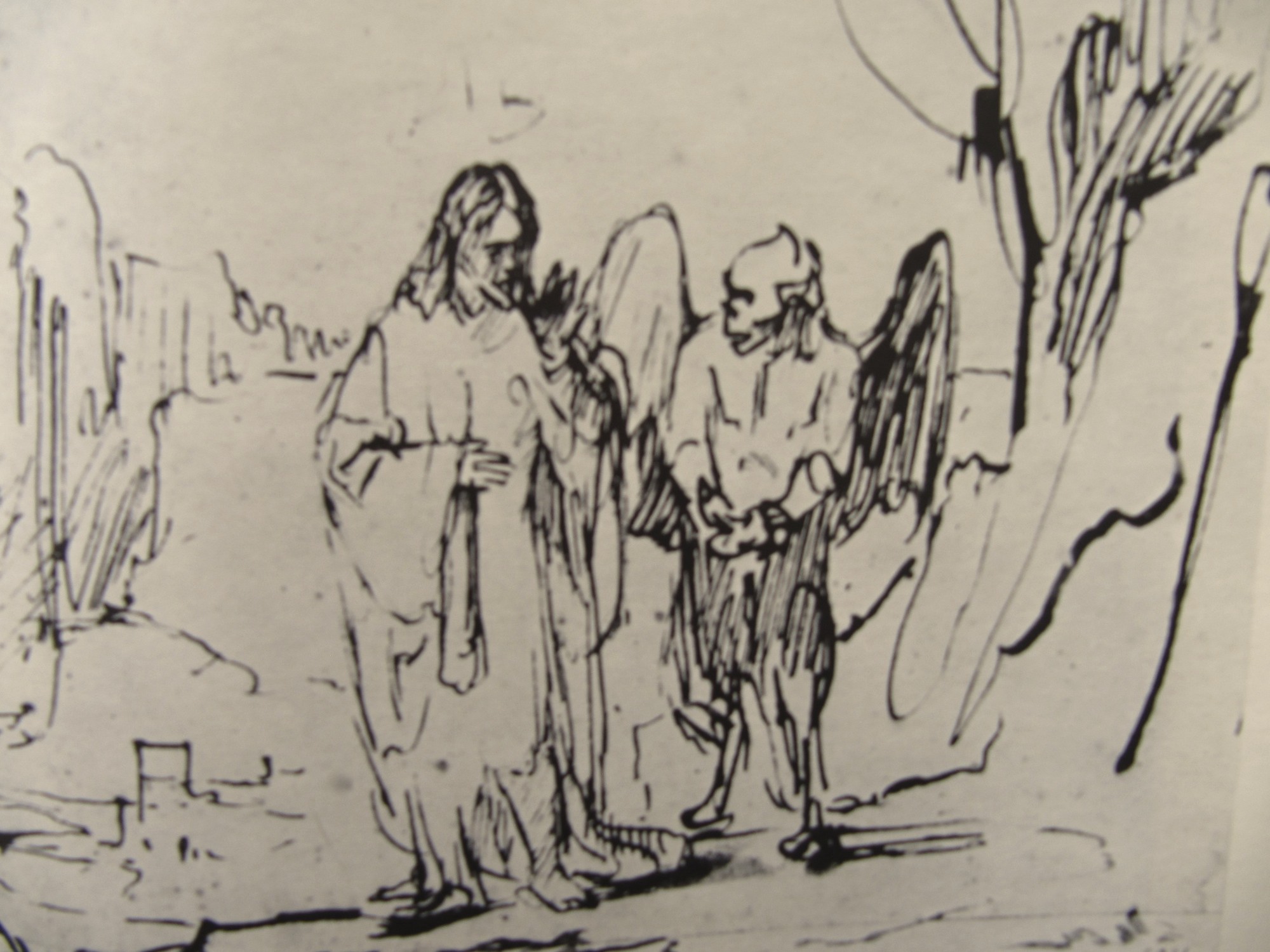
Rembrandt has a wonderful sketch of the lepers approaching Jesus.(above) It looks like Peter, who is behind him, is hiding in back of the Lord afraid to catch anything from the poor creatures who approach begging for help and healing.

Are we too afraid of people like the lepers, people suffering so much, people suffering from unexplained suffering, that we think we’re going to be overwhelmed by their suffering? We hide from the sufferings of the world. “None of that near me,” we say. But Jesus leads us to the leper. Let’s see suffering with him.

The Resurrection Story

On Wednesday night of our mission at St.Charles Borromeo, in Port Charlotte, Florida, I preached on the Resurrection of Jesus. It’s a mystery that predicts our future.

Recent scriptural studies have made us aware that the gospels of Matthew, Mark, Luke and John were originally meant for particular churches and situations, and so when we read them it’s good to keep in mind the world and circumstances behind each one. Each gospel offers its own unique insight into mysteries of Jesus, and to gain that insight we have to resist our tendency to harmonize one gospel with  the others.

Luke’s account of the resurrection of Jesus centers around the story of the two disciples on the road to Emmaus. Like the other gospels, Luke begins with the women at the tomb that Easter morning, but the Risen Jesus does not stay at the tomb. The Lord engages the world at large and shares his risen life with his disciples and all creation.

In his gospel and the Acts of the Apostles, Luke shows God’s plan of salvation being realized in the person and life of Jesus and then extended to all humanity in his church as its spreads from Jerusalem to Rome, which was then considered the center of the world.

He offers the journey of the two disciples on their way to Emmaus as a way to understand the church’s journey through time.  Just as he did with the two disciples, the Risen Lord walks with his church on its mission through the ages.

It’s not an easy journey. Like that of the two disciples, it’s not a triumphant march. It’s marked by disillusionment, by questions and gradual enlightenment, as their journey was. If the Risen Lord were not with them as they left Jerusalem at the end of the Passover feast, they would have ended up hopeless. The church would fall into hopelessness too, if he were not with her.

Like the two disciples we find the Risen Christ slowly in the scriptures and in the breaking of the bread. Like them, he makes our hearts burn within.

Luke’s resurrection account offers us a way to look at the church today. It’s a good corrective to a triumphalistic view that expects the church to be perfect. It isn’t. It’s also a good corrective to a perfectionistic view of ourselves.

Like the two disciples, we have our questions and suffer our disappointments, but the Risen Christ walks with us. He engages our questions and helps us to understand. He is present in the breaking of the bread, the Holy Eucharist. We don’t see him; he has vanished from our sight, but he is with us. We can rejoice in the Risen Lord with us and guiding us to his kingdom.


Let’s Look at the Saints

This morning, the last day of our mission here at St. Charles Borromeo, the school children were at the 8.30 Mass and participated beautifully in the liturgy. I spoke about St. Josephine Bakhita who was kidnapped and sold into slavery as a 7 year old girl in the Sudan, in Africa, around the year 1876.

She worked around the kitchen, cleaned the house and took care of the younger children of her African slave owners. Later, she was bought from them by a European family living in Africa then, and did the same things for them.

The family moved to Italy and brought Bakhita with them. One of her tasks was to take a younger child of the family to a Catholic school, where he became acquainted with the Daughters of Charity, the religious women who taught there.

When the family decided to return to Africa, Bakhita refused to go. The sisters and others made her aware that she didn’t belong to that family. She was a daughter of God who had rights of her own. In fact, Italian law forbade slavery.

Bakhita was freed and took the name Josephine. She was so impressed with the sisters that she joined their community.  She died in Italy in 1947 and was canonized a saint in 2000.

I told the children and others there at Mass that our church upholds human rights. We want all people to enjoy “life, liberty and the pursuit of happiness.”  Jesus came that people should be free.

Wonderful story to tell children. There should be no slaves in our world. Our church has been given a mission by Jesus: that all have rights to be free, to have a place to live, a family, food, medical care.

St. Josephine lived a holy life till she died. St. Josephine pray for us and help all those who are enslaved. Help us work for human rights.

Catechisms Have Changed

Some of us may have learned our faith through the questions and answers of the Baltimore Catechism, but catechisms have changed in recent years. One big change is that they’re not just for children, they’re for adults too.

The United States Catholic Catechism for Adults, published by the US Catholic Bishops in 2006, is an adaptation of The Catechism of the Catholic Church published in 1992 in Rome after the Second Vatican Council, as a response from the American bishops to Pope Paul VI’s call to the bishops of the world to adapt the universal catechism to the circumstances and culture of their own people.

The American catechism follows the arrangement of the Roman catechism and teaches about the Creed, the Sacraments, Moral Life and Prayer. One of its features is that it begins each lesson with a story of faith, a short biography of a Catholic, usually someone from the United States, who introduces us to the teaching that’s presented.

Many of the stories also help us appreciate how the Church in our country grew and the particular spirituality that’s been expressed here.

For example, St. Elizabeth Seton introduces us to its first question: our search for God. We search for God through creation, through human relationships and through the various circumstances of our lives.

Mother Seton found God in all those ways. As a young girl, neglected by her father and her stepmother after her mother’s death, she found God in the beauties of nature, in the fields around New Rochelle, NY, where she played as a child.

Then, she married a successful man, William Seton, and had children, a happy married life, lots of friends, and was active in her Episcopal church, Trinity Church, on Wall Street in New York City.

Her life changed when her husband’s business failed. His health also failed and Elizabeth took him to Italy to see if a better climate could revive him. When they arrived in Livorno, Italy, he died in her arms in a quarantine station at the seaport.

Some Italian friends took Elizabeth and her daughter into their home and there she began to think about becoming a Catholic. That step caused her to lose some old friends; as a widow with small children she faced hard times.

Resettling in Baltimore, then Emmitsburg, Maryland, she established a Catholic school and gathered other women to form a religious community. One of the great saints and founders of the American Church, her quest for God was lifelong and many sided. She is an example of how our search for God goes on through creation, through the people around us and in the circumstances we face going through life.

Mother Seton is a teacher of faith and played an important role in the history of the church in our country.  She reminds us how important women have been, especially religious women,  in building our American church. She also reminds us that we’re all called by God to teach others.

We’re Called

We may think our relationship to God is a personal affair that doesn’t depend on anybody but ourselves, but that’s not so. Others help us on our way to God. Our gospel reading for this Sunday, for example, tells us that John the Baptist told some of his disciples to follow Jesus and Andrew brought his brother Simon to him. More than we know, others lead us to God.

Instead of a lonely journey, we go to God together. Another way of saying it is that we belong to one body, a church.  Much of our knowledge and faith in God comes from others. We’re not lonely believers.

Our first reading is about the young boy Samuel whom God has chosen for a special mission among the Israelites. His mother senses this and sends him to spend some time in the temple; she hopes the priests there will help him understand what his calling is.

The young boy hears God calling in the night but it’s a very indistinct call; he’s a young boy and he doesn’t know what to make of it. The old priest Eli doesn’t help much at first. He tells the young man there’ s no one calling, go back to sleep.

Finally, the old man recognizes that God is calling the young man. This isn’t the first time someone from an older generation doesn’t understand someone younger.  An early example of the “generation gap?” The story, we learn, is not just about a young boy finding what God wants him to do, but it’s also about someone from an older generation helping him find out.


After awhile, the old priest gives Samuel the right advice: “Go to sleep, and if you are called say ‘Speak, Lord, your servant is listening.’”

That’s wise advice. The old priest is telling him, first of all, believe God speaks to you. Then, listen humbly as a servant, without letting your own ideas intrude. Become a listener and hear what God wishes to say. Pray.

An elderly man from California calls us every few months to ask for copies of a little prayer we publish called “Be With Me Today, O Lord,” which he distributes to schools and churches in his area. It’s a simple prayer you can find over at Bread on the Waters, where a lot of prayers like this can be found.

The prayer says that God has something for us to do today and everyday; we have a mission in life and it asks God to point that mission out so that we can do it.

“I have a mission…

I am a link in a chain, a bond of connection between persons.

God has not created me for naught… Therefore I will trust him.

Whatever, wherever I am, I can never be thrown away.

God does nothing in vain.

He knows what he is about.” (J.H. Newman)

We’ re links on a chain, a good image of how we fit into life’s larger picture. God hasn’t created us for nothing. We all have a mission in life, but we need people to help us know it.

Our Sunday readings might suggest one particular calling we need to think about and pray about and promote today–vocations to the priesthood and religious life. We need good priests and religious for our church and our world. God calls young men and young women. But they need others, like Eli, to support them in their call.

Next Saturday in our monastery in Jamaica, New York,  the Passionists are having a “Called by Name” weekend for young men who may be called to our community. I’m part of it. Know anyone who might have a call? Pray, and like Eli could you also encourage them to listen to God’s call?