Tag Archives: Jesus Christ

Come and See

There’s not much said about the apostles in the New Testament; they walk in the shadow of Jesus. Because of that, we have only a few details about Andrew, the brother of Peter, whose feast is today.

One detail is his name, Andrew, a Greek name, which may be due to the fact that the area around the Sea of Galilee was multi-cultural and Jewish families sometimes took gentile names.  His family was from Bethsaida where a lot of trade went on. Did Andrew speak some Greek?

Maybe he did, because later in John’s gospel he and Philip bring some Greek pilgrims to Jesus before his death. Jesus sees their coming as a sign of his approaching passion and glorification and he rejoices. (John 12, 20-28) We have to be careful of seeing Jesus’ apostles as poor uneducated fishermen, not likely to get along in a bigger world.

Andrew must have been religious. Early in John’s gospel, he’s described as a disciple of John the Baptist who points Jesus out to him. Jesus then invites Andrew and another disciple to stay for a day with him. “Come and see.” Afterwards, Andrew “found his brother Simon and said to him ‘We have found the Messiah.’” (John 1,35-41)

The Greek Church honors Andrew as its patron and considers him the first apostle because he was the first to see Jesus and follow him; then he called his brother. Tradition says Andrew was crucified on the beach at Patras in Greece and during his martyrdom extolled the mystery of the Cross of Jesus. He’s also the patron of Russia and Scotland.

A number of saints and feasts are celebrated during Advent. Certainly, saints like Andrew belong in our celebration of the Incarnation.  Jesus, the Incarnate Word, drew people to himself who, in turn, drew others. His grace can’t be contained.

“Come and see,” Andrew says.

The Son of Man

We can make Jesus Christ too small sometimes and thus limit his mission and power. That’s what his disciples seem to do in Mark’s  gospel.

“John said to Jesus,

‘Teacher, we saw someone driving out demons in your name,

and we tried to prevent him because he does not follow us.’”(Mark 9,38)

Someone is doing good, but the disciples don’t know him. He doesn’t belong to their “church.” He’s doing what Jesus would do–in this case casting out demons. We might say he’s acting like a Christian, but he’s not Christian.

“Whoever is not against us is for us,” Jesus says. In other words, anyone acting as I would, thinking as I would, belongs with me, and “they will surely not lose their reward.”

Is this a reminder today for us  who so often fail to recognize the goodness and truth in others because they don’t belong to our church, or nation, or political party, or school, or are just not like us?  It’s seems so, especially in our polarized world, where we increasingly define others by differences instead of what we have in common.

Jesus tells us, as he did his disciples, to see how others are with us, rather than against us.  Look for the truth we share, even in someone we may oppose, for we  share a common nature and a common humanity. We’re human beings made in the image and likeness of God.

That’s what Jesus did. He welcomed others, even those people shunned– lepers, tax-collectors, sinners– outcasts in their day. He was open to all, even his enemies. He welcomed them and was at home with them.

It’s interesting to notice in the gospels how often Jesus seems to shy away from titles that could distance him from others.  “Who do people say I am?” he asks his disciples at one point. “They said in reply, ‘John the Baptist; others, Elijah; still others, ‘One of the ancient prophets has arisen.’ Then he said to them, ‘But who do you say that I am?’ Peter said in reply, ‘The Christ of God.’” (Luke 9,18-22)

Yet, Jesus is hesitant to accept these titles for himself publically.  The one title he seems to prefer is “the Son of Man.”

“The Son of Man must suffer greatly and be rejected by the elders, the chief priests, and the scribes, and be killed and on the third day be raised.” (Luke 9,22)

“ The birds of the air have their nests, the foxes have their dens, but the Son of Man has nowhere to lay his head.”

Scholars can’t say exactly what Jesus means when he calls himself “the Son of Man,” only a couple of references are found in the Old Testament (Daniel) and in Jewish literature, but not enough to indicate its precise meaning. There seems to be no doubt, however, that Jesus did indeed refer to himself as “the Son of Man.”

Some say the best approach is to look at what the words obviously say. “I’m the son of man,” Jesus says;  in other words “I’m a human being.” Can we say that Jesus preferred to present himself in his humanity, rather than his divinity? He came to live among us, not as a divine being, but as a human being, someone like us. Human, he experienced life as we do; he knows suffering and death as we do. To restore our humanity, to show what it means to be human, Jesus became “the Son of Man.”
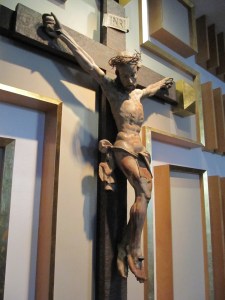
There’s a beautiful crucifix in the chapel where I live now, in Jamaica, New York, a five foot wood carving of Jesus from 15th century Germany.  It bears the wear and tear of the years. Jesus is clearly human, stripped of any sign of his divinity, his head bowed in death. It’s hard to see if he’s white, or black or Asian. He could be any of them. To me he’s the “Son of Man.”

The crucifix has an interesting history. It was given to one of our priests by the Catholic bishops of Germany and Austria after the 2nd World War when Germany was in shambles, its cities in ruins and its people crushed. They were our enemies. The crucifix was from the ruins of a German church.

The priest was in charge of Catholic Relief, one of the agencies that helped get that country on its feet again, and to me the crucifix seems to represent the bishops’ thanks for this recognition of our common humanity. The Son of Man came to reconcile and restore, not to destroy.  That’s what Jesus did.
Words Heal

Just read a review by Gary Wills of a book by Peter Brown about St. Augustine and other early saints. Augustine was someone who couldn’t live outside a community. He needed friends around him from his earliest years and later as a bishop lived in a community, because he appreciated  the help he got from others. It wasn’t that he needed an audience. He needed others to carry him along, to put up with him, because he was a sinner.

In a sermon in today’s liturgy of the hours, Augustine scolds the shepherds of the church for not befriending their flock. Their sheep want good pasture; they’re looking for healing. “You have failed to strengthen the weak,” the Lord says to them. They need shepherds, but do they also need friends?

Augustine turns to the  paralyzed man in the gospel. He needed friends to carry him to be healed, friends with faith in him, friends to bear his burden. They carry him up the roof and lower him down into the presence of Jesus. Yet, before Jesus says a word to the paralytic, did he hear from his friends, “Don’t be afraid?”


Blessed are the poor in spirit

There is no doubt that the poor find it easier than the rich to receive the blessing of humility; for gentleness goes with poverty just as pride more commonly goes with riches. Nevertheless,  many rich people find that their wealth does not swell them up with pride: rather, they do good and benevolent things with it. For these people the greatest treasure is what they spend in relieving the distress and hardship of others.

  In the virtue of humility people of every kind and every standing meet together, because though they differ in their means they share a common purpose. Their inequality of wealth makes no difference if they are equal in spiritual blessings.
  What kind of poverty, then, is blessed? The kind that is not in love with earthly things and does not seek worldly riches: the kind that longs to be filled with the blessings of heaven.
Pope Leo the Great

Tell Us

We have had names for you:

The Thunderer, the Almighty

Hunter, Lord of the snowflake

and the sabre-toothed tiger.

One name we have held back

unable to reconcile it

with the mosquito, the tidal wave,

the black hole into which

time will fall. You have answered

us with the image of yourself

on a hewn tree, suffering

injustice, pardoning it;

pointing as though in either

direction; horrifying us

with the possibility of dislocation.

Ah, love, with your arms out

wide, tell us how much more

they must still be stretched

to embrace a universe drawing

away from us at the speed of light.

R.S.THOMAS, from: The SPCK Book of Christian Prayer, London, 1995

Grace Before Meals

“Not only in Israel, but among the ancient peoples generally, a meal was much more than a meal, understood as an occasion of eating and drinking. A meal was a sacred occasion, something that is hard for us to understand in these days of ‘fast food’, when eating is little more that  a biological function. Even a few decades ago, when  grace before meals was quite common in Western countries, there was some sense that eating and drinking are not merely biological occasions, but carry ( or may carry) many connotations.

The fact that grace before meals has become something of a rarity nowadays is symptomatic of the change that has taken place. Even when people sit down together at table they are often in a hurry to get away so that they can get to some other matter, whether business or pleasure, that seems to them more important. Even when graces are said nowadays, it is often on the least appropriate occasions, lavish banquets in city halls, colleges, or similar institutions.

But the point I want to make is that the disapperance of grace points to the fact that there has been a loss of any sense of the sacred ina meal, any sense of gratitude to God who has provided for the maintenance of life in his creation, or even to those human beings whose labor brought the fruitfulness of earth to a form in which it can nourish the human race.”

John Macquarrie, A Guide to the Sacraments, 102


How to Read the Bible

We’ve been blessed in recent times with a better understanding of the bible, thanks to scholarly studies of the last century or so.  Historians, archeologists, linguists are giving us a clearer picture of these ancient books, their meaning, when they were written, their historical context. New discoveries, like the Dead Sea Scrolls, have increased our knowledge of this book, which is really a library of Christian spirituality.

We know more about the scriptures today than we’ve known for centuries. Our new knowledge helps us to know Jesus Christ better, of course, so shouldn’t we be more acquainted with these readings? Unfortunately, Catholics are still slow to go to the bible for their spiritual nourishment, even though our liturgies have been enriched by readings from scripture since the liturgical reforms of the Second Vatican Council.

What bible should you read? Visit a book store like Barnes and Noble, go to the section where they’re selling bibles and you’ll find a bewildering collection of editions available today, going back to the old King James version.

The King James Bible is still the most popular bible read in the English-speaking world. For some fundamentalists it’s the only “Word of God.” But the King James version, for all its historical and literary qualities, has serious drawbacks. Since the time it was published in 1611, scores of ancient versions of the bible have been found, earlier than those on which this translation was based, and significant progress in biblical studies has also been made.

Because of this, many new translations of the bible have been published which take advantage of the new biblical resources. There are at least 30 new translations on the market today. In 1989, the New Revised Standard Version, a revision of the highly regarded Revised Standard Version, was published enlisting scholars from the major Christian denominations and authorized by these denominations. A fine translation.

In March 2011, a revised edition of The New American Bible (NABRE) was published. It’s a bible sponsored by the Catholic Church and it provides the readings found in its liturgies.  The last edition published 20 years ago was revised to take account of the new resources.

I like this bible myself for a number of reasons. For one, it’s available online free, so it’s always available if you have a computer, iPad, or iPhone. I appreciate especially the notes and introductory material, which may not be found in other versions of the bible. They are concise, clear and based on the latest scholarly research.

Another bible to take a look at is The Jerusalem Bible.

Catholics and other mainstream Christians hear the scriptures regularly from the lectionary during worship. The lectionary breaks down the books of the bible into parts, but there’s one drawback to reading the bible this way, I believe. We can read these parts in isolation, without enriching our reading with a fuller, more complete view that comes from reading the entire gospel or epistle, or prophet.

This month’s Sunday gospels from the 6th chapter of John, which begins with the miracle of the loaves and the fish, is an example. On the following Sundays we read sections of Jesus’ dialogue with the crowd, which is triggered by this powerful sign. Separated as they are from this key event, the readings can become disconnected from miracle and the overall themes that surround it.

There’s something to reading  from the bible itself, rather than settling for selections in the lectionary.

The Hand of the Lord Feeds Us

The Gospel of John, written around the year 90, is skillfully constructed  around seven wondrous actions of Jesus, seven “signs” that lead to his passion and resurrection. Our reading last week was about the fourth sign; Jesus multiplies a few loaves and fish to feed a hungry crowd of people near the Sea of Galilee. (John 6, 1-15)

After each sign, Jesus explains its meaning, and the gospels read on Sundays for the remainder of the month– all from the sixth chapter of John’s gospel– are the dialogue Jesus has with the crowd following this miracle.

They’ve followed him and are clamoring for more. He’s the bread come down from heaven, Jesus says, and he reminds them of a previous sign God gave their ancestors in the desert when he sent manna from heaven as they journeyed from Egypt to the Promised Land. They were hungry and God fed them.

He’s the new Moses come down from above to dwell with humanity, Jesus tells them, and he will feed them and lead them on their journey to God’s kingdom. Yet, like their ancestors described in our first reading from the Book of Exodus, this crowd grumbles too. Yes, they experienced a wondrous gift yesterday or so, but that was yesterday. They want daily miracles, something for their stomachs today.

But miracles of that kind don’t happen everyday. Miracles and exceptional signs from God are rare; we spend most of our years living by faith.

Yet, faith also needs something to go on, signs to help us on our way, and so Jesus leaves a reminder of the miracle of the loaves and the fish. He gives the Bread of the Holy Eucharist as a sign that he abides with humanity. We remember him in this sign, we recognize him and we receive him, the “true bread come down from heaven.”

Jesus came to satisfy our hunger, not just our basic hunger for food and drink, but the hungry for life in so many forms. “The hand of the Lord feeds us, he answers all our needs.”


Mercy

Blessed are the merciful, for they shall receive mercy. ‘Mercy’ is a beautiful word: more beautiful still is mercy itself. All wish to receive it, yet not all behave in a way that deserves it…You must show mercy in this world if you want to receive mercy in heaven.. What is human mercy? Exactly this: to have care for the sufferings of the poor. What is divine mercy? Without doubt, to grant forgiveness of sins. Whatever human mercy gives away on the journey, divine mercy pays back when we arrive at last in our native land. For it is God who feels cold and hunger, in the person of the poor. As he himself has said: As much as you have done for the least of these, you have done it for me. What God deigns to give in heaven, he yearns to receive on earth.

St. Peter Chrysologus

Passing On The Faith

Basilica of St. Ann, Jerusalem, 11th century

Devotion to St. Ann began in Jerusalem, probably at a 5th century basilica near the pool of Bethesda, where Jesus cured the paralyzed man waiting to get into its healing waters. Ruins of the basilica can be seen today in the ruins of the Bethesda pool. The present basilica of St. Ann, begun in the 12th century, stands nearby.

Would the early basilica be near the place where Joachim and Ann lived in the city, or was its site chosen for convenience? The ancient stories of the Protoevangelium associate Mary’s family with the temple and describe Joachim participating in the temple sacrifices. I wonder if we dismiss these stories too quickly as “myths.”

The Protoevangelium says that Mary was presented in the temple and dedicated to God as a child. At the least, this indicates that Mary would be well acquainted with the temple, its worship and the teachings of Judaism. If we accept this reconstruction, Mary would be far from a peasant girl from Nazareth. She would be better formed in Judaism and particularly in temple worship than we sometimes think.

Mary’s family was related to the family of John the Baptist, whose father Zachariah is a priest in the temple. (Luke 1,3-25) They live in the hill country near Jerusalem. Mary’s visit before Jesus’ birth to Elizabeth, Zachariah’s wife, connects her closely with them.

Later, as a young boy Jesus engages the teachers of the law on a pilgrimage to Jerusalem. (Luke 2,41-52) He amazes them with his wisdom. Could some of that  wisdom have come from a mother’s teaching?

“And Jesus advanced in wisdom and age and grace before God and man,” (Luke 2,52)

Mary and Joseph, Ann and Joachim certainly contributed to his growth.

Today at the novena, I’m going to talk about how Mary and Ann may have taught Jesus about the temple and what to do there. Like them, we must pass on our faith to others, particularly to the next generation.

Basilica of St. Ann, Jerusalem