Tag Archives: Jesus Christ

The Good Shepherd

“I am the Good Shepherd.” This is one of the names Jesus often used to describe himself and his mission. The Old Testament before him used this same image to describe God. So, Psalm 21 begins “The Lord is my Shepherd.”

During the Easter season the church favors portraying Jesus in symbolic ways: “I am the vine,”  “I am the Bread of Life,” and the description of him in our gospel: “I am the Good Shepherd.” That is because we know the Risen Christ now, not by seeing him, but in signs and symbols.

The Good Shepherd is a many-faceted image. On one hand, Jesus says he is the shepherd who goes in search of his lost sheep, and when he finds it he cradles it tenderly in his arms and brings it back to the flock. However far we stray, he will search for us and lead us back to the safety and comfort of his presence.

But the shepherd also leads his sheep and guides them through “a dark valley” into experiences and ways they cannot know. So, during the Easter season we read the story of the journey of the early church. Now, as then, Jesus is the shepherd leading his church into paths unknown, until finally she comes into “green pastures.”

He will lead each of us on our journey. Like sheep we feed intently on the small plot of life our eyes fall on. But the Good Shepherd is never far from us. No, we do not see him; but he is always near. We can trust him, “the shepherd and guardian of our souls.”


Where is your Palm today?

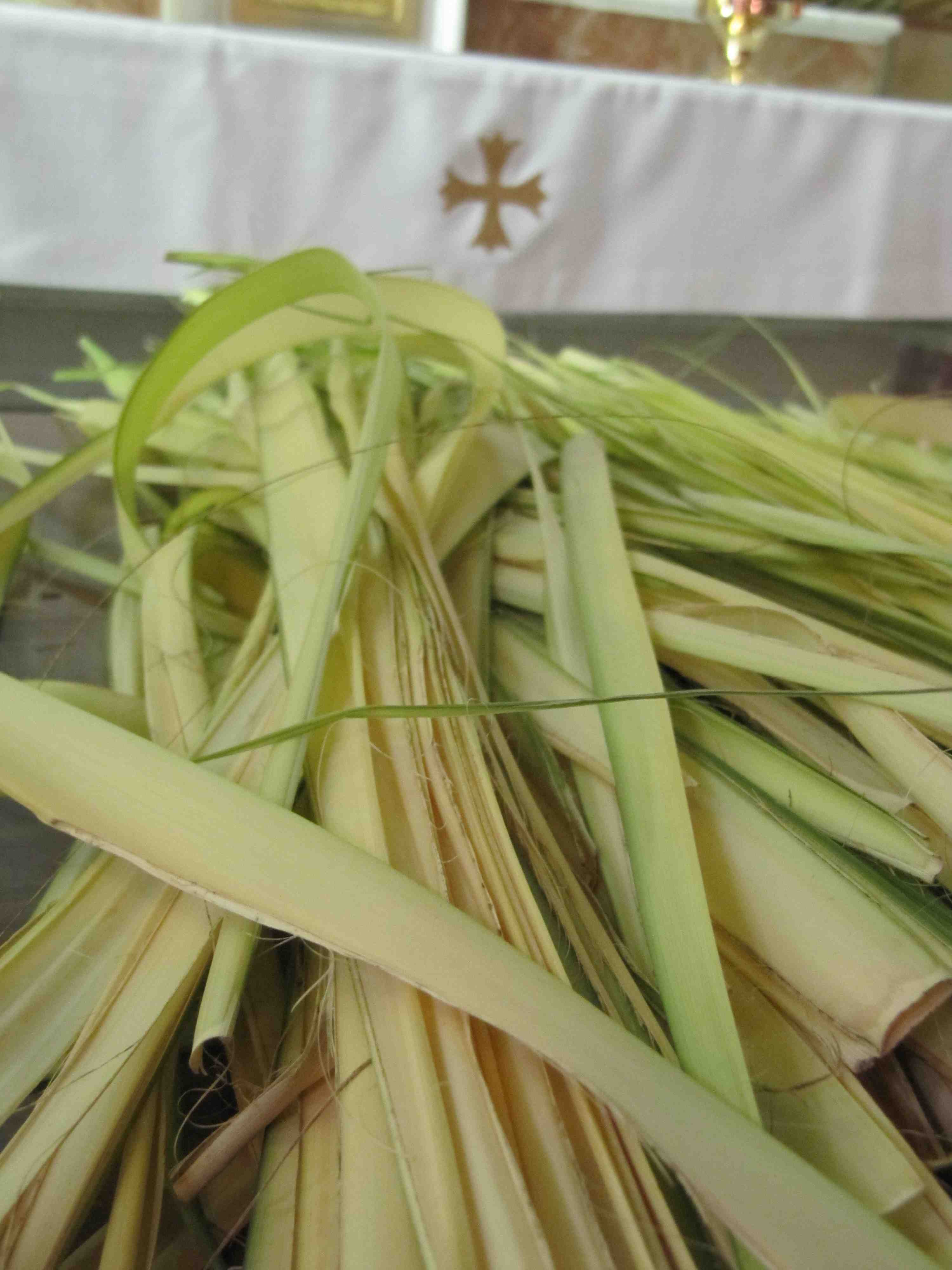
You took some palm home with you Palm Sunday? Where is it today?

Following Jesus isn’t a one day thing, it’s a lifelong journey. Stay at his side day by day. To enter Jerusalem, he sat on a humble beast of burden, the donkey, who carried the burdens of the poor.

Follow him on his way and make it your way too.

Thursday, 4th Week of Lent

Lent 1
READINGS
Different witnesses take the stand in John’s gospel today (John 5,31-47) and we listen to them testify for Jesus. They counter the false witnesses brought forth when Jesus stands before Caiphas, the high priest.

John the Baptist, “a burning and shining lamp,” speaks for him. The miracles and works of healing Jesus performed speak for him. His heavenly Father, who draws to his Son those unhindered by pride, speaks for him. Then, the scriptures, long searched by the Jews for the way to eternal life, “testify on my behalf.”

These are the ways faith in Jesus comes to us even now. How faithfully do we accept them? The church, like John the Baptist, points Jesus Christ out to us; are we guided by its light? His works and words and miracles are proclaimed in the scriptures; do we search into them? Our heavenly Father draws us to his Son; do we pray for faith and humility to accept his grace?

We’re reminded by scholars that “the Jews” spoken of in these passages of John’s gospel are not the whole Jewish nation but those who opposed Jesus because pride and position turned them against him. Ever since, people still oppose him. In Lent, the voice of the Father says once more: “Listen to him.”

Mystics like Paul of the Cross knew that faith is a gift of God; we don’t get it by reason alone. He recommended prayer, steady prayer, as a means to nourish and strengthen faith. “Every time your soul recollects itself in God, in the inner temple of your soul, it is born anew to a new life of love in the Divine Word Jesus Christ. I pray the Lord to help you understand and practice what I am teaching. In this recollection in the flame of holy love all the remains of sin are destroyed and the soul is renewed in God.”(2041)

O God,
Giver of all gifts,
Strengthen my faith.

3rd Sunday of Lent

Lent 1
readings (Please read further for Spanish and Swahili versions)

John’s gospel says that Jesus, setting out from Jerusalem for his native Galilee, “had” to pass through Samaria and meet the Samaritan woman at Jacob’s well. So it was not by chance that Jesus, the Savior, enter that land whose people were so bitterly opposed to their neighbors, the Jews of Judea and Galilee.

“It was about noon, and Jesus, tired after his journey, was sitting by the well.” A Samaritan woman came to the well for water. What a strong, unconventional woman she was! She came alone at noon, not the usual morning or evening time when women of the town came in groups with their water jars. Nor does she hesitate at the sight of a man sitting alone at the well.

How forceful and sarcastic her answer when Jesus asks for a drink! “What! You a Jew, ask for a drink from a Samaritan woman?” The ancient feud between Jews and Samaritans rises in her blood.
Yet the weary man persists, talking of human thirst and the living waters God provides. Gradually, as he talks of higher things, the woman recognizes he has more to give than water from the well; he fulfills all the memories associated with this ancient sacred place. He says something, however, she would rather not hear. “You have had five husbands, the man you are living with now is not your husband.”

She must have heard it less as an accusation than as the truth, for she doesn’t turn away. More than accusing her, she felt him refreshing her soul’s thirst. Eager and inspired, she put down her water jar and hurried to the town to tell her neighbors about the one she met. For two days Jesus stayed in that town. The tired gentle Jew, who sat by Jacob’s well, was welcomed as a Savior.

We must welcome him too; he comes to us and never tires of us. “Feed yourself on Jesus, drink his Precious Blood, quench your thirst from the chalice of Jesus. Yet, the more you drink, the more you will thirst.” (Letter 662)

O Jesus,
is the woman,
sure and strong,
our reflection:
sure but unsure,
strong but so weak,
seeking but afraid to find
our Savior so close by?

Spanish

Domingo, 3ra Semana de Cuaresma (Año A)
Juán 4. 5-42

El evangelio de Juán dice que Jesús, viajando de Jerusalén hacia su nativa Galilea, “tenía” que pasar por Samaria y encontrarse con la mujer samaritana en el pozo de Jacob. Así que no era por coincidencia que Jesús, el Salvador, entrara en esa tierra donde los ciudadanos estaban tan agriamente opuestos a sus vecinos, los judíos de Judea y Galilea.
“Era cerca del mediodía y Jesús, cansado del camino, se sentó junto al pozo.” Una mujer samaritana vino al pozo a buscar agua. Qué mujer tan fuerte y poco convencional! Ellla vino sola a la hora del mediodía, que no era el tiempo usual de la mañana o el atardecer cuando las mujeres del pueblo venían en grupos con sus jarras de agua. Tampoco ella vaciló al ver un hombre sentado solo al lado del pozo.
Qué potente y sarcástica su respuesta cuando Jesús le pide agua! “Qué, tú, un judío pidiendo un trago de agua de una mujer samaritana!” Se le subió en la sangre la riña antigua entre judíos y samaritanos.
Pero el hombre cansado persiste, hablando de la sed humana y del agua viva que Diós provee. Gradualmente el habla de cosas más sublimes y la mujer reconoce que él tiene más para dar que agua de un pozo; él realiza todas las memorias relacionadas con este antiguo lugar sagrado. Entonces él dice algo que ella hubiera preferido no oír. ” Tú haz tenido cinco maridos; el hombre con quien vives ahora no es tu marido.”
Ella tiene que haber oído esto menos como acusación y más como hecho, verdad, porque ella no le da la espalda. Más que acusándola , ella lo sintió refrescando la sed de su alma. Entusiasmada e inspirada, ella deja su cántaro y corre hacia el pueblo para decirle a sus vecinos sobre El que ha conocido. Por dos días Jesús se quedo´en ese pueblo. Ese judío, apacible y cansado, que se sentó junto al pozo de Jacob, fué bienvenido como Salvador.
Nosotros tenemos que darle la bienvenida también; él viene a nosotros y nunca se cansa de nosotros. San Pablo de la Cruz dice: “Alimentate de Jesús, toma su Preciosa sangre, sacia tu sed con el cáliz de Jesús. Pero, lo más que tomes, lo más que aumentará tu sed.” (carta 662)
¿O Jesús,
es la mujer
segura y fuerte,
nuestra reflexión:
segura pero insegura,
fuerte, pero tán débil,
buscando, pero con miedo de encontrar
nuestro Salvador tán cerca?

Lent

Jumapili ya tatu ya kwaresima
Padre Evans Fwamba

Swahilil
Injili ya Yohana inasema kwamba Yesu, alifunga safari kuelekea Yerusalem kwenye nchi yake alikozaliwa. Ilimpasa apitie kijiji cha Samaria ambapo alipofika kwenye kisima cha Yakobo alikutana na mwanamke Msamaria. Haikuwa eti ni bahati kuwa Yesu ambaye ni mkombozi kuingia katika nchi ambayo kuna upinzani mkubwa kati ya Wayahudi na Wagalilaya.
Ilikuwa saa ya mchana na Yesu amechoka kwa safari. Akaketi karibu na kisima. Mwana mke Msamaria akaja kwenye kisima kuchota maji. Mwanamke huyu alikuwa jasiri kwani alikuja pekee yake mchana wala sio asubuhi au jion ambapo ndio ilikuwa kawaida kwa akina mama kuja kuchota maji vikundi vikundi. Hata baada ya kumuona mwanamme aliyeketi pale huyu mama Msamaria hakusita.
Ukiangalia jibu lake, Yesu alipomuomba maji, “Nini!” Wewe ni Myahudi, halafu unaomba maji kutoka kwa Msamaria. Anakumbuka uhasama uliokuwako kati ya Wayahudi na Wasamaria na
kuamsha hisia za uadui.
Lakini Yesu aliyechoka anasisitiza kuongea juu ya kiu ya kibinadam na ya maji ya uzima yanayotolewa na Mungu. Taratibu anavyoendelea kuongea juu ya vitu vikubwa zaidi, mwanamke anatambua kuwa anazaidi cha kutoa zaidi ya maji kutoka kwenye kisima. Anakamilisha kumbukumbu zote zilizohusika na hii sehemu ya wazee iliyo takatifu. Yesu anamwambia kitu ambacho labda asingependa kusikia. Kwamba amekuwa na wanaume watano na hata yule aliye nae sio wake.
Mwanamke yule hakumuona Yesu kuwa anamulaumu bali anamwambie ukweli, kwani mama yule hakukimbia bali alibaki. Zaidi ya kuiona kwamba Yesu alikuwa anamlaum alijisikia kwamba alikuwa anatuliza kiu ya roho yake. Kwa hamu na kuvutiwa aliweka chini mtungi wa maji na kukukimbia mjini kuwaambia majirani juu ya yule mgeni aliyekutana nae. Yesu alibaki katika mji huo kwa siku mbili.
Yesu aliyekuwa amechoka na aliyekaa kwenye kisima cha Yakoba alipokelewa kama mkombozi.
Nasi pia tunapaswa tumkaribishe ndani yetu, anakuja kwetu na hachoki kamwe.
Paulo wa Msalaba anasema kuwa “Ujilishe kwa Yesu, unywe damu yake takatifu, kata/zima kiu yako kutoka kwenye kikombe cha divai ya Kristu. Ingawa vile unavyoendeleal kuinywa, ndivyo hivyo unaendelea kuwa na kiu zaidi.”
(Barua 662, August 9, 1749)

The Scandal of the Incarnation

Nazareth, Annunciation ch


The four gospels take a dim view of Nazareth, the hometown of Jesus Christ. Early in his gospel, John says that Philip, one of Jesus’ first disciples, invited Nathaniel to meet “Jesus, son of Joseph, from Nazareth.” “Can anything good come from Nazareth?” Philip replies. (John 1,46).

The other gospels recall the sad rejection of Jesus by his hometown after his baptism by John the Baptist. According the Matthew, it takes place after Jesus has spoken to a large crowd in parables. Then, he goes to Nazareth and speaks in the synagogue to his own townspeople, who are at first astonished at his wisdom, but then wonder where did “the carpenter’s son” get all this. They know his mother and his family, and they reject him. (Matthew 13,54-58)

Mark’s gospel puts the event after Jesus has raised a little girl from the dead. Going to Nazareth with his disciples, he’s greeted in the synagogue with astonishment because of his wisdom; they’ve heard of his mighty deeds, but then they ask where did this “carpenter” get all of this? He’s “Mary’s son” and they know his family. Jesus “was amazed at their lack of faith.” (Mark 6,1-5)

Why do they reject Jesus? The reason seems to be that they know his family and what he’s done for a living, and they can’t believe someone like him could be a messenger of God to them. He’s just a carpenter. What does he know? He came from an ordinary family, some of whom may not have been nice people at all. So they dismiss him.

At Nazareth we see an example of what’s called the “scandal of the incarnation.” People can’t believe that God could come to us as Jesus did.

That scandal still continues. One obvious instance of it is when people claim to be “spiritual, but not religious.” They want God and not the human ways God comes to us. They want God to be in the beauty of a sunset, but not in a church. They want God as they would like him to be, and not in the messiness of humanity.

I think of that line from one of the English poets:

“I saw him in the shining of the stars, I marked him in the flowering of the fields, but in his ways with men, I knew him not.”

The scandal of the Incarnation is always with us.

The Long Christmas Season

1 Jn 5:5-13
Lk 5:12-16

The Christmas season closes with the Feast of the Baptism of Jesus on Sunday. The season’s already ended for most people, however. The decorations are away. Valentine’s Day is coming up.

But it takes time to celebrate mysteries of God; more than a day or an hour or two. It takes time for the mysteries of God to sink in. And so we prepare for the celebration through the days of Advent. Then on Christmas Day the poor shepherds come from the dark hills to see the Child announced by the angels. A Savior is born for us, a Child is given to us. Yet, as the ancient carol says, “We scarce can take it in.”

The Feast of the Epiphany is a further reminder that the Child is the savior of all nations. He came, not just for one people, but for all. The Magi represent people far away and they bring him their greetings and gifts. Then, they leave to bring back the good news of his birth. That colorful story isn’t over; it’s still unfolding.

The Feast of the Baptism of Jesus may seem like a poor way to end the Christmas season, so far removed from the days and events of Jesus’ birth as it is. But baptism is about birth too, a birth that conquers death.

Jesus Christ “came through water and Blood,” St. John says in his First Letter today. His Spirit is given to us. It’s not enough to just look upon the mystery of the Incarnation. We’re meant to share his life, and baptism is a sign of our union with him.

We need time to understand all this, however. So the Christmas season is a long season. And we’ll celebrate again next year.

I Wonder As I Wander

Nativity

 “I Wonder As I Wander.” The American folklorist John Jacob Niles wrote that haunting Christmas carol. You may remember the words:


I wonder as I wander out under the sky

How Jesus the Saviour did come for to die

For poor on’ry people like you and like I;

I wonder as I wander out under the sky

When Mary birthed Jesus ’twas in a cow’s stall

With wise men and farmers and shepherds and all

But high from God’s heaven, a star’s light did fall

And the promise of ages it then did recall.

If Jesus had wanted for any wee thing

A star in the sky or a bird on the wing

Or all of God’s Angels in heaven to sing

He surely could have it, ’cause he was the King

I wonder as I wander out under the sky

How Jesus the Saviour did come for to die

For poor on’ry people like you and like I;

                                                                                                                     I wonder as I wander out under the sky


Niles heard a young girl sing a fragment of that song in a little town in North Carolina in 1933. “Her clothes were unbelievably dirty and ragged, and she too, was unwashed,” he wrote in his autobiography, “but she was beautiful, and in her untutored way, she could sing. She smiled as she sang, smiled rather sadly, and sang only a single line of the song.”

I wonder. Like so many great Christmas carols this song calls us to reflection, to wonder about the deepest questions of life, questions you only think about as you wander out under the sky. Big questions.

So where do we come from? And where are we going? And what does it all mean? Does God who is beyond our sight, see us? Is Jesus our Savior God’s Son?  Has he really come among us?

I wonder how he came. He could have had anything, our song says, “a star in the sky, or a bird on the wing”…he could have had anything, “cause he was a King.” But he came “for to die.”

I wonder about this fallen world of ours. Why does death still seem so strong?  Why were those innocent children slaughtered by Herod at his birth? And why do innocent children still die, I wonder today? And why in the end did he die such a death?

“When Mary birthed Jesus, twas in a cow stall.” Wise men and ordinary people came to a manger, his first throne on earth. I wonder how God should dwell in so simple a place, where animals were fed. Is it in  simple places like this, in bread and wine, in the simple ways we love each other, that God still feeds us, who wander out under the sky, “poor on’ry people like you and like I?”

Christ, the King

Christ majesty chartre
Luke’s gospel for the Feast of Christ the King presents Jesus, not in a royal palace, but on a dark desolate hill. He’s not surrounded by cheering crowds, but by people cursing his name. He has no crown of gold, but a crown of thorns. His robe lies torn from him, heaped on the ground soaked in his blood. His throne is a cross, and over the cross is the inscription: THIS IS THE KING OF THE JEWS.

We are tempted to see not power but failure here. But listen to the gospel. One of the criminals calls out to the wretched figure hanging next to him: “Jesus, remember me when you enter your kingdom.” And power goes out from him. “This day you will be with me in paradise.

The thief is an interesting figure in the gospel. He has no name, nothing is known of his life or his crime. There he is, desperate, thinking all is gone. Powerless, no one would take a chance on him. Who would bother with him? Who would come close to him? Only a God who in the person of Jesus Christ would come so low as to share a cross with him.

The thief has no name. Christian tradition says he bears everyone’s name. In the thief we see ourselves, our desperate, poor, powerless selves. Yes, that is how much Christ loves us. He will always be close to us.

Feast of the Dedication of the Church of St. John Lateran

Today, is the feast of the Dedication of Church of St. John Lateran in Rome. It seems to me you can see much of the history of the Roman Catholic Church here in this building, one of the great pilgrim churches of Rome.I wrote about this ancient 4th century church, the “mother of all churches” elsewhere.

In a homily for this feast, St. Caesarius of Arles says that this church, like all churches, reminds us we’re temples of God. “And if we think more carefully about the meaning of our salvation, we shall realize that we are indeed living and true temples of God. God does not dwell only in things made by human hands, nor in homes of wood and stone, but rather he dwells principally in the soul made according to his own image and fashioned by his own hand. Therefore, the apostle Paul says: The temple of God is holy, and you are that temple.”

The ancient baptistery at the Lateran church, pictured above, is an entrance to this church. Through baptism we belong to the great church whose Lord, Jesus Christ, shares his life with us.

The beauty of a church reminds us of the beauty of our souls, Caesarius says: “Whenever we come to church, we must prepare our hearts to be as beautiful as we expect this church to be… Just as you enter this church building, so God wishes to enter into your soul, for he promised: I shall live in them, I shall walk through their hearts.”

The Bread of Christ

bread wine
Besides being one body, the Body of Christ, we are also one Bread in him. When we celebrate the Eucharist, we listen first to God’s word and then offer bread and wine. The prayer over the bread points to its meaning:

“Blessed are you, Lord God of all creation, for through your goodness we have received the bread we offer you; fruit of the earth and work of human hands, it will become for us the bread of life.”

We receive the bread, “fruit of the earth and work of human hands,” from our Creator. St. Augustine calls the bread we pray for in the Lord’s Prayer and the bread we offer at Mass “the bread of everything.” The gift of everything is acknowledged at Mass through the bread and wine; we’re blessed with everything, we’re reminded, and through them, we give thanks to the God of goodness for it all. “What do you have that you have not received?”

The greatest of God’s blessings is Jesus Christ who, on the night before he died took bread into his hands, the “bread of everything,” and gave himself to his disciples through this sign. “Take and eat, this is my body which will be given up for you.” In a similar way, he gave them the cup of wine that signifies his blood “poured out” for us.

“Do this in memory of me,” he said.

A mystery of faith, we say in our prayer. We believe through these signs. We can’t let their humble circumstances– the place, the people, the simple acts and words dissuade us. We’re called to wonder at what’s hidden here.

LOST, ALL LOST IN WONDER
Godhead here in hiding, whom I do adore,

Masked by these bare shadows, shape and nothing more,

See, Lord, at thy service low lies here a heart

Lost, all lost in wonder at the God thou art.


Seeing, touching, tasting are in thee deceived:

How says trusty hearing? that shall be believed;

What God’s Son has told me, take for truth I do;

Truth himself speaks truly or there’s nothing true.


On the cross thy godhead made no sign to men,

Here thy very manhood steals from human ken:

Both are my confession, both are my belief,

And I pray the prayer of the dying thief.

I am not like Thomas, wounds I cannot see,

But can plainly call thee Lord and God as he;

Let me to a deeper faith daily nearer move,

Daily make me harder hope and dearer love.

O thou our reminder of Christ crucified,

Living Bread, the life of us for whom he died,

Lend this life to me then:
feed and feast my mind,

There be thou the sweetness
man was meant to find.

Bring the tender tale true of the Pelican;

Bathe me, Jesu Lord, in what thy bosom ran—

Blood whereof a single drop has power to win

All the world forgiveness of its world of sin.

Jesu, whom I look at shrouded here below,

I beseech thee send me what I thirst for so,

Some day to gaze on thee face to face in light

And be blest for ever with thy glory’s sight. Amen.

(translation of Gerard Manley Hopkins, S.J.)