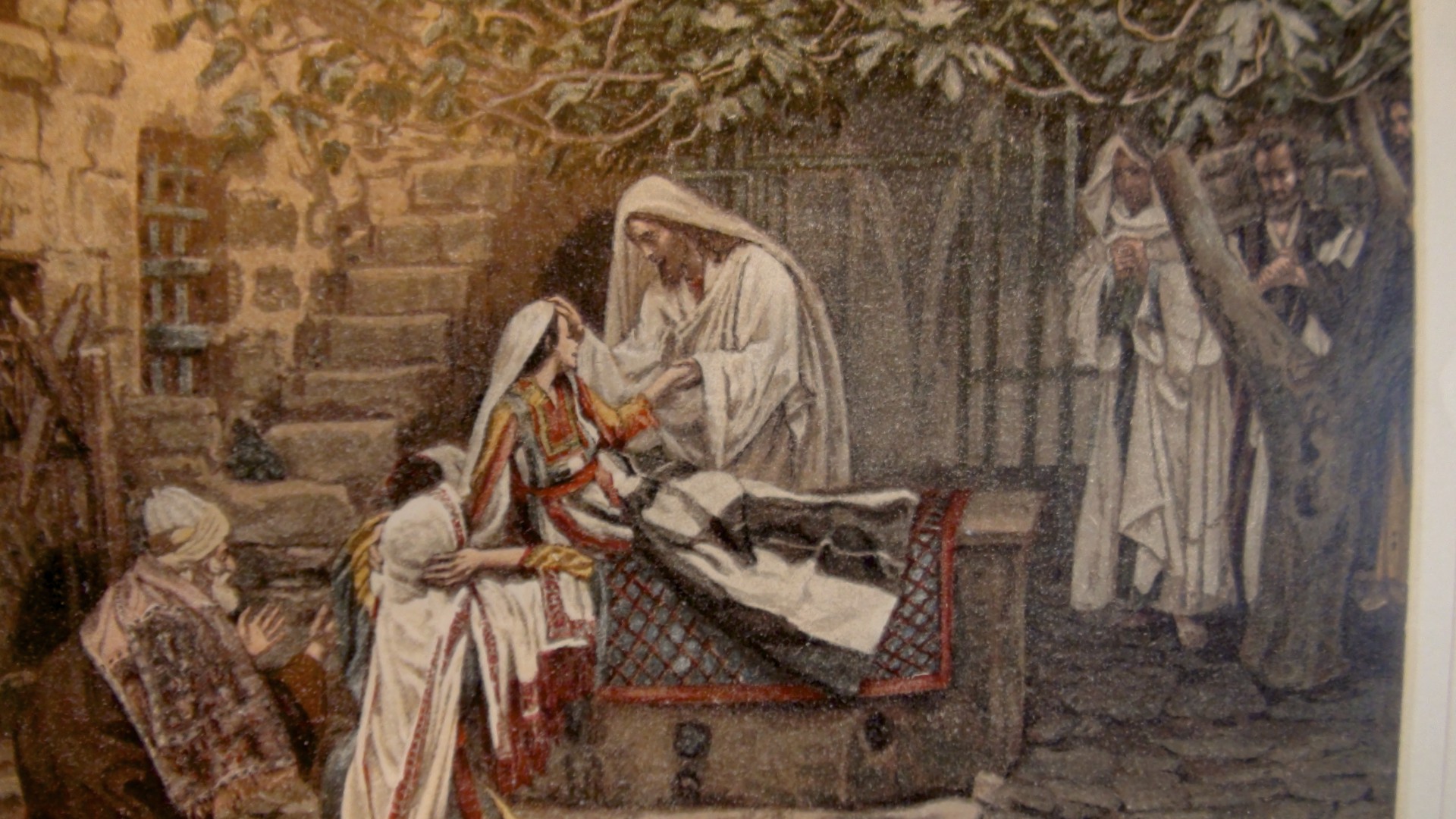
We read this story today at Mass. Why does Mark insert the story of the woman who touched Jesus’ garments into the story of the dead girl brought back to life? Was it simply that she happened to meet him on his way to the girl’s house? Maybe there’s another reason.
A picture of the woman touching the garments of Jesus is one of the oldest pictures found in the catacombs of Rome, where early Christians buried their dead. Is it there to remind them that those who died had also touched the garments of Jesus? They didn’t see him, but he met them in signs.
Those buried there believed in him and were baptized with water; they received his life through that sign and entered into the mystery of his death and resurrection. They received his body and blood in the signs of bread and wine, and so like the woman they touched his garments. His power and life went out to them.
The Gospel of Mark was written in Rome, most scholars say. Is Mark’s arrangement of the stories of Jesus raising the dead girl to life and the woman touching his garments a way of teaching Roman Christians about the mystery of death? Jesus was with them on their last journey.
In preparing the Catechism of the Catholic Church after the Second Vatican Council the Roman authorities responsible for the catechism instructed publishers to put the picture from the catacombs of the woman touching the garments of Jesus at the beginning of the section on the sacraments.
She’s an example, an image of the present church which knows Jesus through sacraments. She helps us believe in the power of simple signs.
To listen to the audio for today’s homily please select file below:
Every once in awhile I watch Jeopardy on television. At one point the host poses a question and waits a few seconds for a contestant to get the answer. Here’s my question. What’s the last of the seven capital sins?
If you got the answer, Sloth, you’re right. Sloth is the last of the capital sins and that’s where you would expect to find it, at the end of the list. It’s sleeping there, because that’s what sloth is. It’s laziness; it’s complacency. It can be spiritual or intellectual or physical laziness or complacency. It could be one or all of them together.
The passage in St. Mark’s gospel we’re reading today begins on the Mount of Olives. Jesus and his disciples have just visited the temple in the city of Jerusalem and one of his disciples points out the majestic temple across the Kidron Valley. “Look, teacher, what stones and what buildings!” Jesus said to him, “Do you see these great buildings? There will not be one stone left upon another that will not be thrown down.”
Can we hear complacency in the disciple’s voice. “ We have everything here, a great place, what more could we want.” Sloth is complacency in that it thinks there nothing more to do; we’ve made it and we don’t need anything more. The Advent season warns us about complacency.
You can see laziness,too, another characteristic of sloth, in the servants Jesus mentions in today’s gospel. The Master goes away and they seem to breathe a sigh of relief. “He’s gone, now we can do whatever we want. We can take it easy.”
The message we hear at the beginning of Advent is the same message Jesus spoke to his disciples on the Mount of Olives. “Watch! Stay awake!” You don’t know when I will knock on your door.
Our first reading today from the Prophet Isaiah is filled with similar warnings about not paying attention to God. You’re like dirty rags, withered leaves, he says to them. You’ve become like mud, hard clay that stuck and hardened in place. You need a potter to come along and water the hardness in you and mold you again. You need the potter’s hands to soften you and give you new life.
That’s what the Advent season is about. We asking God to awaken us from complacency, from laziness, from sloth. The psalm response in our today’s liturgy sums up that prayer so beautifully.
“Lord, make us turn to you, let us see your face and we shall be saved.”
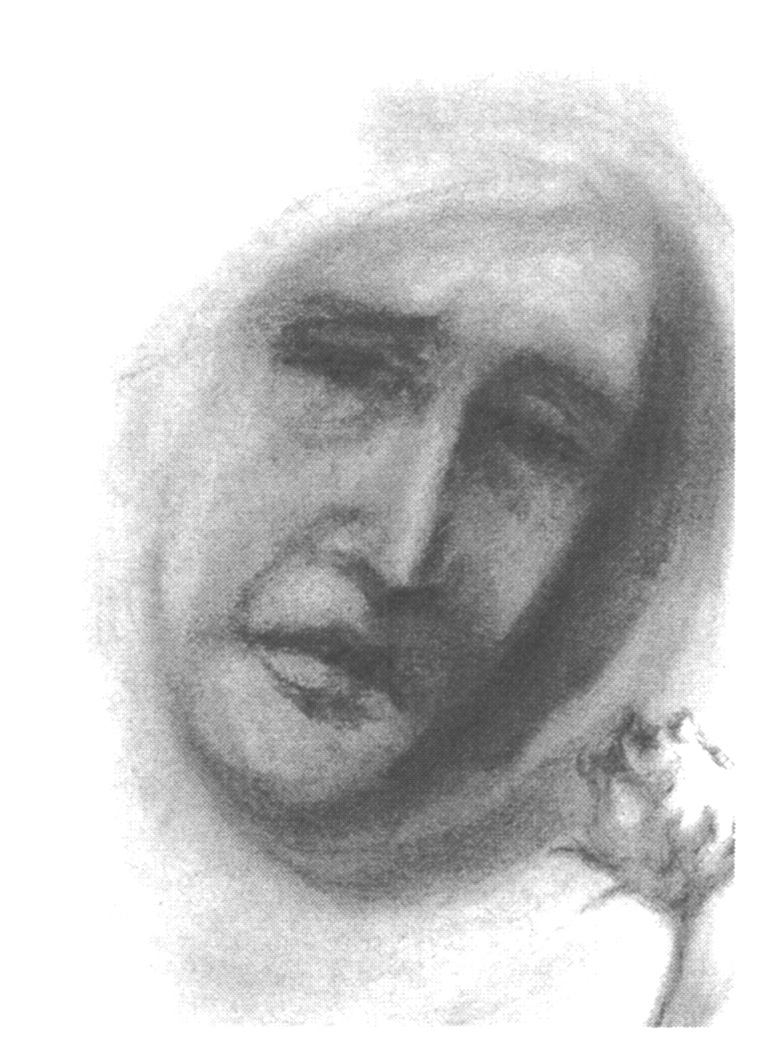
What is the face of God we are to turn to in this season? It’s the face of Jesus Christ, first as a child, born in Bethlehem. Then as a man, who speaks God’s words to us, who reaches into our lives and shares our sufferings. Then, as our Risen Lord whom we hope to see and who promises us life everlasting.
Advent, the season we begin today, is filled with the grace of God. Let’s watch for it.
To listen to the homily please play the audio below.
This parable of Jesus could come from today’s world of bankers and accountants and venture capitalists. We can miss what the story means. It’s deceptively simple, so let’s go slowly through it part by part.
First of all, the master of the house is going on a journey, so he calls three of his servants and writes out checks to them. He wants to make some money from what he gives them, and so they’re to trade till he comes back.
Right away, we see that the master of the house is very wealthy, extremely wealthy. He’s writing out big, big checks for his three servants.
The currency then was different than ours, of course. We have dollars; they had talents. One talent was a lot of money then, the equivalent to 6,000 denarii. And one denarius was the usual pay for a days work. So figure it out. My rough calculation is that 6,000 denarii would be what someone might accumulate after working 20 years.
So the one who got 1 talent got about $500, 000. 00. Not a bad amount to work with. The servant with 2 talents, was given about a million dollars. The servant with 5 talents, was about 2 and a half million dollars. That’s what I figure it was.
Whatever it was, it was a very large sum. That might be the first lesson to learn from the story. The Master of the house– God, of course– is very generous with what he gives us. We’re rich. When we were born and baptized we received, not money– most of us came into this world without a cent to our name. But we have gifts, talents. Actually, the word today means more than money. Talents encompass all the gifts of mind and body we have from God
The second lesson is that we have to use the gifts we have. “Trade till I come,” God says. We are God’s servants and what we have is not ours, it’s been given to us, and we have to account for our lives and what we do with them.. “What do you have that you have not received,“ St. Paul says.
That’s a good question. Some today say “I worked for everything I’ve got. I can do whatever I want with my life and what I have.” No we can’t. We’re God’s servants. We may not like to be called servants, but that’s what we are. The life that pulses through our bodies, health we have, the mind we have, the homes we live in, the cars we have, the jobs we do.
God gives us a great deal of freedom, as he does to the servants in the parable. He’s not standing over us every minute, telling us what to do. No, we’re free to do creatively what we can do. But God wants us to trade till he comes.
The final lesson in the parable is this. Did you notice which servant gets chastized ? It’s the one who was given one talent. His excuse is that he was worried about losing everything and so he buried his master’s money in a field. Actually, from what we know of our Lord’s time, that was the safest place you could keep precious things. Dig a hole and bury them in the fields out of sight.
I always wondered why the Master was so angry with this servant who seems only to be playing it safe. Maybe it’s because he seems to stand for all those with ordinary talents, so ordinary that they bury them and don’t use them.
There’s so much neglect of ordinary talents today, so much belittlement of them, so much of taking them for granted. We think only people with a lot are important. We stand in awe of celebraties and we miss the value of ordinary people and ordinary things and ordinary talents.
Someone sent me this little quiz by email.
Name the five wealthiest people in the world.
Name the last five Heisman trophy winners.
Name the last five winners of the Miss America.
Name ten people who have won the Nobel or Pulitzer Prize.
Name the last half dozen Academy Award winner for best actor and actress.
Name the last decade’s worth of World Series winners.
How did you do? The point is, none of us remember the headliners of yesterday. They are the best in their fields. But the applause dies.. Awards tarnish. Achievements are forgotten. Accolades and certificates are buried with their owners.
Here’s another quiz. See how you do on this one:
List a few teachers who aided your journey through school.
Name three friends who have helped you through a difficult time.
Name five people who have taught you something worthwhile.
Think of a few people who have made you feel appreciated and special.
Think of five people you enjoy spending time with.
Easier?
The lesson: The people who make a difference in your life are not the ones with the most credentials, the most money, or the most awards. They are the ones that care. Use the talents you have.
“Don’t worry about the world coming to an end today. It’s already tomorrow in Australia.” (Charles Schultz)!
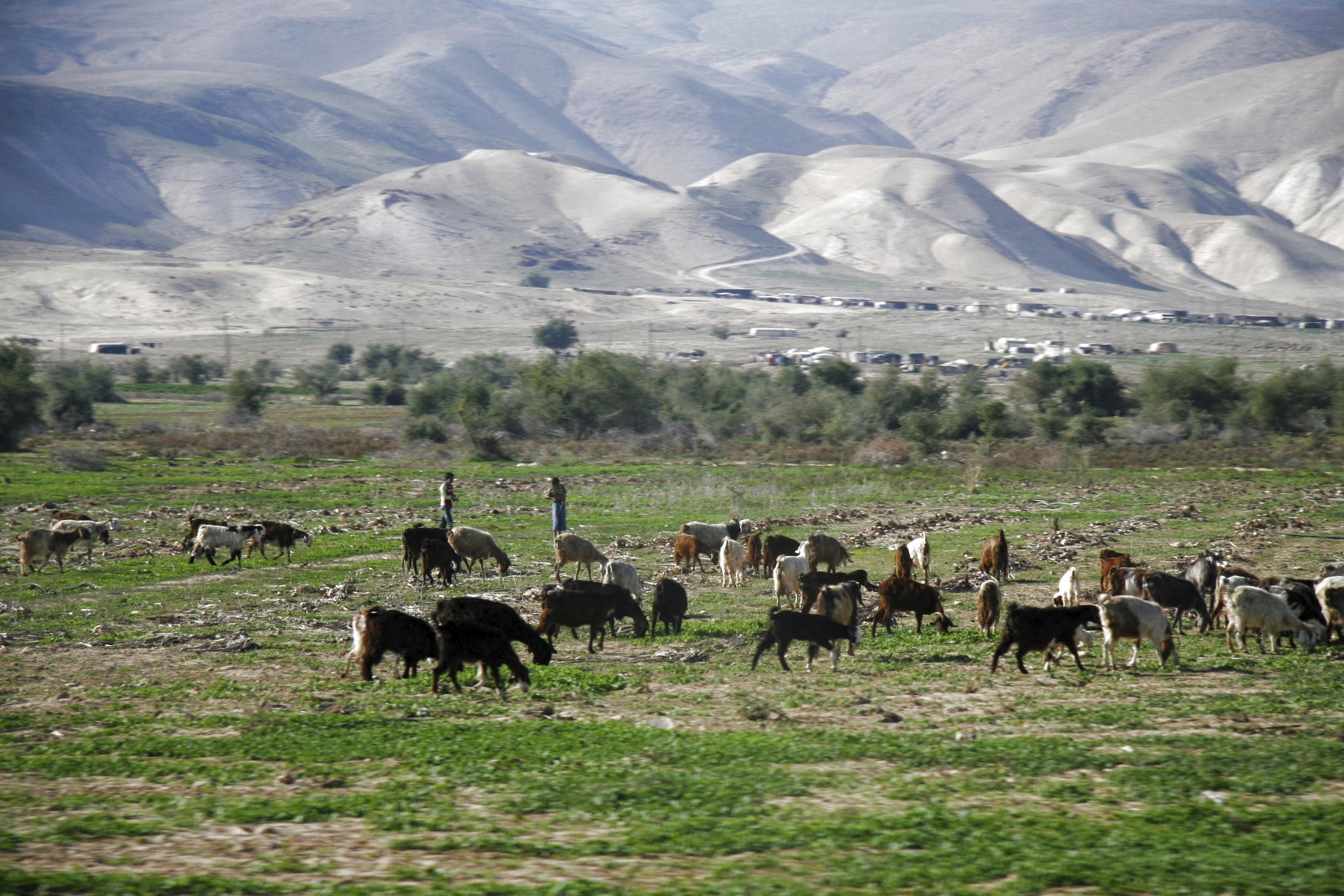
A few years ago a woman sent me some pictures from her pilgrimage to the Holy Land. The one above is a picture of some sheep in the Jordan Valley. In the background are mountains that trail off into the dark distance. In his day, Jesus would have passed this way from Galilee to Jerusalem. Probably sheep were grazing in the green pastureland then as they do now.
I think of this picture whenever I hear his parable of the lost sheep, which we heard in Luke’s gospel today at Mass.
Can you imagine searching for one sheep in those mountains? Just looking at them might cause us to say, “Well, that one’s gone,” and give up. But the Good Shepherd doesn’t say that or give up. He searches the mountains till he finds what was lost, then he puts it on his shoulders and rejoices with his friends and neighbors.
“Rejoice with me because I have found my lost sheep.”
The lost sheep is not only each one of us; it’s also a lost world.
We remember the sorrows of Mary on September 15th, the day after the church celebrates the Feast of the Exaltation of the Cross. In John’s Gospel Mary stands bravely close to Jesus while others flee the dark happenings on Calvary. Standing beneath the cross of her dying Son was certainly her greatest sorrow.
Her sorrows were not confined to Calvary, however. They began earlier. Early in Luke’s gospel, the priest Simeon in the temple, taking the Child Jesus in his arms tells Mary this child will cause a sword to pierce her heart. His words were etched in her mind as she left the temple holding her endangered Child. Fleeing to Egypt, she protected him in her arms. Later, she sought him anxiously when he was lost on a Jerusalem pilgrimage.
These were hardly all the sorrows she faced, though. What of her long waiting in Nazareth, not knowing all to expect? What of the years her Son ministered in Galilee, when he faced rejection even from his own family? What of the ominous journey to Jerusalem? Those years brought, not physical sufferings, but sufferings of another kind.
Mary’s sorrows were the sorrows of her Son. Mary’s cross was a daily one she bore day by day. “O Lady Mary, thy bright crown is no mere crown of majesty. With the reflect of his own resplendent thorns, Christ circled thee.” (Francis Thompson)
Mary teaches us that our sorrows, whatever they may be, reflect the Cross of Jesus. They will not crush us or beat us down; they lift us up to glory.
The parable of the mustard seed tells us to watch for small things. Small gestures, small acts of kindness, small prayers. Life comes from small things.
I was thinking of the Sign of the Cross, a small prayer.
We pray as Jesus did. How did he pray? He prayed from the heart, yet Jesus used words and signs– sometimes even cries– to pray. Like him, we also use words and signs in prayer.
One prayer we pray frequently is the Sign of the Cross.
The Sign of the Cross goes back to the earliest days of Christianity. It’s made on us at baptism, when we become members of the church and it’s the last sign made over us as we pass to our future life. The Sign of the Cross is used in liturgical prayer and celebrating the sacraments. We begin and end our prayers with it.
When we “bless ourselves” we trace with our hand the figure of the cross on our forehead, our heart, our shoulders, and say:
In the name of the Father, and of the Son, and of the Holy Spirit. Amen.
The Sign of the Cross is a prayer of blessing because it symbolizes God embracing us and blessing us. For the Jews God is always One who blesses. God blessed Noah and saved the world from the flood. God blessed Abraham and Sara with blessings more than the stars in the sky. God blessed the Jewish people, redeeming them from the slavery of Egypt. Life itself and all creation are blessings from God. And God’s blessings, beyond measure, continue, always and everywhere.
Since God blesses us continuously, we bless God in return. “I will bless the Lord at all times,” the psalmist says.
As Christians we bless God who is Father, Son and Holy Spirit. As Father, God offers us the blessings of creation and also gives us his Son. “Blessed be God, the Father of our Lord Jesus Christ, who has bestowed on us in Christ every spiritual blessing.” ( Ephesians1,3 ) Jesus Christ is our God, our Friend, our Brother, our Savior. With the Father he sends the Holy Spirit “to complete his work on earth and bring us the fullness of grace.”
When we bless ourselves, we remember God “from whom all blessings flow,” Father, Son and Holy Spirit.
Blessed by the Cross
As Christians we believe the Cross of Jesus Christ is the greatest blessing given to us. Why is it our greatest blessing? Because God expresses his love for us above all in Jesus Christ who died on the Cross for us and rose again. The Sign of the Cross is a reminder that Jesus’ love never ends. His blessings are ours forever.
We express our daily relationship to God in this simple prayer. We have God’s blessings each day, in good times and bad, in danger and sorrow. God’s blessings and love are always there. Before we take one step, we receive blessings from his hands.
In his parables Jesus often presents God as a human being doing things human beings do. He’s a sower sowing seed, an owner of a vineyard with people working for him, a father dealing with a wayward son, a shepherd caring for his sheep, a king whose son has been killed.
The stories bring God into everyday life, where he interacts with people and shares their cares and concerns. Like Jesus, his Son, God enters into the joys and problems of human life in this world.
In the parable we read today, God is a farmer who has sown seed in his field, but afterwards an enemy comes and sows bad seed among the good. Weeds grow up with the wheat. God, as the farmer, faces one of the great problems we all face–the problem of evil.
Why would anyone want to destroy a good field someone else has planted: revenge, jealousy, envy, or just reckless disregard for what’s good? A further question is: what do you do about this?
The farmer’s servants react with fear when they discover weeds growing up with the wheat.. “Do you want us to go out and pull the weeds up? “ The farmer tells them to let the wheat and the weeds grow till the harvest. Then they can be separated; the wheat gathered in barns and the weeds burned and destroyed.
A lesson to draw from this parable is “Don’t be afraid of evil.” It’s an important lesson. Certainly we have to recognize evil and fear it, but not get overly frightened by it. God doesn’t according to our parable. Like the farmer who has confidence in his wheat, God has confidence in the good he has put into this world.
His patience allows evil, because he is confident in the power of what’s good. God is not afraid of an imperfect world, and neither should we be afraid of it. God has confidence in the power of the good, and so should we believe in the good that’s there in life.
In parables like the one we read today, God works in our imperfect world. He’s a farmer who has to deal with a enemy; He’s a father who doesn’t have perfect children, a shepherd who has to manage wandering sheep, a king whose subjects are bad enough to kill his only Son.
Jesus is the fulfillment of the parables. He is God present in our world, to care for it, to give it life, to bring it to harvest. He is God’s Wheat, whom we receive to strengthen the wheat God has sown. He is stronger than any evil.
To listen to my audio recording of today’s post just select the audio file below:
We see Jesus entering Jerusalem on Palm Sunday in today’s Old Testament reading from the Prophet Zechariah. As Savior and Messiah he rides into Jerusalem on a donkey, and the crowd puts palm branches on his path. He’s a humble king, not riding in a war chariot surrounded by soldiers. He comes as a poor man, riding a little donkey, bringing peace. (Zech 9)
Jesus came to Jerusalem as the prophet predicted, Matthew’s gospel says. He’s not a Zealot, a member of a Jewish party that sought to change things by violence; Jesus came calling for peace, not violence. “I am meek and humble of heart,” he says. “Learn from me.”
Humility is a hard lesson for us to learn today; we’re an aggressive society that believes the louder you shout, the harder you push, the less you listen, the more you succeed. Strong words and strong actions, that’s what we like. Patience is weakness, we think. It’s weak to be meek and humble.
Let’s think about humility, however. Do you know where the word humility comes from? It comes from the Latin word “humus” which means dirt. When you’re humble you’re feet are on the ground. You’re “down to earth” You know who you are, where you came from, your weaknesses and strengths. You don’t put on airs. You’re anchored in reality.
And you know other people are like you. We all come from the same roots. Other people are like you. If you think you are above others, you’re not.
Jesus was meek and humble, the gospels recall. Yes, he was powerful in words and deeds. But people were drawn to him mostly because they found him easy to approach and, yes, “down to earth.”
The greatest people are humble. Humility makes you strong.
After the Revolutionary War was over, George Washington met one day with a number of his troops who were disgruntled because the Continental Congress hadn’t paid them yet for their long years of hard service. The ex-soldiers were angry, on the brink of another revolution.
Washington took out a paper to address them, but he couldn’t read it. His eyesight was failing. So he put on a pair of spectacles. “Excuse me, gentlemen,” he said, “ but I have lost my sight in the service of my country. “
No one remembered what Washington went on to say after that, but the mood of the men changed. They remembered what he had gone through. The humility of the man won them over.
So we remember Jesus Christ, who lived simply in his years at Nazareth, who loved those who had little, who submitted to insults and injustice, who labored and bore burdens. “Help us learn from you,” we ask, “for you are meek and humble of heart.”
“I Love a Mystery” was a radio program I listened to as a young boy, long ago. It started, as all mysteries do, with something concealed. Someone, something was lost, someone was killed or was being hunted down and for the next half hour you would follow the various clues until the mystery was solved.
The Mass is a mystery too. A “mystery of faith,” we say, and it hides the treasures of our faith.
One of the earliest terms describing the Mass is “the Lord’s Supper,” referring of course to the supper that Jesus shared with his disciples the night before he died. He spoke to them that night of his love and then gave himself to them under the signs of bread and wine. Then he said “Do this in memory of me.”
In every Catholic church we try to keep his command. Whether it’s St. Peter’s Basilica or a parish church or a small chapel off a busy city street, there’s an altar, a table, at the center of the place and the Lord’s Supper is celebrated here in memory of him.
Readings from the Old and New Testaments will be read here, because Jesus spoke from the scriptures to his disciples. Then the priest who represents Jesus takes bread and wine, gives thanks to God for the gifts of creation and life itself, then repeats the words of Jesus, “This is my body” “This is my Blood.” Then we all receive these gifts.
We gather around Jesus as his disciples did, not perfect disciples to be sure, but we’re among those “whom he loved till the end.” And he feeds us with his wisdom and life.
Our celebration of the Mass can be flawed by cold routine or lifeless participation. We who take part in the Mass–priest and people – may not bring the lively faith or spirit of thanksgiving that’s “right and just” for this great act of worship. But still, as a church we celebrate the Lord’s Supper. We have been celebrating it from the time of Jesus till now, and we will continue till its signs are replaced by the reality of the Kingdom they signify.
Ordinary time is when the Holy Spirit acts. It’s also the time when we know Jesus Christ through the signs he has left us, particularly through the Holy Eucharist.
Jesus came into a Jewish world expecting a Messiah, but what kind of Messiah were they hoping for? Some Jews of the time expected a royal Messiah, the Son of King David. You see that expectation in the Gospel of Matthew which begins by tracing the human origins of Jesus back to David. “An account of the genealogy of Jesus the Messiah, the Son of David and Son of Abraham.”
Hope for a Messiah like the warrior King David who would free the land of Israel from its oppressors grew stronger among the Jews after the Roman occupation of Palestine by the Roman general Pompey in 63 BC. It can be seen in some of the Essene writings discovered from Qumran in recent times.
The Gospel of Matthew indicates that ordinary people too were hoping for a kingly messiah at the time of Jesus. “Can this be the son of David,” the crowd says after he cured a man who could not see or speak. (Mt 12,23) “Hosanna to the son of David,” the crowd says as he enters Jerusalem on Palm Sunday. (Mt 21,9) That causes the leaders in Jerusalem to become angry, because a claim like that could fire revolution and they feared what would happen because of it. (Mt 21.15)
Jesus never claims to be a political revolutionary, however. He refuses to fit neatly into that kind of messianic expectation. He will not lead an uprising against the Romans. He’s not John the Baptist come back from the dead. “Jesus is not confined to playing an already fixed role–that of Messiah– but he confers, on the notions of Messiah and salvation, a fullness which could not have been imagined in advance.” (Pontifical Biblical Commission)
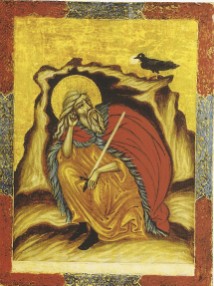
If we ask what messianic expectation of his time Jesus comes closest to, we might find it in the hope for a prophetic messiah like Elijah, who is featured in our readings this week.
Like Elijah, he will speak the truth against the powerful, he will help the poor, he will suffer persecution; he will raise the dead.

 The Victor's Place