Tag Archives: Jesus Christ

Sharing the Resurrection of Jesus

I like the richness and simplicity of the 5th century Catecheses of Cyril of Jerusalem, which he preached in the Church of the Holy Sepulcher after Easter.

“When we were baptised into Christ and clothed ourselves in him, we were transformed into the likeness of the Son of God. Having destined us to be his adopted sons, God gave us a likeness to Christ in his glory, and living as we do in communion with Christ, God’s anointed, we ourselves are rightly called “the anointed ones.” When he said: Do not touch my anointed ones, God was speaking of us.

“We became “the anointed ones” when we received the sign of the Holy Spirit. Indeed, everything took place in us by means of images, because we ourselves are images of Christ. Christ bathed in the river Jordan, imparting to its waters the fragrance of his divinity, and when he came up from them the Holy Spirit descended upon him, like resting upon like. So we also, after coming up from the sacred waters of baptism, were anointed with chrism, which signifies the Holy Spirit, by whom Christ was anointed and of whom blessed Isaiah prophesied in the name of the Lord: The Spirit of the Lord is upon me, because he has anointed me. He has sent me to preach good news to the poor.

“Christ’s anointing was not by human hands, nor was it with ordinary oil. On the contrary, having destined him to be the Saviour of the whole world, the Father himself anointed him with the Holy Spirit. The words of Peter bear witness to this: Jesus of Nazareth, whom God anointed with the Holy Spirit. And David the prophet proclaimed: Your throne, O God, shall endure for ever; your royal sceptre is a sceptre of justice. You have loved righteousness and hated iniquity; therefore God, your God, has anointed you with the oil of gladness above all your fellows.

“The oil of gladness with which Christ was anointed was a spiritual oil; it was in fact the Holy Spirit himself, who is called the oil of gladness because he is the source of spiritual joy. But we too have been anointed with oil, and by this anointing we have entered into fellowship with Christ and have received a share in his life. Beware of thinking that this holy oil is simply ordinary oil and nothing else. After the invocation of the Spirit it is no longer ordinary oil but the gift of Christ, and by the presence of his divinity it becomes the instrument through which we receive the Holy Spirit. While symbolically, on our foreheads and senses, our bodies are anointed with this oil that we see, our souls are sanctified by the holy and life-giving Spirit.”

And so, we are not just observers of Christ’s resurrection, St. Cyril says. We are transformed into the likeness of the Son of God, becoming like him in his glory.  Our outward appearance may resemble the appearance of the Risen Christ, as the  gospels describe him. We may look like the humble gardener Mary Magdalen saw, or the  stranger walking with the disciples towards Emmaus, or the figure at dawn on the shore of Galilee, or one with wounds in our hands and feet.

But if the Holy Spirit anointed us with chrism after our baptism, we have been empowered to bring good news to the poor; we have been anointed with the oil of gladness. We have been given a spiritual joy and a share in the life of Christ.

Creation Redeemed


creation
Pope Francis is soon to issue an important encyclical on the environment. Some say that’s none of the church’s business, but creation is the church’s business, In his great treatise “On the Incarnation of the Word ” St. Athanasius says Jesus Christ came to save it.

“The Word of God, incorporeal, incorruptible and immaterial, entered our world. Yet it was not as if he had been remote from it up to that time. For there is no part of the world that was ever without his presence; together with his Father, he continually filled all things and places.

“ Out of his loving-kindness for us he came to us, and we see this in the way he revealed himself openly to us. Taking pity on our weakness, and moved by our corruption, he could not stand aside and see death have the mastery over us; he did not want creation to perish and his Father’s work in fashioning humanity to be in vain. He therefore took to himself a body, no different from our own, for he did not wish simply to be in a body or only to be seen.

“ If he had wanted simply to be seen, he could indeed have taken another, and nobler, body. Instead, he took our body in its reality.”

Jesus Christ, the Word of God, entered into the world of real time and place, Athanasius says.  The world was not a stage he used, to be dismantled and thrown away.  it was a reality he embraced and redeemed. “He is the Word through whom you made the universe; the Savior you sent to  redeem us.” “He became flesh and dwelt among us.”

God’s plan of salvation, then, was not restricted to human beings: “he did not want creation to perish and his Father’s work of fashioning humanity to be in vain.”

A Shepherd for Dangerous Times

good shepherd
The image of the shepherd is a favorite image for God in scripture. It is an important image to understand the Risen Jesus. He is a shepherd on the journey through life and death, a shepherd who does not walk alone. He leads his sheep through “the valley of death.” He brings them to  green pastures, to rest “all the days of our life.”

God’s shepherding takes many forms. God is the Shepherd of Israel, we hear in the Old Testament. The Lord is my shepherd, Psalm 23 says; God shepherds us on the personal journey we make in life; God is with us at every moment, good or bad. God  also shepherds his church, the new Israel, and he will always guide it, even in periods of uncertainty.

But does it end there? What about our world, which is also on a journey? If we believe Jesus Christ is its Savior and Lord, will he not be its shepherd too?

Easter time is a good time to think about the unknown in all its dimension. As we look ahead, our world faces many dangers. It’s clear our environment is endangered. What shall we do? As the nations of the earth are drawn closer through new systems of communications and economic development, violence and terror are so evident. Can we live in peace?

We’re tempted to close our eyes and lose hope. But God always tells us to face life and go on. Alone, we may see a dark valley ahead, but a Shepherd leads us, so let’s not fear.

Bread and Wine

The Easter season is a time of sacraments, the way the Risen Jesus comes to us today. It’s the time for First Communions, when little children are initiated into this mystery and we adults are reminded of it again.

I often think how impoverished we moderns are compared to generations long ago who experienced bread and wine so much more concretely than we do today. They watched bread made in their own homes and  probably helped pressing grapes for wine.

You can see that experience in the old commentaries on the Eucharist, like this one from St. Gaudentius of Brescia.(+410) Bread-making and wine-making help to understand the mystery:

“ Daily this mystery is before our eyes as a representation of the passion of Christ. We hold it in our hands, we receive it in our mouths, and we accept it in our hearts.

“It is appropriate that we should receive the body of Christ in the form of bread, because, as there are many grains of wheat in the flour from which bread is made by mixing it with water and baking it with fire, so also we know that many members make up the one body of Christ which is brought to maturity by the fire of the Holy Spirit.

“Christ was born of the Holy Spirit, and since it was fitting that he should fulfil all justice, he entered into the waters of baptism to sanctify them. When he left the Jordan he was filled with the Holy Spirit who had descended upon him in the form of a dove. As the evangelist tells us: Jesus, full of the Holy Spirit, returned from the Jordan.

“Similarly, the wine of Christ’s blood, drawn from the many grapes of the vineyard that he had planted, is extracted in the wine-press of the cross. When we receive it with believing hearts, like capacious wineskins, it ferments within us by its own power.”

The Passionist Nuns from Erlanger, Kentucky, make Communion wafers for many churches and they made a video of how it’s done, for children making their First Communion.

The Homelessness of Faith

“When Paul had finished speaking he knelt down and prayed with them all. They were all weeping loudly as they threw their arms around Paul and kissed him, for they were deeply distressed that he had said that they would never see his face again. Then they escorted him to the ship.”

As the gospel spread to all nations, we seldom see scenes in the scriptures like Paul’s farewell to the presbyters at Ephesus, described in our reading for today, but there must have been others like it. Peter biding farewell to his family at Capernaum; James and John parting from the mother who wanted so much for them; others who left the places and people they knew for the sake of the gospel. Goodbyes are hard, even when they happen for noble purposes.

There’s a homelessness in every human life. The Carmelite poet, Jessica Powers describes it so well in one of her poems:

“It is the homelessness of the soul in the body sown

it is the loneliness of mystery;

of seeing oneself a leaf, inexplicable and unknown

cast from an unimaginable tree;

of knowing one’s life to be a brief wind blown

down a fissure of time in the rock of eternity.”

This is the homelessness that touches us all, even as we believe.

The elders of Ephesus would miss Paul who had been with them for three years and become part of their life, and he would miss them. The disciples of Jesus at the Last Supper must have been touched as he told them he was going away. They had to feel loss.

Only the promise of a spiritual union and a homecoming tempered their sense of loss. Only the promise of reunion of another day.

Ist Sunday of Easter: The Thomas in Us All

Audio of the homily below:

The yearly feast of Easter is a celebration, not of one day, but of fifty days, from Holy Saturday till the feast of Pentecost. We also celebrate Easter each Sunday of the year.

Why this extensive celebration? Because we’re so slow to realize what it means, and need reminding over and over.

Some things — like telling time or tying our shoes — we learn once, but the resurrection of Jesus is a mystery not learned at once. Never grasped completely, it unfolds as life unfolds, day by day.

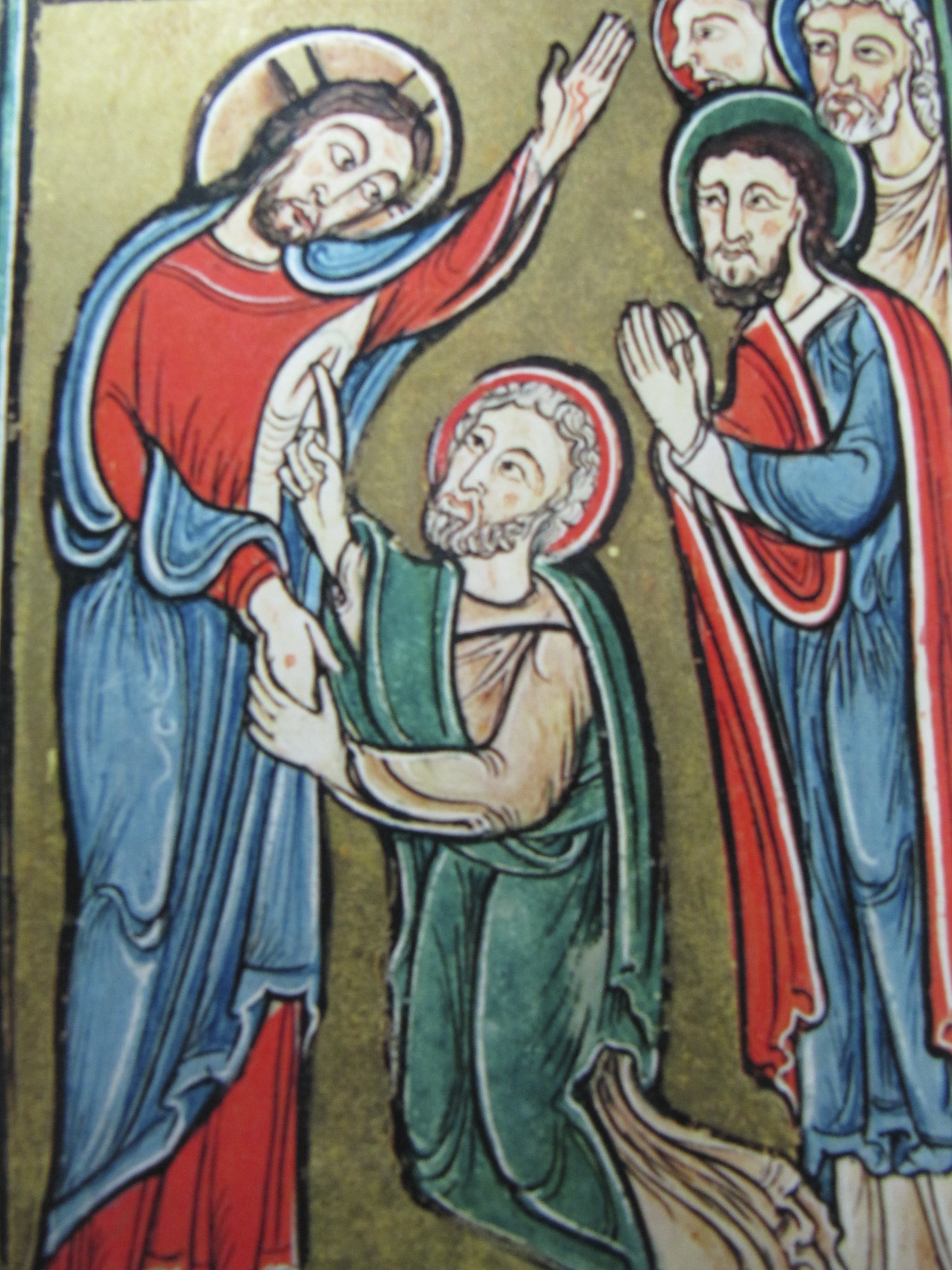
That’s why Thomas, the apostle, whom we remember on the 2nd Sunday of Easter, is such an important figure. Far from being a lonely skeptic, an isolated dissenter, he represents the slowness of heart and mind, the recurrent skepticism, that affects us all.

Yet, Thomas is still a sign of hope. He reminds us that the Risen Jesus offers, even to the most unconvinced, the power to believe.

Lord Jesus,
the Thomas in us all
needs the wounds in your hands and side,
to call us to believe
you are our Lord and God.

Risen, present everywhere,
bless those who have not seen,
blind with doubts
and weakened faith.

Bless us, Lord,
from your wounded hands and side,
give us faith
to believe in you.

Spanish
El Tomás Dentro de Todos Nosotros
Juán 20, 19-31, Segundo Domingo de Pascua

La fiesta anual de Pascua florida es una celebración, no de un día, sino de cincuenta días, desde el Sábado Santo hasta la fiesta de Pentecostés. También celebramos el Domingo de Pascua cada domingo del año.

¿Por qué esta extensa celebración? Porque somos tan lentos en realizar lo que significa, y también necesitamos ser recordados una y otra vez.

Algunas cosas – como leer el reloj o amarrarnos los zapatos – las aprendemos una sola vez, pero la resurrección de Jesús es un misterio que no se aprende de una vez. Nunca comprendido completamente, se revela gradualmente mientras la vida se despliega día por día.

Por eso es que Tomás, el apóstol a quien recordamos el Segundo Domingo de Pascua, es una figura tan importante. Lejos de ser un escéptico solitario, un disidente aislado, él representa la lentitud de corazón y mente, el esceptisismo recurrente, que nos afecta a todos.

Sin embargo, Tomás sigue siendo un signo de esperanza. Él nos recuerda que el Jesús Resucitado nos ofrece hasta el menos convencido de nosotros, el poder de creer.

Señor Jesús, el Tomás en todos nosotros
necesita las heridas de tu costado y manos,
llamándonos a creer que eres nuestro Señor y Dios.
Resucitado, presente en todas partes,
bendice a los que no han visto,
ciegos con dudas y fé debilitada.
Bendícenos Señor; a través de tus heridas manos y costado,
danos fé para creer en Tí.

3rd Sunday of Lent: Jesus comes to CNN


To listen to today’s homily, select the audio file below:

CNN is running a series on Jesus at 9 on Sundays this Lent exploring the usual questions the networks and cable TV like to explore. Did Jesus really exist? Is that his image on the Shroud of Turin? Are other gospels out there that contradict the four we know? Have the archeologists found out anything about him? Was he married?

According to The Hollywood Reporter the CNN series entitled Finding Jesus: Faith, Fact and Forgery was viewed by over 1 million people last week and beat out all other networks. I watched the first episode on the Shroud of Turin last week.

I was glad to see the advice Father James Martin, SJ, offered on the CNN site about a series like this one:

“With Lent beginning, and a new CNN series on Christ coming up, you’re going to hear a lot about Jesus these days. You may hear revelations from new books that purport to tell the “real story” about Jesus, opinions from friends who have discovered a “secret” on the Web about the Son of God, and airtight arguments from co-workers who can prove he never existed.

Beware of most of these revelations; many are based on pure speculation and wishful thinking. Much of what we know about Jesus has been known for the last 2,000 years.”

Father Martin’s right. A lot of the supposed new revelations and new disclosures about Jesus are unproven and based on speculation and wishful thinking. They don’t negate what we have long known about Jesus. So, I’m not waiting for the final word on the Shroud of Turin to decide whether Jesus existed or not.

The media often rely on stuff like this–sometimes true, sometimes not– to get an audience. Ratings are important to them, but it’s not a good idea to rely on CNN or any of the mainstream media as your main source of information about Jesus. You can end up wondering if we can know him at all.

I’m not saying we shouldn’t ask questions or take into account new perspectives and information about Jesus. Not at all. We probably know more about his times and culture than has been known for centuries. We have a better understanding of the bible and the New Testament today, thanks to the efforts of modern scholars. Our challenge today is to incorporate what we know now into the faith we have.

For instance, I can listen to John’s gospel describing Jesus entering the temple in Jerusalem. (the gospel we’re reading the 3rd Sunday of Lent) I can visualize that temple. There’s a wonderful model of it created by archeologists and historians in the Israel Museum in Jerusalem. In fact, they have created a model of the whole city of Jerusalem at the time of Jesus.

Dominating the city, the temple was one of the great buildings of the world. It was the religious and political center of the Jewish world of the time. God was present there. It was the center of worship and politics.

When Jesus went into the temple and overturned the tables of the money-changers and those who sold the animals he was challenging the religious and political establishment of his time. It was a dramatic symbolic gesture by which he claimed that the kingdom of God was greater than all the beauty, all the power, all the splendor of our earthly kingdoms. He wasn’t just asking for reform; he was announcing a new world. It was present in him. He was the true temple. In his dying and rising he brought resurrection and new life to our world.

Do I think this happened? Yes, I do. Is this what our gospel today is saying? Yes, it is. Jesus made a tremendous claim during his lifetime. He claimed to be divine, to be God’s Son, to be God himself.
“God from God, light from light” we say in our creed. “Born of the Virgin Mary, he suffered under Pontius Pilate, he was crucified, died and was buried, and on the third day he rose again.”
He will come again to judge the living and the dead. He’s told us there is a forgiveness of sins, a resurrection of the body and life everlasting. He’s with us all days. He’s with us now.

CNN and the Holy Shroud

CNN

I watched CNN’s segment on The Holy Shroud of Turin on my computer last night. According to the Hollywood Reporter it topped the ratings last Sunday evening. Over 1 million people watched the first part of Finding Jesus: Faith. Fact. Forgery.

The narrator began the program: “Jesus Christ, he changed the course of world history yet the most famous man that ever lived left no physical trace, or did he?” For most of the program it looked like the answer was going to be “Yes, the shroud is an authentic witness to the death and resurrection of Jesus.” But in the final moments it was declared a medieval forgery.

But wait. Maybe not. All the evidence may not be in. Come back next year to see what CNN has uncovered. There was a hint as the program ended of more to come.

Like so many religious programs from the mainstream media, Finding Jesus. Faith.Fact.Forgery presumes we don’t know much about Jesus at all. Finding him means sifting through a jumble of faith, facts and forgeries. So far, there’s not much, but eventually we’ll learn more. We’ll get it right. Until then, suspend judgment till we have more facts.

If we follow CNN, finding Jesus is a long way off.

If the shroud is a medieval forgery I wondered why CNN spent so much time reconstructing the story of the Passion of Jesus from it as they did. Their reconstruction was along the lines that Mel Gibson used in his blockbuster The Passion of the Christ. Blood and violence are popular tools of the media these days.

The four gospels don’t use that approach in describing the Passion of Jesus, nor do they care to describe what Jesus looked like, another concern of the CNN special.

The claim of programs like Finding Jesus: Faith. Fact. Forgery that we have no physical traces of Jesus can be disputed, of course. In his day, eyewitnesses, real people, saw Jesus, ate with him, accompanied him. Their recollections are found in the gospels and letters they left or inspired. True, they’re not like the historical documents we have today, but substantial evidence is there just the same.

For most believers these are facts enough. More might come to light, but will they change the basic story about him? I don’t think so.

So we don’t have to stay on page 1 with CNN, waiting for more facts. Certainly we need to ask questions about Jesus, but questions of a deeper kind. What does it mean to follow him? What can we learn from him? We need to hold on to the signs he left us and ask: what does it mean to have his kingdom come to our world? Those questions are all in our Creed.

I don’t think we need the Shroud of Turin or CNN for that.

One more thing. What Jesus looked like is another concern of the CNN special. In the recent issue of The Hollywood Reporter, there’s a piece entitled “Jesus in Film and TV: 13 Devilishly Handsome Actors Who’ve Played the Son of God.”
There were the pictures of all the devilishly handsome actors who played Jesus in the movies or on television. None looks like Jesus to me. I go with Paul who says in his Letter to the Philippians that Jesus took on the form of a slave. If we met him on the street, we wouldn’t recognize him at all. But Hollywood can’t believe that.

Friday after Ash Wednesday

Lent 1
Mt 9, 14-15

The 30 or so years that Jesus Christ lived on earth are brief on the timeline of human history. Hardly visible at all. But we believe Jesus, “in the fullness of time,” changed the way we look at life and time itself in those years. He’s God’s revelation to us.

His first disciples saw him, listened to his words, followed him and told us about him. They tell us very little about his birth and early years. The part of his life they tell us most about is the story of his death and resurrection. It’s the longest story in the gospels and we believe it’s the key to understandi the One “who is, who was and is to come.”

How can we understand that story best? Shall we study it academically, maybe read a popular book like Bill O”Reilly’s “Killing Jesus”? Shall we ask historians or scholars what it means?

My community, the Passionists, always begins Lent by celebrating on the day before Ash Wednesday the Feast of the Prayer of Jesus in the Garden. The feast points out the best way to share in the mystery of Jesus’ death and resurrection– enter the Garden of Gethsemane and pray there with Jesus.

Gethsemane is more than a place, it’s an experience humanity shares. Jesus came to the garden in his humanity and faced there the mystery of death, the fears and helplessness it brings, the questions about God’s care, God’s love and God’s will that humanity faces.

He shares our humanity. We enter the garden–not to fall asleep or simply observe Jesus at prayer–but to face death as he faced it, to face our fears and questions about God’s will and care that he faced then, and to draw divine support as he did.

In his spiritual diary, St. Paul of the Cross said that sharing the humanity of Christ leads to sharing his divinity; meditating on his death and resurrection leads us to new life.

“I also had knowledge of the soul united in a bond of love to the Sacred
Humanity and, at the same time, dissolved and raised to a deep, conscious, and
felt knowledge of the Divinity. For since Jesus is both God and Man, the soul
cannot be united in love to the Sacred Humanity without being at the same time
dissolved and brought to a deep, conscious, felt knowledge of the Divinity.” (Diary)

Thank you, Father, for the gift of your Son, Jesus Christ,
the Word who made the universe,
the Savior you sent to redeem us,
who came as one like us
to make us one with you.

Come With Me

Jesus garden

You went into the garden and fell to the ground
and prayed
alone,
yet all humanity was there
holding the cup of death
and hearing itself in your words.
“Father, if it possible, let this cup pass from me.
The cup of death.
you drank
contained our fears and cries too,
our sweat of blood.
“Your will be done,” you said.
“Your will be done,”we say
and wait for an angel to strengthen us.