Tag Archives: Jesus Christ

2nd Sunday of Easter (C): The Promise Unfolds

To listen to today’s homily, please select the audio file below:

Acts 5,12-16 The Jerusalem Church
Revelations 1, 9-11a, 12-13.17-19 The Promise of the Risen Lord
John 20,19-31 Doubting Thomas

The resurrection of Jesus happened centuries ago, but today’s three readings remind us it’s a mystery still unfolding even now. Jesus is the “first fruits,” others must still follow him to share in his life. His resurrection gave birth to a church, which must still reach out to a doubting humanity symbolized in the apostle Thomas for its growth. All creation is still “groaning” till it reach its completion when  God’s kingdom comes.

When Jesus entered Jerusalem to face death, he used the familiar figure of the seed to describe the mystery before him. “The hour has come for the Son of Man to be glorified. Amen, amen, I say to you, unless a grain of wheat falls to the ground and dies, it remains just a grain of wheat; but if it dies, it produces much fruit.”

Like the seed the mystery of the resurrection grows to bear much fruit.

Our gospel reading, Jesus appearance to Thomas, reminds us that the Lord still reaches out to a humanity whose faith is imperfect, like Thomas, like Nicodemus, like the crowds whom he feeds with the loaves and the fish in Galilee, like his own disciples at the Last Supper. He still draws into this great mystery people with imperfect faith, slow to believe, like us.


The church he brought into being was a small seed at first in Jerusalem,  but it’s spreading its branches throughout the world, despite the thorns and hard ground that resists its growth. And creation itself despite fears about its future is makings its way to a completion beyond what we know now.

The Risen Jesus remains with us . “There is nothing to fear,” he says to his disciple on the Lord’s day, “ I am the First and the Last and the One who lives. Once I was dead, now I live–forever and ever. I hold the keys of death and the nether world. Write down, therefore, whatever you see in visions-what you see now and what you will see in time to come.” (Revelations 1.17-19)

We see him now by faith, in time to come face to face.

Holy Thursday

Lent 1
Readings
“Love makes one little room an everywhere.” That’s what happened  when Jesus entered the supper room in Jerusalem the night before he died. A dark fate awaited him as powerful forces readied to take his life. His disciples, “his own who were in the world,” were arguing among themselves as they took their places at table. Jn 13,1-15

What would he do? Understandably, he might do nothing, disappointed  like the servant whom the prophet Isaiah described, “I toiled in vain; and for nothing, uselessly, spent my strength…” (Is. 49).

Jesus, however, took bread and gave it to his disciples. “Take this,” he said, “this is my body.” He took the cup and gave it to them. “This is my blood, the blood of the new covenant, to be poured out in behalf of many.”

That night, without wariness or regret, he gave himself to his Father and to his disciples. As our Savior and Redeemer he gave himself unhesitatingly for the life of the world. In the supper room a love was tested and a love was displayed that reached everywhere.

Holy Thursday night. “Now is not the time to write, rather to weep. Jesus is dead to give us life. All creatures are mourning, the sun is darkened, the earth quakes, the rocks are rent, the veil of the temple is torn. Only my heart remains harder than flint. I will say no more. Join the poor mother of the dead Jesus as her companion. Ask the dear Magdalene and John where their hearts are. Let the sea of their pains flood within you. I end at the foot of the cross.” (St. Paul of the Cross,Letter 181)

How shall I make a return to the Lord
for the goodness he has shown to me.
The cup of salvation I will take up
and call on the name of the Lord. Ps 116

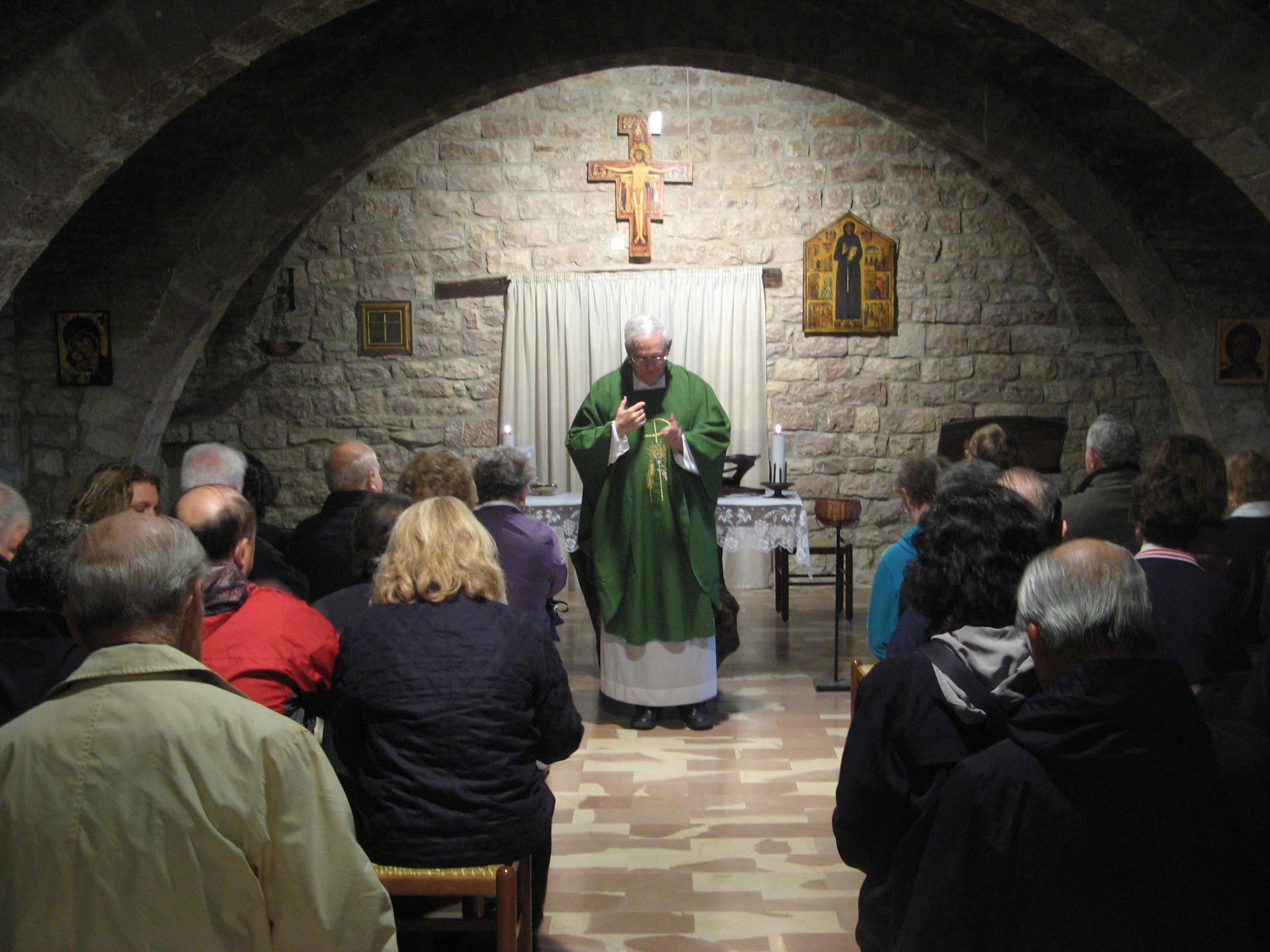
Praying at Mass

IMG_1517

Catholics are not going to Mass as much as they did.  People are busy, of course. Some say they don’t get much out of it. Whatever the reasons, US Catholics aren’t going to Mass as they did before.

We have new texts for Mass, will they turn things around?  I don’t know. Better preaching? That would help. But there’s more. We need to look at the way we pray and participate at Mass.  The Mass is the central act of our faith, and we need to bring everything we have– our bodies, our minds, our memories, ourselves– to it.

We’re there to pray, from the moment we enter the church to the moment we leave. Only by praying at Mass will we appreciate it.

The way we pray at Mass is simple. It begins as we enter church and make the Sign of the Cross. It’s a key to a world of faith. Taking  holy water  we bless ourselves “In the Name of the Father and of the Son and of the Holy Spirit. Amen.” We are reminding ourselves  that we’re blessed by God with the gift of life and everything it means through Jesus Christ. Water is a sign of that life. 60% of the human body is made up of water, and so it’s a reminder we are being blessed by the God of life.

Water, like bread, is a sign of life.The signs of water and bread stand for the totality of blessings we receive , and we acknowledge our blessings and give thanks through them.

Jesus said “If anyone is thirsty come to me.” He also said “I am the bread of life.” As we make the Sign of the Cross,  we’re reminded we’re at the source of life now and of life everlasting, Jesus Christ. We’re blessed by his life, death and resurrection. We trace his sign on ourselves, on our foreheads, our hearts and our shoulders. We’re blessed in mind and heart and all our being.

So, as Mass begins, the priest leads us into this great  act of blessing and thanksgiving by inviting us to make the Sign of the Cross.

Notice we bless ourselves  a number of times at Mass besides its beginning.  We bless ourselves as the gospel is proclaimed, asking that our minds and hearts be blessed to hear God’s Word. We bless ourselves as we leave the church at the end of the Mass, because we carry God’s blessings to our world.

Besides the Sign of the Cross,  simple acclamations at Mass  draw us into this blessed mystery. So,  as the priest concludes a prayer or action, we often say “Amen” an ancient Hebrew word, which means “Yes” we agree. The “Amen” at Mass calls us into the blessing of God. Simple word like “Amen”  draw us to the prayer of the church.

“The Lord be with you.” “Lift up your hearts.” “Let us give thanks to the Lord our God.”

Listen carefully to those words and the readings, the songs and the music at Mass. Say them and mean them. Sing them when they’re sung, for“Someone who sings well prays twice.” So we join our voices in song. At Mass we pray together.

We pray with our eyes, too, as we see the actions and signs of Mass. Walking, kneeling, standing are prayers. Simple actions, like bowing and offering our hand to receive the Host are prayers. At Mass we pray with our whole being. Our walking, seeing, listening, speaking become acts of prayer that bring us into the presence of God.

Of course, we often come to Mass with a lot of things on our mind that distract us from this great mystery. So often we’re on overload. Our faith may not be the strongest. We have our doubts. We get sunk in the everydayness of our own lives.

But God’s grace is here in this great mystery and God will draw us–weak as we are–into this great mystery.  God will give us– all of us– the gift to pray and find blessings here. God draws us here to bless us.

3rd Sunday of Lent

Some of the biggest  questions we have about God are found in the scripture readings at Mass today. Is God  punishing us through tragedies like earthquakes, or accidents or  acts of violence that suddenly happen. Does God care?

Those question were asked of  Jesus in today’s gospel. (Luke 13,1-9)  His listeners wonder why 18 people were killed in a recent construction accident in Jerusalem. A tower fell on them? Why did those people  die in a riot that the Roman procurator, Pontius Pilate, put down  by slaughtering everyone in sight?

Jesus answers that  God’s not punishing those involved in those tragedies. Tragedies are part of life; they’re sharp reminders that life on earth isn’t permanent or without risk. Jesus says  be ready for the moment that God calls you.

There’s another question, though. Does God care about it at all? And here we can turn to the 1st reading from the Old Testament about Moses and his vision of God on Mount Horeb. (Exodus 3, 1-15) Moses at the time was a man on the run. He’d killed an Egyptian and had fled from Egypt to hide as a shepherd in the Sinai desert. His people, the Jews, were slaves in Egypt.

As he ascends the mountain tending his sheep, he sees a burning bush and suddenly hears a voice. “Don’t come any nearer. Take the shoes off your feet; you’re on holy ground…I’m the God of your ancestors, of Abraham, Isaac and Jacob.” Moses was afraid, a normal reaction to God who is beyond anything we know.

But then God begins to speak words of love and concern.

“I know the affliction of my people in Egypt; I hear their cries of complaint against their slave drivers; I know well what they are suffering.
So I’ll rescue them from the hands of the Egyptians and lead them out of that land into a good and spacious land, a land flowing with milk and honey.”

“I am the God of your ancestors, Abraham, Isaac and Jacob,” God says. “I have ties with the world before you were born and I will care for the world when you are long gone.”

The encounter that Moses has on the mountain is our encounter with God too.

We know what followed Moses vision on Mount Horeb.  He returns to Egypt and with God’s help brings his people out of Egypt. God’s presence isn’t always obvious as they journey through the desert for 40 years. But God is faithful and he brings them to “a good and spacious land, flowing with milk and honey.”

Does God care for us. Yes, he does.

As we go further into the lenten season, we come to another mountain that’s burning with fire too. We’ll see  a Cross and a man hanging there. He knows our sorrows and shares them too. He’s God  come to us, to lead us and all the world from slavery to freedom, in a good land where sorrow and pain are no more, where we will be with our good God forever.

I’m preaching a mission at  the Sacred Heart Cathedral in Raleigh, North Carolina this week. It begins at all the Masses this weekend. Each evening at 7 I’m preaching during an hour service and at Mass 12.15 each day, Monday to Thursday. I’ll put some material from the mission on this website. Pray for the mission.

3rd and 4th Sunday C; His Own Turn Against Him

Audio homily here:

Luke begins his account of Jesus’ public life by recalling his return to Nazareth after his baptism by John in the Jordan. This Sunday and next Sunday we read from Luke’s long account of that event.

Mark and Matthew tell this story later in their gospels, but Luke, who concentrates more on Jesus’ early life than the other evangelists, puts the beginning of Jesus’  public life in Nazareth, in the synagogue where he worshipped, among those who knew him best. (Luke 4, 14-21)

Luke paints the coming of Jesus into this world in broad, sweeping terms in his gospel. Caesar Augustus was the world’s ruler, Herod ruled in Palestine, others ruled under them. At the same time, he focuses on Jesus’ own personal history. Born in Bethlehem, Jesus’ first home is an obscure village in northern Galilee– Nazareth, where he grows “in wisdom and age and grace, before God and man.” There he was brought up.

The synagogue at Nazareth was probably like other synagogues in the towns of Galilee. Some, like that at Magdala on the Sea of Galilee, have been excavated in recent times. It was a small one story rectangular building, with two tiers of seating all around its walls, made for a town of no more than 500 people. In the middle of the synagogue was a stand holding copies of the various books of the scriptures. The synagogue was the center of life in those towns.

Jesus has returned to Nazareth after beginning his ministry “all through Galilee, teaching in their synagogues and praised by all. (Luke 4, 14-15) Now, back home, he goes into the synagogue on the Sabbath, “as he was accustomed to do.”

He gets up from his place to read the scriptures. (From the same place where he sat for years? Was Mary his mother there with him?) He’s “ handed a scroll of the prophet Isaiah.

He unrolled the scroll and found the passage where it was written:

The Spirit of the Lord is upon me,

because he has anointed me

to bring glad tidings to the poor.

He has sent me to proclaim liberty to captives

and recovery of sight to the blind,

to let the oppressed go free,

and to proclaim a year acceptable to the Lord.

Rolling up the scroll, he handed it back to the attendant and sat down,

and the eyes of all in the synagogue looked intently at him.

He said to them,

“Today this Scripture passage is fulfilled in your hearing.”

A short sermon, and a powerful statement. “This scripture passage is fulfilled in your hearing.” The Spirit of the Lord is upon me, Jesus says. I’m anointed to bring glad tiding to the poor. Jesus claims a messianic calling.

His neighbors, who have known him for years, are first impressed, then question him, then deny his claims, then threaten to put him to death.

In their gospels, Mark and Matthew describe opposition to Jesus coming first from the scribes and Pharisees, the leaders from Jerusalem, but Luke sees opposition to Jesus coming first from his own hometown, from family, neighbors and friends. He knows how important this rejection is.

It’s true, isn’t it? When we enter this world, we enter the small unit of human life, a family, and beyond the family, the people and places that shape us early in life. We’re subject to this important smallness, our “Nazareths” where we grow “in wisdom and grace.” We’re first nourished there; we look for lasting love and support there. It means so much to us.

Throughout his ministry, Jesus will know opposition. Leaders of the people, public officials will oppose him.  In his final days, his own disciples will abandon him. Only a few will stand by his cross. The physical sufferings he endured were great. He was scourged, his head was crowned with thorns, his hands were nailed to a cross, he died hanging there long hours alone.

But rejection from his own at Nazareth will weigh heavily on him. It was a big part of the mystery of his cross. “He was amazed at their unbelief.” Yet, Jesus who embraced humanity with love, embraced Nazareth too. He loved it with God’s great love.

We have to pay a lot of attention to where we’re born, where we’re brought up, our families, the people we live and work with. Nazareth is important to us.


Jesus and the Elderly

Presentation
Jesus drew all people to himself, men and women, rich and poor, old and young. The gospels show that even at his birth he gave life to all.

In our readings these days at Mass, St. Luke tells of two old people, Simeon and Anna, who recognize the Child Jesus when he’s brought by Mary and Joseph into the temple after his birth. They give thanks to God and speak about him to those “waiting for the redemption of Israel.” (Luke 2, 36-38

The artist  describes their meeting in the portrait above. The two elderly people are transformed with wonder as they meet Jesus and Mary and Joseph.

We are living in an aging society; our elderly population is increasing. The temptation is to see old age as a stage in life when all is over, but this gospel story gives us pause. The Lord comes at every moment of life. He draws us to himself our whole life long.Not only did Simeon and Anna wonder at the child they saw and held in their arms, but they spoke about him to those “waiting for the redemption of Israel.”

The old have an important role in the Christmas story.

Readings here. .

Elijah On the Run

Our first readings this week and next are from the Book of Kings–the story of Elijah, the prophet, and his interaction with Ahab the King of Israel and his notorious wife Jesebel.

Elijah is a powerful prophet, one of the greatest of the prophets; he raises people from the dead and brings fire from heaven on his enemies. Yet he leaves no writings, which means we know him mainly from the life he leads.

According to the First Book of Kings, Elijah is on the run most of the time, fleeing from Ahab and his wife in pursuit. We follow him from water hole to water hole, hiding in mountain caves and isolated wadis in the desert, with scarcely enough to eat. Most of our readings for the coming days are about a fleeing prophet.

It’s a difficult, humbling flight. A popular icon of Elijah pictures him hand to his head, wondering if he will make it, as a raven hovers behind him bringing bread for the day. He’s living through a desperate drought that the king and his enemies see him responsible for. He scrounges for food, even relying on a poor widow with almost nothing of her own.

The powerful prophet is helpless. He’s living through a drought, which God alone can lift. He needs food, which God alone can give. He has to wait for God to act.

Yet Elijah learns from this experience. It trains him to see. From experience, the prophet learns to see what others may not see, and so he sees God’s redeeming presence in the far-off tiny cloud that promises rain and the whisper of a wind that says God is here.

In Jesus’ time, people were hoping for a Messiah. Elijah was one type of Messiah some hoped for. He’s closest to the kind of Messiah Jesus was.

Isn’t Elijah in the drought like Jesus in the mystery of his Incarnation and Passion? “He humbled himself, taking on the form of a slave.” That humbling led to death on a cross. He was a rejected prophet, yet God raised him up in power.

Following him into the mystery of his Incarnation and Passion do we also gain a wisdom to see grace in weakness and death? In the small whisper where God can be found?

A Love like God’s

What Paul the Apostle praises in our 1st reading today at Mass and Jesus urges in the gospel is a love that reaches out beyond our friends and those close by. Paul sees this love in the collection taken up by the Macedonians for the poor in Jerusalem. It’s a graced love, Paul says, expanding your care and your vision. Your love is like God’s.(2 Corinthians 8,1-9)

Jesus urges the same kind of love in the gospel. God’s love is like the sun that shines on everyone, life the rain that falls on the just and the unjust. It’s not an easy love, but if you wish to be perfect “Be perfect just as your heavenly Father is perfect. (Matthew 5,43-48)

A couple of years ago CNN carried a story of that kind of love. Paula Cooper was released from the Rockville Correctional Facility in Indiana yesterday, a free woman. In 1985 as a young girl of 15 she decided to steal some money from a 76 year old bible teacher, Ruth Pelke. After smoking marijuana and drinking wine, she went to her home, hit Pelke with a vase and stabbed her in the stomach thirty times–for $10.

Leading the pleas for Cooper’s release, was Pelke’s grandson, Bill Pelke, who said he forgave her shortly after Cooper was sentenced to death.

Here’s the CNN story:

“’I became convinced beyond a shadow of a doubt that my grandmother would have had love and compassion for Paula Cooper and her family,’ Pelke told CNN. ‘I felt she wanted someone in my family to have that same sort of love and compassion. I didn’t have any but was so convinced that’s what she would have wanted, I begged God to give me love and compassion for Paula Cooper and her family and do that on behalf of my grandmother.’”

“He said it was ‘a short prayer,’ but it was answered.
“’For a year and a half, whenever I thought about my grandmother, I always pictured how she died. It was terrible,’ he said. ‘But when my heart was touched with compassion, forgiveness took place. I knew from that moment on when I think about her, I would no longer pictured how she died, but I would picture how she lived, and what she stood for, what she believed in — the beautiful, wonderful person she was.’”

“Pelke tried to visit Cooper in 1986, but the two didn’t come face to face until eight years later. The two struck up an unlikely friendship over the years, exchanging messages through the prison e-mail system every week. And in 1989, the Indiana Supreme Court reduced Cooper’s death sentence to 60 years in prison.”

“Pelke said he would like to help Cooper with her transition to life outside of prison.
‘I hope that we’re able to go out and have a meal. I’ve told her when she got out of prison I’d like to buy her a computer and I have a friend that would like to buy her some clothes. Hopefully we’ll get together within the next few days and go shopping,’ he said.”

“Pelke said he’s never asked Cooper to explain her actions – ‘There’s not a good answer for that’ — but said she has shown remorse for the killing.
‘She would take it back in a heartbeat if she could, but she knows she has to live with it for the rest of her life,’ he said. ‘She knows she took something valuable out of society. She wants to try to give back. She wants to help work with other young people to avoid the pitfals she fell into.’”

There’s an example of perfect love.

Trinity Sunday

To listen to today’s homily, select the audio file below:


Last week we concluded the Easter season with the Feast of Pentecost, the coming of the Holy Spirit. Today we celebrate the Solemnity of the Holy Trinity, an appropriate conclusion to the liturgical time when God reveals himself as Father who created the world, as Son born of Mary, who suffered under Pontius Pilate, died and rose again, and as Holy Spirit come to complete the work of God among us. In the Solemnity of the Holy Trinity, we recall God’s revelation of himself–who he is– a “wondrous mystery” beyond our knowledge and expectation.

Remember where belief in the Trinity comes from. It’s not made up by human being like ourselves; it’s not something arrived at by human speculation or human reason. Belief in the Trinity comes from God, who reveals himself to us as Father, Son and Holy Spirit.

Our first reading from the Book of Deuteronomy recalls the beginning of that revelation in God’s revelation of himself to the Jews. God announces he is not only the Creator of all things, someone distant and unknowable. He draws near and wants to be known. He enters into human history to become intimately involved in the lives and destiny of his people. “I’m your provider, caregiver, father, mother, one who loves you as my own children,” God says. “I walk with you in your life and your trials, I argue with you when you question me, I forgive you when you sin, I promise you a kingdom.”

Read the psalms. You can hear the tender, intimate voice of God speaking to his people and revealing himself to them.

In the next step of revelation, God reveals himself in Jesus Christ. “This is my beloved Son,” God says at the baptism of Jesus in the Jordan. “My Father and I are one,” Jesus says in the gospels. In Jesus God takes a human face, a human mind, a human heart, a human history. He speaks to us in human words and actions, in cries and tears and sufferings and death and a profound love. In Jesus’ resurrection God shows us the path to life. We have the promise of eternal life in him.

The final revelation God makes is when he sends us the Holy Spirit. Jesus says the Spirit will teach us all truth. He will abide with us and gather all peoples from the ends of the earth to form one family of God. The Spirit will recreate the earth.

Sometimes you hear people say that belief in the Trinity is not important. The Moslem world, for instance, holds that God is One, only One. Others say that this belief is too much to understand.

Our belief in the Trinity is important. Why? Because God reveals himself to us this way. We may not understand it fully, but that’s because minds are limited and God is beyond what we can know.
This belief is not something we thought up; it’s God telling us who he is.

Yes, God is unknowable, but he calls us to know him. Yes, are words are inadequate, and yet we can put our belief in simple words and gestures. We can listen to God revealing himself in the scriptures and are blessed by God through this belief.

“In the name of the Father, and of the Son, and of the Holy Spirit. Amen.”

Walk’in All Over God’s Heaven

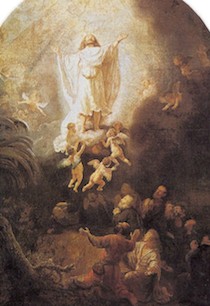
Jesus did not just come out of the tomb; he ascended to heaven. He rose from the dead and disappeared from our sight to return to his Father and our Father, his God and our God. The mystery of his ascension completes the Paschal Mystery. In his victory over death we’re promised a life beyond this one.

When I was a boy, I remember my father buying a record player. It was the mid 1940’s and times were hard; I’m sure he broke the family bank to pay for it. For a good while he only had a couple of those old vinyl records he would play over and over.

One of them was a haunting black spiritual sung by Marian Anderson called “Heaven.”

“I got shoes, and you got shoes, all God’s children got shoes.

When I getta heaven gonna put on my shoes

and gonna walk all over God’s heaven, heaven.

Everybody’s talking bout Heaven ain’t goin’ there.

heaven, heaven.  Gonna walk all over God’s heaven.”

I still feel the hope in that great singer’s voice as she sang that song. She was singing the song of barefooted slaves who were looking for something more. It wasn’t just a pair of shoes that would wear out after awhile. These were shoes God gave you in heaven, a place of completed dreams. Once you put on those shoes you could walk freely and walk everywhere.

The Feast of the Ascension describe heaven as our final home, where all our dreams are realized, where tears are wiped away, where sadness is no more, where wrongs are righted, where reunion with those we love takes place, where we enjoy the presence of God and all the saints.

For now, we only have hints of heaven. We only have assurances of faith. However, it’s not enough to just talk about it, as the spiritual says, we must walk in the steps of Jesus. Walking in his steps brings us, not to a grave, but to the place where he is. That’s heaven.