Tag Archives: Gospel of John

5th Sunday of Easter: I am the Vine


The other day a priest in my community, Father Theophane Cooney, CP, gave me a short instruction that he gives to people about reading the scriptures; it’s based on an old method called in latin “lectio divina” or “sacred reading.” I put his instruction on my blog yesterday and a surprising number of people read it, so I’d like to share it with you today as we read from the Gospel of John.

What is Lectio Divina (Sacred Reading)?

It is a spiritual, rather than academic, reading of the Bible. It enables the reader to get to know Jesus in a more personal way, through reading, above all through listening.
It is to experience a personal meeting of an intimate kind with the God who loves you and comes to meet you in the sacred reading. You should not feel obliged to read a complete passage, you are there to listen. God can say an awful lot in a few words.
Avoid opening the scriptures at random: choose rather the Sunday gospel, for example.

Preparation

Time: set aside 10 or 15 minutes when you will be free from interruptions.
Place: somewhere free of interruptions, no telephone, no television, no computer.
1. Take some moments to calm down.
2. Invoke the assistance of the Holy Spirit. Pray to be enlightened with an inspiration that may inspire your life.
3. Read calmly, very slowly, the biblical text. Read it again. Take the time to listen to the Lord and the message he wishes to share with you from this reading. Don’t expect blinding revelations. God is teaching you to listen and seek him in silence.
4. Meditate: ask yourself–“What does this word of God, which I have read carefully say to me.”
5. Pray. Speak to the Lord who has spoken to you in the text you have reflected on. Let your attitude be that of the Virgin Mary: “Be it done onto me according to your word.”
6. Contemplate in silence. Remain fascinated and impressed as you calmly allow the word of God to inspire you as though it were the heat of the sun.
7. Act. Make a commitment that springs from this encounter with the Lord. Inspired and filled with the word of God you return to daily life with a renewed attitude.
If you are faithful to this practice, your life will begin to change. The word of God will lead you to a change of attitudes, values and feelings. Love the word of God. Study it and allow it to form your personality.

This Sunday’s gospel’s a good gospel for practicing the lectio divina. Do you remember how it begins? “Jesus said to his disciples.” Who are his disciples? Aren’t they us? Jesus said these words when he was with his disciples at the Last Supper. Isn’t he with us now?

“I am the true vine, and my Father is the vinegrower…I am the vine and you are the branches. Can God be so close that we are branches on the vine? “Remain in me, as I remain in you. Just as a branch cannot bear fruit on its own unless it remain on the vine, so neither can you unless you remain in me.” “Remain in me,” Jesus tells us. “I remain in you,” he tells us. “Just as a branch cannot bear fruit on its own unless it remains on the vine, so neither can you unless you remain in me.”
If we cut ourselves off from our God, we become lifeless branches.

“If you remain in me and my words remain in you, ask for whatever you want and it will be done for you. By this my Father is glorified that you bear much fruit and become my disciples.”
If we remain in Jesus, we have life and bear fruit, and listen to his promise: “Ask whatever you want and it will be done for you.”

You can see how these words bring us into the presence of the Lord, how fascinating they are, how they bring close to God and God close to us.

“If you are faithful to this practice, your life will begin to change. The word of God will lead you to a change of attitudes, values and feelings. Love the word of God. Study it and allow it to form your personality.”

The Easter Season

Spanish

The Easter season is a seven week period that begins with the Easter vigil and concludes with the feast of Pentecost. Most Catholic parishes give attention to the First Communion of children, but this season has a larger purpose:. it’s time for the whole community to be renewed in its faith in the Risen Christ.

“Blessed are they who have not seen, but believe,” Jesus said to his Apostle Thomas, a key figure in the Easter season. John’s gospel recalling the Risen Christ meeting Thomas is read on all three cycles for the 2nd Sunday of Easter. Jesus’ words to Thomas summarize this season: he blesses those who have not seen him.

We have not seen him as his apostles and other eye-witnesses have, but we’re blessed with faith, which is a way of knowing Jesus through sacraments and signs and, most importantly, through loving one another. Relying on the witness of his disciples, we know the Risen Christ in the church and its sacraments, particularly in the Eucharist, and in life around us.

Our faith needs strengthening, however, because our world questions this way of knowing the mysteries of God and Jesus Christ. We also find it hard to give our minds to great mysteries like this; so much else holds our attention. The Easter season brings a renewing grace to us.

Weekday Readings: Octave of Easter

Monday: Acts 2:14,22-23; Matthew 28,8-15
Tuesday: Acts 2, 36-41; John 20,11-18
Wednesday: Acts 3,1-19; Luke 24, 13-35
Thursday: Acts 3,11-36 Luke 24, 35-48
Friday Acts 4,1-12 John 21,1-14
Saturday Acts 4, 13-21 Mark 16,9-15

The weekday readings at Mass for the next 7 weeks of the Easter season come mainly from the Acts of the Apostles and the gospel of John. This is a good time to read the introductions to these books in the NABRE.

The Acts of the Apostles, the second part of St. Luke’s work, describes how salvation promised to Israel and accomplished by Jesus now extends to the Gentile world under the guidance of the Holy Sprit. The same book by which we understand how the church developed in the beginning can help us see how it develops today.

Luke shows the growth of the church from its Jewish Christian origins in Jerusalem to a series of Christian communities that point to Rome, the capital of the civilized world. As our church today continues to become a global church, what can we learn from Acts to help us understand and contribute to its growth in the world today?

The gospels for the octave of Easter are resurrection accounts from all four gospels. Written about 70 AD and after, they are later descriptions of the resurrection of Jesus. Earlier short statements about the resurrection– from the letters of Paul, for example– report the utter amazement of the first witnesses as they met the Risen Jesus and the difficulty they had describing him. He is beyond any experience his first disciples had or knew of.

The evangelists adapt the story of the Risen Jesus to the situation of the churches they’re writing for, which explains the differences in their accounts. They can also teach us about our own church and times. The gospels reveal what we can know about the resurrection, what it calls us to do and what we can hope for.

3rd Sunday of Lent: Jesus comes to CNN


To listen to today’s homily, select the audio file below:

CNN is running a series on Jesus at 9 on Sundays this Lent exploring the usual questions the networks and cable TV like to explore. Did Jesus really exist? Is that his image on the Shroud of Turin? Are other gospels out there that contradict the four we know? Have the archeologists found out anything about him? Was he married?

According to The Hollywood Reporter the CNN series entitled Finding Jesus: Faith, Fact and Forgery was viewed by over 1 million people last week and beat out all other networks. I watched the first episode on the Shroud of Turin last week.

I was glad to see the advice Father James Martin, SJ, offered on the CNN site about a series like this one:

“With Lent beginning, and a new CNN series on Christ coming up, you’re going to hear a lot about Jesus these days. You may hear revelations from new books that purport to tell the “real story” about Jesus, opinions from friends who have discovered a “secret” on the Web about the Son of God, and airtight arguments from co-workers who can prove he never existed.

Beware of most of these revelations; many are based on pure speculation and wishful thinking. Much of what we know about Jesus has been known for the last 2,000 years.”

Father Martin’s right. A lot of the supposed new revelations and new disclosures about Jesus are unproven and based on speculation and wishful thinking. They don’t negate what we have long known about Jesus. So, I’m not waiting for the final word on the Shroud of Turin to decide whether Jesus existed or not.

The media often rely on stuff like this–sometimes true, sometimes not– to get an audience. Ratings are important to them, but it’s not a good idea to rely on CNN or any of the mainstream media as your main source of information about Jesus. You can end up wondering if we can know him at all.

I’m not saying we shouldn’t ask questions or take into account new perspectives and information about Jesus. Not at all. We probably know more about his times and culture than has been known for centuries. We have a better understanding of the bible and the New Testament today, thanks to the efforts of modern scholars. Our challenge today is to incorporate what we know now into the faith we have.

For instance, I can listen to John’s gospel describing Jesus entering the temple in Jerusalem. (the gospel we’re reading the 3rd Sunday of Lent) I can visualize that temple. There’s a wonderful model of it created by archeologists and historians in the Israel Museum in Jerusalem. In fact, they have created a model of the whole city of Jerusalem at the time of Jesus.

Dominating the city, the temple was one of the great buildings of the world. It was the religious and political center of the Jewish world of the time. God was present there. It was the center of worship and politics.

When Jesus went into the temple and overturned the tables of the money-changers and those who sold the animals he was challenging the religious and political establishment of his time. It was a dramatic symbolic gesture by which he claimed that the kingdom of God was greater than all the beauty, all the power, all the splendor of our earthly kingdoms. He wasn’t just asking for reform; he was announcing a new world. It was present in him. He was the true temple. In his dying and rising he brought resurrection and new life to our world.

Do I think this happened? Yes, I do. Is this what our gospel today is saying? Yes, it is. Jesus made a tremendous claim during his lifetime. He claimed to be divine, to be God’s Son, to be God himself.
“God from God, light from light” we say in our creed. “Born of the Virgin Mary, he suffered under Pontius Pilate, he was crucified, died and was buried, and on the third day he rose again.”
He will come again to judge the living and the dead. He’s told us there is a forgiveness of sins, a resurrection of the body and life everlasting. He’s with us all days. He’s with us now.

We’re Called: 2nd Sunday B

Audio below

We may think our relationship to God is something just between the two of us, but it isn’t. Others help us on our way to God. So, in this Sunday’s gospel John the Baptist tells some of his disciples to follow Jesus and in that same reading, Andrew brings his brother Simon to the Lord. More than we know, we’re led to God by others and we lead others to God too.

We go to God together. Another way of saying it is that we belong to one body, a church. We’re not lonely believers. We know and are called to God together.

Our first reading from the Book of Samuel is about the young boy Samuel whom God has chosen for a special mission among the Israelites. His mother is the first to sense this, and she sends him to the temple where she hopes the priests there will help him understand what his calling is. Parents are the first guides for their children; they know them and they’re their most important teachers.

Young Samuel hears God calling in the night but it’s a very indistinct call; he’s a young boy and he doesn’t know what to make of it. The old priest Eli doesn’t help much at first. He tells the young man there’ s no one calling, go back to sleep.

Finally, the old man recognizes that God’s calling the young boy. You wonder if this isn’t an early example of “the generation gap,’ someone from an older generation not understanding someone from a younger generation? The story is not just about a young boy finding what God wants him to do; it’s also about someone from an older generation helping him find out. What was the old priest thinking? Was he too concerned with himself perhaps and couldn’t be bothered with this young boy? Or had he lost hope in the youth of his day?

After awhile, the old priest gives Samuel the right advice: “Go to sleep, and if you are called say ‘Speak, Lord, your servant is listening.’”

Very wise advice. The old priest is telling him, first of all, believe that God speaks to you. Believe, even in the night. Listen humbly like a servant. Don’t let your own ideas intrude. Be a listener; hear what God wants to tell you. Pray.

We published a little prayer some years ago “Be With Me Today, O Lord” asking for God’s guidance each day. There’s an elderly man from California who calls me every few months asking for copies of the prayer which he distributes in schools and churches in his area. I’m reminded of him and the prayer as we listen to the story of Samuel.

Be with me today, O Lord,

May all I do today begin with you, O Lord.

Plant dreams and hopes within my soul, revive my tired spirit, be with me today.

May all I do today continue with your help, O Lord.

Be at my side and walk with me. Be my support today.

May all I do today reach far and wide, O Lord.

My thoughts, my work, my life: Make them blessings for your kingdom;

Let them go beyond today.

Today is new, unlike any other day, for God makes each day different.

Today God’s everyday grace falls on my soul like abundant seed,

Though I may hardly see it.

Today is one of those days Jesus promised to be with me, a companion on my journey.

And my life today, if I trust him, has consequences.

My life has a purpose…

“ I have a mission…I am a link in a chain, a bond of connection between persons. God has not created me for naught…Therefore I will trust him. What ever, where ever I am, I can never be thrown away. God does nothing in vain. He knows what he is about.” (John Henry Newman)

Father Quentin Amrhein (1926-2014)


Sower


Yesterday I preached the homily at the Mass for Christian Burial for Father Quentin Amrhein, a Passionist priest who died at Queens Hospital, New York City, on July 31st and was buried at St. Paul’s Monastery, Pittsburgh, Pa., August 7, 2014. He was a member of the community at Immaculate Conception Monastery, Jamaica, New York, at the time of his death.

“Each of us is a witness to the gospel; we’re living gospels, however imperfect we may seem. What gospel did we see in Quentin?

We’ve been reading the parables of Jesus recently at Mass; the parable of the sower; the parable of the treasure hidden in the field, the mustard seed, the parable of the net cast into the sea. I wonder if Quentin’s life might tell what some of those parables mean. Parables need to be explained and sometimes the best explanation comes, not from books, but from people who are living gospels.

God the Sower is one of Jesus’ most important parables. He’s the sower who sows seed in the field of humanity. He never stops sowing; from the first moment of creation, from the first moment of our lives, God is at work sowing good seed. Sometimes the growth is quick and obvious, sometimes it isn’t. Sometimes the growth is delayed, but all our life long, God is the sower sowing good seed. And he doesn’t stop.

In a poem called “Putting in the Seed” Robert Frost describes what he calls “a farmer’s love affair with the earth.” It’s spring and getting dark, but the farmer keeps working his field. Someone from the house goes to fetch him home. Supper’s on the table, yet he’s a

“ Slave to a springtime passion for the earth.

How Love burns through the Putting in the Seed

On through the watching for that early birth

When, just as the soil tarnishes with weed,

The sturdy seedling with arched body comes

Shouldering its way and shedding the earth crumbs.”

Isn’t that a good image of God: a Sower, passionately in love with our world, casting saving grace on it in season and out, and watching it grow?

God blessed Father Quentin. He came from a good Pittsburgh family with strong Passionist roots. His grand uncle, Father Joseph Amrhein, served the Passionist community in Rome and in the United States. His uncle, Father Leonard Amrhein, was a missionary in China and then the Philippines. His younger brother, Raphael, was a Passionist priest, and his sister, Mary, was a Passionist Nun who died a missionary in Japan. Quentin was always proud and grateful for his family.

He was blessed by God with a keen mind and an exceptional memory. Those who knew him marveled at the way he recalled in detail things that took place 20, 30, 40 years ago. I remember him telling me the line-up of the 1944 Pittsburgh Pirates.

But much of Quentin’s life was clouded by sickness of one kind or another, which prevented him from doing many of the ministries a Passionist priest does. He loved preaching, yet for many years he wasn’t able to preach. He loved to study, and yet sickness kept him from doing that as well.

What we noticed in him in recent years, though, was not the sickness but the way he persevered through the suffering and disappointments that sickness brings. He wasn’t beaten by it; he fought the good fight. He was an exceptional fighter. At our wake service for him in Jamaica, a doctor and members of the medical community who cared for him through recent life-threatening crises spoke admiringly of Quentin’s determination to live. He came back again and again from death’s door.

How did he do it? Was it simply him? Was it his strong personality, good constitution, or German determination? We usually explain things like this in purely human terms.

Yet, if the gospel is at work in us, was God at work in him? Do we see in him God the Sower tending the life of his seed and seeing it grow?

Last week before he died, Father Quentin celebrated and preached at the community Mass at our Jamaica monastery. He hadn’t done that in years. The thirty of us who were there that day will remember that Mass for a long time, I think. It was a beautiful Mass: we were watching a promise come true. A resurrection, a Lazarus come to life.

It was like watching the birth of a seed, as Frost describes it in his poem:

“The sturdy seedling with arched body comes

Shouldering its way and shedding the earth crumbs.”

I said to Father Quentin after that Mass, “ I hope you are going to do that again.” “Yes, I am,” he said, “ the vicar has me down for celebrating Mass for the Feast of the Transfiguration.” Then he went on to tell me with his usual enthusiasm, how the Lord shares his glory with us as he did Moses and Elijah and the apostles. But first, we have to follow him in suffering, as he told his apostles when he predicted his passion to them.

Last Wednesday was the Feast of the Transfiguration, but Quentin was not going to preach that day. God was going to bring him up the mountain to share his glory with him.

We’re living gospels and Quentin was a gospel to us. He’s a reminder that God the Sower is always at work in the world, in a world where we think that people with long term disabilities are going nowhere, in a world where we think that life ends with youth, in a world where we think that suffering has no meaning, where we think there’s no resurrection and God has given up on us.

The Gospel of Quentin. I know he would be the last to call it his gospel, because he saw it as the gospel of Jesus, whom he served and love and prayed to and relied on all his life. Today as we commend him to God we read from the Gospel of John a passage he himself chose for this Mass.

“The hour has come for the Son of Man to be glorified. Amen, amen, I say to you, unless a grain of wheat falls to the ground and dies, it remains just a grain of wheat; but if it dies, it produces much fruit. Whoever loves his life loses it, and whoever hates his life in this world will preserve it for eternal life. Whoever serves me must follow me, and where I am, there also will my servant be. The Father will honor whoever serves me.”

The seed has fallen to the ground, but it will bear much fruit.”

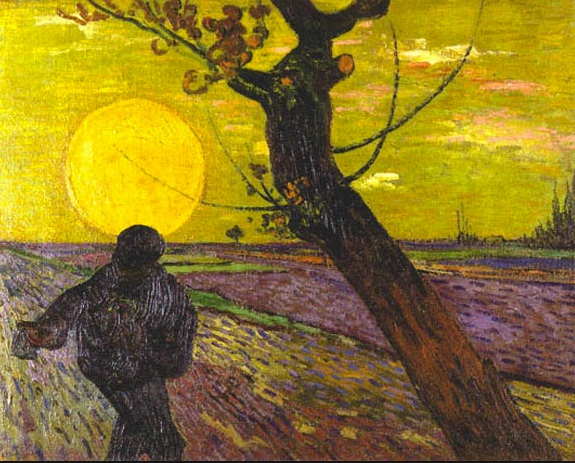
(Vincent Van Gogh painted the Sower (above) many times and found the subject filled with spiritual significance. He once said “one begins to see more clearly that life is a kind of sowing time, and the harvest is not here.”).

The Blind Believe

Jesus sorrowing

Rejected by your own,
By those who know so much
yet know so little.

This week in Jerusalem,
the city that knows so much
yet knows so little,
you walk its streets where a blind man begs
and give him sight that he never had before,
but they don’t believe
you’re God’s Son,
his only Son, equal to him.

“Who is he, sir, that I may believe in him?”
the blind man said with new sight.
“You have seen him,
the one speaking with you is he,”
you said to the man with new sight.

He worshiped you,
“I do believe, Lord.”

Give us his sight.

art: Duk Soon Fwang

The Hand of the Lord Feeds Us

The Gospel of John, written around the year 90, is skillfully constructed  around seven wondrous actions of Jesus, seven “signs” that lead to his passion and resurrection. Our reading last week was about the fourth sign; Jesus multiplies a few loaves and fish to feed a hungry crowd of people near the Sea of Galilee. (John 6, 1-15)

After each sign, Jesus explains its meaning, and the gospels read on Sundays for the remainder of the month– all from the sixth chapter of John’s gospel– are the dialogue Jesus has with the crowd following this miracle.

They’ve followed him and are clamoring for more. He’s the bread come down from heaven, Jesus says, and he reminds them of a previous sign God gave their ancestors in the desert when he sent manna from heaven as they journeyed from Egypt to the Promised Land. They were hungry and God fed them.

He’s the new Moses come down from above to dwell with humanity, Jesus tells them, and he will feed them and lead them on their journey to God’s kingdom. Yet, like their ancestors described in our first reading from the Book of Exodus, this crowd grumbles too. Yes, they experienced a wondrous gift yesterday or so, but that was yesterday. They want daily miracles, something for their stomachs today.

But miracles of that kind don’t happen everyday. Miracles and exceptional signs from God are rare; we spend most of our years living by faith.

Yet, faith also needs something to go on, signs to help us on our way, and so Jesus leaves a reminder of the miracle of the loaves and the fish. He gives the Bread of the Holy Eucharist as a sign that he abides with humanity. We remember him in this sign, we recognize him and we receive him, the “true bread come down from heaven.”

Jesus came to satisfy our hunger, not just our basic hunger for food and drink, but the hungry for life in so many forms. “The hand of the Lord feeds us, he answers all our needs.”


Immaculate Conception Parish: Melbourne Beach, Fl

Today we began a parish mission in Immaculate Conception Parish, Melbourne Beach. I’m preaching at the Sunday Masses and Monday, Tuesday and Wednesday at Masses at 8 AM and 7 Pm.

Here’s the sermon at the Sunday liturgy.

“We would like to see Jesus”

In his remarkable books on Jesus of Nazareth, Pope Benedict describes his own personal search for God as he follows Jesus through the mysteries of his life, death and resurrection. Jesus is the way to see the face of God. The pope, who spent most of his life as a theologian, understands especially how modern scholarship has influenced the way we see Jesus.

The figure of Jesus has become “more and more blurred” today by different interpretations of him, the pope says. For example, some say  that “Jesus was an anti-Roman revolutionary working–though finally failing–to overthrow the ruling powers.” For others, “ he was the weak moral teacher who approves everything and unaccountably comes to grief.” Jesus loves everybody and everything goes.

What we face today, the pope says, is widespread skepticism about our ability to know Jesus at all. “This is a dramatic situation for faith, because its point of reference (Jesus Christ) is being placed in doubt: Intimate friendship with Jesus, on which all else depends, is in danger of clutching at thin air.” The pope wrote his books on Jesus of Nazareth to affirm who Jesus is and what he means to us and to our world. They’re worth reading.

( Jesus of Nazareth, From the Baptism in the Jordan to the Transfiguration, Ignatius Press 2008,  foreward xi)

It’s true what he says, isn’t it? If you go into the religion section in a big book store like Barnes and Noble today, you face an array of books about Jesus Christ that see him in totally different ways. If you search the internet, you find the same situation. The figure of Jesus becomes “more and more blurred;” some wonder if we can see him at all. Then, of course, others say he’s totally irrelevant to our times and our lives.

That’s why today’s gospel (John 12,20-33)–part of the Palm Sunday event we’ll celebrate next Sunday– is so interesting. Let’s look at its context. Jesus has just raised Lazarus from the dead.  A crowd is ready to acclaim him by casting palm branches before him as he enters Jerusalem, crying “Hosanna to the Son of David.” Many of them see him as a political messiah, someone who is going to change the government and restore Judaism to its golden age. As his popularity grows, his enemies see him as a dangerous troublemaker in a volatile time and place. Jerusalem’s religious establishment has decided to kill him. Jesus, of course, sees death coming.

Even before he enters the Garden of Gethsemane, he’s fearful about what lies before him.

Just then, some Greeks approach Philip and Andrew and say, “We would like to see Jesus.” It seems like a minor thing, some Greeks requesting to see him, but John’s gospel loves simple signs like this, signs that point to something else, signs that point to glory.

The Greeks who come to Jesus tell us it’s not the end, but the beginning. They come as Jesus approaches his death, like the Magi who approached him at his birth. They’re people from afar; they’re the first of many, the promise that others will come from the east and the west, from centuries beyond his own.

And Jesus rejoices at their coming. At this crucial uncertain time, when so many misunderstand him, when so many oppose him, so many ignore him, these strangers want to see him.

He sees the lasting fruitfulness of his mission on earth. “Like a grain of wheat I will fall to the ground and die, but if I die I’ll bring much fruit.” “My soul is troubled now, yet what shall I say, “Father, save me from this hour. But it was for this hour I have come.” His Father gives him this sign to strengthen him.

The unnamed Greeks received an immense grace when they saw Jesus at this time. An immense grace can come to us when we see Jesus at a time like theirs, when we search for him and find him.

The Greeks see him as seed falling to the ground, as the one rejected by his own, as a suffering man who dies on a cross. Shall we join them?

Help us see signs like those you gave them, Lord,

Unexpected signs like the mystery of your cross,

Dark signs like a church in decline,

Small signs like Bread and Wine

And Words from an old Book.

We want to see you,  Jesus.


A Mission in Plainville, CT

I’m beginning a mission at Our Lady of Mercy Parish in Plainville, Ct today and I’ll be preaching at all the Masses over the weekend. We will have a mission service each evening at 7 o’clock from tomorrow evening till Wednesday. I’ll be preaching at the morning Masses at 8 o’clock  too. Confessions after each service.

John’s gospel for Sunday about the blind man receiving his sight is a wonderful gospel with which to begin a mission: a dramatic story, involving Jesus and his disciples, the blind beggar, his parents, the neighbors, the Pharisees, and of course ourselves.

I like especially the way John’s Gospel links the disciples with Jesus.

“We have to do the works of the one who sent me while it is day.

Night is coming when no one can work.

While I am in the world, I am the light of the world.”  John 9

We receive light from Jesus, but also from his disciples who share his mission to be light  for the world. So besides Peter and James and John and the others, we have a mission too. I’m going to speak about that at the mission tomorrow night.

We also are there in the blind man, who can do nothing for himself. Like him, we wait for God, like beggars with empty hands and no eyes.

We are there too in the blind man’s parents who don’t want to get involved in all of this, even if he is their son. We don’t like involvement.

We’re there in the curious neighbors, like a Greek chorus chiming in as the events unfold.

Then, there are the Pharisees, blind in a different way but convinced they see. We can find ourselves in them too.

I’ll be posting blogs during the mission for those who can’t make it, or would like to follow it from a distance. I’ve done this before and it seems to work.

A mission is like the spit and clay Jesus used to heal. Doesn’t look like much, but it can bring some to see again. Please God, this one will do it also.

The Loving Father

Jn 4:43-54

At that time Jesus left [Samaria] for Galilee.
For Jesus himself testified
that a prophet has no honor in his native place.
When he came into Galilee, the Galileans welcomed him,
since they had seen all he had done in Jerusalem at the feast;
for they themselves had gone to the feast.

Then he returned to Cana in Galilee,
where he had made the water wine.
Now there was a royal official whose son was ill in Capernaum.
When he heard that Jesus had arrived in Galilee from Judea,
he went to him and asked him to come down
and heal his son, who was near death.
Jesus said to him,
“Unless you people see signs and wonders, you will not believe.”
The royal official said to him,
“Sir, come down before my child dies.”
Jesus said to him, “You may go; your son will live.”
The man believed what Jesus said to him and left.
While the man was on his way back,
his slaves met him and told him that his boy would live.
He asked them when he began to recover.
They told him,
“The fever left him yesterday, about one in the afternoon.”
The father realized that just at that time Jesus had said to him,
“Your son will live,”
and he and his whole household came to believe.
Now this was the second sign Jesus did
when he came to Galilee from Judea.

Monday, 4th week in lent

From earliest times, the church has chosen the Gospel of John to tell the story of the passion and death of Jesus on Good Friday. It also reads from this gospel on the days leading up to this great mystery, beginning Monday of the 4th week of lent and continuing till Holy Week.

John’s stories, and the people and places they recall,  cast a subtle light on his final story that reveals the Word made flesh. His account of the government official, a loving father who begs Jesus to come and heal his son, is not an isolated miracle unconnected to anything else. It’s a sign, the gospel says. Here in Cana in Galilee, water was changed into wine. The loving father seeking his son’s life is a sign of the Father whose love will change his Son’s death into life.

Jesus proclaims his relationship to his Father in lively encounters with his enemies throughout John’s gospel, but we will hear him express it often in the readings for these final days of lent.  They are  inseparable: “The Father and I are one.”  “My Father is at work until now, so I am at work.”

The father at Cana in Galilee is an image the Father of Jesus. He is no heartless father, nor is the Father of Jesus, whose love for his Son never wavers, but brings him to life.