Tag Archives: Eucharist

Corpus Christi


To listen to today’s homily, please select the audio below:


I missed my train last week because I wasn’t paying attention to signs in the subway announcing delays due to track repairs. Keep your eye on signs.

Today’s Feast of the Solemnity of the Body and Blood of Christ calls our attention to the signs of bread and wine; They’re sacred signs Jesus gave us; we can take them for granted. They point to a great mystery.

Our first reading today from the Book of Exodus points to the altar where Moses called the people to remember through signs the life they received from God. It’s a covenant moment, Moses says. God graciously gives himself to us and we are called to give ourselves to God. That’s what we do here at our altar as we bring the signs of bread and wine.

The prayers we say help us to understand these sacred signs. In our prayer over the bread at Mass we say: “Blessed are you, Lord God of all creation, for through your goodness we received the bread we offer you, fruit of the earth and work of human hands, it will become for us the bread of life.”

The bread we offer, the wine we offer are signs of creation and the human efforts that are part of creation. They’re signs of everything that the “God of all creation” gives us, of everything that comes from our hands. “The word bread stands for everything,” Augustine said in one of his commentaries on the Lord’s Prayer. (Epistle to Proba)

The bread and wine stand for everything. Let’s think of what that means. Scientists say that our universe came into existence about 15 billion years ago. The bread and wine stand for the 15 billion years our universe has been in existence. About 3.5 billion years ago life began on our planet. The bread and wine represent that 3.5 billion years of life on our planet. When they’re brought to the altar the whole universe is brought here.

About 200,000 years ago human life emerged on our planet. 200,000 years of human life are represented in the bread and wine. Our lives are part of the human story represented in the bread and wine .

We believe that when Jesus sat down with his disciples at the Last Supper and took bread and wine into his hands he took all creation, all life, all human life, he took us into his hands.

“This is my body.” “This is my blood,” he said. He is God in human flesh giving himself to us and to everything that God made. In a love poured out, he renews the covenant God makes with us and with creation.

Of course, we can miss the signs.
Corpus Christi

Tagbha carol roth 2


“I Love a Mystery” was a radio program I listened to as a young boy, long ago. It started, as all mysteries do, with something concealed. Someone, something was lost, someone was killed or was being hunted down and for the next half hour you would follow the various clues until the mystery was solved.

The Mass is a mystery too. A “mystery of faith,” we say, and it hides the treasures of our faith.

One of the earliest terms describing the Mass is “the Lord’s Supper,” referring of course to the supper that Jesus shared with his disciples the night before he died.  He spoke to them that night of his love and then gave himself to them under the signs of bread and wine. Then he said “Do this in memory of me.”

In every Catholic church we try to keep his command. Whether it’s St. Peter’s Basilica or a parish church or a small chapel off a busy city street, there’s an altar, a table, at the center of the place and the Lord’s Supper is celebrated here in memory of him.

Readings from the Old and New Testaments will be read here, because Jesus spoke from the scriptures to his disciples. Then the priest who represents Jesus takes bread and wine, gives thanks to God for the gifts of creation and life itself, then repeats the words of Jesus, “This is my body” “This is my Blood.” Then we all receive these gifts.

We gather around Jesus as his disciples did, not perfect disciples to be sure, but we’re among those “whom he loved till the end.” And he feeds us with his wisdom and life.

Our celebration of the Mass can be flawed by cold routine or lifeless participation. We who take part in the Mass–priest and people – may not bring the lively faith or spirit of thanksgiving that’s  “right and just” for this great act of worship. But still,  as a church we celebrate the Lord’s Supper. We have been celebrating it from the time of Jesus till now, and we will continue till its signs are replaced by the reality of the Kingdom they signify.

Ordinary time is when the Holy Spirit acts. It’s also the time when we know Jesus Christ through the signs he has left us, particularly through the Holy Eucharist.

The Eucharist and the Environment

A recent major study warns about climate change and its affect on our environment, but commentators say the political establishment isn’t going to do anything about it. Too hard to deal with. What about the religious establishment?

Two years ago representative Catholics and Methodists came together to address the crisis and issued a document entitled “Heaven and Earth are Full of Your Glory: United Methodist and Roman Catholic” It looked on “the ecological crisis as a summons to an ecumenical response…The signs of the times call for an “ecological conversion” as we face “climate destabilization, the destruction of the ozone layer and the loss of biodiversity,” and hear creation’s groaning.( Romans 8,22)

The two churches have prayer traditions in which bread and wine represent the creation that Jesus Christ loved and came to save. How can we use these signs to raise our sense of the sacredness of creation?
The document says that looking at creation in an inadequate way also “leads to a diminished sense of the salvific work of Christ.” (12)

The Bread of Christ

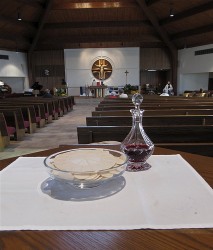
bread wine
Besides being one body, the Body of Christ, we are also one Bread in him. When we celebrate the Eucharist, we listen first to God’s word and then offer bread and wine. The prayer over the bread points to its meaning:

“Blessed are you, Lord God of all creation, for through your goodness we have received the bread we offer you; fruit of the earth and work of human hands, it will become for us the bread of life.”

We receive the bread, “fruit of the earth and work of human hands,” from our Creator. St. Augustine calls the bread we pray for in the Lord’s Prayer and the bread we offer at Mass “the bread of everything.” The gift of everything is acknowledged at Mass through the bread and wine; we’re blessed with everything, we’re reminded, and through them, we give thanks to the God of goodness for it all. “What do you have that you have not received?”

The greatest of God’s blessings is Jesus Christ who, on the night before he died took bread into his hands, the “bread of everything,” and gave himself to his disciples through this sign. “Take and eat, this is my body which will be given up for you.” In a similar way, he gave them the cup of wine that signifies his blood “poured out” for us.

“Do this in memory of me,” he said.

A mystery of faith, we say in our prayer. We believe through these signs. We can’t let their humble circumstances– the place, the people, the simple acts and words dissuade us. We’re called to wonder at what’s hidden here.

LOST, ALL LOST IN WONDER
Godhead here in hiding, whom I do adore,

Masked by these bare shadows, shape and nothing more,

See, Lord, at thy service low lies here a heart

Lost, all lost in wonder at the God thou art.


Seeing, touching, tasting are in thee deceived:

How says trusty hearing? that shall be believed;

What God’s Son has told me, take for truth I do;

Truth himself speaks truly or there’s nothing true.


On the cross thy godhead made no sign to men,

Here thy very manhood steals from human ken:

Both are my confession, both are my belief,

And I pray the prayer of the dying thief.

I am not like Thomas, wounds I cannot see,

But can plainly call thee Lord and God as he;

Let me to a deeper faith daily nearer move,

Daily make me harder hope and dearer love.

O thou our reminder of Christ crucified,

Living Bread, the life of us for whom he died,

Lend this life to me then:
feed and feast my mind,

There be thou the sweetness
man was meant to find.

Bring the tender tale true of the Pelican;

Bathe me, Jesu Lord, in what thy bosom ran—

Blood whereof a single drop has power to win

All the world forgiveness of its world of sin.

Jesu, whom I look at shrouded here below,

I beseech thee send me what I thirst for so,

Some day to gaze on thee face to face in light

And be blest for ever with thy glory’s sight. Amen.

(translation of Gerard Manley Hopkins, S.J.)

Hunger

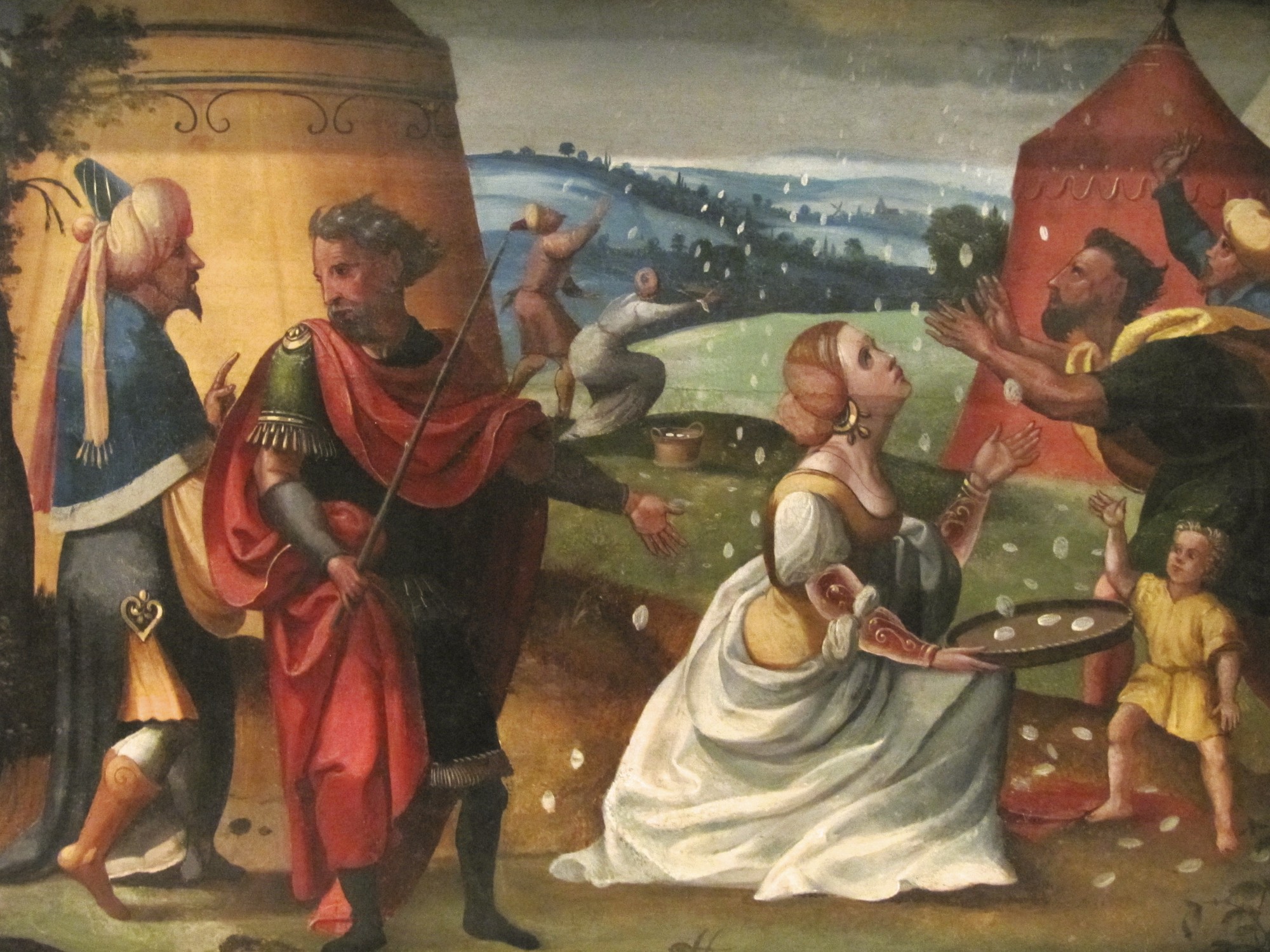
Manna in the Desert

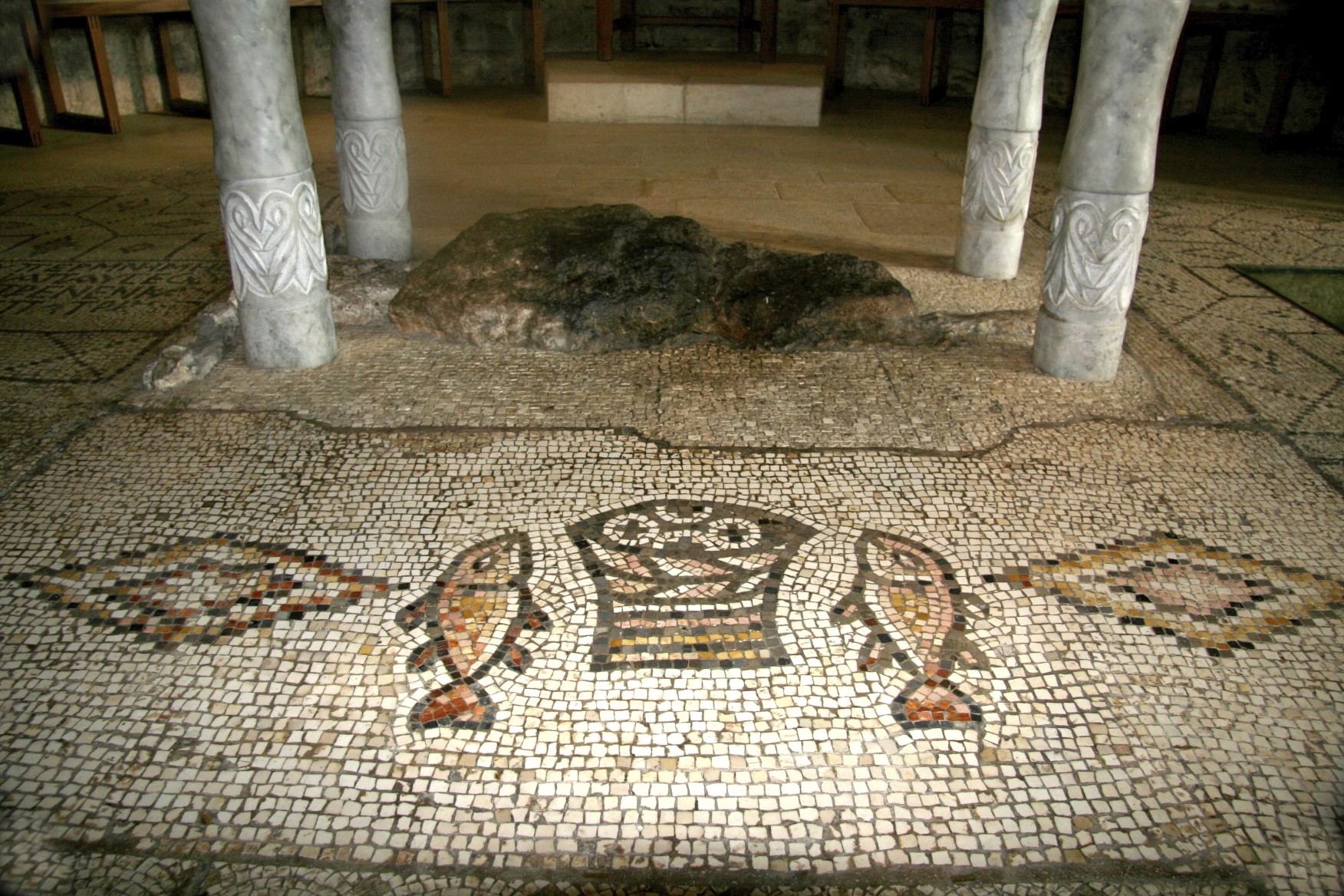
The next five Sundays we’ll read from the 6th chapter of St. John’s gospel, beginning this Sunday with the miracle of the loaves and the fish. All four gospels recall this miracle, Mark and Matthew report it twice. The miracle and Jesus’ words that follow it in John’s gospel are about the Holy Eucharist. Jesus, the Bread of Life, is the answer to our hunger.

The miracle takes place across the Sea of Galilee, in a “deserted place,’ as Matthew’s gospel describes it. There’s no place to buy food for a hungry crowd.

There’s only five barley loaves and two fish a small boy has. Barley loaves were the ordinary food for the poor.

Jesus initiates this miracle by pointing out to his disciples  a hunger in the crowd. They seem hardly aware of it and have no answer what to do, except to say “We don’t have enough!”  Taking what’s there, the five barley loaves and two fish, Jesus multiplies this food and feeds a multitude. John notes the Passover is near; it’s spring and green grass has grown up in this deserted place. Not only is it enough, but fragments are left over as the crowd has its fill.

Keep in mind the basic reality the miracle addresses: hunger. It’s bodily hunger, yes, but hunger of all kinds is addressed here. Like the disciples, we may be hardly aware of it. Humanity is hungry, this gospel says. Only God can fill its silent, hidden hunger, this miracle says. Only Jesus can.

Hunger

“I come among the peoples like a shadow,

I sit down by each man’s side,

None sees me,

but they look on one another and know that I am there

My silence is like the silence of the tide that buries the playground of children

Like the deepening of frost in the slow night, when birds are dead in the morning.

Armies travel, invade, destroy with guns roaring from earth and air.

I am more terrible than armies.

I am more feared than cannon, kings and chancellors

I give no command to any, but I am listened to more than kings

and more than passionate orators

I unswear words and undo deeds,

Naked things know me.

I am more the first and last to be felt of the living.

I am hunger. “

Lawrence Binyon

Reasoning to faith

I mentioned in my last blog how Elizabeth Seton came to believe in the presence of Jesus Christ in the Eucharist. She offers a an example of how ordinary reasoning leads to faith. “She thought of the Filicchis’s devotion and asked how God created her ‘ and how a hundred other things I know nothing about? I am a mother, so the mother’s thought came also. How was my God a little babe in the first stage of his mortal existence in Mary?’”

Three simple things influenced her: the Filicchis’s belief in the Eucharist, the many mysteries she found in her own life and could not explain, and finally the mystery of the Incarnation itself. Humbly, Jesus became flesh in the womb of Mary. Could not the One who “emptied himself and took on the form of a slave” choose to be really present in bread and wine?

Commentators say that the long narrative in the 6th chapter of John’s gospel on the miracle of the loaves and fish is meant to meet questions that arose in his church in the last decade of the 1st century. The first disciples and eyewitnesses are gone. Some Christians, probably influenced by Gnostic pessimism, questioned the Incarnation of Christ. Would God become human and part of our created world? The authors of John’s gospel use the miracle of the loaves and fish and Jesus’ words that he is “the bread of life” to assert that he works through creation. He is the Word made flesh.

Elizabeth was raised an Episcopalian and belonged to Trinity Church and St. Paul’s Chapel in lower Manhattan. From my reading it seems that her church at the end of the 18th century was emerging from the heavy influence of the Enlightenment, which stressed a rational approach to religion. Then, Henry Hobart,a new ministerarrived and began to preach a biblical message based on the words and ministry of Jesus; Elizabeth responded warmly to his message.

I like best her simple reasoning for belief in Jesus present in the Eucharist: “I am a mother, so the mother’s thought came also. How was my God a little babe in the first stage of his mortal existence in Mary?”

Grace Before Meals

“Not only in Israel, but among the ancient peoples generally, a meal was much more than a meal, understood as an occasion of eating and drinking. A meal was a sacred occasion, something that is hard for us to understand in these days of ‘fast food’, when eating is little more that  a biological function. Even a few decades ago, when  grace before meals was quite common in Western countries, there was some sense that eating and drinking are not merely biological occasions, but carry ( or may carry) many connotations.

The fact that grace before meals has become something of a rarity nowadays is symptomatic of the change that has taken place. Even when people sit down together at table they are often in a hurry to get away so that they can get to some other matter, whether business or pleasure, that seems to them more important. Even when graces are said nowadays, it is often on the least appropriate occasions, lavish banquets in city halls, colleges, or similar institutions.

But the point I want to make is that the disapperance of grace points to the fact that there has been a loss of any sense of the sacred ina meal, any sense of gratitude to God who has provided for the maintenance of life in his creation, or even to those human beings whose labor brought the fruitfulness of earth to a form in which it can nourish the human race.”

John Macquarrie, A Guide to the Sacraments, 102


Signs of the Risen Christ

At Easter we see the Risen Christ in sacraments, especially Baptism, Confirmation and the Holy Eucharist. St. John Chrysostom, following the Gospel of John, says that these are signs already revealed on Calvary. Jesus is dead when the soldier pierces his side; he is still on the cross. From his wounds the sacraments of Baptism and the Eucharist are given to his church.

Water comes forth and then the blood, Chrysostom says, “because first comes baptism and then the mysteries (the Eucharist).” With his spear, the soldier pierced the temple wall, the saint goes on, “but I am the one who finds the treasure and gets the wealth.” (cf. John 2,19)

From the sacraments the church is formed, the saint continues. Like Adam, who was cast into a deep sleep to form Eve, Christ dies the sleep of death and from his side the church is taken. “From his side Christ formed the church just as he formed Eve from the side of Adam.” (Baptismal Homilies, 3,16-18)

In an early baptismal homily preached in the church of the Holy Sepulcher in Jerusalem which the Emperor Constantine constructed atop of the remains of Calvary and the newly discovered tomb of Jesus, Cyril, bishop of Jerusalem (+387), says: “… you descended three times into the water and ascended, showing the symbol of the three days of Christ’s burial… How kind and loving! Christ received nails in his hands and feet, while I without pain and trials receive freely a gift of salvation because I share in his suffering.”

At Easter we recall our baptism and the Eucharist. Sacraments are real signs that bring us into the mystery of the Passion and Resurrection of Jesus. We meet the Risen Christ in them.

4th Sunday of Advent

The readings for the 4th Sunday of Advent would have us look at small, insignificant things– a little town in Judea, Bethlehem, and a visit of two women, Mary and her cousin Elizabeth.

Faith sees meaning here. A mystery, a great mystery,  hidden in this place and in these people.

Bethlehem, some say, means “House of Bread,” and with eyes of faith, we believe that the Bread of Life, Jesus Christ, was born in that humble town. The women, visiting together, were holy women who brought Jesus Christ, the Son of God, into the world and were among the first to recognize him.

With eyes of faith we look back and see.

But eyes of faith are not just for looking back; they help us see life today and discover God’s presence and call now.

Along with our scriptures, the signs and prayers of the Mass  help us see. Like our readings they point to great meaning in small things.

Look at the bread and the wine. Jesus took these small signs into his hands the night before he died and made them  bearers of important mysteries. As we bring them to the altar after our Creed and take them into our hands and ourselves, we ask:  What do they mean?

They’re food and drink, we say, and so they are. Real food and real drink, Jesus said, giving life beyond what we hope for and joys we cannot imagine. God feeds us, as a mother feeds a child, as a father giving daily bread to his children. The bread and wine reveal God’s love for us in Jesus Christ.

They point, though, to other realities too. They tell us of our relationship to God, but they also point to our relationship to the universe made by  God our Creator.

“Blessed are you, Lord, God of all creation, through your goodness we have this bread to offer, which earth has given and human hands have made. it will become for us the bread of life.”

“Blessed are you, Lord, God of all creation, through your goodness we have this wine  we have this wine to offer, fruit of the vine and work of human hands, let it become our spiritual drink.” (Offertory prayers)

Bread and wine are symbols of creation, our prayers say. We don’t live apart from the created world.  We receive God’s gifts through it. God comes to us through it. Creation’s story is our story too.

Both the bible and science tell that story, but in different ways, the Book of Genesis in poetic language;  scientists in the language of science.

As scientists tell it, after probing into space with instruments like the Hubble telescope and sifting through the earth’s crust,  our universe began 15 billion years ago. Then, about 3.5 billion years ago primitive life began on our planet. 200,000 years ago human life emerged. We humans come lately into the story of creation.

However, we late-comers have an important role in the well being and development of our universe. The Book of Genesis describes Adam and Eve, the first of our human family, as cultivators and leaders of the earth community. God made them stewards of the earth and its gifts.

Today the human role as stewards of  the universe has become critical. The recent meeting on climate control in Copenhagen, Denmark, called the human family from all  parts of the earth, to come together and decide what changes must be made in the way we humans live, so that the environment of our world does not deteriorate further.

Sadly, the meeting ended with its goals unmet.

Pope Benedict XVI was one of those who sent a message to the leaders of the conference:

“Can we remain indifferent before the problems associated with such realities as climate change, desertification, the deterioration and loss of productivity in vast agricultural areas, the pollution of rivers and aquifers, the loss of biodiversity, the increase of natural catastrophes and the deforestation of equatorial and tropical regions?”

“It is becoming more and more evident that the issue of environmental degradation challenges us to examine our lifestyle and the prevailing models of consumption and production, which are often unsustainable from a social, environmental and even economic point of view,” the pope said.

“Protecting the natural environment in order to build a world of peace is thus a duty incumbent upon each and all. It is an urgent challenge, one to be faced with renewed and concerted commitment; it is also a providential opportunity to hand down to coming generations the prospect of a better future for all,”

“If you want to cultivate peace, protect creation.”

As we take the bread and wine at Mass, let’s remember God who blesses us in Jesus Christ, but let’s also remember the earth they represent. These small signs point to a universe we are called by God to protect.

The Prayer of Abel

“Look with favor on these offerings and accept them as you once accepted the gifts of your servant Abel.” (1st Eucharistic Prayer)

In a homily, St. Ambrose explains why God accepted Abel’s gifts and not Cain’s. His gifts were a prayer from his heart.

He brought them to God prompted by the same gratitude that caused the Samaritan to give thanks to Jesus after being cured of leprosy. Gratitude is always at the heart of the Eucharist.

Abel’s gifts were the result of true prayer, according to Ambrose, who summarizes what true prayer is: “Jesus told us to pray urgently and often, so that our prayers should not be long and tedious but short, earnest and frequent. Long elaborate prayers overflow with pointless phrases, and long gaps between prayers eventually stretch out into complete neglect.

Next he advises that when you ask forgiveness for yourself then you must take special care to grant it also to others. In that way your action can add its voice to yours as you pray. The apostle also teaches that when you pray you must be free from anger and from disagreement with anyone, so that your prayer is not disturbed or broken into.

The apostle teaches us to pray anywhere, while the Saviour says Go into your room – but you must understand that this “room” is not the room with four walls that confines your body when you are in it, but the secret space within you in which your thoughts are enclosed and where your sensations arrive. That is your prayer-room, always with you wherever you are, always secret wherever you are, with your only witness being God.

Above all, you must pray for the whole people: that is, for the whole body, for every part of your mother the Church, whose distinguishing feature is mutual love. If you ask for something for yourself then you will be praying for yourself only – and you must remember that more grace comes to one who prays for others than to any ordinary sinner. If each person prays for all people, then all people are effectively praying for each.

In conclusion, if you ask for something for yourself alone, you will be the only one asking for it; but if you ask for benefits for all, all in their turn will be asking for them for you. For you are in fact one of the “all.” Thus it is a great reward, as each person’s prayers acquire the weight of the prayers of everyone. There is nothing presumptuous about thinking like this: on the contrary, it is a sign of greater humility and more abundant fruitfulness.”