Tag Archives: Epiphany Cathedral mission

The Woman who touched Jesus’ Garments

Mark 5, 21-43

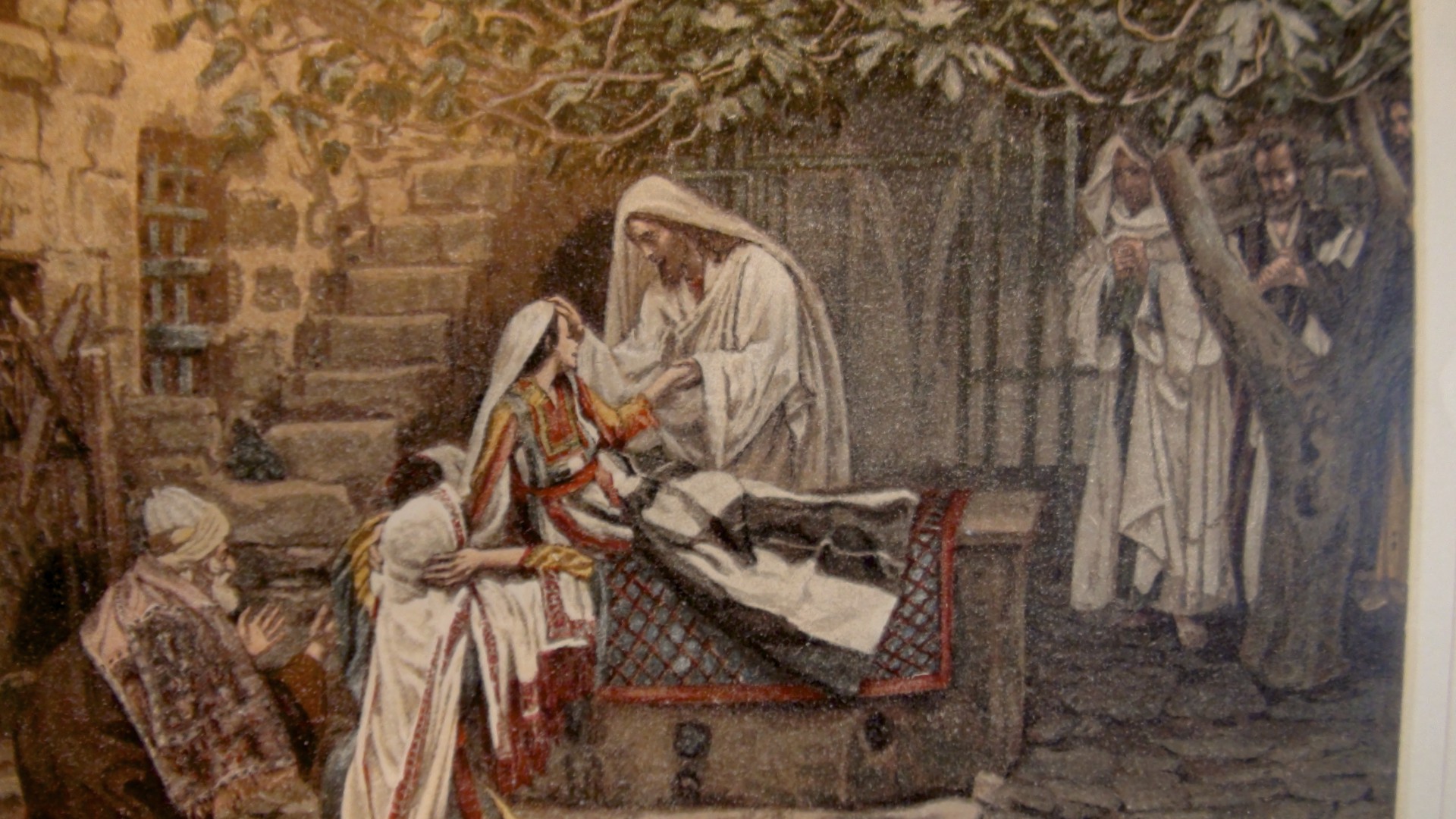
We read this story today at Mass. Why does Mark insert the story of the woman who touched Jesus’ garments into the story of the dead girl brought back to life? Was it simply that she happened to meet him on his way to the girl’s house? Maybe there’s another reason.

A picture of the woman touching the garments of Jesus is one of the oldest pictures  found in the catacombs of Rome, where early Christians buried their dead. Is it there  to remind them that those who died had also touched the garments of Jesus? They didn’t see him, but he met them in signs.

Those buried there believed in him and were baptized with water; they received his life through that sign and entered into the mystery of his death and resurrection. They received his body and blood in the signs of bread and wine, and so like the woman they touched his garments.  His power and life went out to them.

The Gospel of Mark was written in Rome, most scholars say. Is Mark’s arrangement of the  stories of Jesus raising the dead girl to life and the woman touching his garments a way of teaching Roman Christians about the mystery of death? Jesus was with them on their last journey.

In preparing the Catechism of the Catholic Church after the Second Vatican Council the Roman authorities responsible for the catechism instructed publishers to put the picture from the catacombs of the woman touching the garments of Jesus at the beginning of the section on the sacraments.

She’s an example, an image of the present church which knows Jesus through sacraments.  She helps us believe in the power of simple signs.
Catechisms Have Changed

Some of us may have learned our faith through the questions and answers of the Baltimore Catechism, but catechisms have changed in recent years. One big change is that they’re not just for children, they’re for adults too.

The United States Catholic Catechism for Adults, published by the US Catholic Bishops in 2006, is an adaptation of The Catechism of the Catholic Church published in 1992 in Rome after the Second Vatican Council, as a response from the American bishops to Pope Paul VI’s call to the bishops of the world to adapt the universal catechism to the circumstances and culture of their own people.

The American catechism follows the arrangement of the Roman catechism and teaches about the Creed, the Sacraments, Moral Life and Prayer. One of its features is that it begins each lesson with a story of faith, a short biography of a Catholic, usually someone from the United States, who introduces us to the teaching that’s presented.

Many of the stories also help us appreciate how the Church in our country grew and the particular spirituality that’s been expressed here.

For example, St. Elizabeth Seton introduces us to its first question: our search for God. We search for God through creation, through human relationships and through the various circumstances of our lives.

Mother Seton found God in all those ways. As a young girl, neglected by her father and her stepmother after her mother’s death, she found God in the beauties of nature, in the fields around New Rochelle, NY, where she played as a child.

Then, she married a successful man, William Seton, and had children, a happy married life, lots of friends, and was active in her Episcopal church, Trinity Church, on Wall Street in New York City.

Her life changed when her husband’s business failed. His health also failed and Elizabeth took him to Italy to see if a better climate could revive him. When they arrived in Livorno, Italy, he died in her arms in a quarantine station at the seaport.

Some Italian friends took Elizabeth and her daughter into their home and there she began to think about becoming a Catholic. That step caused her to lose some old friends; as a widow with small children she faced hard times.

Resettling in Baltimore, then Emmitsburg, Maryland, she established a Catholic school and gathered other women to form a religious community. One of the great saints and founders of the American Church, her quest for God was lifelong and many sided. She is an example of how our search for God goes on through creation, through the people around us and in the circumstances we face going through life.

Mother Seton is a teacher of faith and played an important role in the history of the church in our country.  She reminds us how important women have been, especially religious women,  in building our American church. She also reminds us that we’re all called by God to teach others.