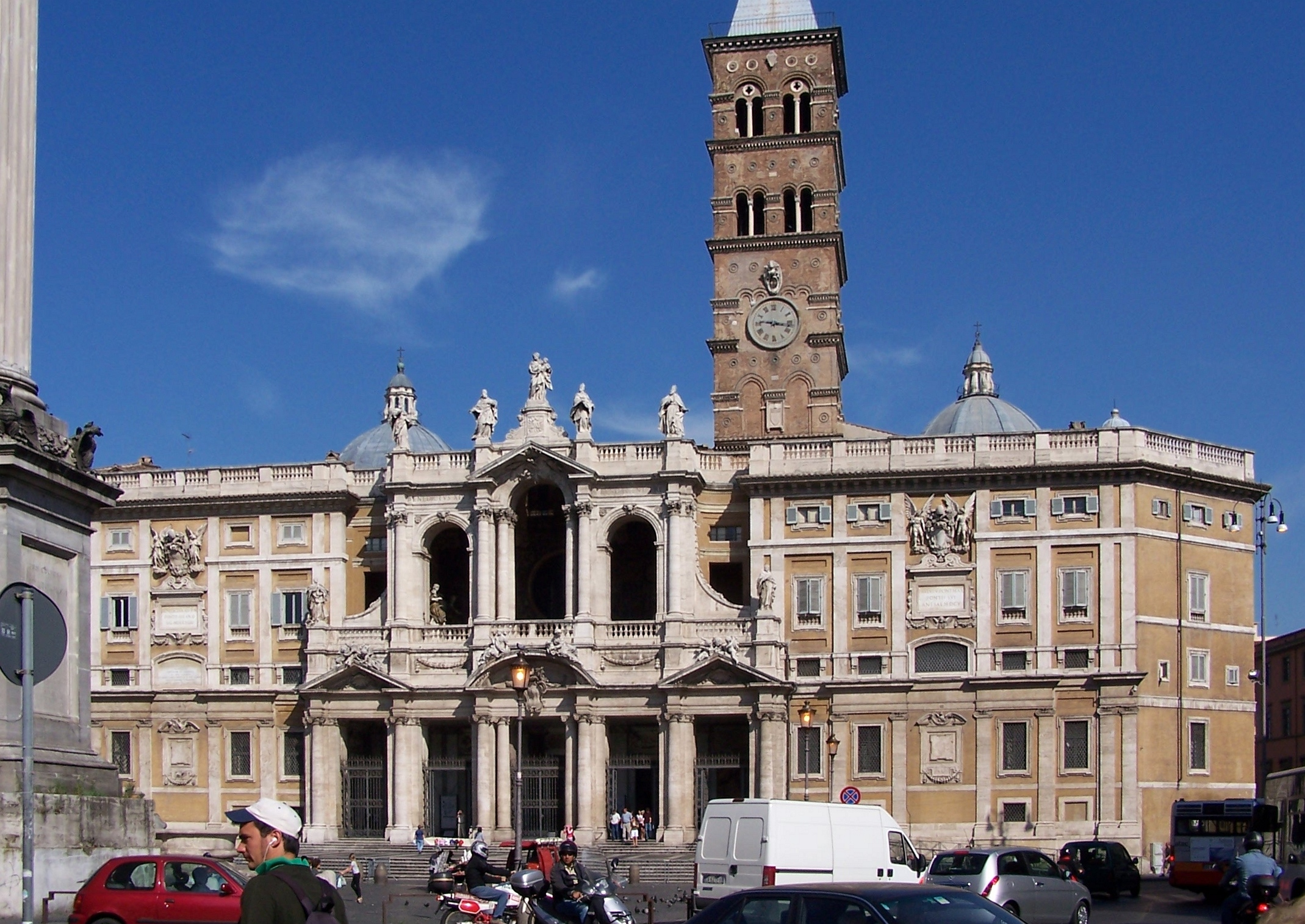
On the summit of the Esquiline Hill, a short distance from the Lateran Basilica, is the church of St. Mary Major, begun in the early 5th century and completed by Pope Sixtus III (432-440.)

Mary, the mother of Jesus, is honored here as the Mother of God. . In 431, the Council of Ephesus repudiated Nestorius, the patriarch of Constantinople, for refusing to call her “Mother of God.”
The title is important because it safeguards Christian belief in the mystery of the Incarnation: Jesus is God and man, the council said. For the Christian world Mary is the defender of Jesus, her son, who was both human and divine.
Devotion to Mary ran high in the Christian world after the Ephesus council, and churches dedicated to Mary arose everywhere. In the city of Constantinople alone, 250 churches and shrines in her honor were built before the 8th century. Pictures, icons of Mary holding her divine child multiplied, especially in churches of the East, where they became objects of special devotion.
Mary’s title, Mother of God, does not make her a goddess, otherwise how could she have given birth to Christ who is truly human? Yet, she can be called Mother of God, because Jesus who is truly her human son is truly Son of God from all eternity as well.
The 5th century, however, was hardly a good time to build a church in Rome. In 410, Alaric and his Goths shocked the Roman world by sacking a city all thought invincible. In 455 the Vandals under Genseric vandalized Rome. Twice more in the century other barbarian tribes invaded.
In far off Palestine St. Jerome cried out in disbelief at Rome’s misfortunes, which he saw heralding the end of the world. In Africa St. Augustine wrote “The City of God” in response to the followers of Rome’s traditional religions, who said Christian weakness caused the city’s devastation. Christians were not the cause of the city’s misfortunes, St. Augustine wrote; two loves are at work in the world building two cities. One love builds an evil city; Christianity builds the City of God, promoting love and justice.
The English historian Edward Gibbon called this period a time of decline and fall, the end of the Roman Empire. God’s plan does not lead to decline and fall, they say, but to triumph in Christ. God’s plan does not lead to decline and fall, they say, but to triumph in Christ. God’s plan does not lead to decline and fall, this church says. On the walls of St. Mary Major has stories from the Old and New Testaments calling for courage and hope.
In the church of St. Mary Major, Mary appears as Jesus’ mother and closest disciple. To use a phrase of St. Pope John Paul II, this church is “a school of Mary” who teaches mysteries she has learned. A noticeable number of women from the Old and New Testaments surround her: she represents those who seem powerless, but are empowered by God.

The great 13th century mosaic in the church’s apse of Mary crowned by Jesus Christ as heaven’s queen proclaims God’s triumph in her, but also his triumph in the church as well. She is taken up to heaven “to be the beginning and pattern of the church in its perfection, and a sign of hope and comfort for your people on their pilgrim way.” (Preface of the Assumption)
It shouldn’t surprise us that many of the mysteries in which Mary had a special role were first celebrated here as liturgical feasts. The Christmas liturgy, especially the midnight Mass on December 25th , began in this church in the 5th century and spread to other churches of the west.
A replica of the cave under the church of the Nativity at Bethlehem, the traditional site of Jesus’ birth, was constructed here early on.. After the Muslim conquest of the Holy Land in the 7th century, Christian refugees placed relics here purported to be from the crib that bore the Christ Child and relics of St.Matthew, an evangelist who told the story of Jesus birth.

Besides the Christmas liturgy, other great Marian feasts, such as her Immaculate Conception and Assumption, developed their liturgical forms in this church.
Built on a hill where all could see it, near Rome’s eastern walls so often threatened by barbarian armies, St. Mary Major affirms Christianity’s ultimate answer to its enemies. It is not military might, but the power of faith and love that triumphs in the end.
Visiting St.Mary Major
The church’s 18th century façade was built to enhance the appearance of this important church at a time when many visitors, especially from England and Germany, were traveling to Rome on the Grand Tour to visit its classical and religious sites.
The church’s interior, with its splendid 5th century mosaics along the upper part of the nave, retains its original form better than any other of the major basilicas of Rome.
The Sistine Chapel at the right hand side of the nave was built to house a silver reliquary with relics of the crib brought from the Holy Land in the 8th century. Two popes, Sixtus V and Pius V are buried there.
The Borghese Chapel at the left hand side of the nave honors the ancient icon of the Virgin and Child,”Salus populist Romani”, that Roman Christians have reverenced for centuries. A reproduction of the icon is a nice remembrance to bring home. Pope Francis has requested to be buried here.
The magnificent 13th century mosaic in the apse of the basilica presents the Coronation of Mary in heaven. It’s surrounded by 5th century mosaics depicting scenes from the birth of Jesus and the life of Mary.
Website:
 The Victor's Place