Tag Archives: bread and wine

The Bread of Christ

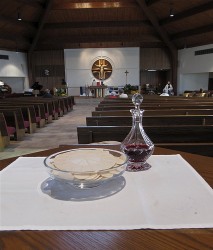
bread wine
Besides being one body, the Body of Christ, we are also one Bread in him. When we celebrate the Eucharist, we listen first to God’s word and then offer bread and wine. The prayer over the bread points to its meaning:

“Blessed are you, Lord God of all creation, for through your goodness we have received the bread we offer you; fruit of the earth and work of human hands, it will become for us the bread of life.”

We receive the bread, “fruit of the earth and work of human hands,” from our Creator. St. Augustine calls the bread we pray for in the Lord’s Prayer and the bread we offer at Mass “the bread of everything.” The gift of everything is acknowledged at Mass through the bread and wine; we’re blessed with everything, we’re reminded, and through them, we give thanks to the God of goodness for it all. “What do you have that you have not received?”

The greatest of God’s blessings is Jesus Christ who, on the night before he died took bread into his hands, the “bread of everything,” and gave himself to his disciples through this sign. “Take and eat, this is my body which will be given up for you.” In a similar way, he gave them the cup of wine that signifies his blood “poured out” for us.

“Do this in memory of me,” he said.

A mystery of faith, we say in our prayer. We believe through these signs. We can’t let their humble circumstances– the place, the people, the simple acts and words dissuade us. We’re called to wonder at what’s hidden here.

LOST, ALL LOST IN WONDER
Godhead here in hiding, whom I do adore,

Masked by these bare shadows, shape and nothing more,

See, Lord, at thy service low lies here a heart

Lost, all lost in wonder at the God thou art.


Seeing, touching, tasting are in thee deceived:

How says trusty hearing? that shall be believed;

What God’s Son has told me, take for truth I do;

Truth himself speaks truly or there’s nothing true.


On the cross thy godhead made no sign to men,

Here thy very manhood steals from human ken:

Both are my confession, both are my belief,

And I pray the prayer of the dying thief.

I am not like Thomas, wounds I cannot see,

But can plainly call thee Lord and God as he;

Let me to a deeper faith daily nearer move,

Daily make me harder hope and dearer love.

O thou our reminder of Christ crucified,

Living Bread, the life of us for whom he died,

Lend this life to me then:
feed and feast my mind,

There be thou the sweetness
man was meant to find.

Bring the tender tale true of the Pelican;

Bathe me, Jesu Lord, in what thy bosom ran—

Blood whereof a single drop has power to win

All the world forgiveness of its world of sin.

Jesu, whom I look at shrouded here below,

I beseech thee send me what I thirst for so,

Some day to gaze on thee face to face in light

And be blest for ever with thy glory’s sight. Amen.

(translation of Gerard Manley Hopkins, S.J.)
Earth Day and Solar Panels

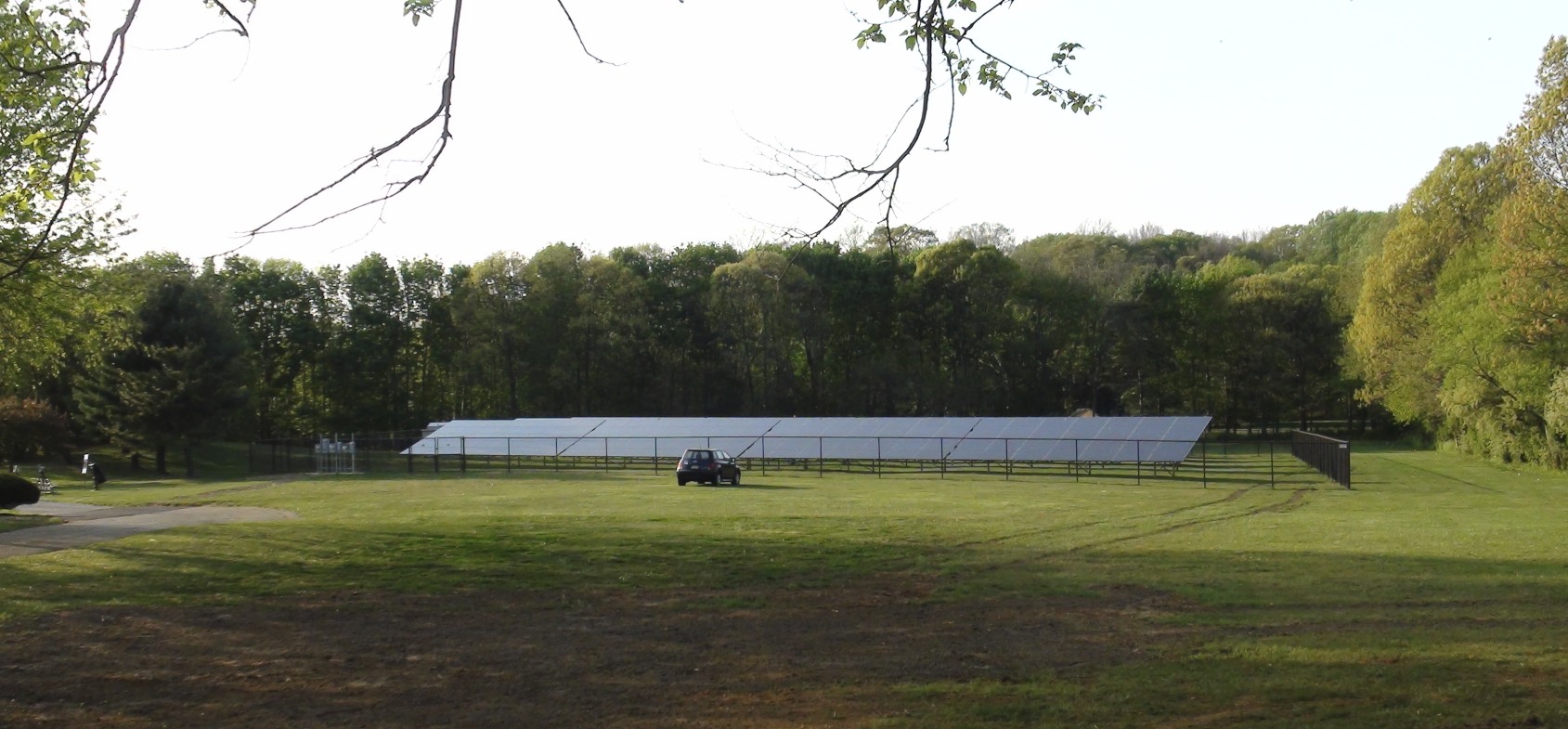
Saturday evening,  April 21, after the 5 PM Mass, the Parish of St. Mary’s in Colts Neck, NJ, dedicated an array of solar panels that will cut their use of energy in the parish complex by 90%.  It’s the first parish in the Trenton Diocese to do it, and one hopes an incentive to others. Congratulations to Fr. Tom Triggs and his lively environmental committee.


I offered these thoughts at two Sunday Masses the next morning:

“Bread from heaven.” How frequently Jesus uses earthly things to speak of the things of heaven. “I am the vine,” “I am the light,” “I am living water.” He calls himself the “son” of the “Father.”

Jesus takes things we know: birds of the air, flowers of the field, seed scattered in the earth, to point to things unknown. The created world reveals secrets of a world beyond here.

Shouldn’t we reverence creation then? If we follow Jesus we will. Yet, as we watch our natural world being plundered, its air and waters polluted, its environment sacrificed for human convenience and pleasure, we know our attitude toward our natural world must change. Human-centered and human-concerned, we lack respect for the non- human.

In the Book of Genesis, human beings are said to be made in the image of God and are given an important relationship to the rest of creation. We’re caretakers of creation; we don’t own it; we care for it for awhile. We have a responsibility for it; it has rights of its own, and we have to use all our ingenuity in its care.

Our understanding of God and Jesus Christ, his Son, also suffers from lack of respect for creation. Taking bread, taking wine, Jesus gave thanks; they’re creation’s ambassadors, instruments of a divine exchange. They enlarge our relationship to God by reminding us that God’s plan includes creation as well as our human family and it embraces even the simplest creative things.

Placing bread and wine on precious plates and in precious cups, we carry them to the altar in church and they bring Jesus to us. Can we begin to learn a greater respect for creation here?

4th Sunday of Advent

The readings for the 4th Sunday of Advent would have us look at small, insignificant things– a little town in Judea, Bethlehem, and a visit of two women, Mary and her cousin Elizabeth.

Faith sees meaning here. A mystery, a great mystery,  hidden in this place and in these people.

Bethlehem, some say, means “House of Bread,” and with eyes of faith, we believe that the Bread of Life, Jesus Christ, was born in that humble town. The women, visiting together, were holy women who brought Jesus Christ, the Son of God, into the world and were among the first to recognize him.

With eyes of faith we look back and see.

But eyes of faith are not just for looking back; they help us see life today and discover God’s presence and call now.

Along with our scriptures, the signs and prayers of the Mass  help us see. Like our readings they point to great meaning in small things.

Look at the bread and the wine. Jesus took these small signs into his hands the night before he died and made them  bearers of important mysteries. As we bring them to the altar after our Creed and take them into our hands and ourselves, we ask:  What do they mean?

They’re food and drink, we say, and so they are. Real food and real drink, Jesus said, giving life beyond what we hope for and joys we cannot imagine. God feeds us, as a mother feeds a child, as a father giving daily bread to his children. The bread and wine reveal God’s love for us in Jesus Christ.

They point, though, to other realities too. They tell us of our relationship to God, but they also point to our relationship to the universe made by  God our Creator.

“Blessed are you, Lord, God of all creation, through your goodness we have this bread to offer, which earth has given and human hands have made. it will become for us the bread of life.”

“Blessed are you, Lord, God of all creation, through your goodness we have this wine  we have this wine to offer, fruit of the vine and work of human hands, let it become our spiritual drink.” (Offertory prayers)

Bread and wine are symbols of creation, our prayers say. We don’t live apart from the created world.  We receive God’s gifts through it. God comes to us through it. Creation’s story is our story too.

Both the bible and science tell that story, but in different ways, the Book of Genesis in poetic language;  scientists in the language of science.

As scientists tell it, after probing into space with instruments like the Hubble telescope and sifting through the earth’s crust,  our universe began 15 billion years ago. Then, about 3.5 billion years ago primitive life began on our planet. 200,000 years ago human life emerged. We humans come lately into the story of creation.

However, we late-comers have an important role in the well being and development of our universe. The Book of Genesis describes Adam and Eve, the first of our human family, as cultivators and leaders of the earth community. God made them stewards of the earth and its gifts.

Today the human role as stewards of  the universe has become critical. The recent meeting on climate control in Copenhagen, Denmark, called the human family from all  parts of the earth, to come together and decide what changes must be made in the way we humans live, so that the environment of our world does not deteriorate further.

Sadly, the meeting ended with its goals unmet.

Pope Benedict XVI was one of those who sent a message to the leaders of the conference:

“Can we remain indifferent before the problems associated with such realities as climate change, desertification, the deterioration and loss of productivity in vast agricultural areas, the pollution of rivers and aquifers, the loss of biodiversity, the increase of natural catastrophes and the deforestation of equatorial and tropical regions?”

“It is becoming more and more evident that the issue of environmental degradation challenges us to examine our lifestyle and the prevailing models of consumption and production, which are often unsustainable from a social, environmental and even economic point of view,” the pope said.

“Protecting the natural environment in order to build a world of peace is thus a duty incumbent upon each and all. It is an urgent challenge, one to be faced with renewed and concerted commitment; it is also a providential opportunity to hand down to coming generations the prospect of a better future for all,”

“If you want to cultivate peace, protect creation.”

As we take the bread and wine at Mass, let’s remember God who blesses us in Jesus Christ, but let’s also remember the earth they represent. These small signs point to a universe we are called by God to protect.

Bread and Wine

After the homily at every Sunday Mass, we pray the Creed, that sweeping summary of what we believe as Christians.  We say it before we bring the bread and wine to the altar because it helps us understand what we’re doing. It begins:

We believe in God the Father Almighty,

creator of heaven and earth,

of all that is seen and unseen.

Bread and wine are symbols of the heavens and the earth– the world God has made. They represent the totality of God’s gifts found in creation which we acknowledge as we bring them to their Creator:

“Blessed are you, Lord God of all creation, through your goodness we have this bread to offer, which earth has given and human hands have made. It will become for us the bread of life.” “Blessed are you, Lord God of all creation, through your goodness we have this wine to offer, fruit of the vine and work of many hands, it will become our spiritual drink.”

These simple gifts stand for all the gifts that come from an almighty God, a kind Father, the generous One who made the heavens and earth, the Maker “of all that is seen and unseen.” They point to a God, beyond our minds grasp, a good God, who is with us always; a loving God who is our friend.

They  represent God’s promise of life everlasting.

The prayers at Mass address God, the Creator. “All life, all holiness comes from you,” (3rd Eucharistic Prayer) “All things are of your making, all times and seasons obey your laws,” (P33) “In you we live and move and have our being. Each day you show us a Father’s love.(P34)

At Mass we approach God, Maker of all.

As Creator, God doesn’t act alone, but shares power with his creation. Our prayers at Mass recognize that: “You formed us in your own likeness, and set us over the whole world in all its wonder. You made us the stewards of creation to serve you our creator and to rule over all creatures.” (P33)

As “stewards of creation” we have an important role in the world, but we’re not the only power in our universe.  Creation itself has rights and a role in God’s plan. As we come to know the story of our own universe, we’re amazed at its mysterious development, its complexity and its beauty. It’s charged with the glory of God, and so for all our importance, we’re  meant to be respectful participants in its story.

That’s the vision of faith our Mass offers. But is it true? Our experience of life can sometimes tempt us to doubt it. Is God really the creator of us all? Does God really care? Why do bad things happen? Why do people do what they do? Why do we die? Why is there suffering? Why is there injustice. Questions like that raise doubts. Then too, preoccupation with ourselves also can weaken our vision of faith. We think we are the creators of the world and its gods.

The Mass tells the story of creation, but also the story of salvation. The Creed reminds us that God sent his only Son to be our Savior. In the mystery of the Mass, Jesus Christ is sent into the world. He comes into the bread and wine, just as he came into the womb of Mary.  Listen to the words of one of our prayers.

“Father, you so loved the world,

that in the fullness of time you sent your only Son to be our Savior.

He was conceived through the Holy Spirit,

and born of the Virgin Mary,

one like us in all things but sin.

To the poor he proclaimed the good news of salvation,

to prisoners, freedom,

to those in sorrow, joy.

In fulfillment of your will

he gave himself up to death,

but by rising from the dead,

he destroyed death and restored life.

And that we might live no longer for ourselves but for him,

he sent the Holy Spirit from you, Father,

as his first gift to those who believe,

to complete his work on earth

and bring us the fulness of grace.”

The prayer goes on to ask God, the Father, to send his Holy Spirit upon the bread and the wine, as he did on Mary.

“Father, send your Holy Spirit to sanctify these offerings,

Let them become the body and blood of Jesus Christ our Lord

as we celebrate the great mystery

which he left us as an everlasting covenant.” (4th Eucharistic Prayer)

Our Mass is a creation story and a story of salvation.

Corpus Christi

“I Love a Mystery” was a radio program I listened to as a young boy, long ago. It started, as all mysteries do, with something concealed. Someone, something was lost, someone was killed or was being hunted down and for the next half hour those who would solve the mystery followed various clues until the mystery was solved.

The Mass is a mystery we Christians love. A “mystery of faith,” we say, that reveals the great blessings of God’s love.  It’s a sacrament, a holy sign Jesus has given to his Church, and there are a number of ways to describe it.

One of the earliest terms describing the Mass is “the Lord’s Supper,” which refers to the supper when Jesus sat down with his disciples the night before he died and shared his life with them.  He spoke at the table that night of his love for them and then gave himself to them under the signs of bread and wine.

Whenever I go into a Catholic church or chapel I see how faithfully the church has kept Jesus’ command “Do this in memory of me.” Whether it’s St. Peter’s Basilica at the Vatican or a small chapel off a busy city street, there will be an altar, a table, at the center of the place. The Lord’s Supper is celebrated here in memory of him.

Readings from the Old and New Testaments will be read here, because Jesus spoke from the scriptures to his disciples. Then the priest who represents Jesus takes bread and wine, gives thanks to God for the gifts of creation and life itself, then repeats the words of Jesus, “This is my body” “This is my Blood.” Then we all receive these gifts.

We don’t just look at a picture from the past when we remember the Lord’s Supper or imagine it in our mind. It’s not enough to read about it in the bible. As Catholics we celebrate it again, by gathering together as Jesus’ own, “whom he loved till the end.” We are his people whom he calls to a table and feeds with his wisdom and life.

You may have seen one of the large Christian “mega-churches”  springing up in our country today. They’re usually large buildings to hold a big congregation gathered around a preaching platform where there’s also room for a choir and musical groups. The mega-churches stress preaching-usually by a well-known preacher- and stirring spiritual music.

But there is no altar in the mega-church, no celebration of the Lord’s Supper. Yes, the Catholic celebration of the Mass can be flawed by cold routine or lifeless participation. Those who take part in the Mass–priest and people – may not bring the lively faith or spirit of thanksgiving  that’s  “right and just” for this great act of worship. We certainly need better preaching and better efforts at celebration.

But still,  as a church we celebrate the Lord’s Supper. We have been celebrating it from the time of Jesus till now, and we will continue till its signs are replaced by the reality of the Kingdom they signify.