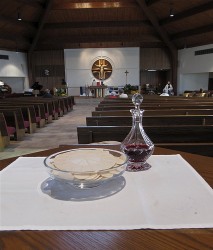
Besides being one body, the Body of Christ, we are also one Bread in him. When we celebrate the Eucharist, we listen first to God’s word and then offer bread and wine. The prayer over the bread points to its meaning:
“Blessed are you, Lord God of all creation, for through your goodness we have received the bread we offer you; fruit of the earth and work of human hands, it will become for us the bread of life.”
We receive the bread, “fruit of the earth and work of human hands,” from our Creator. St. Augustine calls the bread we pray for in the Lord’s Prayer and the bread we offer at Mass “the bread of everything.” The gift of everything is acknowledged at Mass through the bread and wine; we’re blessed with everything, we’re reminded, and through them, we give thanks to the God of goodness for it all. “What do you have that you have not received?”
The greatest of God’s blessings is Jesus Christ who, on the night before he died took bread into his hands, the “bread of everything,” and gave himself to his disciples through this sign. “Take and eat, this is my body which will be given up for you.” In a similar way, he gave them the cup of wine that signifies his blood “poured out” for us.
“Do this in memory of me,” he said.
A mystery of faith, we say in our prayer. We believe through these signs. We can’t let their humble circumstances– the place, the people, the simple acts and words dissuade us. We’re called to wonder at what’s hidden here.
LOST, ALL LOST IN WONDER
Godhead here in hiding, whom I do adore,
Masked by these bare shadows, shape and nothing more,
See, Lord, at thy service low lies here a heart
Lost, all lost in wonder at the God thou art.
Seeing, touching, tasting are in thee deceived:
How says trusty hearing? that shall be believed;
What God’s Son has told me, take for truth I do;
Truth himself speaks truly or there’s nothing true.
On the cross thy godhead made no sign to men,
Here thy very manhood steals from human ken:
Both are my confession, both are my belief,
And I pray the prayer of the dying thief.
I am not like Thomas, wounds I cannot see,
But can plainly call thee Lord and God as he;
Let me to a deeper faith daily nearer move,
Daily make me harder hope and dearer love.
O thou our reminder of Christ crucified,
Living Bread, the life of us for whom he died,
Lend this life to me then:
feed and feast my mind,
There be thou the sweetness
man was meant to find.
Bring the tender tale true of the Pelican;
Bathe me, Jesu Lord, in what thy bosom ran—
Blood whereof a single drop has power to win
All the world forgiveness of its world of sin.
Jesu, whom I look at shrouded here below,
I beseech thee send me what I thirst for so,
Some day to gaze on thee face to face in light
And be blest for ever with thy glory’s sight. Amen.
(translation of Gerard Manley Hopkins, S.J.)

 The Victor's Place