Tag Archives: Baptism

3rd Sunday of Advent

Readings are here.

Knowing who you are is one of the most important tasks we have in this life.

Here’s a homily on John the Baptist  by St. Augustine. He had to distinguish himself from Jesus, the Messiah.

John is the voice, but the Lord is the Word who was in the beginning. John is the voice that lasts for a time; from the beginning Christ is the Word who lives for ever…

Because it is hard to distinguish word from voice, even John himself was thought to be the Christ. The voice was thought to be the word. But the voice acknowledged what it was, anxious not to give offence to the word.

I am not the Christ, he said, nor Elijah, nor the prophet. And the question came: Who are you, then? He replied: I am the voice of one crying in the wilderness: Prepare the way for the Lord.

The voice of one crying in the wilderness is the voice of one breaking the silence. Prepare the way for the Lord, he says, as though he were saying: “I speak out in order to lead him into your hearts, but he does not choose to come where I lead him unless you prepare the way for him.”

What does prepare the way mean, if not “pray well”? What does prepare the way mean, if not “be humble in your thoughts”? We should take our lesson from John the Baptist. He is thought to be the Christ; he declares he is not what they think. He does not take advantage of their mistake to further his own glory.

If he had said, “I am the Christ,” you can imagine how readily he would have been believed, since they believed he was the Christ even before he spoke. But he did not say it; he acknowledged what he was. He pointed out clearly who he was; he humbled himself.

He saw where his salvation lay. He understood that he was a lamp, and his fear was that it might be blown out by the wind of pride.

Signs of the Risen Christ

At Easter we see the Risen Christ in sacraments, especially Baptism, Confirmation and the Holy Eucharist. St. John Chrysostom, following the Gospel of John, says that these are signs already revealed on Calvary. Jesus is dead when the soldier pierces his side; he is still on the cross. From his wounds the sacraments of Baptism and the Eucharist are given to his church.

Water comes forth and then the blood, Chrysostom says, “because first comes baptism and then the mysteries (the Eucharist).” With his spear, the soldier pierced the temple wall, the saint goes on, “but I am the one who finds the treasure and gets the wealth.” (cf. John 2,19)

From the sacraments the church is formed, the saint continues. Like Adam, who was cast into a deep sleep to form Eve, Christ dies the sleep of death and from his side the church is taken. “From his side Christ formed the church just as he formed Eve from the side of Adam.” (Baptismal Homilies, 3,16-18)

In an early baptismal homily preached in the church of the Holy Sepulcher in Jerusalem which the Emperor Constantine constructed atop of the remains of Calvary and the newly discovered tomb of Jesus, Cyril, bishop of Jerusalem (+387), says: “… you descended three times into the water and ascended, showing the symbol of the three days of Christ’s burial… How kind and loving! Christ received nails in his hands and feet, while I without pain and trials receive freely a gift of salvation because I share in his suffering.”

At Easter we recall our baptism and the Eucharist. Sacraments are real signs that bring us into the mystery of the Passion and Resurrection of Jesus. We meet the Risen Christ in them.

The Baptism of Jesus

The heavens open when Jesus goes into the waters of the Jordan to be baptized. The Spirit descends on him and the Father announces his pleasure in him: “Listen to him,” we’re told, and share in his life.

The baptism of Jesus, a feast we celebrate with the Feast of the Epiphany,  affirms a new connection between earth and heaven. It speaks through the simple, fundament sign of water. Going into the Jordan, Jesus indicates that God blesses the waters of the earth– and consequently creation itself– with life. Our second reading today from Isaiah 55, 1-11 illustrates this mystery so well. First of all, Jesus quenches the thirst of our souls; he comes to quench the thirst of all:

“ All you who are thirsty,

come to the water!

You who have no money,

come, receive grain and eat;

come, without paying and without cost,

drink wine and milk!” Isaiah 55, 1

God’s gift of Jesus Christ not only satisfies our thirst as individuals, he comes to revive the institutions of our world.

“I will renew with you the everlasting covenant,

the benefits assured to David.

As I made him a witness to the peoples,

a leader and commander of nations,

so shall you summon a nation you knew not,

and nations that knew you not shall run to you,

because of the LORD, your God,

the Holy One of Israel, who has glorified you.” (Isaiah 55)

Jesus Christ also comes to purify the world and those who dwell in it:

“Seek the LORD while he may be found,

call him while he is near.

Let the scoundrel forsake his way,

and the wicked man his thoughts;

let him turn to the LORD for mercy;

to our God, who is generous in forgiving.

For my thoughts are not your thoughts,

nor are your ways my ways, says the LORD.

As high as the heavens are above the earth

so high are my ways above your ways

and my thoughts above your thoughts.” (Isaiah 55

Finally, in his Son, God makes an everlasting covenant with our world:

“For just as from the heavens

the rain and snow come down

and do not return there

till they have watered the earth,

making it fertile and fruitful,

giving seed to the one who sows

and bread to the one who eats,

so shall my word be

that goes forth from my mouth;

my word shall not return to me void,

but shall do my will,

achieving the end for which I sent it.”

There’s an good article on the significance of water in the scriptures on the American Bible Society site.

St. Gabriels, Toronto

I’m spending a few days in Toronto with our Canadian Passionists, who minister at St. Gabriel Church, a new church built in 2006 which reflects the eco-theology of Fr. Thomas Berry, a Passionist who died a few years ago. He believed we need to foster a life enhancing relationship with the earth and the whole cosmos.

The church is located in a booming area along Sheppard Avenue in North York where high-rise condos and a new subway line are recent additions to this growing prosperous Canadian city. It’s a showplace for human technology and building skills. What better place for a  reminder of things beyond the human?

The church and its surroundings are almost swallowed up by the great buildings around it; a modest sign along busy Sheppard Avenus beckons you into St. Gabriels.

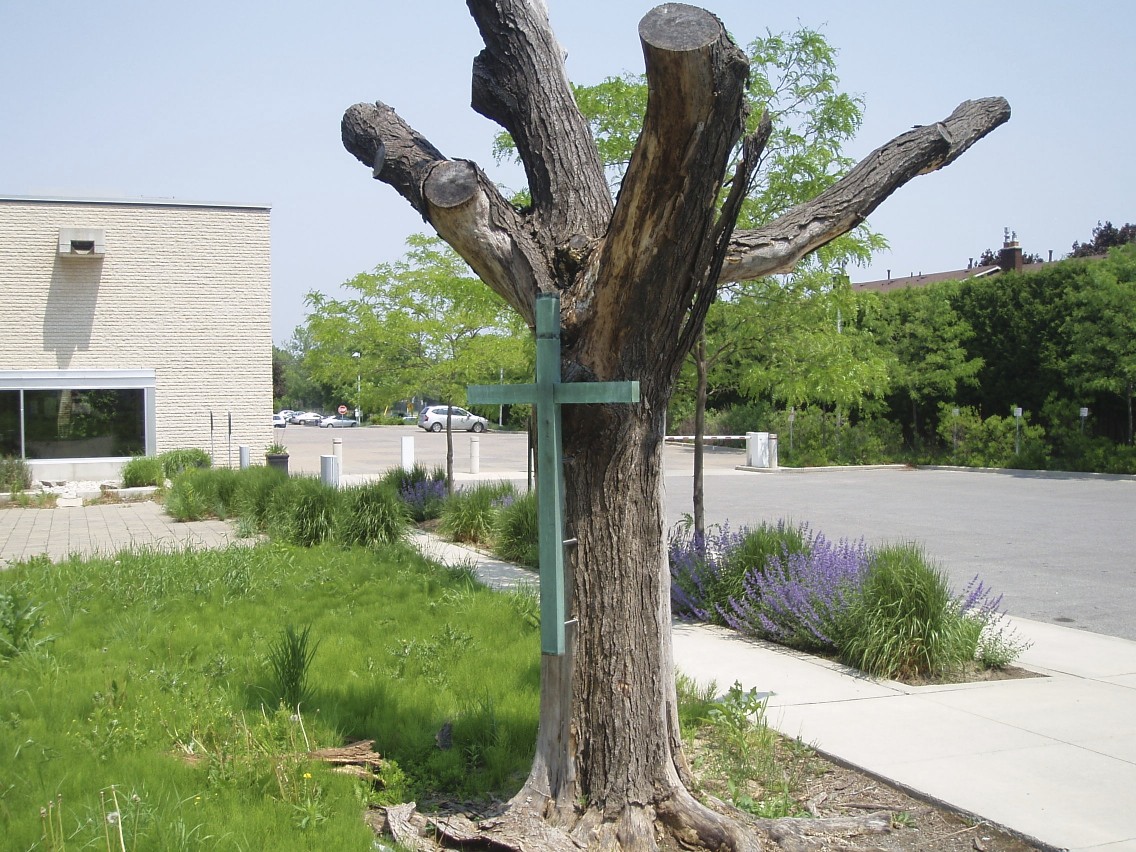
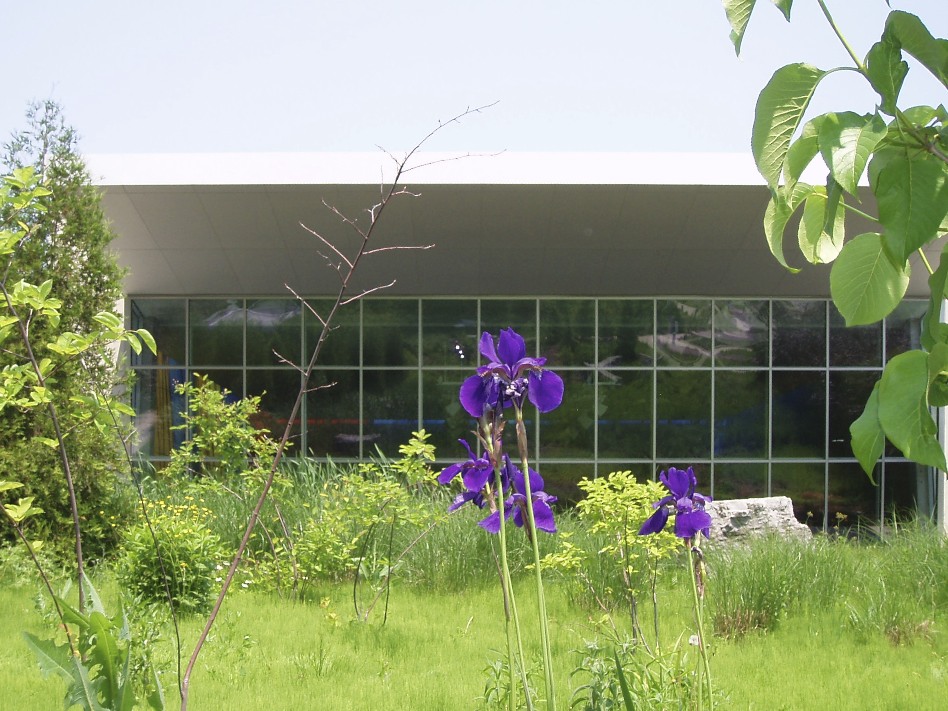
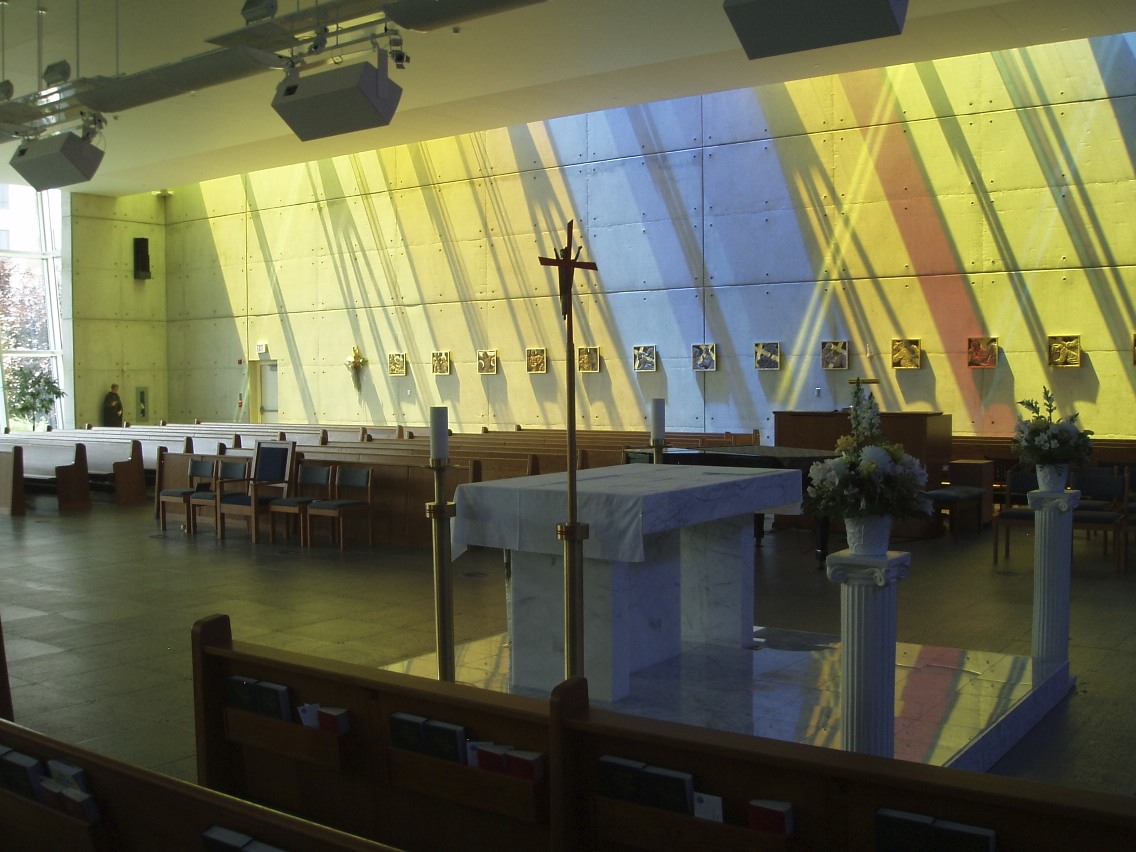
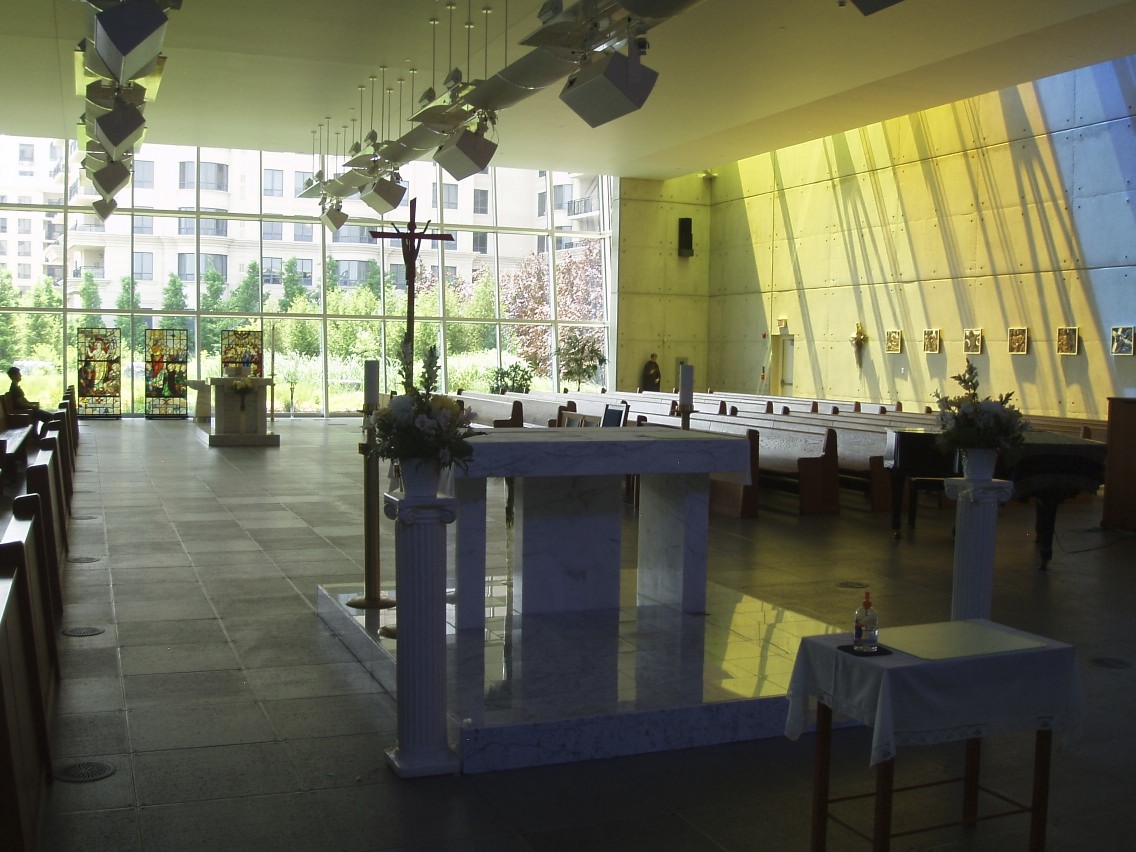
It’s not a church you would expect. No steeple skyward, no shrines of saints outside. A solitary statue of Christ stands on the roadway toward it. The entire south facade of the church is clear glass welcoming sunlight into the worship space within and a garden where the story of creation is retold from its beginning. Rocks, flowers, trees and grasses face the glass wall that dominates the new building,  A large tree trunk cut from a land development nearby stands at the edge of the outdoor garden, signed with a green cross. It signifies the Passion of the Earth, which the human community, recklessly exploiting the earth’s resources, has inflicted on the natural world.

Looming beyond the garden are the tall buildings of our modern human world.

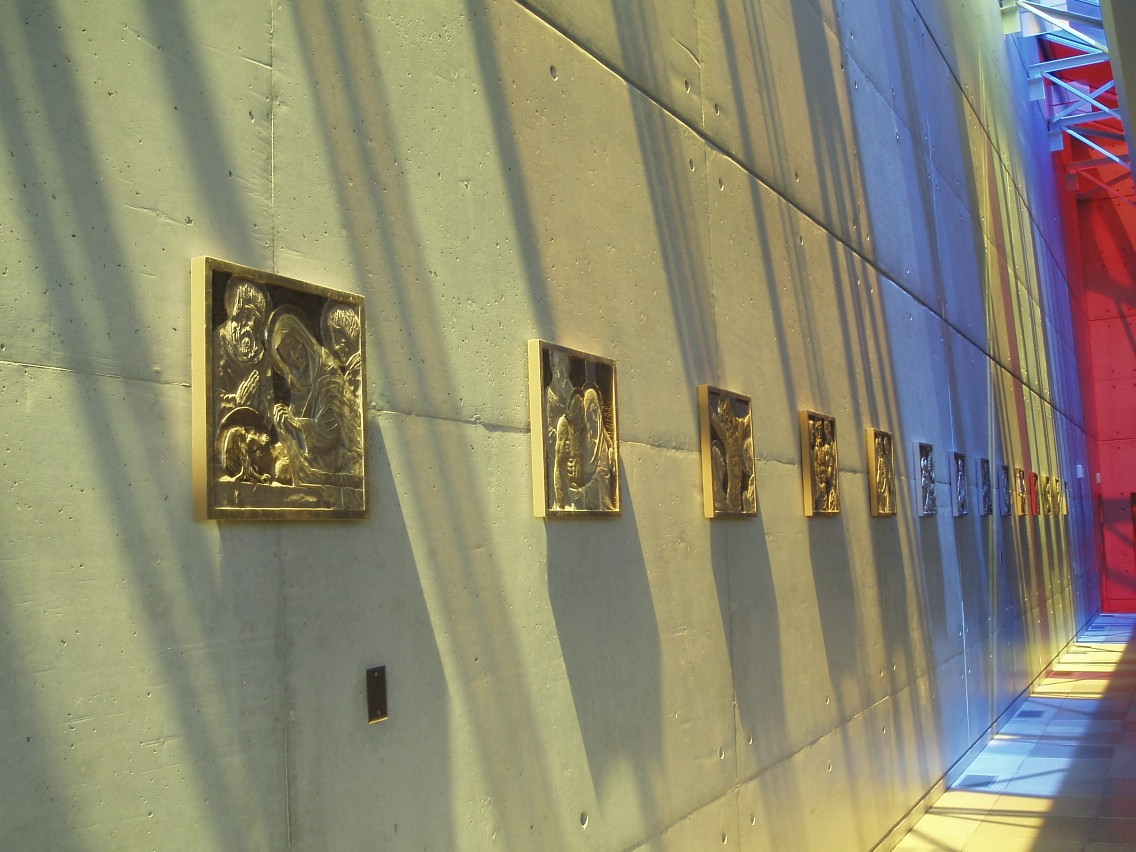
Sunlight through its expansive southern window and upper windows plays through the interior space of the church by day and over the seasons. This is not a church cut off from the world outside but in harmony with it.

The church pews, salvaged from an earlier church, are arranged antiphonally facing the baptismal fount near the southern glass wall, the ambo where the gospel is proclaimed, and the altar where the Eucharist is celebrated. A chapel where the Blessed Sacrament is reserved is situated in the northern part of the worship space. The Word who made the universe; the Savior sent to redeem us is present here in this church.

The baptismal fount, also from the earlier church, has water flowing from it; a rainspout on the outside southern wall delivers rainwater to a simple river bed below. The two remind us of our dependence on water as well as light.

The church seats 750 people; the present parish membership comes from all the continents and many nations. A parallel narthex provides a meeting place for these “living stones” who form the church today.

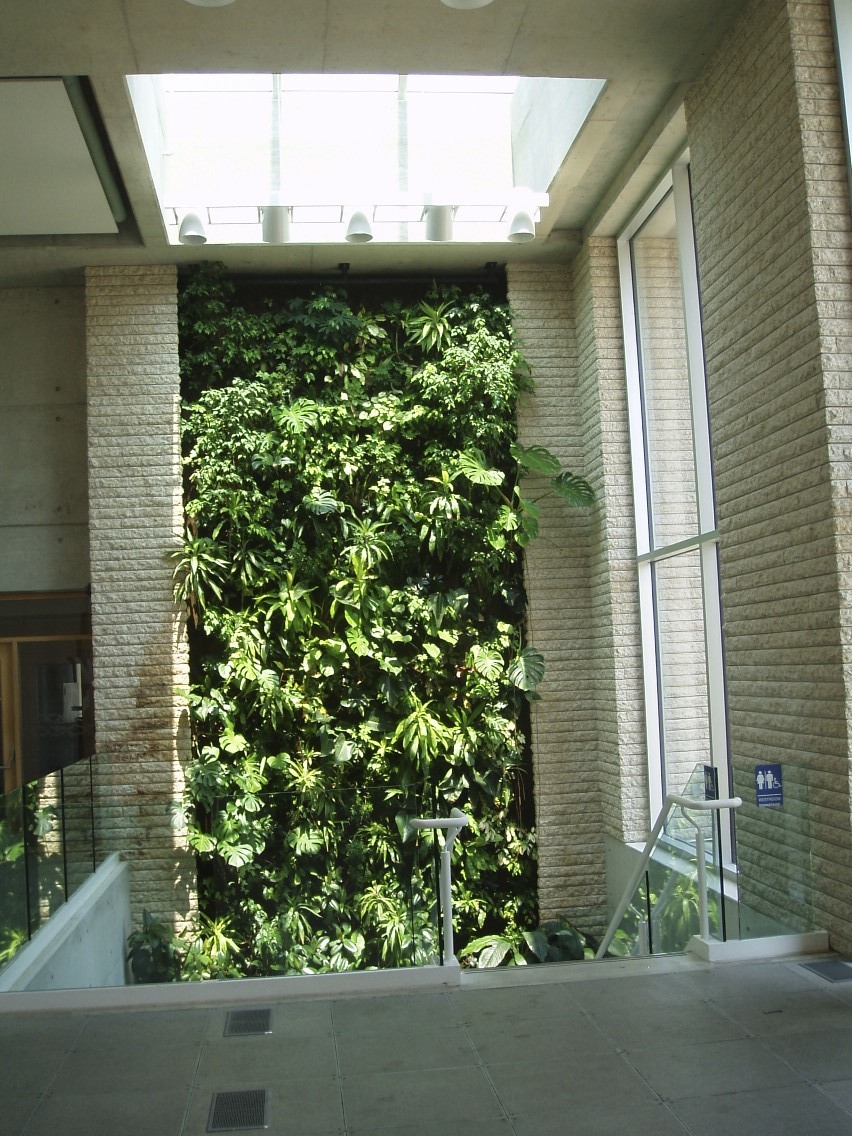
The church was built to be energy efficient. Most of its parking area is located beneath the church. Parishioners ascending from the underground parking face a large bank of plants, which serve to purify the air as well as remind them of the importance of the rain forests for the earth.

”Imaginative and creative,” Aloysius Cardinal Ambrozic, Archbishop of Toronto, Canada, called the new Passionist church of St. Gabriel, when he dedicated it on Sunday, November 19, 2006. The Jesuit magazine AMERICA featured the church in a recent issue on church architecture.

The parish website is http://stgabrielsparish.ca/

A Youtube video is here: http://www.youtube.com/watch?v=GasOYiK1l68

Living Waters

The church of Our Lady of Mercy, where I’m preaching a mission,  is a beautiful church, rather recently renovated. I thought it provided a wonder visual presentation for the first reading for today from Ezechiel, chapter 47. The prophet is promising a new temple and from its right side water flows out to all the world, giving life to the earth and all nations.

Jesus, of course, said he was the new temple.

The figure of Jesus hanging on the cross above the altar is pierced on his right side. John’s gospel says “blood and water flowed out” when the soldier pierced his side with a lance.

The altar receives his blood and the beautiful baptistery visually connected to the altar and the cross receives the water that flows from his side bringing life to the world.

I had to take of picture of that baptistery. It’s so good when the church’s symbols support the scriptures being read and the mysteries being celebrated.

The pope in his new book Jesus of Nazareth, part 2 has a nice treatment of Jesus as the new Temple.

Christmas: A Call to Baptism

Matthew’s gospel was the gospel most used for catechesis in the early church. It also plays an important role in the creation of our Christmas season. It gives us the Feast of the Epiphany, for example. Jesus Christ came for the gentiles as well as for the Jews.

I think Matthew’s gospel is also an important source for our upcoming Feast of the Baptism of Jesus which closes the Christmas season. Matthew sees baptism as a way of repentance. That’s how John the Baptist describes it in Matthew’s gospel: “In those days, John the Baptist appeared in the wilderness of Judea, proclaiming: ‘Repent, the kingdom of God is near.’” (Mt 3,1-2)

When Pharisee and Sadducees come for baptism, John calls them “a brood of vipers” because they presume they are saved as “children of Abraham.” “God is able to raise up from these stones children of Abraham, “ John says to them.

Baptism is not an entitlement. Baptism is a commitment to repentance. That’s important for us to realize too.

But repentance is a difficult path. Can we do it alone?  John continues in Matthew’s gospel with the promise that one more powerful than he is coming. “He will baptize you with the Holy Spirit and fire.” When we are baptized into Christ, we are given the Holy Spirit and his fire to continue on the path of repentance.

Christmas is not just for looking at the Child in a manger; it’s a call  to enter into the mystery of Jesus Christ.


The World of Blogs

I miss the give-and-take world of theological inquiry I often found in a number of periodicals that have become too expensive for my budget or can only be reached by a long trip to a library–or are going out-of-print. At the same time, it’s hard to find theological inquiry in the official Catholic press.  But you can’t stop people from thinking and I’m wondering if we are taking our thinking to the world of blogs.

I find I’m looking these days at the blogs from America Magazine and Commonweal as almost required reading. Today in America’s blog James Martin, SJ, writes about whether we should baptize children whose parents are not very interested in the church, and Austen Ivereigh has one on church marriage. Both hot pastoral topics. The blogs, written by people from different specialties and interests, cover a wide range of topics, from health care to Christian unity to religious toys for Christmas. They’re often followed by comments from readers pro and con. Welcome to the interactive world!

The church is healthy, not only when it prays and acts justly, but when it thinks. Is the church thinking making its way to blogworld?

Signs of Faith

“What shall we do?” those in Jerusalem who hear Peter ‘s witness to the Risen Jesus ask. “Repent and be baptized in the name of the Lord Jesus so that your sins will be forgiven and you will receive the gift of the Holy Spirit,” Peter responds. (Acts 2,38)

Now at the Easter Vigil we baptize those who hear the Easter message for the first time and we who are already baptized renew our baptismal commitment. We ask forgiveness for our sins and a greater openness to the gift of the Holy Spirit.

We’re reading these days (http://www.universalis.com/readings.htm) from the wonderful catechetical sermons of Cyril, the 4th century bishop of Jerusalem, which he gave to the newly baptized of his community, in the great church of the Anastasis, built over the tomb of Jesus and the rock of Calvary. Today it’s called the Church of the Holy Sepulcher.

Those being baptized were led down into a pool of water to symbolically die and rise in the very place where Jesus died and rose again. What a powerful experience that must have been!

They were anointed as they came from the baptismal pool. The Holy Spirit was given to them.
Cyril explains that this is the same Spirit who rested on Jesus when he came from the Jordan. “The Spirit of the Lord is upon me, because he has anointed me. He has sent me to preach good news to the poor.”

It’s “the oil of gladness,” Cyril says, “ a source of spiritual joy.” “Rejoice,” is a word you hear over and over in the gospel, especially at Easter. Before you run off to do anything, take time to rejoice and don’t stop rejoicing.

I watched Susan Boyle, the wonderful 47 year old woman from Scotland, who sings like an angel and looks like a nobody. Over 2 million have watched her so far on Youtube sing on Britains Got Talent 2009. Look at the joy that pours out of her.

Yes, she’s got a wonderful voice, but see her joy.

Easter Readings

In the weeks following Easter, the Catholic church in its readings focuses on the witness of Peter the Apostle, leader of Jesus’ disciples and a key eyewitness to his resurrection. He speaks in the first readings at Mass from the Acts of the Apostles, which report what he said to the people in Jerusalem after Jesus’ resurrection.

In the office of readings Peter’s 1st Letter is read. Peter speaks from Rome to the gentile churches along the Black Sea, according to Raymond Brown in his interesting commentary in “An Introduction to the New Testament.” The churches the apostles writes to were founded from Jerusalem, from the pilgrims Peter spoke to immediately after Jesus’ resurrection.

Now, years later, Peter reaches out to these churches whose founders had asked for baptism in Jerusalem; he reminds them what that sign meant–they received “ a new birth, unto hope which draws its life from the resurrection of Jesus from the dead.”

The churches are suffering “many trials” and the apostle tells them they are being tested like gold in the fire.

Brown thinks the trials may come from a lack of acceptance these believers are experiencing from their neighbors who misinterpret their beliefs and ostracize  them because they seem so out of step with the culture and thinking of the times.

Peter reminds them of the dignity they have as God’s people; like the Jews journeying out of Egypt they should not forget their destiny.

Maybe we’re not too far from the situation of those Christians from Pontus and Cappadocia today. We need reminding about who we are.

I wish there were a better way to bring the wealth of our liturgical readings to ordinary people.

Who are Priests?

“When we speak of Christ’s priesthood, what else do we mean than his incarnation?”

Fugentius of Ruspe, a learned bishop from 5th century Africa, touches on a truth we easily forget. Christ is a priest because he became flesh and part of creation, which he then represents before the Creator.

He does not represent creation from a distance, untouched by it, or partially, hesitantly, protected,  but he became fully one with it, emptying himself and taking the form of a slave. “He humbled himself even accepting death.”

Being a priest, therefore, is not to become a person apart, but someone incarnate. That’s true for all those baptized into Christ and share in his priesthood, as well as those ordained for a ministry in the church.

“The living, the living give you thanks, as I do today.”