Tag Archives: Assumption

Where did the Feast of the Assumption come from?

Mary’s Tomb, Jerusalem

We celebrate the Feast of the Assumption of Mary into heaven August 15th. It’s the most important feast of Mary in the church’s calendar. Where did it come from?

There’s no account of Mary’s death or assumption into heaven in scripture. An account in the apocryphal body of literature called the Transitus Mariae, popular in the Christian churches of the east from the 5th century, describes the return of the apostles to Jerusalem for Mary’s burial and their discovery that her body was taken up to heaven. The writings attest to an early interest in the death of Mary in some parts of the early church.

The first liturgical celebrations of Mary’s death and assumption to heaven took place in Jerusalem at her tomb (above) on the Mount of Olives about the 5th century. The Roman Catholic Church draws her present belief from this early tradition and her conviction that Mary is “wholly united with her son in the work of salvation.” For scriptural support, the church looks to sources like Paul’s First Letter to the Corinthians–the second reading at Mass for August 15th – to understand this mystery.

Paul wrote that letter about the year 56 AD to Corinthian Christians who had questions about the resurrection of Jesus. Their precise difficulty seems to be that they saw only the soul surviving death and not the body, a common conception of the Greek mindset of the day. That belief brought a low appreciation of the body and the place of creation itself in the mystery of redemption.  The created world wasn’t worth much and was passing away, so let it go.

Paul countered that opinion with the belief he received, a belief from the beginning:  “For I handed on to you as of first importance what I also received: that Christ died for our sins in accordance with the scriptures; that he was buried; that he was raised on the third day in accordance with the scriptures; that he appeared to Cephas, then to the Twelve. After that, he appeared to more than five hundred brothers at once, most of whom are still living, though some have fallen asleep” (1 Corinthians 15: 3-6).

Jesus was raised bodily from the dead, Paul affirms, and we will rise bodily too. Jesus is “the first fruits of those who have fallen asleep.” Mary’s bodily assumption follows the bodily resurrection of Jesus. Because of her unique role in the mystery of redemption she is among the “first fruits of those who have fallen asleep.” Her assumption is part of the mystery of the resurrection; it’s an affirmation we will follow Jesus who rose body and soul.

In her prayer, the Magnificat – the gospel read on the Feast of the Assumption – Mary accepts her mission from God to share in the mission of her Son, the Word made flesh, who came to redeem the world.

The church gradually understood the mystery of Mary’s Assumption over time. A rising Gnosticism in the 3rd and 4th centuries certainly promoted appreciation of this mystery. Gnosticism promised escape from the limits of bodily life through a higher knowledge. As a result, human life and creation itself didn’t matter.

Mary’s Assumption claims they do.

The Roman Catholic Church formally defined the dogma of the Assumption on November 1, 1959, on the Feast of All Saints, but the belief was firmly held for centuries before:

“…the Immaculate Virgin, preserved free from all stain of original sin, when the course of her earthly life was finished, was taken up body and soul into heavenly glory, and exalted by the Lord as Queen over all things, so that she might be the more fully conformed to her Son, the Lord of lords and conqueror of sin and death.” The Assumption of the Blessed Virgin is a singular participation in her Son’s Resurrection and an anticipation of the resurrection of other Christians: ‘In giving birth you kept your virginity; in your Dormition you did not leave the world, O Mother of God, but were joined to the source of Life. You conceived the living God and, by your prayers, will deliver our souls from death'” (Catechism of the Catholic Church 966).

Mary’s Assumption was defined in a century when human life and the planet itself were threatened. World War I ended in 1918 after four years when millions perished. World War II, ending in 1945, left the real possibility that war and nuclear weapons could bring about the destruction of the human race. The Holocaust seemed to prove the capability of human evil.

Threats to human life continue and creation itself is increasingly endangered by climate change and consequent poverty. August 15, the date for the celebration of this feast from earliest times, is the time of harvest for most of the Western Hemisphere. Our belief in the resurrection of the body sees creation itself promised a share in this mystery. The readings and prayers of the feast describe Mary in heaven as the woman clothed with the sun, the moon and the stars beneath her feet. (Revelation 11)

The Feast of Mary’s Assumption is the oldest and most important of Mary’s feasts in our church calendar.
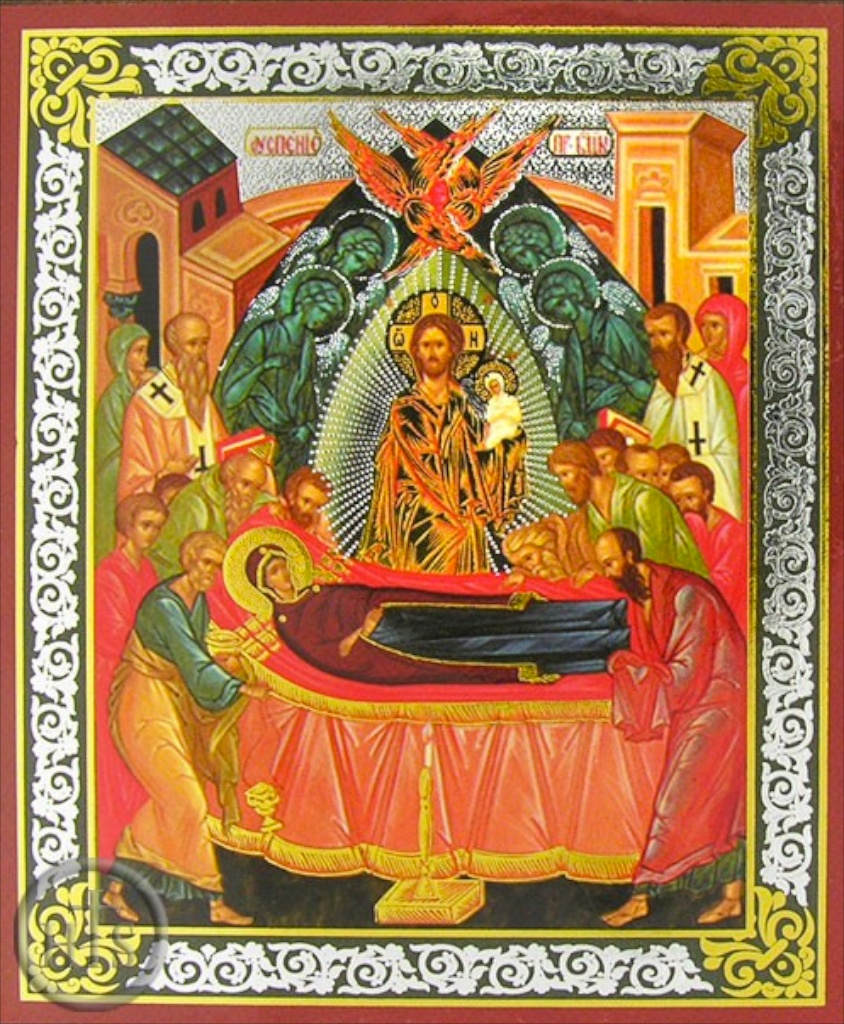
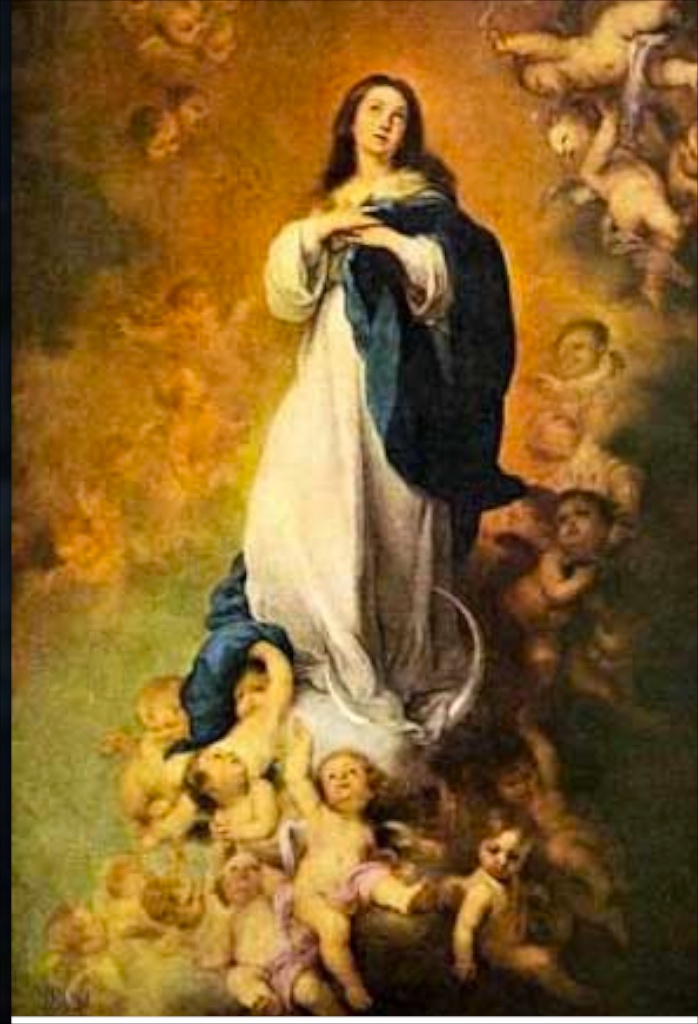
Assumption, Dormition

The Feast of the Assumption, August 15th in the Roman Church, and the Feast of the Dormition in the Eastern Church celebrate the belief that Mary, the Mother of Jesus, was taken body and soul into heaven by her welcoming Son.

The Eastern Church year begins with the Great Feast of the Birth of Mary, September 8 and ends with Great Feast of the Dormition. The mysteries of Jesus take place within these two feasts.

The two churches express the mystery differently in art. In the Western Church Mary, radiantly dressed, often surrounded by angels, turns her face to heaven,

The Eastern Church invariably has Jesus standing over his mother’s body, carrying her soul in his arms as a little child. How else would she be at death? Didn’t Jesus say we cannot enter the kingdom of heaven unless we become a little child. She became one.

Her Son brings her body and soul to heaven. She bore him in her womb through grace, now she enters heaven through grace. The apostles, surrounding her body, have been summoned from the ends of the earth to be witnesses to her death and resurrection. She is the “first fruits” of her Son’s redemption. Angels cry out for heaven’s gates to be opened.

“Open your gates and welcome the One who gave birth to the Creator of Heaven and earth; let us celebrate with hymns of glory her holy and venerable body which housed the Lord who is unseen by us. We also cry out: O worthy of all praise, lift up our heads and save our souls”. (Troparion, Feast of the Dormition)

“Today, the Virgin Mother of God

was assumed into heaven

as the beginning and image

of your church’s coming to perfection

and a sign of sure hope and comfort

to your pilgrim people.” (Preface of the Assumption)

God took Mary, the lowly one, and “raised her up to this grace, that your Only-Begotten Son was born to her according to the flesh and that she was crowned this day with surpassing glory. Grant through her prayers that, saved by the mysteries of your redemption, we may merit to be exalted by you on high.” (Collect, Feast of the Assumption)

Because Mary shares in her Son’s resurrection, she also shares his desire that “all be saved and come to the knowledge of the truth.” She joins her voice to his and intercedes for us.

“In falling asleep, you did not forsake the world, O Mother of God,

You were translated to life, O Mother of Life.

And by your prayers you deliver our souls from death.” (Troparion)

The Feast of the Assumption of Mary

There’s no account of Mary’s Assumption in scripture. An account of her burial and assumption into heaven appears in an apocryphal body of literature called the Transitus Mariae, from Christian churches of the east around the 5th century. This account may contain material from earlier sources  and witnesses to the belief in Mary’s bodily assumption in some significant parts of the early church.

The Roman Catholic church bases its belief  in Mary’s Assumption on scriptural sources like I Corinthians–the second reading for our feast on August 15th.

In his First Letter to the Corinthians, ( c 56) St. Paul writes to Christians who are wavering in their faith in the resurrection of Jesus. Their precise difficulty seems to be that they see only the soul surviving death and not the body, a common conception fostered by the Greek mind-set of his day. With that belief came a low appreciation of creation. The created world wasn’t worth much and was passing away. Let it go.

Paul counters this incomplete belief with the faith he has received. Interestingly, it’s a faith that preached, not written down; the gospels and other New Testament writings were not in written form yet:
“For I handed on to you as of first importance what I also received: that Christ died for our sins in accordance with the scriptures; that he was buried; that he was raised on the third day in accordance with the scriptures; that he appeared to Cephas, then to the Twelve. After that, he appeared to more than five hundred brothers at once, most of whom are still living, though some have fallen asleep.” ( 1 Corinthians 15, 3-6)

Jesus was raised bodily from the dead, Paul affirms, and we will rise bodily too. Jesus is “the first fruits of those who have fallen asleep.”

Mary’s Assumption follows the bodily resurrection of Jesus. Because of her unique role in the drama of redemption, Mary is among the“first fruits of those who have fallen asleep.” She follows Jesus who rose body and soul. Her Assumption, body and soul into heaven, is a resurrection story.

Bodily life is important, the bodily resurrection of Jesus says. The created world is important, the bodily resurrection of Jesus says, and so we must care for it according to God’s plan. We live in the body from birth to death; like the seed planted in the earth our bodily life will develop into a risen life we cannot imagine. ( John 12,21-26)

In her prayer, the Magnificat– the gospel for her feast– Mary accepts her mission from God to live in the created world of her day, accepting its limitations, its misunderstandings, its sufferings. She accepts fully the mission of her Son, the Word made flesh.

The realization of the mystery of the Assumption grew gradually in the church. Christians of the 3rd and 4th centuries confronted Gnosticism, which tempted them to depreciate creation and human existence itself.  Promising a better life beyond the limitations of this life,  the gnostics counseled escape from life as it is. Human life and creation itself didn’t matter.

The Roman Catholic church defined the dogma of the Assumption November 1, 1959, on the Feast of All Saints. Humanity and the planet itself seemed endangered in the 20th century. World War I ended in 1918 after four years of bloody conflict when millions perished. World War II ended in 1945 in which 35 million people were killed in Europe alone. Millions of lives perished in the Holocaust. Conventual war and nuclear weapons brought the real threat of mass destruction to the human race and the planet itself.

The 21st century offers new threats from climate change, widespread poverty, wars and terrorism.

The Assumption of Mary is a sign from God. Far from a pious legend, it tells us to look upon human life and creation itself as sacred. We believe in the resurrection of the body according to our ancient creed. Mary was the first of our humanity to share in the resurrection of Jesus Christ.