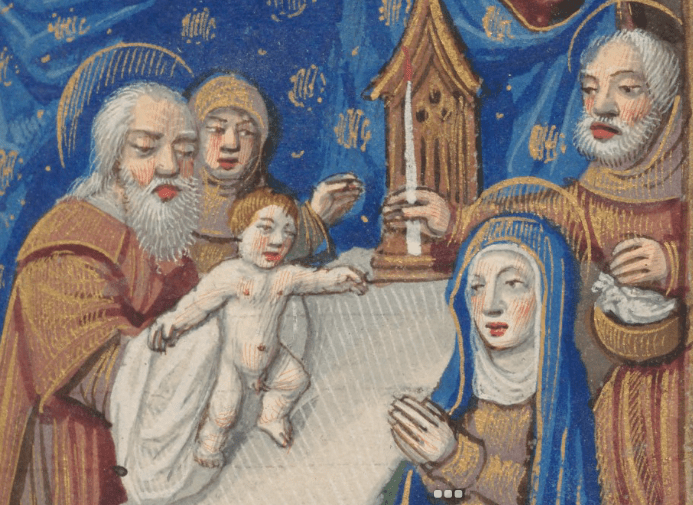
Two elderly Jews, Simeon and Anna, meet the Child, when Mary and Joseph take him to the temple, “to present him to the Lord.” Simeon joyfully takes the Child in his arms. “Now you can dismiss your servant in peace, Lord, because my eyes have seen your salvation.” No temple priests, no officials, no angels recognize the Child, according to Luke’s gospel, , just two old people. (Luke 2:36-40)
Anna, an 84 year temple regular and a widow after being married for only seven years doesn’t say anything when she sees the Child. In our picture above he stands behind Simeon gazing at the Child. “Coming forward at the very time,” Luke says, “she gave thanks to God and spoke about the child to all who were awaiting the salvation of Jerusalem.” She doesn’t keep word of him to herself. She speaks of him to all.
The Lord comes to the 84 year old woman, to Simeon, to Mary and Joseph, Elizabeth and Zechariah, the shepherds in the hills, the wise men from afar. He comes to all. John’s letter, which we read today at Mass, says that too. ( 1 John 2:11-17)
Anna gives thanks at the sight of the Child and goes out to speak about him to everyone she meets. “Let the heaven be glad and the earth rejoice. Go tell all the nations the Lord is King.” Our responsorial psalm says.
November 30th is the Feast of St. Andrew. On the lakeshore in Galilee Jesus called him and his brother Simon Peter to follow him. We only know a few details about Andrew. What are they?
He’s a fisherman, of course. Andrew is a Greek name. Why would a Jew have a Greek name? The area around the Sea of Galilee was then multi-cultural, and Andrew’s family were originally from Bethsaida, a trading town in the upper part of the Sea of Galilee with a substantial Greek population. Would that explain why they may have spoken some Greek? Afterwards they located in Capernaum, another trading town close by.
Could that explain why later in John’s gospel, Andrew and Philip bring some Greek pilgrims to Jesus before his death in Jerusalem. Jesus rejoices, seeing them as signs that his passion and glorification will draw all nations to him. One sees why the Greek church has Andrew as its chief patron: he introduced them to Jesus.
Bethsaida, on the northern shore of the Seas of Galilee, has been recently excavated.
Bethsaida: Winegrowers house
Bethsaida: Ruins
Bethsaida: Ruins
Andrew seems to have an interest in religious questions. He’s described as a disciple of John the Baptist, who points Jesus out to him. Jesus then invites Andrew and another disciple to stay for a day with him. “Come and see.” Afterwards, Andrew “found his brother Simon and said to him ‘We have found the Messiah.’” (John 1,35-41)
I notice too that Andrew bring the little boy with the bread and fish to the attention of Jesus.
The Greek Church sees Andrew as the first of the apostles because he’s the first to follow Jesus; then he calls his brother. Western and eastern Christian churches together celebrate his feast on November 30th.
The letter to the Romans, the first reading for his feast in the Roman Catholic liturgy, stresses there is no distinction between Jew and Greek, and praises messengers who bring God’s word to others. Tradition says Andrews brought the gospel to the Greeks, and also claims that Andrew was crucified on the beach at Patras in Greece. Besides Greece, Andrew’s also the patron of Russia and Scotland.
We ask you, O Lord, that, just as the blessed Apostle Andrew was for your Church a preacher and pastor, so he may be for us a constant intercessor before you.
Troparion (Tone 4) (Greek Orthodox)
Andrew, first-called of the Apostles and brother of the foremost disciple, entreat the Master of all to grant peace to the world and to our souls great mercy. Kontakion (Tone 2)
Let us praise Andrew, the herald of God, the namesake of courage, the first-called of the Savior’s disciples and the brother of Peter. As he once called to his brother, he now cries out to us:
“Come, for we have found the One whom the world desires!”
Finally, from John Chrysostom in our Office of Reaadings today, we learn how to read the scriptures:
After Andrew had stayed with Jesus and had learned much from him, he did not keep this treasure to himself, but hastened to share it with his brother. Notice what Andrew said to him: We have found the Messiah, that is to say, the Christ. Notice how his words reveal what he has learned in so short a time. They show the power of the master who has convinced them of this truth. They reveal the zeal and concern of men preoccupied with this question from the very beginning. Andrew’s words reveal a soul waiting with the utmost longing for the coming of the Messiah, looking forward to his appearing from heaven, rejoicing when he does appear, and hastening to announce so great an event to others. To support one another in the things of the spirit is the true sign of good will between brothers, of loving kinship and sincere affection.
Notice, too, how, even from the beginning, Peter is docile and receptive in spirit. He hastens to Jesus without delay. He brought him to Jesus, says the evangelist. But Peter must not be condemned for his readiness to accept Andrew’s word without much weighing of it. It is probable that his brother had given him, and many others, a careful account of the event; the evangelists, in the interest of brevity, regularly summarise a lengthy narrative. Saint John does not say that Peter believed immediately, but that he brought him to Jesus. Andrew was to hand him over to Jesus, to learn everything for himself. There was also another disciple present, and he hastened with them for the same purpose.
When John the Baptist said: This is the Lamb, and he baptizes in the Spirit, he left the deeper understanding of these things to be received from Christ. All the more so would Andrew act in the same way, since he did not think himself able to give a complete explanation. He brought his brother to the very source of light, and Peter was so joyful and eager that he would not delay even for a moment.
Saints Simon and Jude, whose feast we celebrate October 28, are mentioned only a few times in the New Testament list of apostles, tenth and eleventh respectively. (Mark 3,13-19, Luke 6,12-16)
Simon is called `the Zealot,’ either because he was zealous for the Jewish law or because he was a member of the Zealot party, which in the time of Jesus sought to overthrow Roman domination by force.
Some of Jesus’ followers, the Gospels indicate, were hardly pacifists. Peter was ready to use his sword in the garden of Gethsemani when the temple guards came to seize Jesus; James and John told Jesus to call down fire from heaven on the hostile Samaritans whom they met on their journey to Jerusalem. So did Simon have thoughts of revolution when he answered Jesus’ call ?
Jude, called “Thaddeus” to distinguish him from Judas Iscariot, may be the brother of James, the son of Alphaeus, some interpreters of the Gospel say. If that’s so, he’s also a relative of Jesus. He may be the author of the Epistle of Jude in the New Testament.
Early Christian traditions – all difficult to prove historically – locate the ministry of these apostles in places as far apart as Britain and Persia; one important legend from 3rd century Syria says they were apostles to Syria. If so, we ask their intercession for that troubled place today.
Knowing little about Simon and Jude may be a good thing, because then we have to look to their mission to know them – they were apostles. Even if we don’t know exactly where each of them went, they were apostles. The mission of the apostles was to follow Jesus. “ As the Father has sent me, so I send you.” Jesus says in the Gospel of John. He also said, “I have come down from heaven, not to do my own will, but the will of him who sent me.”
God made his will known to the apostles in due time. They didn’t decide what to do or where to go by themselves. They knew God’s will day by day, as we do. So often, it was unexpected and perhaps not what they planned. Simon had revolutionary thoughts. This was a revolution of another kind. Jude followed his cousin. He found himself in a family of another kind.
“Your will be done,” we say in the Lord’s Prayer. That’s an apostle’s prayer. We try to make it our prayer too.
Saints share their gifts, and recognize the gifts of others. That’s what St. Barnabas did. He was a gifted teacher of the Gospel; he also recognized the gift of Paul of Tarsus. His feast is June 11.
After his dramatic conversion on the way to Damascus, Paul preached the gospel in Damascus and then in Jerusalem, but his past caused some in Jerusalem to be suspicious of him. “They were all afraid of him, not believing that he was a disciple.”
“Then Barnabas took charge of him and brought him to the apostles, and he reported to them how on the way he had seen the Lord and that he had spoken to him, and how in Damascus he had spoken out boldly in the name of Jesus.” (Acts 9, 25-27) Barnabas recognized the grace of God in Saul.
Then, as gentiles in Antioch became increasingly interested in the gospel, the leaders of the Jerusalem church sent Barnabas to see what to do. “When he arrived and saw the grace of God, he rejoiced and encouraged them all to remain faithful to the Lord in firmness of heart, for he was a good man, filled with the holy Spirit and faith. And a large number of people was added to the Lord. Then he went to Tarsus to look for Saul, and when he had found him he brought him to Antioch. For a whole year they met with the church and taught a large number of people, and it was in Antioch that the disciples were first called Christians.” (Acts 11,23-26)
Barnabas recognized Paul’s gifts once again and sought him out to bring the gospel to the gentiles. Previously, the Apostle Peter encountered the gentile Cornelius in Ceasaria Maritima and baptized him and his friends. Now, Barnabas chooses Paul to come to Antioch, and the two embark on a mission to the gentiles. The Acts of the Apostles refer first to “Barnabas and Saul”, then gradually it becomes “Paul and Barnabas.”
Paul emerged as a gifted apostle. The Acts of the Apostles follows him all the way to Rome, while Barnabas is hardly mentioned at all. There are indications he returned to Cyprus where he came from. Did he get sick, or was he too old to embark on something new?
Whatever it was, Barnabas first recognized Paul and his gifts. I noticed on his feast, Paul is quoted in his letter to the Corinthians. “I handed on to you what I myself received…” Part of that was from Barnabas.
May 14th is the Feast of St.Matthias, chosen by lot to take the place of Judas. Appropriately, the feast falls in the Easter season, the time he was selected. Matthias brings the number of apostles back to twelve, symbolic of the twelve tribes of Israel who await the promises of God. The Spirit comes after Matthias is selected in Luke’s account.
The qualifications for a new apostle seem simple enough. Peter says it should be someone “who accompanied us the whole time the Lord Jesus came and went among us, beginning from the baptism of John until the day on which he was taken up from us. He joins us as a witness to his resurrection.”
Two have those qualifications. Joseph called Barsabbas and Matthias.
Then, they pray:
“You, Lord, who know the hearts of all,
show which one of these two you have chosen.”
Then they gave lots to them, and the lot fell upon Matthias,
and he was counted with the Eleven Apostles.” (Acts 1,15-17, 20-25)
Yet, it isn’t as easy as it sounds. To be a witness to Jesus it wasn’t enough to get all the details right about what Jesus did or said, as a reporter or witness at a trial might do. In John’s gospel read for Matthias’ feast, Jesus describes a disciple as one who abides in him, who remains in him– a friend committed to him. So, a disciple cannot be just an on-looker, but one who enters the mystery of Jesus’ death and resurrection. He’s one who weathers doubts and uncertainties as the disciples listening to Jesus’ Farewell Discourse did. He’s like Thomas who sees the wounds in the Lord’s hands and side and learns to trust and believe through them.
I think also that the disciples of Jesus were conscious of their own failures as they selected Matthias. They thought Jesus was the key to an earthly kingdom, but he was not. Surely, they wanted someone who looked beyond their vision as a successor for Judas. They were looking for someone with a new vision of things.
Rembrandt’s wonderful portrayal of Jesus showing his wounds to Thomas (above) presents Thomas, not as a lonely skeptic, but someone representing all the disciples. All the disciples must look at Jesus’ wounds.
Pope Francis in a homily spoke of the importance of the wounds of Christ for a disciple of Jesus. We’re on an exodus beyond ourselves, he said, and there are two ways open for us. “one to the wounds of Jesus, the other to the wounds of our brothers and sisters.”
“If we are not able to move out of ourselves and toward our brothers and sisters in need, to the sick, the ignorant, the poor, the exploited – if we are not able to accomplish this exodus from ourselves, and towards those wounds, we shall never learn that freedom, which carries us through that other exodus from ourselves, and toward the wounds of Jesus.”
The wounds of Christ and the wounds of our brothers and sisters– we learn from both to see victory over death and to trust in the passion of Jesus.
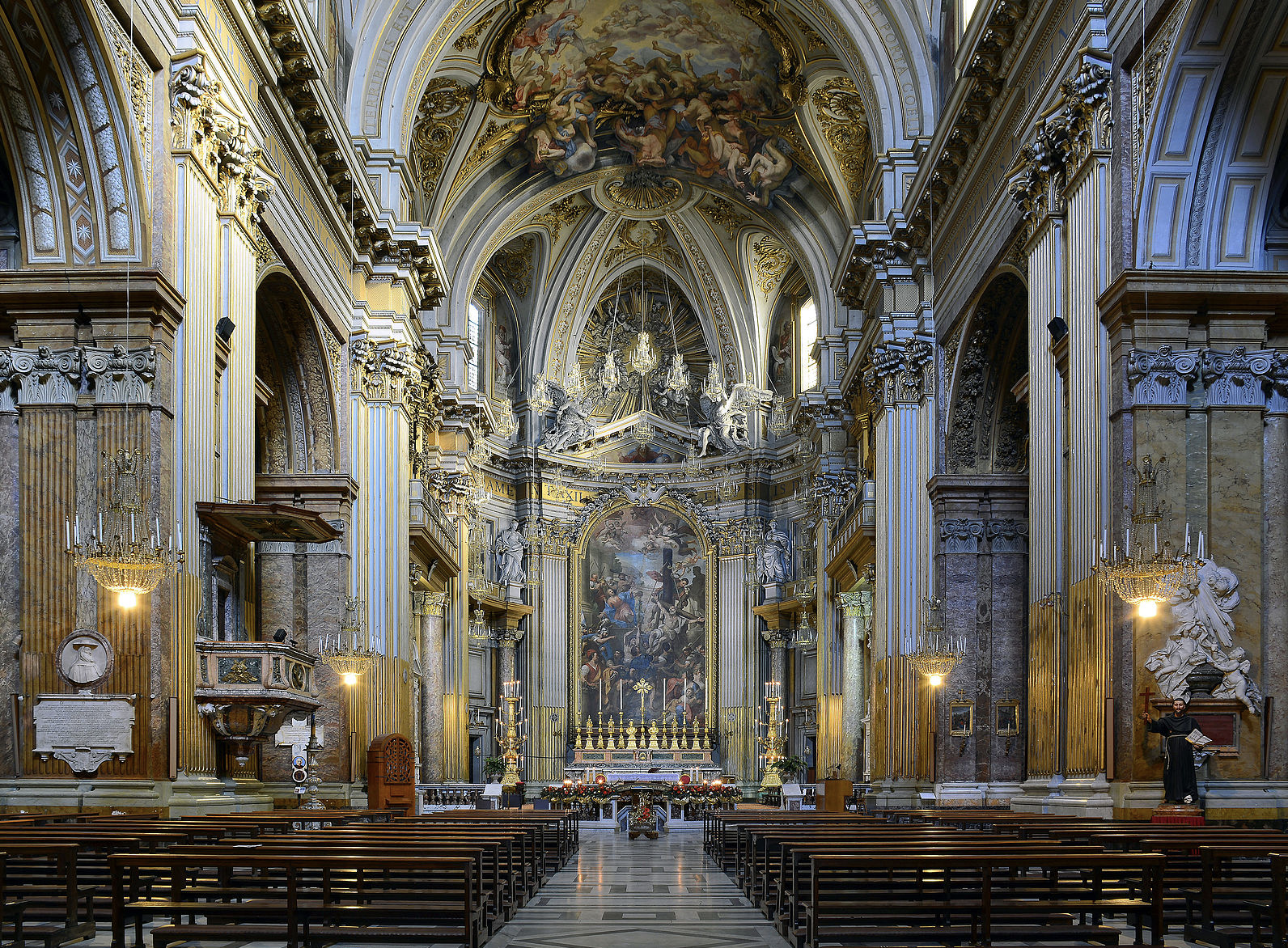
We celebrate a feast of the apostles each month. Why? Every family wants to find out how it began. Our church began with the apostles. Today, May 3rd, we remember two apostles together, Philip and James.They’re celebrated together because their relics were placed side by side in the Church of the Twelve Apostles when it was built in Rome in the 6th century.
Philip was called by Jesus to follow him the day after he called Andrew and Peter. (John 1:43-45) James, who is also called James the Less to distinguish him from James, the brother of John, was the son of Alpheus and a cousin of Jesus. He later became head of the church in Jerusalem. His mother Mary, stood with Mary the mother of Jesus and Mary Magdalen beneath the cross of Jesus. (John 19: 25) He was martyred in Jerusalem in the year 62.
On a feast of an apostle you expect to hear one or more heroic act or wise saying, but in today’s reading from St. John’s gospel we hear an apostle’s clumsy question instead. During his Farewell Discourse, Jesus says, “I am the way and the truth and the life. No one comes to the Father except through me. If you know me, then you will also know my Father.”
“Master, show us the Father, and that will be enough for us.” Philip says to Jesus, who responds:
“Have I been with you for so long a time and you still do not know me, Philip? Whoever has seen me has seen the Father. How can you say, ‘Show us the Father’? Do you not believe that I am in the Father and the Father is in me? The words that I speak to you I do not speak on my own.”
Can we hear exasperation in Jesus’ words to Philip ? Better, perhaps, they point out how slow Jesus’ apostles were to understand him; how uncertain, fearful–even ready to betray him. Philip isn’t the only one who can’t fathom Jesus and his message.
James, son of Alpheus, came from conservative Nazareth. He knew Jesus as the son of Joseph, the carpenter and probably played with Jesus as a child. He lead the Jerusalem church, while apostles like Peter and John embarked on missions to distant lands. James favored keeping the Jewish tradition as the Spirit’s means of spreading the gospel. James and his allies would certainly be early critics of Paul’s mission to the gentiles. He alienated Jerusalem’s leaders less than Stephen or Paul, but eventually he was put to death in the year 62, as the Jewish wars approached and Jerusalem was destroyed by the Romans. Jewish Christians fled the city for the safety of another place.
Called by Jesus, all of his disciples were human. Their humanness and slowness makes us realize where our power comes from. “Not to us, O Lord, not to us be the glory!” The church’s one foundation is Jesus Christ.
But before we dismiss an apostle like Philip, let’s remember he pointed Jesus out to Nathaniel at the Jordan River and he brought Greek visitors to Jesus as he was entering Jerusalem to die on a cross. ( John 12: 20-23) He never stopped pointing to the One whom he tried to understand. It’s an apostle’s gift.
The apostles make us realize the patience of Jesus, which is the patience of God. They reveal the different gifts and weaknesses found in the followers of Jesus.
Church of the. Twelve Apostles, Rome. Wiki commons
Like the apostles we’re slow to understand the mystery of the death and resurrection of Jesus. The two disciples going to Emmaus are not the only ones slow to understand– we’re slow too.
Peter, who preaches to the crowds in Jerusalem at Pentecost, certainly was slow to understand. He speaks forcefully at Pentecost, forty days after the Passover when Jesus died and rose from the dead, but the days before he’s speechless. It took awhile for him and for the others who came up with Jesus from Galilee to learn and be enlightened about this great mystery..
Mark’s accounts of Jesus resurrection appearances, read on the Saturday of Easter week, stresses the unbelief of his disciples. They were not easily persuaded.
For this reason, each year the Lord refreshes our faith in the resurrection, but it’s not done in a day. We need time to take it in, like the first followers of. Jesus, and for that we have an easter season of forty days. Just for starters.
The disciples are slow to understand the mission they’re to carry out because it’s God plan not theirs, a plan that outruns human understanding. A new age had come, the age of the Holy Spirit, and they didn’t understand it. The fiery winds of Pentecost had to move them to go beyond what they see, beyond Jerusalem and Galilee to the ends of the earth.
The Holy Spirit also moves us to a mission beyond our understanding. Luke says that in the Acts of the Apostles. “The mission is willed, initiated, impelled and guided by God through the Holy Spirit. God moves ahead of the other characters. At a human level, Luke shows how difficult it is for the church to keep up with God’s action, follow God’s initiative, understand the precedents being established.” (Luke Timothy Johnson, The Acts of the Apostles)
“You judge things as human beings do, not as God does,” Jesus says to Peter elsewhere in the gospel. We see things that way too.
Peter’s slowness to follow God’s plan remained even after Jesus is raised from the dead. He doesn’t see why he must go to Caesaria Maritima to baptize the gentile Cornelius and his household. (Acts 10,1-49) It’s completely unexpected. Only gradually does he embrace a mission to the gentiles and its implications. The other disciples are like him; God’s plan unfolds but they are hardly aware of it.
One thing they all learned quickly, though, as is evident in the Acts of the Apostles. Like Jesus, they experience the mystery of his cross, and in that experience they find wisdom.
Some things — like telling time or tying your shoes — you learn once, but we know Jesus Christ gradually, day by day. Human and divine, he makes himself known to us as he promises and as we are ready to receive him.
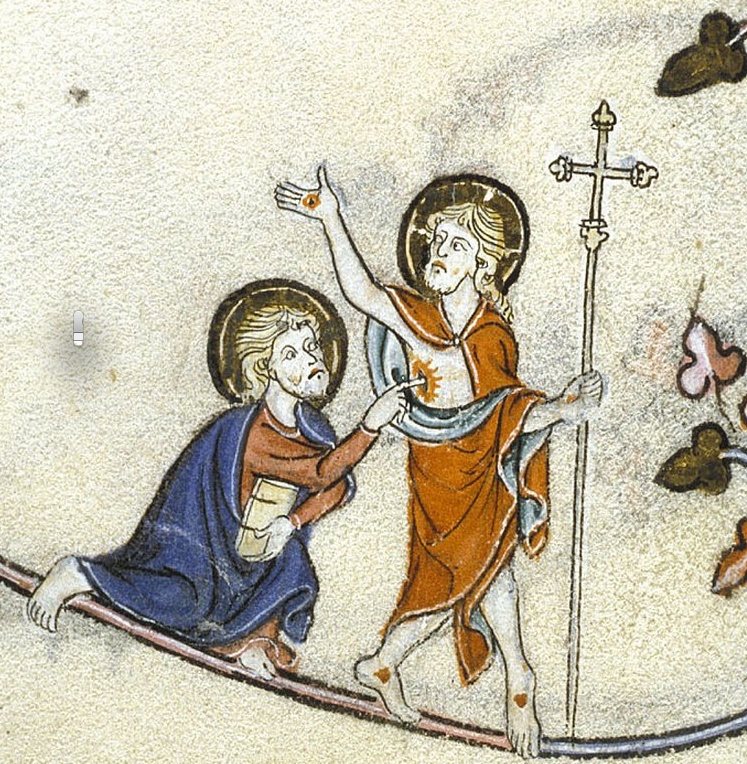
That’s why Thomas, the apostle, whose feast is today, is such an important figure. Far from being a lonely skeptic, an isolated dissenter, he represents the slowness of heart and mind, the recurrent skepticism, that affects us all.
Yet, Thomas is a sign of hope. He reminds us that the Risen Jesus offers, even to the most unconvinced, the power to believe.
Lord Jesus,
the Thomas in us all
needs the wounds in your hands and side,
to call us to believe
you are our Lord and God.
Risen, present everywhere,
bless those who have not seen,
blind with doubts
or weakened faith, or no faith at all.
Bless us, Lord,
from your wounded hands and side,
strengthen our faith
to believe in you.
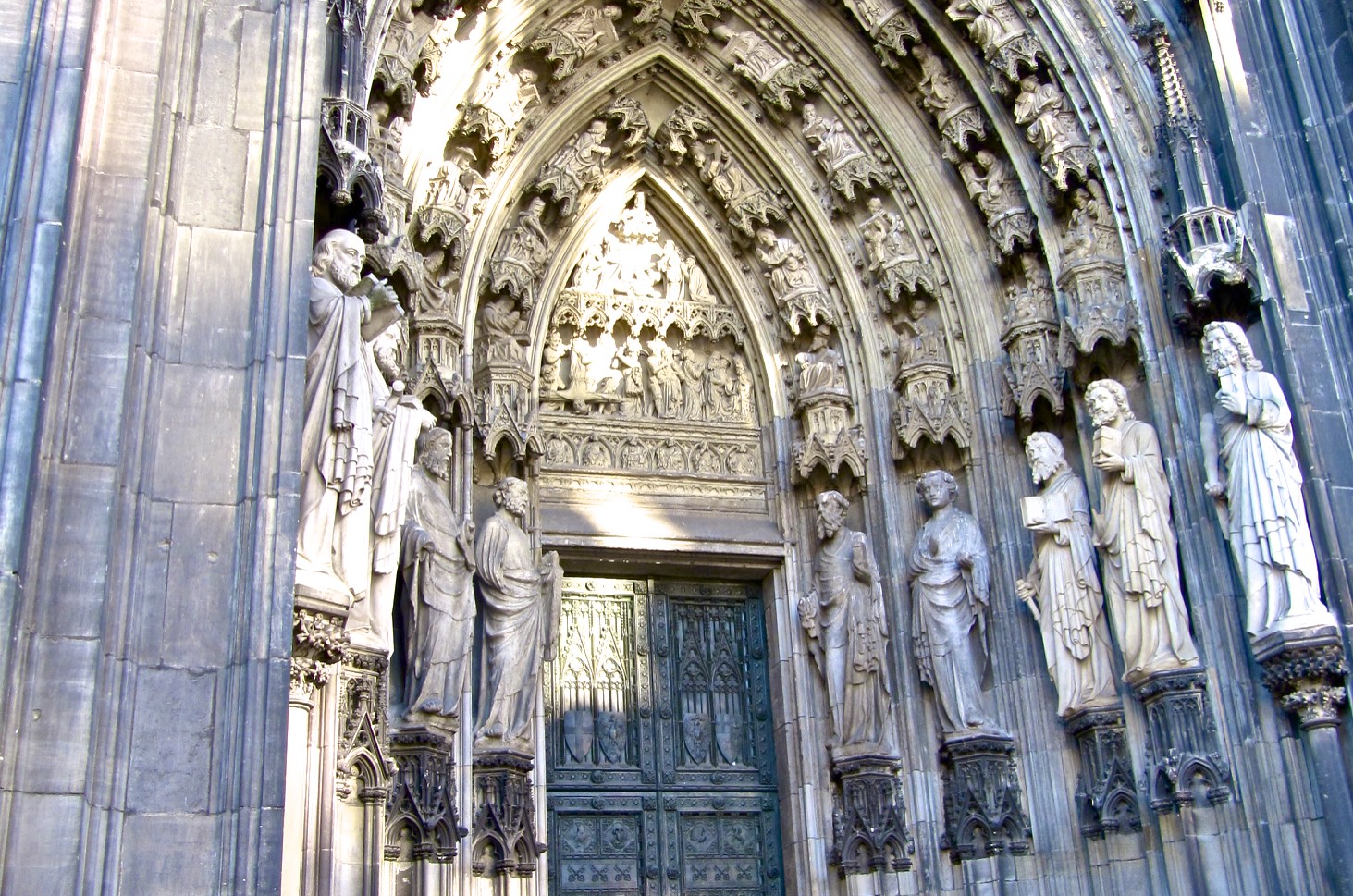
We hurry through doors, because we want to get inside. But cathedral doors are not ordinary doors; they try to slow you down and get you ready for what’s inside.
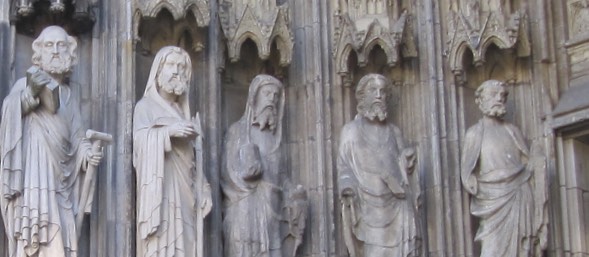
The apostles stand at the western door of the Cologne Cathedral. Peter and Paul are nearest the door itself. Above them is the scene of their martyrdom under Nero. They’ve given their lives to the truth that’s told here, that Jesus Christ, the Son of God, was sent from above, and by his death and resurrection he calls us to follow him to glory. They’re teachers of faith who invite us to believe. You might call this door a version of the Apostles’ Creed.
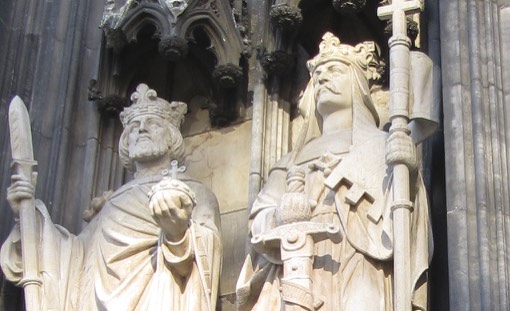
Earthly rulers, like Charlemagne, stand at the door too, witnesses of another authority. The faith is to be lived on earth as well as heaven.
The images of prophets, teachers, martyrs and saints on the outside and within the cathedral echo the same promise. The Cologne Cathedral was an important church that welcomed pilgrims from other parts of northern Europe and so, besides the Three Kings, images of the popular saints honored at other shrines along the pilgrim routes of Europe, like St. James of Compestelo, are found there. It encouraged a common vision of life that made the various peoples one.
In days when people couldn’t read, they read the cathedral’s stained glass, paintings and sculpture. With them can we see the building’s reach into the heavens pointing to a world above, a world where the promises of God will be fulfilled?
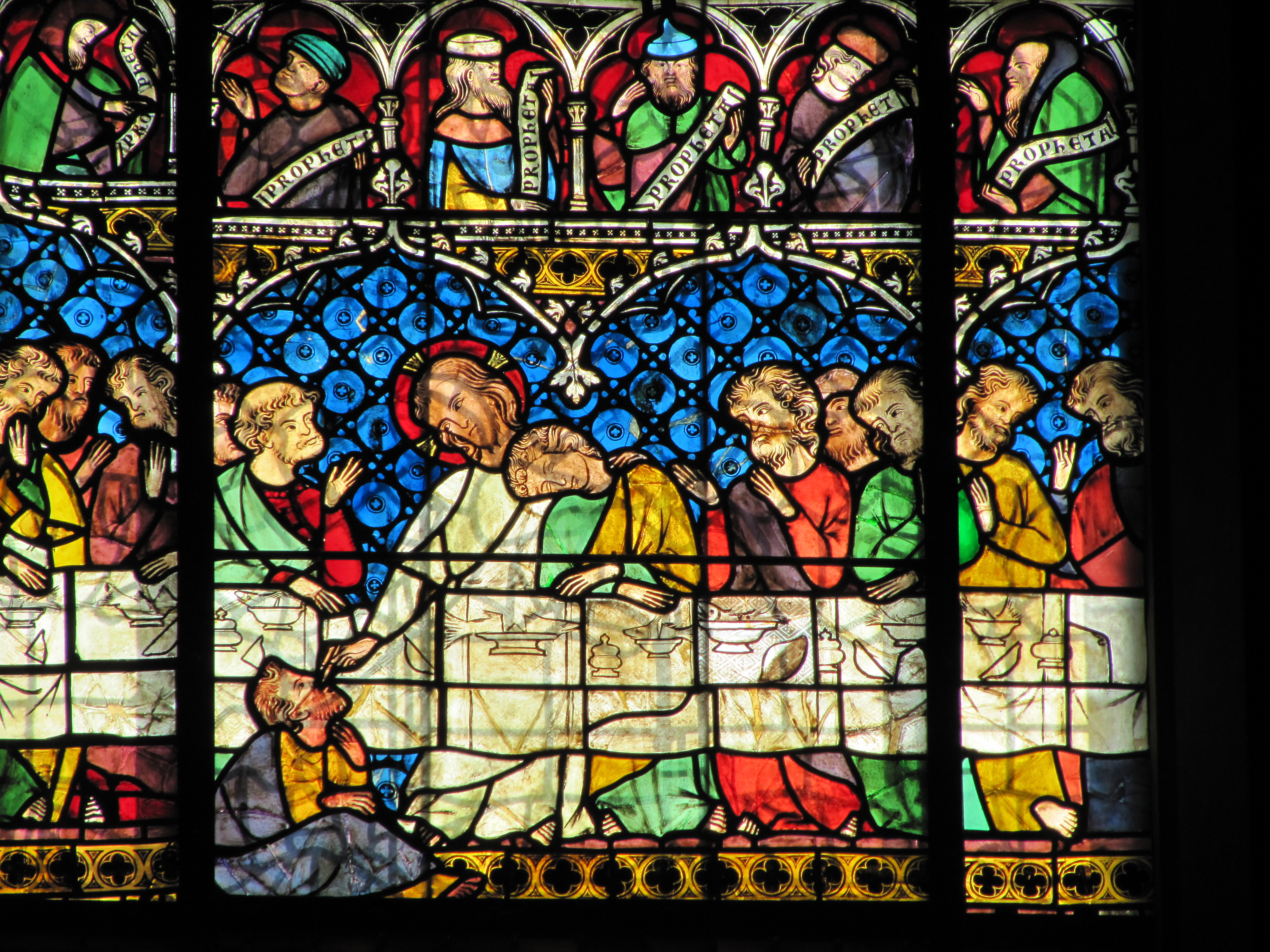
I took a picture of a stained glass window of the Last Supper in the Strasbourg Cathedral. Jesus hands a morsel to Judas, who then goes out into the night. How beautifully the artist captures the sadness of the Lord.
There’s not much said about the apostles in the New Testament; they walk in the shadow of Jesus. Because of that, we have only a few details about Andrew, the brother of Peter, whose feast is today.
One detail is his name, Andrew, a Greek name, which may be due to the fact that the area around the Sea of Galilee was multi-cultural and Jewish families sometimes took gentile names. His family was from Bethsaida where a lot of trade went on. Did Andrew speak some Greek?
Maybe he did, because later in John’s gospel he and Philip bring some Greek pilgrims to Jesus before his death. Jesus sees their coming as a sign of his approaching passion and glorification and he rejoices. (John 12, 20-28) We have to be careful of seeing Jesus’ apostles as poor uneducated fishermen, not likely to get along in a bigger world.
Andrew must have been religious. Early in John’s gospel, he’s described as a disciple of John the Baptist who points Jesus out to him. Jesus then invites Andrew and another disciple to stay for a day with him. “Come and see.” Afterwards, Andrew “found his brother Simon and said to him ‘We have found the Messiah.’” (John 1,35-41)
The Greek Church honors Andrew as its patron and considers him the first apostle because he was the first to see Jesus and follow him; then he called his brother. Tradition says Andrew was crucified on the beach at Patras in Greece and during his martyrdom extolled the mystery of the Cross of Jesus. He’s also the patron of Russia and Scotland.
A number of saints and feasts are celebrated during Advent. Certainly, saints like Andrew belong in our celebration of the Incarnation. Jesus, the Incarnate Word, drew people to himself who, in turn, drew others. His grace can’t be contained.









 The Victor's Place