In his Sermon on the Mount Jesus acknowledges his teaching is not totally new. He assures his followers that he’s following teachers and prophets before him. “Do not think that I have come to abolish the law and the prophets; I have come not to abolish but to fulfill.” ( Mt 5, 17, Wednesday, Week 10 )
I repeat James Tissot’s painting in today’s blog for a number of reasons. Seeing those people dressed in clothes of long ago, some might say: “That’s old, we’ve gone way beyond all that.”
Some teachings are never out of date and so it’s wise to pay attention to old laws and prophets from long ago. The last 20 minutes is not the only reality in life, nor am I the only expert on life. We learn from human experience over the ages. Jesus did.
Some might think the Jewish tradition found in the Old Testament not worth looking at, but that too would not be wise. Jesus was an observant Jew, Matthew’s gospel makes clear. He learned from his tradition, its prayers, its observances, its teachers, its life. Our lectionary wisely offers selections from the Jewish scriptures to study and learn from. Jesus told his disciples to do this.
We should learn from other religious traditions too, especially those that have formed the peoples of Asia and Africa. In the global world we live in today, we are meant to share in their wisdom and good works.
13 Tue St Anthony of Padua, Memorial 2 Cor 1:18-22/Mt 5:13-16
14 Wed Weekday 2 Cor 3:4-11/Mt 5:17-19
15 Thu Weekday 2 Cor 3:15—4:1, 3-6/Mt 5:20-26
16 Fri SACRED HEART OF JESUS Solemnity
Dt 7:6-11/1 Jn 4:7-16/Mt 11:25-30
17 Sat Immaculate Heart of Mary Memorial 2 Cor 5:14-21 (364)/Lk 2:41-51
18 SUN ELEVENTH SUNDAY IN ORDINARY TIME
Ex 19:2-6a/Rom 5:6-11/Mt 9:36—10:8
We begin reading this week (wk 10) from chapter 5 (the Beatitudes) of Matthew’s gospel and continue reading from this gospel till the 21st week of the year.
Matthew’s gospel presents us with Jesus the teacher in Matthew’s gospel. In our readings there’s little about his miracles or his travels to other places. He makes his place on a mountain in Galilee to teach in a land where people sit in darkness and the shadow of death. He brings light and the promise of life to them, and to us.
The Sermon on the Mount summarizes his teaching and of his life. I think that’s why the first of the beatitudes is “Blessed are the poor in spirit, for theirs is the kingdom of heaven.” Jesus became poor, to bring us to life. He “ took the form of a slave, being born in human likeness, and so he humbled himself even to death, death on a cross. God exalted him.” (Philippians)
St. Anthony of Padua, a popular saint, is celebrated this week. The Feasts of the Sacred Heart and the Immaculate Heart of Mary also occur.
For this week’s homily, please watch the video below.
AMEN
Little words are important. Little words like Yes and No. They’re at the heart of our lives. Yes, No.
Today we are celebrating the mystery of the Holy Eucharist, Corpus Christi. Instead of talking about the Holy Eucharist in theological terms, I would like to reflect on the little words we say as we celebrate this mystery, especially that little word, Yes, which at Mass is the word Amen. Amen is the Hebrew word for yes.
Did you ever count how many times we say that word, Amen, at Mass? Let me remind you of some of them.
We began Mass “In the name of the Father, and of the Son, and of the Holy Spirit. Amen.” Yes , we say, we’re began something that only be known by faith. In that simple dialogue, we acknowledge this is something we can only do through the grace of faith that the Triune God, Father, Son and Holy Spirit, gives us, and we pray for that faith.
Amen not only expresses our faithful assent, but we’re asking for faith. We’re asking for faith through Jesus Christ, our Lord. We’re like the man in the gospel whom Jesus asked, “Do you believe”, who answered “I do believe, but help my unbelief.”
“Amen” ‘’Yes” is what we say to so many of our prayers at Mass. We will end our Creed, our profession of faith, with that word. We will end the prayers we offer for the various intentions with that word, Amen. We end the Our Father with that word.
The most important Amen we say at Mass is at the end our Eucharist Prayer, when we hold up the host and the chalice, the Body of Blood of Jesus Christ, and say. “Through him, and with him and in him, in the unity of the Holy Spirit, all glory and honor is yours, Almighty Father, forever and ever. We are saying yes to a prayer of praise that thanks God for the blessings of creation, for the presence of Jesus, God’s Son, for the promise of life he brings us and to all creation. We’ll sing that prayer and that Amen, to signify its importance.
When you come up for communion (that’s another beautiful word, “communion”) the priest or Eucharistic ministers say simply, “the Body of Christ” and you say “Amen.” We are in communion here. Jesus himself comes to us. We say the Body of Christ because Jesus comes in his body, not only his physical body, but in his body the Church. We’re in communion with one another as we are in communion with him. We’re in communion with the world itself, which he has created and redeemed.
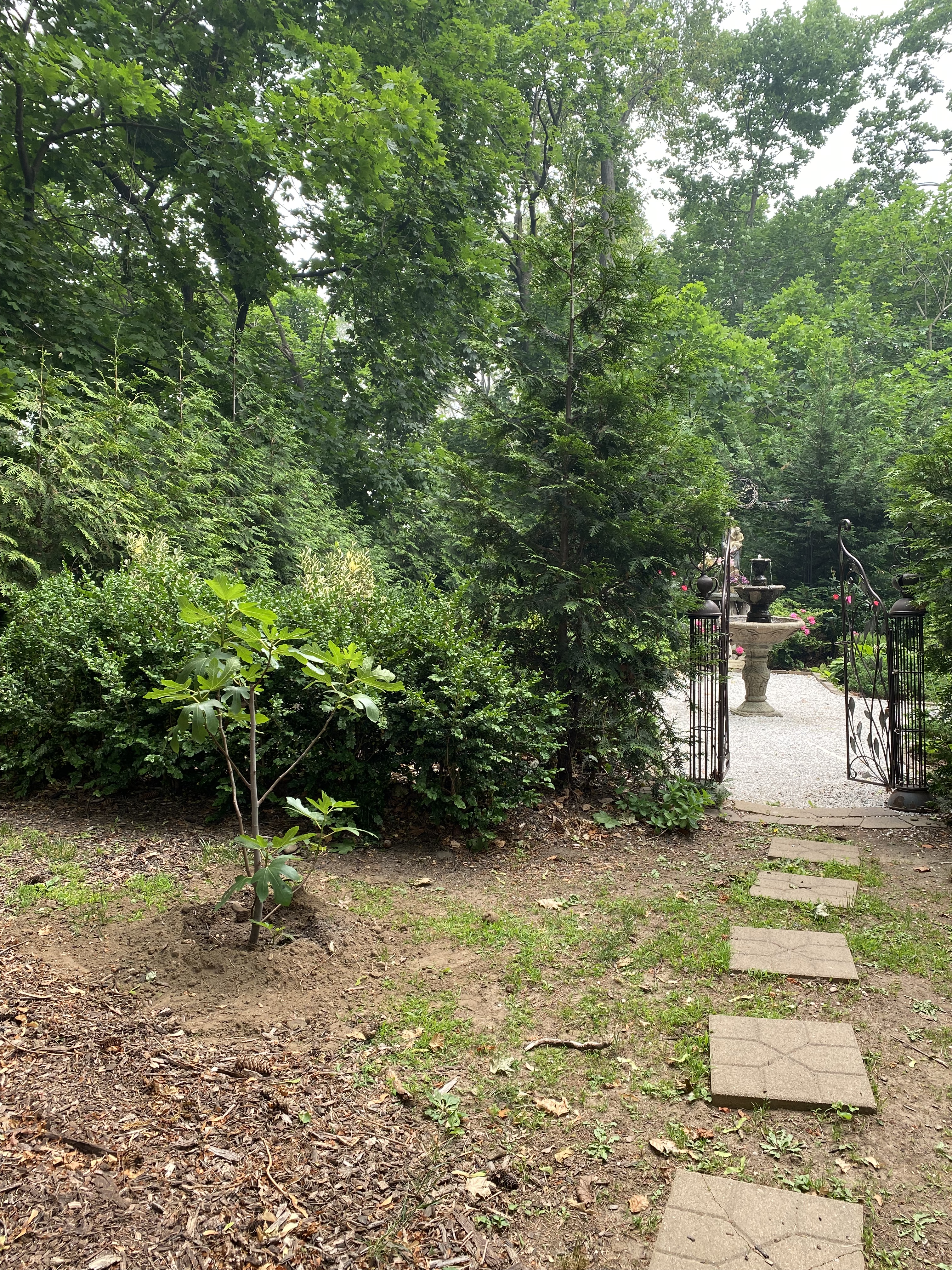
Our neighbor Manuel came over yesterday with the gift of a fig tree, which he planted near the entrance to our Mary Garden. A fig tree belongs there. It’s the first tree named in the garden of Eden (Genesis 3: 7 ), and the last tree mentioned in the Book of Revelations (6: 13). No tree is mentioned more in the Bible.
The fig tree was treasured by Jewish families who prized its dependable supply of fruit, a sign of God’s dependable providence. The prophets often used it to describe God’s blessings and his people’s unfaithfulness. The Prophet Habakkuk’s in our morning prayer describes his own faithfulness to God, using it as an image:
“For though the fig tree blossom not, nor fruit appear on the vine. Though the yield of the olive fails and the terraces produce no nourishment. Though the flocks disappear from the foldand there is no herd in the stalls, Yet I will rejoice in the LORD and exult in my saving God. GOD, my Lord, is my strength; he makes my feet swift as those of a deer, and enables me to go upon the heights. (Habakkuk 3: 17-19)
Michelangelo’s tree of good and evil in the Sistine Chapel is a fig tree.
We’re reading this week about Jesus’ entry into Jerusalem from Mark’s Gospel. Unfaithfulness is why Jesus curses the fig tree as he enters the city, and its roots wither. He finds no fruit on it. (Though it was not time for fruit)
It’s the only miracle of Jesus in Jerusalem recorded by Mark, and it surprises his disciples. (Mark 11:12-14; 20-25 ) Jesus, hungering for a response of faith, finds none from Jerusalem’s leaders he meets.
Manuel explained to me the fig tree’s roots spread quickly so the soil doesn’t have to be especially good, but it needs plenty of sun for growing. I have a feeling it will grow in that holy place. It’s meant to be there.
Poor Tobit, sunk in the misfortune of his blindness and with no one on his side, asks God to “go from the face of the earth into dust”, in our lectionary reading today:
“So now, deal with me as you please, and command my life breath to be taken from me, that I may go from the face of the earth into dust. It is better for me to die than to live, because I have heard insulting calumnies, and I am overwhelmed with grief.
“Lord, command me to be delivered from such anguish; let me go to the everlasting abode; Lord, refuse me not. For it is better for me to die than to endure so much misery in life, and to hear these insults!” (Tobit 3:1-11)
He doesn’t blame God, but he’s had enough. His prays, groaning and weeping aloud.
Sarah, soon to be his daughter-in-law, prays a desperate prayer too. She’s had 7 husbands who have all died mysteriously immediately after their marriage. She’s turned into a desperate woman who seems to be lashing out at everyone. A real witch, some were calling her.
She’s ready to hang herself, but decides not to for her parents’ sake. She prays:
“Blessed are you, O Lord, merciful God, and blessed is your holy and honorable name. Blessed are you in all your works for ever!”
Simultaneously, two desperate people are heard:
“At that very time, the prayer of these two suppliants was heard in the glorious presence of Almighty God. So Raphael was sent to heal them both: to remove the cataracts from Tobit’s eyes, so that he might again see God’s sunlight; and to marry Raguel’s daughter Sarah to Tobit’s son Tobiah, and then drive the wicked demon Asmodeus from her.” (Tobit 3: 16-17)
God hears desperate people, even if they can’t find words for a prayer.
I have been reading a book on how our lectionary was composed after the Second Vatican Council.”Words Without Alloy” by Paul Turner. Some wanted the Book of Tobit left out of the readings. I’m glad they didn’t. God hears desperate people.
Last week’s lectionary readings from the Old Testament were from the Book of Sirach; this week’s readings are from the Book of Tobit. Sirach offered words of wisdom to his son and grandson in his book. Tobit offers the story of a life that falls apart and God puts back together again. Two respected Jewish holy people.
Tobit describes himself in the first chapter of his book as a Jew from northern Israel enslaved in Nineveh by the Assyrians. He’s a very successful businessman, appreciated by the Assyrians who want to create a world class empire. Tobit became one of Assyria’s financial agents traveling their vast empire. In one place he visits, Tobit entrusted some of his money to a relative, just in case.
Tobit was a religious Jews, generous to the poor, faithful to his religious duties and intent on the restoration of Jerusalem. In Nineveh he buried the dead, a dangerous act if the Assyrians wanted the dead body to rot away unburied in a public place.
That didn’t stop Tobit, our story says. During the Jewish feast of Pentecost he leaves his supper table, goes to the market, takes an exposed body and buries it that evening, then he washes and goes to sleep in an alleyway outside his house because of the heat. Something absurd happens: bird droppings fall into his eyes and blind him.
For 4 years he goes to doctors, who make his blindness worse. Not only does his blindness get worse, but he gets worse. Everything gets on his nerves. His wife has to go to work to support them. When she brings home a goat given to her as a gift, Tobit accuses her of stealing the goat. She has enough of him.
“I flushed with anger at her over this.” Tobit says, “So she retorted: ‘Where are your charitable deeds now? Where are your righteous acts? Look! All that has happened to you.”
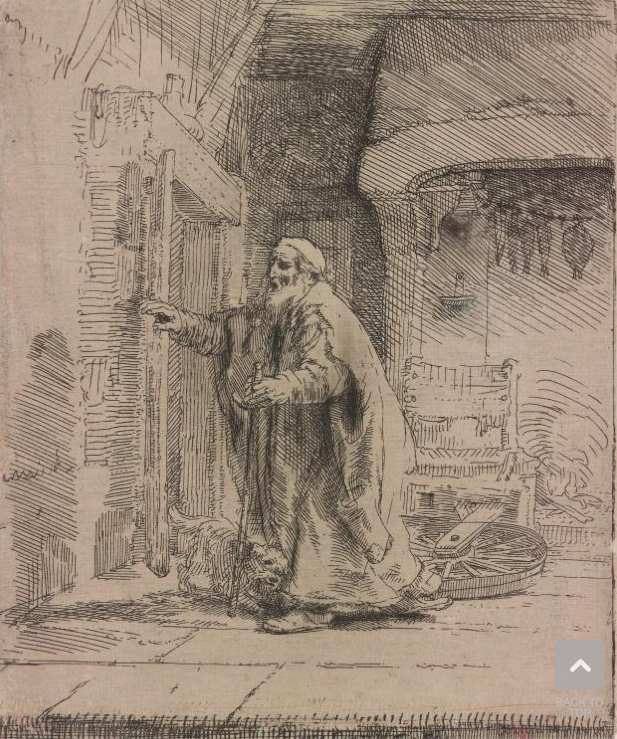
Tobit becomes so despondent that he wants to die. Rembrandt captures poor Tobit groping for the door in his blindness, while a little dog tries to push him in the right direction. But everything changes, though he doesn’t see it till it does. His son Tobiah returns with a beautiful bride, he gets the money he gave to his relative and an angel cures his blindness.
Tobit offers two beautiful prayers at the end of his book, which are not in our lectionary but we pray them in the Liturgy of the Hours.
‘Blessed be God who lives forever
because his kingdom lasts for all ages.
for he scourges and then has mercy.
he casts down to the depths of the nether world
and he brings up from the great abyss…
Praise him, you Israelites, before the Gentiles,
for though he has scattered you among them, he has shown you his greatness even there….
In the land of my exile I praise him
And show his power and majesty to a sinful people.” (Tuesday morning, Week 1)
“Let all speak of his majesty, and sing his praises in Jerusalem.
O Jerusalem, holy city,
he scourged you for the works of your hands,
but will again pity the children of the righteous.”
(Friday morning Week 4)
In the land of our exile, we may fall apart physically, emotionally, spirituality, but God is still at work.
God will restore Jerusalem, the holy city, for he pities the children of the righteous.
10 Sat Weekday [BVM] Tb 12:1, 5-15, 20/Mk 12:38-44
11 SUN USA: CORPUS CHRISTI Dt 8:2-3, 14b-16a/1 Cor 10:16-17/Jn 6:51-58
This week’s readings from the Book of Tobit offers an opportunity to relish the wisdom of the Old Testament. We may think only of the New Testament when we think of the scriptures, but God’s wisdom unfolds in the Old Testament as well. I think Jesus must have enjoyed hearing about Tobit in the synagogue at Nazareth. He was a holy man, a Jewish saint, tried by life.
Two important Christian saints are remembered this week. Boniface, the apostle to the Germanic peoples, and Ephrem, one of the great Christian teachers of Syria. Both are witnesses to the spread of the gospel to other parts of the world.
Mark’s gospel in chapter 12 follows Jesus into Jerusalem where he faces fierce questioning from his enemies before his death. Jesus will work only one miracle in Jerusalem.
Our selections in our liturgy from the Book of Sirach end Friday and Saturday with an old man’s reflections on growing in faith from his childhood. Far from rote learning, Sirach saw his faith grow through prayer and celebrating the Jewish feasts. This kind of prayer brings wisdom and joy. Saturday’s reading says:
“When I was young and innocent, I sought wisdom openly in my prayer. I prayed for her before the temple and I will seek her until the end…My heart delighted in her, my feet kept to the level path because I was familiar with her.”
The journey of faith begins from childhood. Fortunate for those, like Sirach, who get to know faith from the beginning of their lives and never cease to be instructed in her “secrets”. They will keep to the right path. I wonder if young parents today realize that?
In Friday’s reading Sirach sees the example of holy people forming us in faith. I will paraphrase some of his words:
Now will I praise those godly men and women, our ancestors, each in their own time. But of others there is no memory, for when they ceased, they ceased. And they are as though they had not lived, they and their children after them. Yet these also were godly women and men whose virtues have not been forgotten; Their wealth remains in their families, their heritage with their descendants; Through God’s covenant with them their family endures, their posterity, for their sake.
Thank God for the example of holy people in your life. Learn from them. They are often, “the saints next door”, a phrase Pope Francis used to described the familiar saints, like mothers and fathers, neighbors and all.
Sirach, “Ecclesiasticus”, was a staple source in the catechesis of the early Christian church. You can see why. The learning Sirach describes is not knowing short questions and answers and then you got it. Catechesis, as you see in Sirach, introduces us to the mystery of God from childhood and carries on until the end. It’s not a lesson in human behavior. It’s a prayerful search into what was, what is and what ever shall be. It goes far beyond the human world, but embraces the human world.
It’s learning by doing in the everyday classroom of life. Blessed are those who embrace this kind of “great instruction”.
“All generations shall call me blessed,” Mary says as she visits Elizabeth and praises God for his gift and the mission God gives her. There are signs of her blessed presence in all generations. Sometimes she comes to bless people through someone she appears to, as she did when she appeared to Juan Diego in Mexico City in the 16th century, to Bernadette Soubrious in France the 19th century and to the children at Fatima in the 20th century. The apparitions at Mexico City, Lourdes and Fatima are especially significant.
For more than 2000 years Mary has been a steady presence in the church and in the world.
What’s Mary’s mission? Why do generations call her blessed? Mary brings joy to the world by announcing the presence of her Son, the child of womb, Jesus Christ, who came to take away our fears and offers his promise. She brings wisdom for each generation to live wisely in its time.
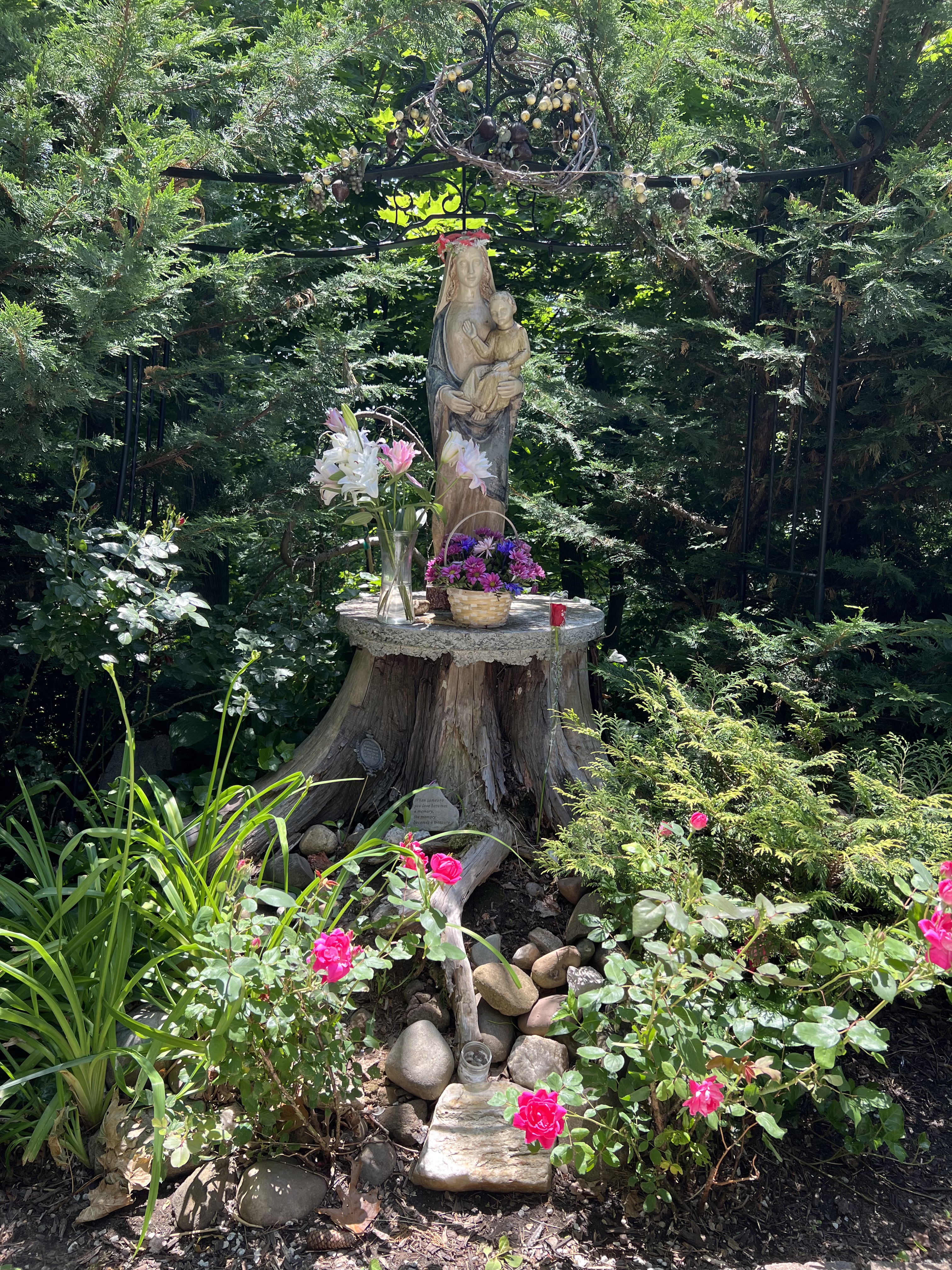
Yesterday, we celebrated the Feast of the Visitation with Mass and then a procession to our Mary Garden. In our generation, I think Mary’s mission is to make us aware that our world is a garden we should love and care for. We seem so uncaring and unloving to creation today, especially to the poor.
In the 14th century, the Black Death took countless lives in Europe, and many saw the earth itself the cause of the pandemic. In response, Mary Gardens were planted next to religious houses and churches. They were reminders of the Garden of Eden, where God first blessed the human family with the blessings of creation. God saw creation as good, a place of blessing.
Mary has a special place in creation. She has a special place renewing faith in the God of life. Our procession to our Mary Garden yesterday was a simple way of asking her help today, when creation in endangered.
She stands in our Mary Garden with her mighty Child in her arms, looking out on creation. Don’t lose hope in this planet of ours, she says. Care for it, cherish it, and pray that God, the Creator of heaven and earth, will move the hearts of the children of Adam and Eve, so that all the creatures of the earth, the birds of the sky, the fish of the sea will flourish.
“Pray for us, O Holy Mother of God, that we may be made worthy of the promises of Christ.”






 The Victor's Place