12 Wed Weekday Gn 41:55-57; 42:5-7a, 17-24a/Mt 10:1-7
13 Thu Weekday[Saint Henry] Gn 44:18-21, 23b-29; 45:1-5/Mt 10:7-15
14 Fri USA: Saint Kateri Tekakwitha, Virgin Memorial Gn 46:1-7, 28-30/Mt 10:16-23
15 Sat St Bonaventure, Gn 49:29-32; 50:15-26a/Mt 10:24-33 (388)
16 SUN FIFTEENTH SUNDAY Is 55:10-11/Rom 8:18-23/Mt 13:1-23 or 13:1-9
The Jewish Scriptures this week are about Jacob who, helped by his mother, secures the blessing of his father Isaac and enters into a convenant with God. We have only a few readings in our lectionary from Jacob’s story. I wonder if it’s because so much of it is complicated and unedifying. We should see his story for what it is: God engages humanity, sinful as it is, and mercifully guides it towards the Promised Land. “In you and your descendants all the nations of the earth shall find blessing. Know that I am with you; I will protect you wherever you go, and bring you back to this land. I will never leave you until I have done what I promised you.”
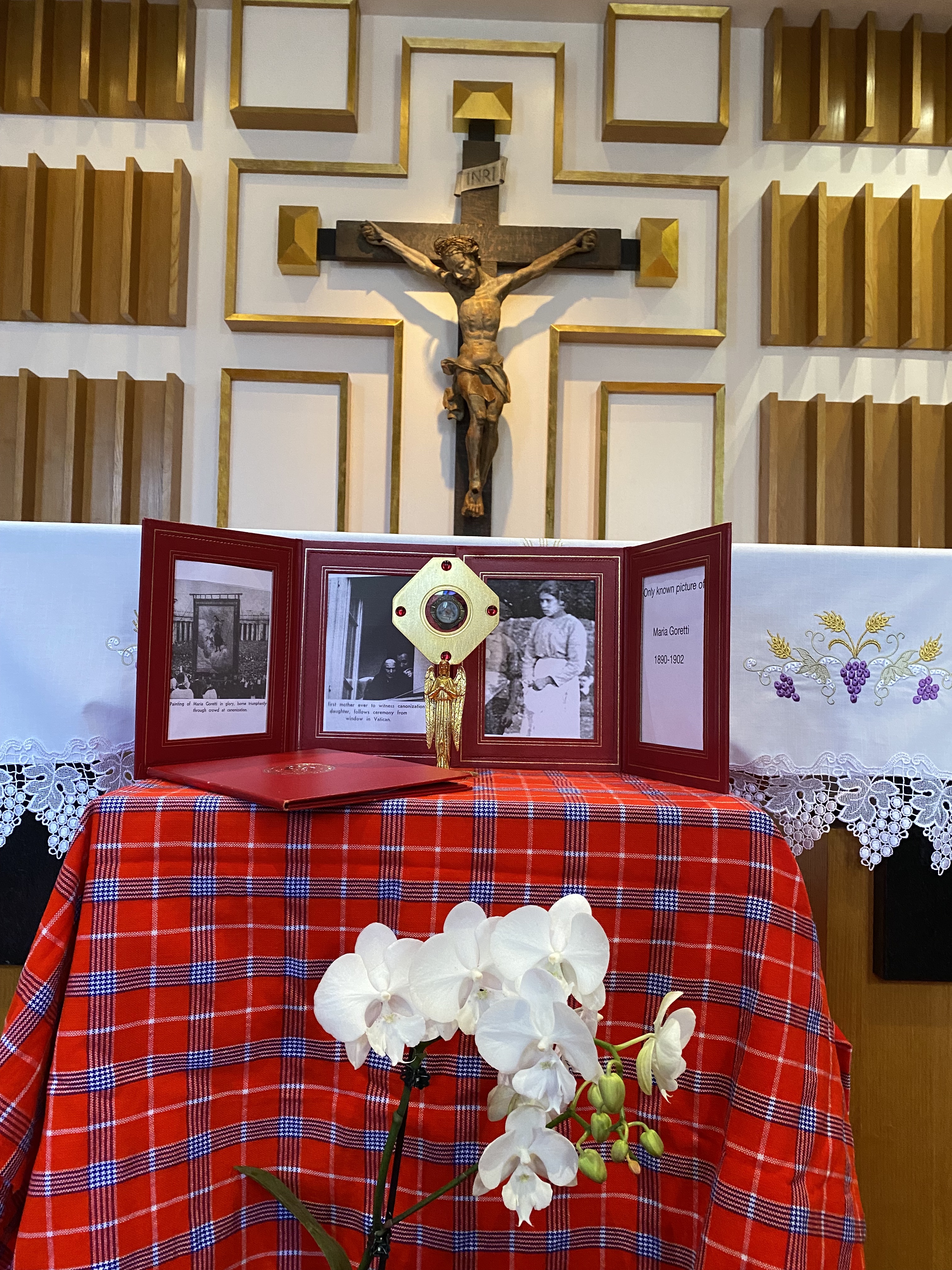
Maria Goretti was an 11 year old Italian girl who was killed today, July 6, 1902, during an attempted rape. She was the third of seven children in a family of migrant workers who worked on the farms near Nettuno, a city south of Rome.
Maria was minding her younger sister, Teresa, while her mother and the others were working in the fields, when a young man who lived in the same building, Alessandro Serenelli, tried to rape her. Maria was alone.
Alessandro attempted to seduce her a number of times before, but Maria resisted his advances. “God does not want this,” she said to him. The young man, enraged, stabbed her 14 times.
Maria survived for 24 hours and expressed forgiveness for Alessandro and promised to pray for him. For three years he was in prison unrepentant, and then he spoke of a vision he had of Maria, who offered him lilies, which he claimed “burned in his hands.”
Alessandro was released from prison and went to beg forgiveness from Maria’s mother, Assunta Goretti. She forgave him and the next day the two of them went to Mass and received Communion together.
They both attended Maria’s canonization as a saint in St. Peter’s Basilica in Rome. 500,000 people are present at her canonization.
Our first reading today, God’s command that Abraham sacrifice his only son, is particularly appropriate for today’s feast of Maria Goretti. Abraham is “our father in faith.” What are the limits of faith? Are we willing to give our life or the life of someone dear to us in answer to God’s will?
The article in Wikipedia on Maria Goretti is well done and worth reading.
What does it mean to believe? Abraham is “our father in faith,” and we read his story at the Easter Vigil, where it’s as a key reading, and in odd years from Monday of the 12th week of the year to Thursday of the 13th week of the year.
God invites us through the gift of faith to a life far beyond what we have now. “The Lord said to Abram: ‘Go forth from the land of your kinsfolk and from your father’s house to a land I will show you.’” It’s not a land we discover, but a land God gives. We have to leave a land we know and enter a land unknown.
Faith is a challenge as well as a gift. Genesis 22,1-19 begins: “God put Abraham to the test.” There no greater test for Abraham than to take his son, Isaac, “your only one, whom you love,” and go up a high mountain and “offer him up as a burnt offering.”
Intimations of the Passion of Jesus are here: “the high mountain… the only son, whom you love.” Approaching the mountain, Abraham takes “the wood for the burnt offering and laid it on his son Isaac’s shoulders.” “God will provide the sheep.” Abraham tells Isaac. He builds an altar and arranges the wood. “Next he ties up his son Isaac, and put him on top of the wood on the altar.” All suggesting the Passion of Jesus.
But when Abraham takes his knife, God stops him. “I know how devoted you are. You did not withhold from me your beloved son.” And God blesses him. “I will bless you abundantly and make your descendants as the stars of the sky and the sands of the sea.”
The Letter to the Hebrews says, “By faith Abraham, when put to the test, offered up Isaac, and he who had received the promises was ready to offer his only son of whom it was said, ‘Through Isaac descendants shall bear your name.’ He reasoned that God was able to raise even from the dead and he received Isaac back as a symbol.” (Hebrews 11,18-19)
“He reasoned that God was able to raise even from the dead.” He’s not a dumb executioner, immune to what he was to do, but “he reasoned,” he believed deep within that God was a God of life. Like Jesus, Abraham faced an absurd death and yet he believed in a God of love and promise. Like Jesus, his answer was “Not my will, but yours be done.”
The commentator in the New American Bible describes Abraham’s test. “… after the successful completion of the test, he has only to buy a burial site for Sarah and find a wife for Isaac. The story is widely recognized as a literary masterpiece, depicting in a few lines God as the absolute Lord, inscrutable yet ultimately gracious, and Abraham, acting in moral grandeur as the great ancestor of Israel. Abraham speaks simply, with none of the wordy evasions of chapters 12 and 21. The style is laconic; motivations and thoughts are not explained, and the reader cannot but wonder at the scene.”
We ask for Abraham’s faith.
Abraham’s sacrifice is portrayed frequently in the Christian catacombs of Rome where believers also faced the mystery of death. (above)
A medieval book for artists, “Speculum humanae salvationis,” the prime resource medieval artists used for comparing New Testament stories with the Old Testament, pairs the story of Abraham bringing Isaac to be sacrificed with the story of Jesus carrying his cross to Calvary, as shown in the example below:
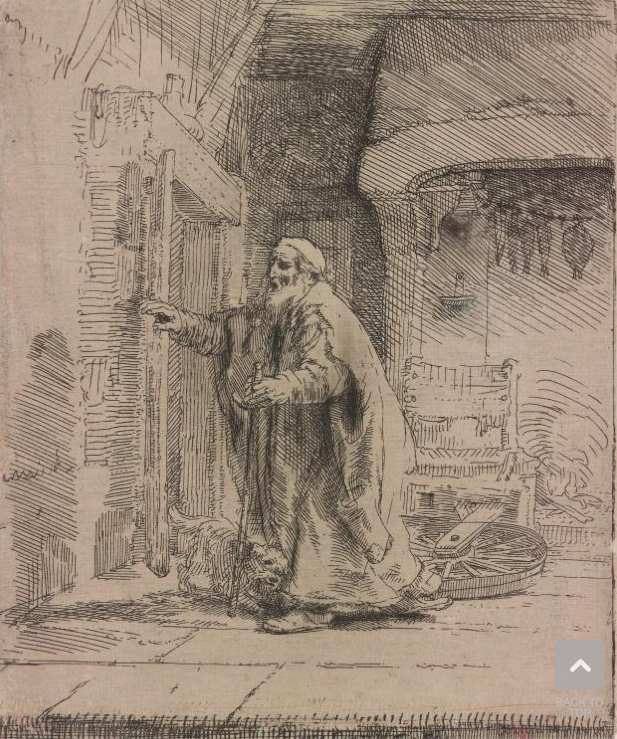
I notice in the Old Testament stories of Tobit and Abraham we’ve been reading lately there’s always a “meanwhile” going on. Tobit is struck with blindness, leaving him fumbling in the dark. “Meanwhile” his son Tobiah is being blessed with a new bride and the money needed back home, besides a cure for his father’s blindness.
Abraham sends out emissaries to arrange for a burial place for his wife Sarah and to get a wife for his son Isaac. “Meanwhile” he has to wait, not knowing how it will turn out or when. It’s out of his control.
“Meanwhile” God at work and that work, far beyond what we immediately see, bless us too.
Maybe we should think of “meanwhile” more? We belong to the Me generation, easily stuck on ourselves and what’s happening to us so that we fail to see beyond. We can even limit God to One concerned for us, but God is greater than that. Something bigger than ourselves is taking place and we will share in its good.
“Meanwhile” is God’s time.
In Rembrandt’s drawing above, Tobit is hitting up against a brick wall. He’s blind in more ways than one. He can’t see anything else.
We’re celebrating July 4th in the USA this week, our Independence Day. Parades, fireworks, speeches, hot dogs. What else? How about the meaning of it all?
There are special readings suggested by the church, but I wonder if there are plenty of suggestions in the readings we have this week from the Old and New Testaments.Our first readings this week about Abraham and Lot speak of the separation of peoples, nations. There are stories of hospitality that speak of the benefit newcomers bring to a nation. There are readings–Hagar and Sarah– that speak of the injustices brought about by slavery. The Old Testament readings offer the story of an imperfect world that God still loves and guides to the Kingdom to come. The feast of St. Thomas the Apostle is a story of doubt and cynicism. Plenty of that around these days.
In Matthew’s gospel Jesus teaches in chapters 5-7; he heals and works wonders in chapters 8-9, which we’re reading this week. He not only heals a leper (Mt 8: 1-4), a paralyzed man (Mt 8:5-16) and others, but he calms the sea (Mt 8: 23-27)and has power over the animal world. (Mt 8: 27-34) He also calls others– Matthew the tax collector– to share in his mission. (Mt 9:23-27)
We need his teaching and healing today. Plenty to pray for.
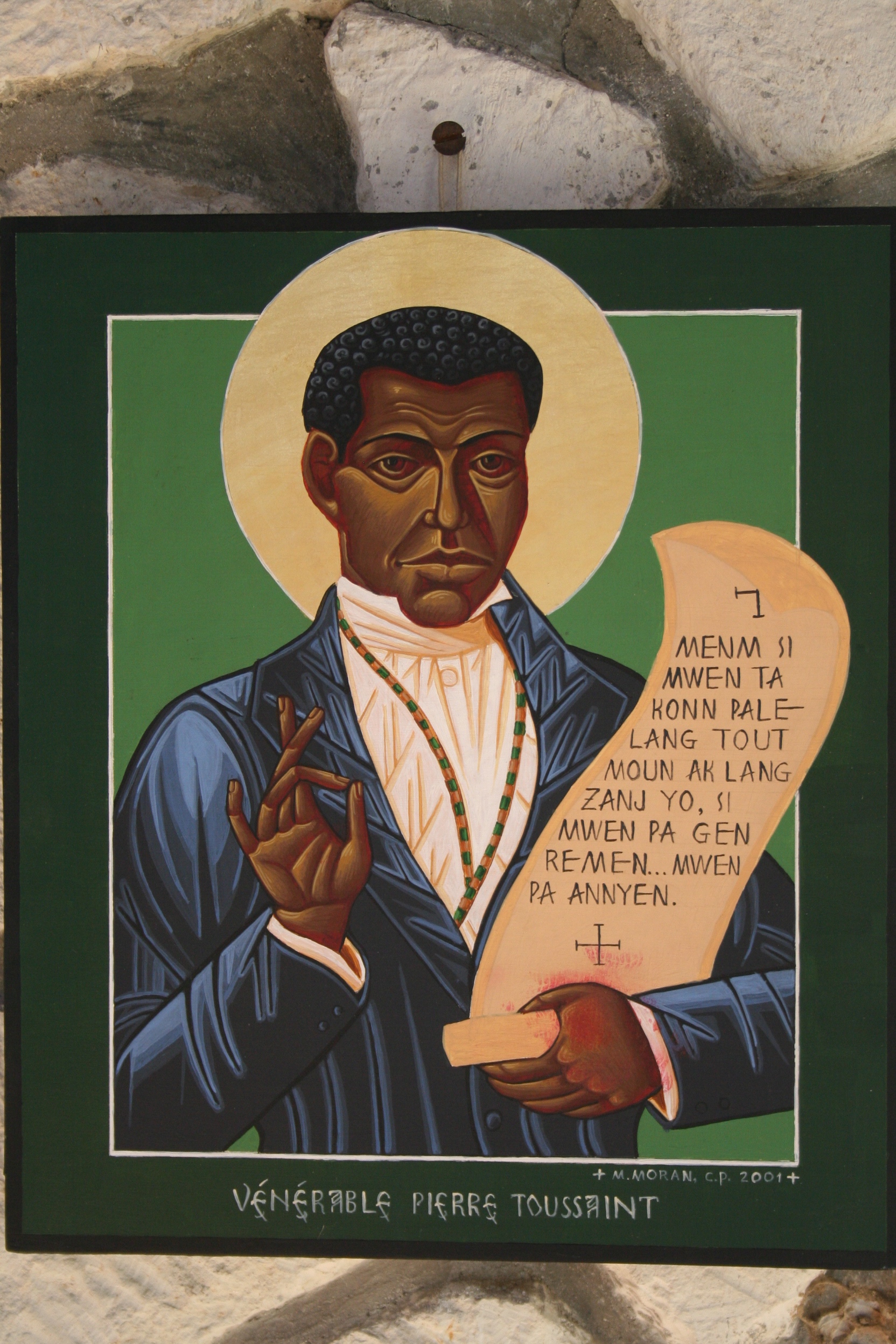
Pierre Toussaint, who came to the United States as a slave from Haiti, died 150 years ago in New York City. He’s been declared Venerable by the Catholic Church, a man admired for his dedication to the poor and his strong religious faith. See video above.
We may think slavery is a thing of the past in most of the world now, but a recent UN report reminds us it’s more than alive today, everywhere in the world.
Over 50 million people live in modern forms of slavery today and the number is growing. 28 million live in forced labor, 22 million in forced marriages; a large number are women and children. Enslavment takes place in every country of the world. Many are sexual exploitated.
Pierre Toussaint is a voice for them. Like Jesus, who “took on the form of a slave” Toussaint became a sign of God’s grace that raises the human condition to glory.
We remember him today.
Here are some references to slavery together, courtesy of Annmarie O’Connor, who represents the Passionists at the United Nations:
And the UN has Special Rapporteurs – Independent Experts who monitor various issues. Here is information (and you can read his full report) from the Special Rapporteur on Contemporary Forms of Slavery
Finally, the Passionists are connected to Haiti today through Fr. Rich Frechette CP who has long labored among the poor in that country. Native born Haitians are now also members of our community.
What does it mean to believe? Abraham is “our father in faith.” We read his story from the Book of Genesis at the Easter Vigil, where it appears as a key reading, and in odd years from Monday of the 12th week of the year to Thursday of the 13th week of the year.
First, faith is a gift by which God invites us to a life far beyond what we have now. “The Lord said to Abram: ‘Go forth from the land of your kinsfolk and from your father’s house to a land I will show you.’” It’s not a land we discover, but a land God shows us. We must leave a land we know and enter a land unknown.
Faith’s a gift, but also a challenge. Genesis 22,1-19 begins: “God put Abraham to the test.” There would be no greater test for Abraham than to take his son, Isaac, “your only one, whom you love,” and go up a high mountain and “offer him up as a burnt offering.”
Intimations of the Passion of Jesus are here: “the high mountain… the only son, whom you love.” Approaching the mountain, Abraham takes “the wood for the burnt offering and laid it on his son Isaac’s shoulders.” “God will provide the sheep.” Abraham tells Isaac. He builds an altar and arranges the wood. “Next he ties up his son Isaac, and put him on top of the wood on the altar.” All suggesting the Passion of Jesus.
But when Abraham takes his knife, God stops him. “I know how devoted you are. You did not withhold from me your beloved son.” And God blesses him. “I will bless you abundantly and make your descendants as the stars of the sky and the sands of the sea.”
The Letter to the Hebrews says, “By faith Abraham, when put to the test, offered up Isaac, and he who had received the promises was ready to offer his only son of whom it was said, ‘Through Isaac descendants shall bear your name.’ He reasoned that God was able to raise even from the dead and he received Isaac back as a symbol.” (Hebrews 11,18-19)
“He reasoned that God was able to raise even from the dead.” He faces sadness and cruelty. He’s not a dumb executioner, immune to what he was to do, but “he reasoned,” he believed deep within that God was a God of life. Like Jesus, Abraham faced an absurd death like this, and he believed in a God of love and promise. Like Jesus, his answer was “Not my will, but yours be done.”
The commentator in the New American Bible describes Abraham’s test. “… after the successful completion of the test, he has only to buy a burial site for Sarah and find a wife for Isaac. The story is widely recognized as a literary masterpiece, depicting in a few lines God as the absolute Lord, inscrutable yet ultimately gracious, and Abraham, acting in moral grandeur as the great ancestor of Israel. Abraham speaks simply, with none of the wordy evasions of chapters 12 and 21. The style is laconic; motivations and thoughts are not explained, and the reader cannot but wonder at the scene.
We ask for Abraham’s faith.
Abraham’s sacrifice is portrayed frequently in the Christian catacombs of Rome, where believers also faced the mystery of death. (above)
A medieval book for artists, “Speculum humanae salvationis,” the prime resource medieval artists used for comparing New Testament stories with the Old Testament, pairs the story of Abraham bringing Isaac to be sacrificed with the story of Jesus carrying his cross to Calvary, as shown in the example below:
We reading the story of Abraham in our lectionary this week. He is called “Our father in faith” in our 1st Eucharistic Prayer. That’s because Abraham believed when God called him to leave his own land and go to a land he did not know. He believed in God’s call.
A pastoral nomad who settled down and then moving on. Abraham moved on to a permanent home. That’s us too. Abraham trusted in God rather than in himself. As an old man, he believed God who said he would have a child. His wife Sarah was old too.
The great patriarch was tested. Faith grows through testing. Abraham’s greatest test came when God asked him to sacrifice his only son Isaac.
My favorite reflection on Abraham is Jessica Power’s beautiful poem:
“I love Abraham, that old weather-beaten
unwavering nomad; when God called to him
no tender hand wedged time into his stay.
His faith erupted him into a way
far-off and strange. How many miles are there
from Ur to Haran? Where does Canaan lie,
or slow mysterious Egypt sit and wait?
How could he think his ancient thigh would bear
nations, or how consent that Isaac die,
with never an outcry nor an anguished prayer?
I think, alas, how I manipulate
dates and decisions, pull apart the dark
dally with doubts here and with counsel there,
take out old maps and stare.
Was there a call after all, my fears remark.
I cry out: Abraham, old nomad you,
are you my father? Come to me in pity.
Mine is a far and lonely journey, too.




 The Victor's Place
