For this week’s homily, please watch the video below.
25th Sunday a: The Harvest is Great
Leave a reply
For this week’s homily, please watch the video below.
For this week’s homily please watch the video below.
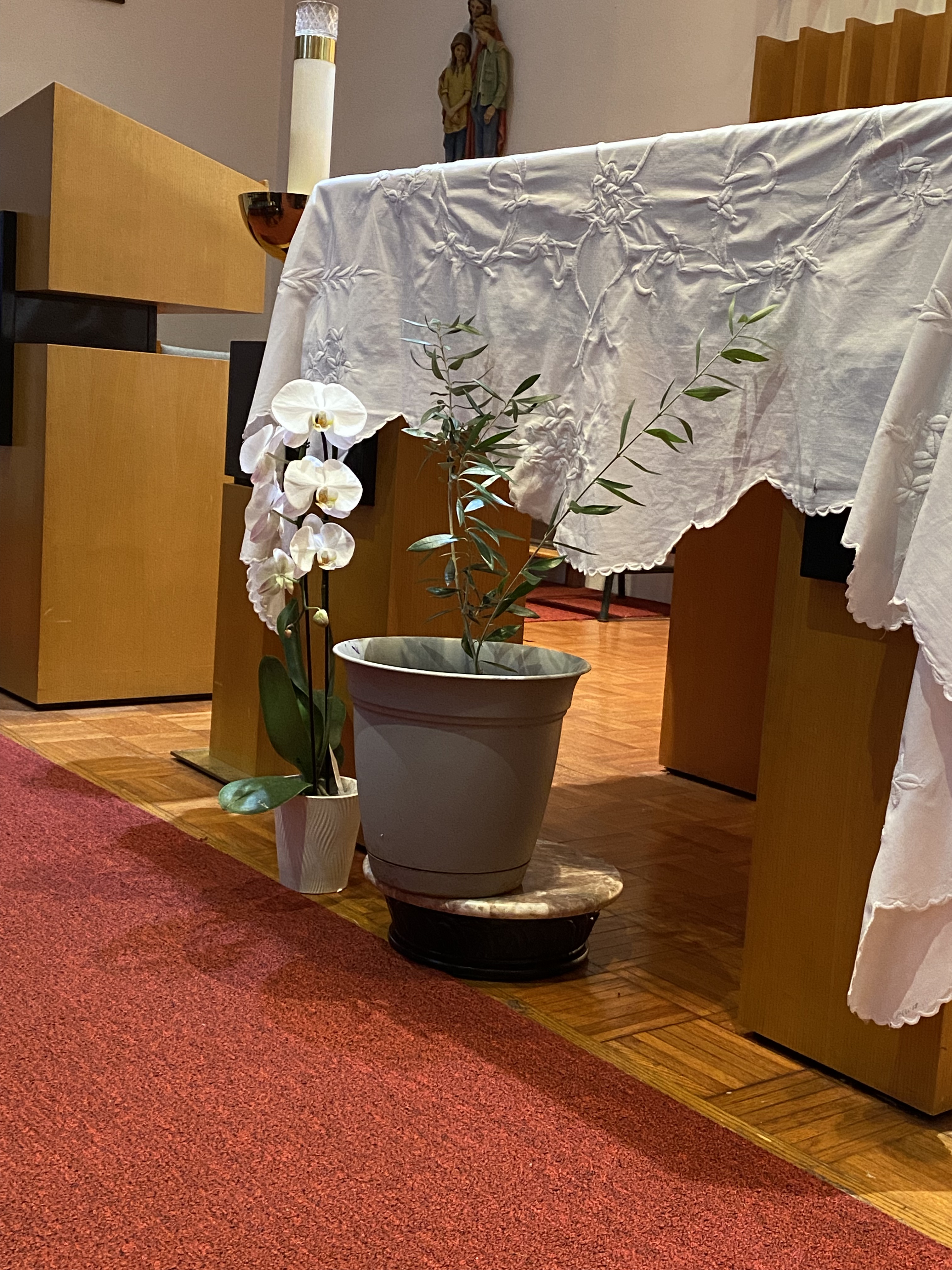
We have an olive tree before our altar today. Olive trees were highly prized in biblical times and centuries afterwards for oil that nourishes and heals. They bring life. For the ancients an abundance of olive trees was a sign of God’s blessing; their destruction or lack of fruitfulness was a test of faith.
The Prophet Habakkuk, for example, saw the disappearance of olives testing his faith, yet still he rejoiced in the Lord, “though the yield of the olive fail, and the terraces produce no nourishment, though the flocks disappear from the fold and there be no herd in the stalls.” (Habakkuk 3)
Faith is tested in different ways in different times. In the first three centuries Roman persecutions led to martyrdom. By the 4th century, Roman authorities drove Christian bishops who disagreed with them into exile and tried replacing them with more pliable leaders. For bishops like John Chrysostom– whose feast we celebrate September 13 – Athanasius, Basil, Gregory Nazianzen, exile was their test of faith.
Faith is always tested. How is it tested today? Are we being tested by radical change affecting our society, our church and creation itself?
“Though the yield of the olive fail, and the terraces produce no nourishment, though the flocks disappear from the fold and there be no herd in the stall, I rejoice in the Lord.”
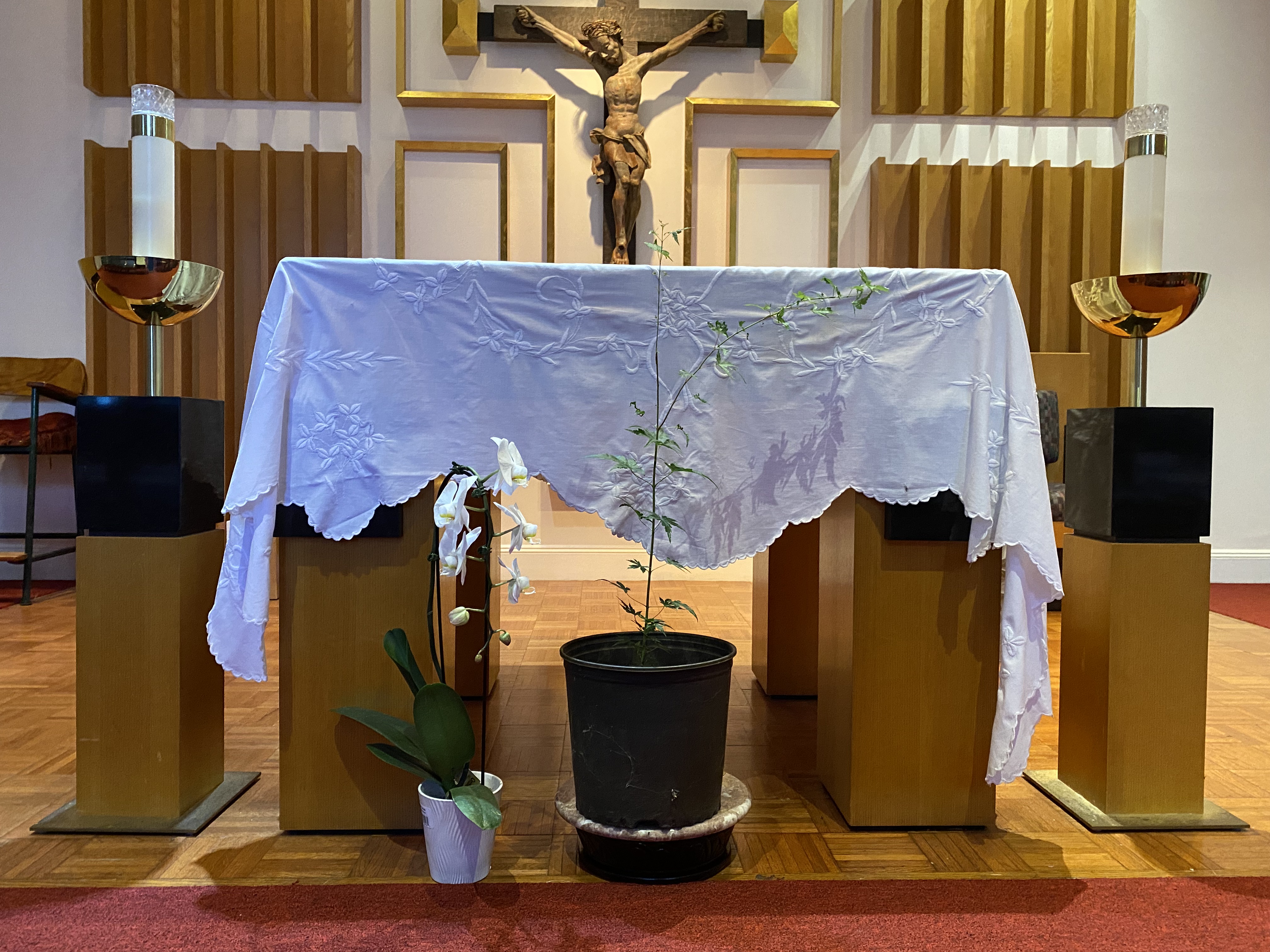
The Chinese, or Japanese Maple ( Acer palmatum) is not a native of North America but, as its name suggests, of Asia.
The Chinese maple at our altar today during the Season of Creation is a descendant of the Chinese Maple planted at Fr. Thomas Berry’s research center in Riverdale, NY, by Brother Conrad Fiederspiel, CP, one of Tom’s devoted friends and assistants. Conrad gave a cutting of that tree to my sister, who planted it in her back yard about 25 years ago. It’s now provided a shoot for us.
The Chinese Maple grows to the height of 15 to 20 feet. It has an interesting growth pattern in its limbs and brilliant leaves in the fall, something like the pattern in Thomas Berry’s own life.
So many of our plants, flowers and trees are like the Chinese Maple – immigrants in new lands. They witness to the connectedness of creation. They bring new refreshing life. We can’t live without them. Only a few might we call “invasive species.”
Victor Hoagland, CP

SEPTEMBER 11 Mon Weekday Col 1:24—2:3/Lk 6:6-11
12 Tue Weekday[ Holy Name of Mary] Col 2:6-15/Lk 6:12-19
13 Wed St John Chrysostom, Col 3:1-11/Lk 6:20-26
14 Thu Exaltation of the Cross Nm 21:4b-9/Phil 2:6-11/Jn 3:13-17
15 Fri Our Lady of Sorrows 1 Tm 1:1-2, 12-14 (441)/Jn 19:25-27
16 Sat Sts Cornelius and Cyprian, Bishop 1 Tm 1:15-17/Lk 6:43-49
17 24TH SUNDAY Sir 27:30—28:7/Rom 14:7-9/Mt 18:21-35
Two important feasts for the Passionists this week. The Exaltation of the Cross and Our Lady of Sorrows, September 14 and 15.
We celebrate the Feast of John Chrysostom September 13 and Cornelius and Cyprian on September 16.
Pope Francis in his letter Desiderio Desideravi spoke of exploring the mysteries of faith through the liturgy and through feasts like these.
The feasts of the Exaltation and Our Lady of Sorrows offer insight into the mystery of the death and resurrection of Jesus, a central mystery of our faith.
John Chrysostom was engaged in the sticky question of church and state. Like so many of the early bishops he dealt with governments and authorities who tried to absorb the church into their world.
Cornelius and Cyprian were not only martyrs, but they dealt with the great question of God’s mercy and forgiveness after the period of persecution when many defected from the church.
These feasts help us understand the historical dimension of our faith.
For this week’s homily please watch the video below.
Learning takes place day by day; it goes on and on. That’s true about faith as well. We’re learning each day, which is why our church calendar is so important.
John Chrysostom, one of this month’s saints, complained that people of his time didn’t know much about the church’s calendar; they were hardly aware of it: “Many people today just about know the names of the feasts we celebrate in church. They know hardly anything about their history and meaning…What a shame.”
Chrysostom loved the feasts of our Lord and his saints, seasons like Lent and Advent, which teach us how to live and what to hope for. They’re an ongoing school; they “teach us to number our days aright and gain wisdom of heart.”
September’s a good example, with a parade of interesting saints, like Gregory the Great, John Chrysostom himself, Peter Claver, Matthew the tax collector, Cornelius and Cyprian, Vincent De Paul, Jerome. All important teachers of faith.
There are two big feasts of Mary, the mother of Jesus, this month, her birth on September 8th and her sorrows on September 15, right after the great feast of the Triumph of the Cross, September 14.
I like the way the Feast of our Mother of Sorrows, September 15th, follows the Lord’s Triumph of the Cross. Mary’s greatest sorrow was standing beneath the cross of her Son, but sorrow spanned her whole life. She teaches that bearing the Lord’s cross is not the same as sharing his physical sufferings. Her patient waiting, her struggle to understand God’s plan, her experience of faith’s darkness show the mystery of the cross in other forms.
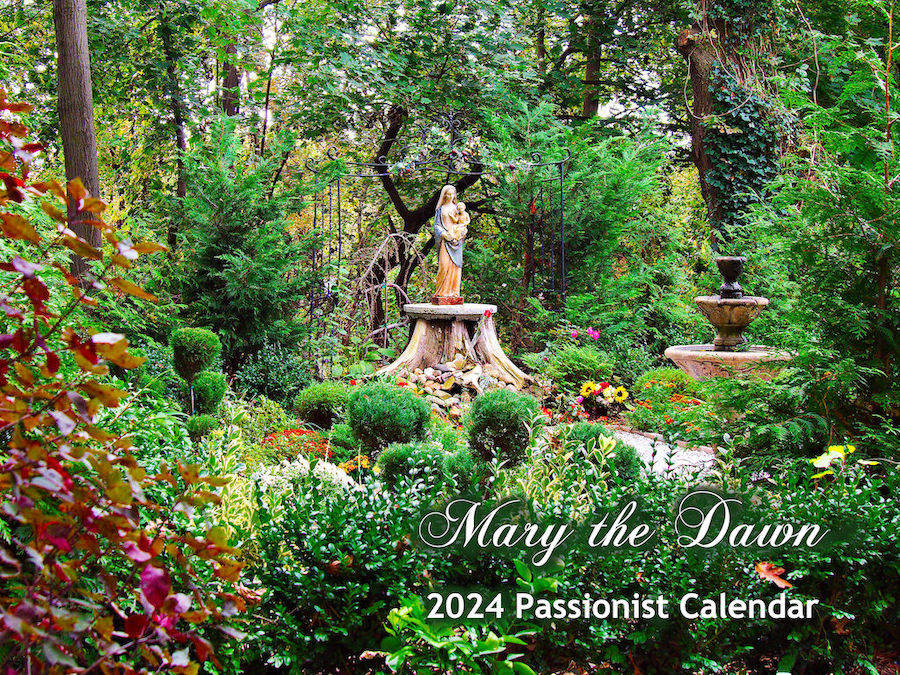
I just got from the printer this week our new 2024 Passionist Calendar (above). It combines the 2024 Roman Calendar, the 2024 USA Liturgical Calendar, and the 2024 Passionist Calendar and lists the feasts, seasons, saints, and scripture readings for the year. The 2024 Passionist Calendar is linked to this blog www.vhoagland.com which follows the liturgy through the year.
The 2024 Passionist Calendar features reflections by Pope Francis on the environment. It’s a calendar for laypeople, religious and priests. It’s sponsored by the Confraternity of the Passion. $7.00
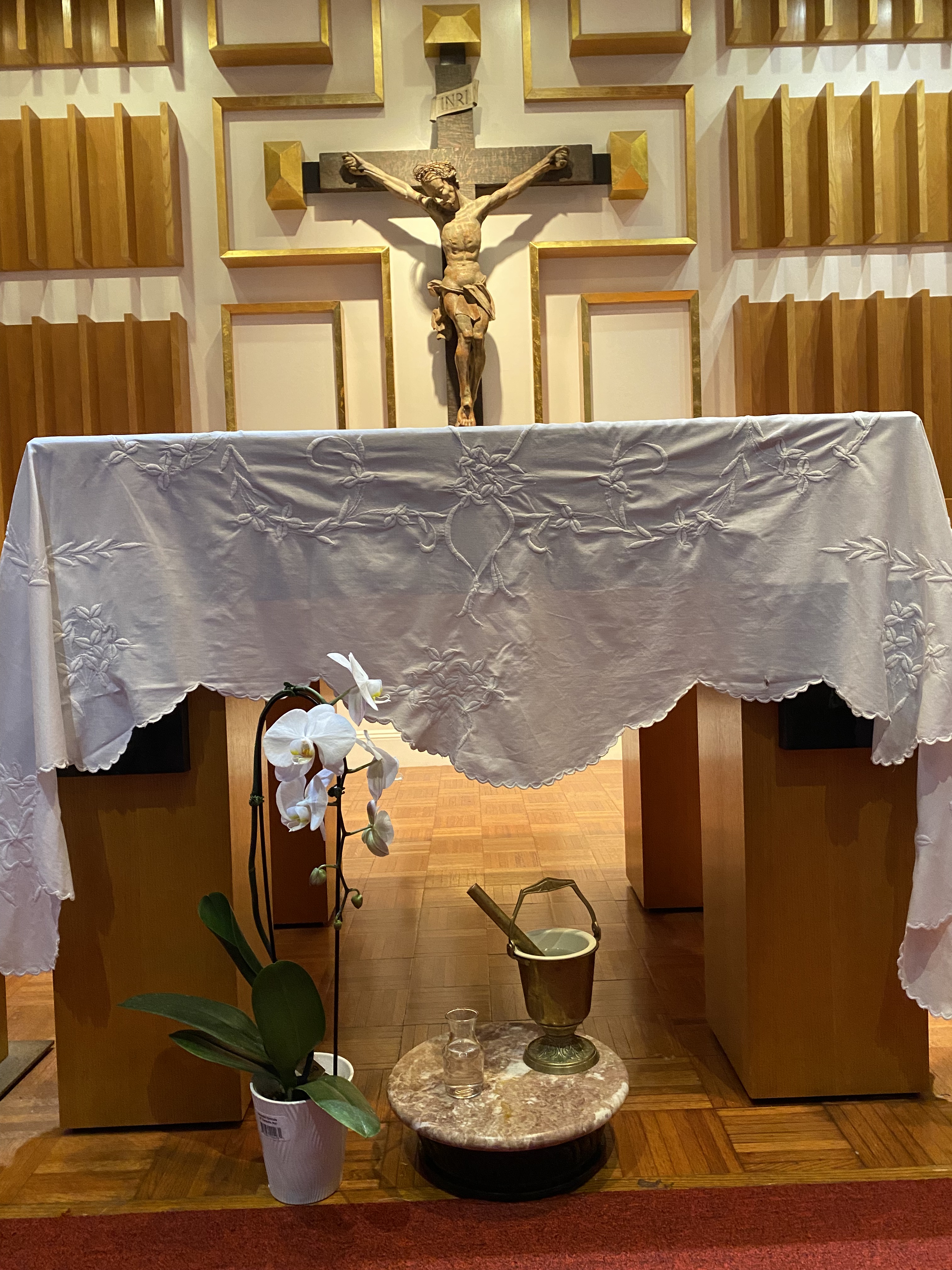
At the altar we place the small cup of water that’s mixed with the wine at the Eucharist and the water for blessing all things.
“When God created water he was thinking of the Baptism of each of us, and this same thought was his in the history of salvation every time he used water for his saving work.”(Pope Francis ) Water is a sign that the Holy Spirit is “poured out” and creates in us a thirst for God, our Creator.
Jesus entered the waters of the Jordan to begin his life-giving ministry. Water from his side flowed upon the earth at his death on the Cross. Water has a place in the sacraments, the saving signs of his love. Through water and the power of the Holy Spirit we are born again in Baptism. We bless ourselves and others with water “In the name of the Father and of the Son and of the Holy Spirit. Amen.”
“Praise be to you, my Lord, for Sister Water, she is very useful and humble and precious and pure.” (Francis of Assisi, Canticle of the Sun)


Like our ancestors, we live near water. The Genesis story describes water welling up from the earth bringing a garden to life: plants, animals, human beings. From the garden four mighty rivers bring life to other parts of the earth (Genesis 2), even reaching New York, NY.

We bless water in our prayers,: “All you waters above the heavens, bless the Lord…All you seas and rivers, bless the Lord.” (Daniel, 3, 57-58) The baptismal fount in our churches honors water. Some say it’s from the faraway Jordan River. We take it in our hand and bless ourselves with it as we go in and out of church. Water brings blessings from God.
We need “ to thank the Creator for the impressive and marvellous gift of the great waters and all that they contain (cf. Gen 1:20-21; Ps 146:6), and to praise him for covering the earth with the oceans (cf. Ps 104:6), “ Pope Francis says.
Unfortunately, we lose the blessings of water when drought dries up our lands and pollution poisons our rivers and oceans.
Now, wars and disputes over territorial waters increasingly threaten the waters uniting the peoples of the world, endangering the 90% of the world’s trade that takes place by sea– much of it food and necessities for life. We’re also seeing an increase in plunder of the seas as resources become scarce on the land.
“We cannot allow our seas and oceans to be littered by endless fields of floating plastic”, Pope Francis says. He calls for the ” development and application of international regulations on the seas in order to safeguard individuals, countries, goods, natural resources – I think, for example, of marine fauna and flora, and coral reefs or sea beds – and to guarantee an integral development in view of the common good of the entire human family and not particular interests.”
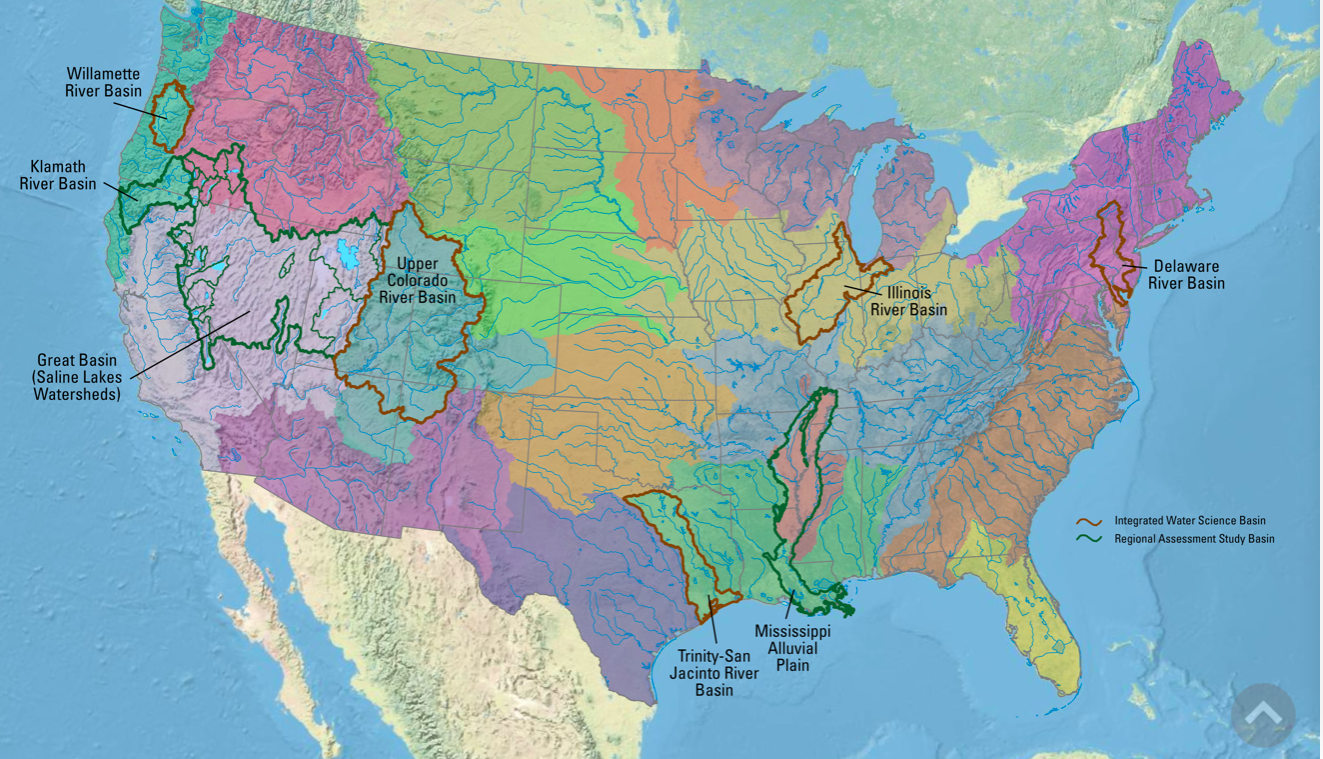
The map above shows the intricate water system that enables life on the land where I live, the United States of America.The waters near us here in New York are part of that intricate water system. They should bring life. Do they bring about a garden of life?
In my 91 years I’ve watched the waters of New York harbor suffer from massive industrialization during World War 11, unregulated real estate development afterwards along the Newark Bay, the Passaic and Hackensack Rivers. The waters have experienced human greed and neglect. I can remember, way back as a little boy, when you could fish and swim in those waterways. No more.
“Blessed be God for Seas and Rivers.” Pope Francis asks for more than words of a prayer. “Here too, our active commitment is needed to confront this emergency. We need to pray as if everything depended on God’s providence, and work as if everything depended on us.”
“

We have the precious gift of water that we drink each day before the altar today and tomorrow. Pope Francis offered this important reflection on water during the Season of Creation in 2018:
“ I would like to draw attention to the question of water, a very simple and precious element, yet access to it is, sadly, for many people difficult if not impossible. Nonetheless, “access to safe drinkable water is a basic and universal human right, since it is essential to human survival and, as such, is a condition for the exercise of other human rights. Our world owes a great social debt towards the poor who lack access to drinking water, because they are denied the right to a life consistent with their inalienable dignity” (Laudato si’ 30).
Water invites us to reflect on our origins. The human body is mostly composed of water, and many civilizations throughout history arose near great rivers that marked their identity. In an evocative image, the beginning of the book of Genesis states that, in the beginning, the spirit of the Creator “swept over the face of the waters (1:2)”.
In considering the fundamental role of water in creation and in human development, I feel the need to give thanks to God for “Sister Water”, simple and useful for life like nothing else on our planet. Precisely for this reason, care for water sources and water basins is an urgent imperative. Today, more than ever, we need to look beyond immediate concerns (cf. Laudato Si’, 36) and beyond a purely utilitarian view of reality, “in which efficiency and productivity are entirely geared to our individual benefit” (ibid., 159). We urgently need shared projects and concrete gestures that recognize that every privatization of the natural good of water, at the expense of the human right to have access to this good, is unacceptable.
For us Christians, water represents an essential element of purification and of life. We think immediately of baptism, the sacrament of our rebirth. Water made holy by the Spirit is the matter by which God has given us life and renewed us; it is the blessed source of undying life. For Christians of different confessions, baptism also represents the real and irreplaceable point of departure for experiencing an ever more authentic fraternity on the way to full unity. Jesus, in the course of his mission, promised a water capable of quenching human thirst for ever (cf. Jn 4:14). He prophesied, “If any one thirst, let him come to me and drink (Jn 7:37). To drink from Jesus means to encounter him personally as the Lord, drawing from his words the meaning of life. May the words he spoke from the cross – “I thirst” (Jn 19:28) – echo constantly in our hearts. The Lord continues to ask that his thirst be quenched; he thirsts for love. He asks us to give him to drink in all those who thirst in our own day, and to say to them, “I was thirsty and you gave me to drink” (Mt 25:35). To give to drink, in the global village, does not only entail personal gestures of charity, but also concrete choices and a constant commitment to ensure to all the primary good of water.
I would like also to mention the issue of the seas and oceans. It is our duty to thank the Creator for the impressive and marvellous gift of the great waters and all that they contain (cf. Gen 1:20-21; Ps 146:6), and to praise him for covering the earth with the oceans (cf. Ps 104:6). To ponder the immense open seas and their incessant movement can also represent an opportunity to turn our thoughts to God, who constantly accompanies his creation, guiding its course and sustaining its existence (cf. St. John Paul II, Catechesis of 7 May 1986).
Constant care for this inestimable treasure represents today an ineluctable duty and a genuine challenge. There is need for an effective cooperation between men and women of good will in assisting the ongoing work of the Creator. Sadly, all too many efforts fail due to the lack of effective regulation and means of control, particularly with regard to the protection of marine areas beyond national confines (cf. Laudato Si’, 174). We cannot allow our seas and oceans to be littered by endless fields of floating plastic. Here too, our active commitment is needed to confront this emergency. We need to pray as if everything depended on God’s providence, and work as if everything depended on us.
Let us pray that waters may not be a sign of separation between peoples, but of encounter for the human community. Let us pray that those who risk their lives at sea in search of a better future may be kept safe. Let us ask the Lord and all those engaged in the noble service of politics that the more sensitive questions of our day, such as those linked to movements of migration, climate change and the right of everyone to enjoy primary goods, may be faced with generous and farsighted responsibility and in a spirit of cooperation, especially among those countries most able to help.
Let us pray too, for all those who devote themselves to the apostolate of the sea, for those who help reflect on the issues involving maritime ecosystems, for those who contribute to the development and application of international regulations on the seas in order to safeguard individuals, countries, goods, natural resources – I think, for example, of marine fauna and flora, and coral reefs (cf. ibid., 41) or sea beds – and to guarantee an integral development in view of the common good of the entire human family and not particular interests. Let us remember, too, all those who work to protect maritime areas and to safeguard the oceans and their biodiversity, that they may carry out this task with responsibility and integrity.
Finally, let us be concerned for the younger generation and pray for them, that they may grow in knowledge and respect for our common home and in the desire to care for the essential good of water, for the benefit of all. It is my prayerful hope that Christian communities may contribute more and more concretely helping everyone to enjoy this indispensable resource, in respectful care for the gifts received from the Creator, and in particular rivers, seas and oceans.
From the Vatican, 1 September 2018
 The Victor's Place