NOVEMBER 1 Wed ALL SAINTS Rv 7:2-4, 9-14/1 Jn 3:1-3/Mt 5:1-12a
2 Thu All Souls Day Any readings from no. 668 or from the Masses for the Dead
3 Fri Weekday (Saint Martin de Porres,] Rom 9:1-5/Lk 14:1-6
4 Sat St Charles Borromeo Rom 11:1-2a, 11-12, 25-29/Lk 14:1, 7-11
5 31st SUNDAY Mal 1:14b—2:2b, 8-10/1 Thes 2:7b-9, 13/Mt 23:1-12
All Saints Day and All Souls Day begin the month of November, when the fall reminds us that life passes away. But does life end or does it change? “Life is changed, not ended” our faith says.
St. Martin de Porres (Friday) reminds us of the holiness found in those who care for the sick and the needy.
St. Charles Borromeo (Saturday) was a reformer of the Catholic Church at the time of the Reformation. He promoted the movement of reform that followed the Council of Trent.
Readings from the Letter to the Romans conclude this week with interesting greetings to various members of the Roman church, both Jewish Christians and Greeks.
I celebrated Mass at the Maritime Academy in King’s Point, NY, this morning at 9 AM. Half the student body was on their way to sea duty. There were also exams this week. Here’s the homily I preached:
30th Sunday a
When I was a boy years ago over in Bayonne, NJ –that’s the first city in New Jersey you see as you come into New York Harbor– there was a phrase they used to describe new immigrants. “They just got off the boat.” Immigrants came to our country then by boat.
Our first reading today from the Book of Exodus tells us about immigrants and how to treat them. “Thus says the LORD ‘You shall not molest or oppress an alien, for you were once aliens yourselves in the land of Egypt.’” Look at where you came from, God says, and ask how you would be want to be treated. The lesson: Don’t mistreat immigrants, you were once an immigrant yourselves..
My grandfather came to this country from Ireland in 1872. Times there were bad then and he came looking for work. When he got off the boat he got a job in the oil refinery in Bayonne. He married and had five kids; he had to raise them himself when his wife died shortly after the birth of their last child.
My mother, his second daughter, said he couldn’t read or write when he came here. She taught him. She said he never missed a day of work or Mass on Sunday. He lived with us before he died. I remember him sitting on the porch in the summer, proudly reading the Bayonne Times, the local newspaper. He wanted to know what was going on. He seemed to know everyone going by and enjoyed passing the time of day with them. He was thankful for this country and he did his best to make it better.
In the gospel today the Pharisees ask Jesus what the greatest commandment is. He said,”You shall love the Lord, your God, with all your heart, with all your soul, and with all your mind. This is the greatest and the first commandment. Then be added a second commandment. The second is like it, he said.”You shall love your neighbor as yourself.”
When they asked Jesus “Who is my neighbor?” you remember his answer. Your neighbor is everyone who’s making the journey of life with you,whether they look like you or not, whether they talk like you or not, whether they think like you or not – they are your neighbor.
Wouldn’t our world be great if we treated each other that way, as neighbors, the same as us, no matter how different we all may seem. Our world today doesn’t seem like that at all, does it?
A few years ago, Pope Francis wrote a letter entitled “Fratelli Tutti”, an extended reflection on the parable of the Good Samaritan. In the letter, the pope goes beyond how we treat our neighbor as individuals. He speaks of how the nations of the world need to be neighbors to one another.
Our world is not a good neighborhood now. “ For all our hyper-connectivity, we witness a fragmentation that made it more difficult to resolve problems that affect us all.” We facing a changed world where all the nations of the world need to work together, as neighbors, not grudgingly, but dreaming together.
“Today, in many countries, hyperbole, extremism and polarization have become political tools. Employing a strategy of ridicule, suspicion and relentless criticism, in a variety of ways one denies the right of others to exist or to have an opinion. Their share of the truth and their values are rejected and, as a result, the life of society is impoverished and subjected to the hubris of the powerful. Political life no longer has to do with healthy debates about long-term plans to improve people’s lives and to advance the common good, but only with slick marketing techniques primarily aimed at discrediting others. In this craven exchange of charges and counter-charges, debate degenerates into a permanent state of disagreement and confrontation.
Let us dream, then, as a single human family, as fellow travelers sharing the same flesh, as children of the same earth which is our common home, each of us bringing the richness of his or her beliefs and convictions, each of us with his or her own voice, brothers and sisters all.”
“Love your neighbor as yourself” has many meanings..
One reason I like coming over here to the Maritime Academy to help Fr. Gilbert when he’s away is that I think you are boat people; your neighborhood is the sea. Some of.you will be on boats soon taking you to all parts of the great sea that connects many nations and peoples. 90% percent of the world’s trade takes place on the sea. Nations are fighting over trade routes on that sea now. Commercial interests are trying to mine it for its riches. Like the rest of our world, the sea is an uneasy neighborhood now.
It needs people who love it and care for it. The commandment of Jesus has many meanings. As we celebrate Mass today, ask the Lord to keep you safe as you go to sea, but also ask God to make the dream of the Creator your dream. God, who created heaven and earth, the sea and all that is in it, made it good. Love your neighbor, the sea. Keep the dream alive.
St.Paul describes the mission of the Holy Spirit in our current reading from his Letter to the Romans as “the Lord, the Giver of Life.” We can call God, the creator of heaven and earth, “Abba, Father!” God is Creator of heaven and earth and all things. We are God’s adopted children, “joint heirs with Christ”, sharing in his glory, “if only we suffer with him.” The Spirit helps us become children of God. (Romans 8)
The Spirit also helps creation which “awaits with eager expectation the revelation of the children of God.” It “groans in labor pains” until that day when there will be a “new heaven and a new earth.” Just as we are awaiting the fruit of our adoption, creation waits to share in our adoption, in “the redemption of our bodies.”
“The Spirit comes to the aid of our weakness; for we do not know how to pray as we ought, but the Spirit himself intercedes with inexpressible groanings.” The Spirit aids us in weakness, our personal weakness, the weakness of our world, the weakness of all creation.
We pray for the help of the Holy Spirit, whom Jesus promised to send, for all those dimensions of weakness, which are so apparent today. Come, Holy Spirit, and renew the face of the earth.
Desire for God is at the heart of prayer, St. Augustine says, and so we need to “pray always with unwearied desire.” Prayer does not begin with a list of needs for God who already knows them. Prayer begins with our thirst for the One who loves us and gives us life.
We set aside certain times to eat because we’re not always aware of our hunger; we set aside times to pray because we’re not aware of our desire. We need to put aside certain times to pray.
“At set times and seasons we pray to God in words, so that by these signs we may instruct ourselves and mark the progress we have made in our desire, and spur ourselves on to deepen it. “
The words of prayer are teachers of prayer, we grow in prayer by paying attention to them.
“The more fervent the desire, the more worthy will be its fruit. When the Apostle tells us: Pray without ceasing, he means this: Desire unceasingly that life of happiness which is nothing if not eternal, and ask it of him who alone is able to give it.” (Letter to Proba)
“O Lord, open my lips.” “O God, come to my assistance.”
The liturgy begins with short prayers like this, asking God to stir up the gift of prayer in us.. Open our lips, come to help. Stir up the desire we have for you, O God. Desire is itself your gift.
”The heavens declare the glory of God; the firmament proclaims the works of his hands. Day unto day pours forth speech; night unto night whispers knowledge.There is no speech, no words; their voice is not heard. A report goes forth through all the earth, their messages, to the ends of the world.” (Psalm 19: 2-5)
Without words, creation speaks of the glory of God and reveals the One who made it. Day by day, night by night it whispers knowledge. Through things small and great, God’s creation reveals its Creator.
“Ever since the creation of the world, his invisible attributes of eternal power and divinity have been able to be understood and perceived in what he has made.” Still, human beings turn from the God of creation, creating gods of their own, St. Paul says in his Letter to the Romans,
Yet, God bestows glorious blessings through his Son, Jesus Christ, who comes as God’s Word made flesh and dwells among us. In the fullness of time he comes; in humble flesh he comes and taking the form of a slave, died on a cross.
He is exalted and all creation is exalted in him. His death brought life to the world. His passion is the sign of God’s love for humanity and all that was made.
Jesus Christ calls us to follow him.
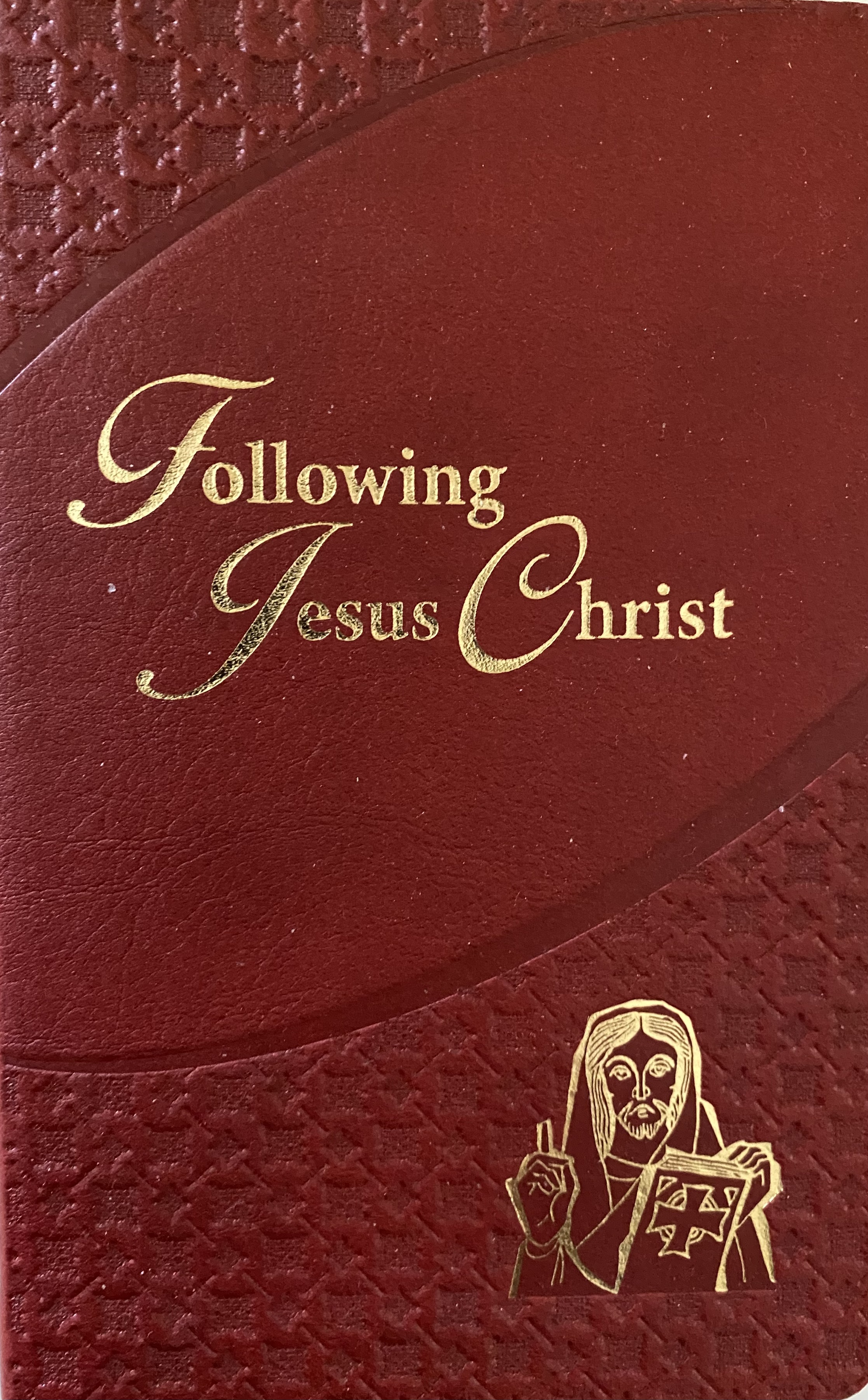
The revised edition of Following Jesus Christ, a prayerbook I edited, will be available this week. The preface follows the thought of Paul’s Epistle to the Romans. I’m more and more aware of letting creation whisper knowledge of God to us. Jesus entered humbly into our world and brought God’s saving grace to it. Here’s a picture of the prayerbook which has the four gospels of the Passion, meditations of the Passion of Jesus, morning and evening prayers, the mysteries of the Rosary, prayers for our needs, and other prayers. $12. 00
God reveals himself in creation, Paul the Apostle reminds us as he begins his Letter to the Romans. “Ever since the creation of the world, his invisible attributes of eternal power and divinity have been able to be understood and perceived in what he has made.” (Romans 1:16-25) God reveals himself in creation, not just to one people, the Jews, but to all people.
“The heavens declare the glory of God,” our psalm response for Tuesday declares. Yet human beings, blind to the God of creation, turn from this revelation and create gods of their own, and they lose sight of the One who made all things.
As an apostle sent by God into a world blinded by this sin, Paul announces a message of recreation and grace. God sends Jesus Christ, his Son, as our Savior and Lord.
Paul’s message takes on added meaning in a world failing to care for creation itself.
In his letter Laudato sí , on caring for the earth our common home, Pope Francis notes that certain times in history provoke a spiritual crisis which leads to a deeper faith in God. The Babylonian captivity when the Jewish people went into exile in the 6th century before Christ and the fierce Roman persecution of Christians at the beginning of the 4th century AD are examples he cites.
These crises led to “a growing trust in the all-powerful God: ‘Great and wonderful are your deeds, O Lord God the Almighty! Just and true are your ways ‘ (Rev 15:3). The God who created the universe out of nothing can also intervene in this world and overcome every form of evil.” (74)
Our world now is paralyzed and will not be the same. Are we at one of those crucial moments? Will God intervene? God, the Father, Creator of heaven and earth, God who is surprisingly creative?
Don’t forget God, the Creator, the pope says. If we do ” we end up worshipping earthly powers, or ourselves usurping the place of God, even to the point of claiming an unlimited right to trample his creation underfoot. The best way to restore men and women to their rightful place, putting an end to their claim to absolute dominion over the earth, is to speak once more of the figure of a Father who creates and who alone owns the world. Otherwise, human beings will always try to impose their own laws and interests on reality.” (75)
Important as it is, science alone is not enough, the pope says. We need to look also to our own tradition for hope and inspiration. Our prayers, our sacraments, currents of our spirituality waiting to be recognized and developed can guide us now to what God has planned from eternity.
Paul’s Letter to the Romans speaks for today as well as yesterday.
If sacred history tells us anything, God the Creator never stops fashioning a beautiful unknown.
Paul’s Letter to the Romans, a basic statement of faith, is timely. We need to follow the path that leads to creation.



 The Victor's Place