Hanukkah, an eight day Jewish celebration, which can occur in late November to late December, and Christmas, the Christian celebration on December 25th, are celebrated close together in time. Are they connected beyond that?
The quick answer usually given is no, but think about it a little. Hanukkah celebrates the rededication of the temple in Jerusalem after its desecration by Antiochus Epiphanes IV in 167 BC. After conquering Judea, the Syrian leader plundered the temple, ended Jewish services and erected an altar to Zeus in it.
Leading a Jewish revolt, Judas Maccabeus reconquered the city, cleansed the temple and initiated an eight day celebration in memory of the event. Eight lights lit successively call people to God’s holy place.
Christmas celebrates the birth of Jesus Christ approximately 167 years later.
Both of these feasts are about the Presence of God. For the Jews God was in the temple as Creator and Savior. For Christians God reveals his presence in Jesus Christ, who proclaimed himself God’s Son, “the light of the world” as he celebrated the Jewish feasts in the temple. (John 7-10)
All the gospels report that Jesus cleansed the temple and spoke of himself replacing it. Luke’s gospel begins in the temple with the promise to Zechariah of the birth of John the Baptist and ends as the Child Jesus enters his “Father’s house.” (Luke 1-2) Our readings today link the restoration of the temple by Judas Maccabeus and the Jesus cleansing the temple: 1 Mc 4:36-37, 52-59/Lk 19:45-48
Far from being separate, Hanukkah and Christmas are connected in their celebration of God’s presence. Hanukkah reminds us of the temple, the place of God’s provisional presence. The Christmas mystery reminds us of the abiding presence of God with us in Jesus Christ, Emmanuel, the Light that never fails, who gives life to all nations.
This week our first readings at Mass are from the First and Second Books of Maccabees commemorating the Jewish revolt against Antiochus Epiphanes, successor to Alexander the Great. The revolt led to the rededication of the temple by Judas Maccabeus after its profanation by foreign invaders. The Jewish Feast of Hannukah recalls the event. (Thursday) The revolt took place over a hundred years before the time of Jesus.
The Maccabean revolt is one reason why the times of Jesus were so politically sensitive. On his journey to Jerusalem, some “thought that the kingdom of God would appear there immediately.” (Luke 19,11) A number of his disciple probably thought that would happen by an armed uprising against the Romans, like the revolt against Antiochus Epiphanes.
Our readings this week, however, are not battle accounts from the uprising but rather stories of two elderly faithful Jews: Eleazar, a scribe who refused to assimilate to the culture of the conquerors, and a mother who inspired her seven sons to resist the invaders. (Tuesday and Wednesday)
All Eleazar had to do was pretend to eat the meat of sacrifice, but the ninety-year old chose to die rather than give bad example to the young. “I will prove myself worthy of my old age, and I will leave to the young a noble example of how to die willingly and generously for the revered and holy laws.” (2 Maccabees 6. 30-31)
The Jewish mother, seized with her seven son and witness to their torture and death, urged them to keep their faith and persevere: “I do not know how you came into existence in my womb; it was not I who gave you the breath of life, nor was it I who set in order the elements of which each of you is composed. Therefore, since it is the Creator of the universe who shapes each man’s beginning, as he brings about the origin of everything, he, in his mercy, will give you back both breath and life, because you now disregard yourselves for the sake of his law.” (2 Maccabees 7,1, 21-31)
Pope Francis often speaks of the wisdom and influence of the elderly. We rely on them. Maybe now more than ever.
“Lex orandi, lex credendi”. That latin sentence can be understood in a number of ways, but what it comes down to is this, I think: our liturgy guides the way we pray and the way we believe. Courses in theology, scripture, spiritual books and devotions are fine but they don’t supplant the liturgy of the church for building our faith.
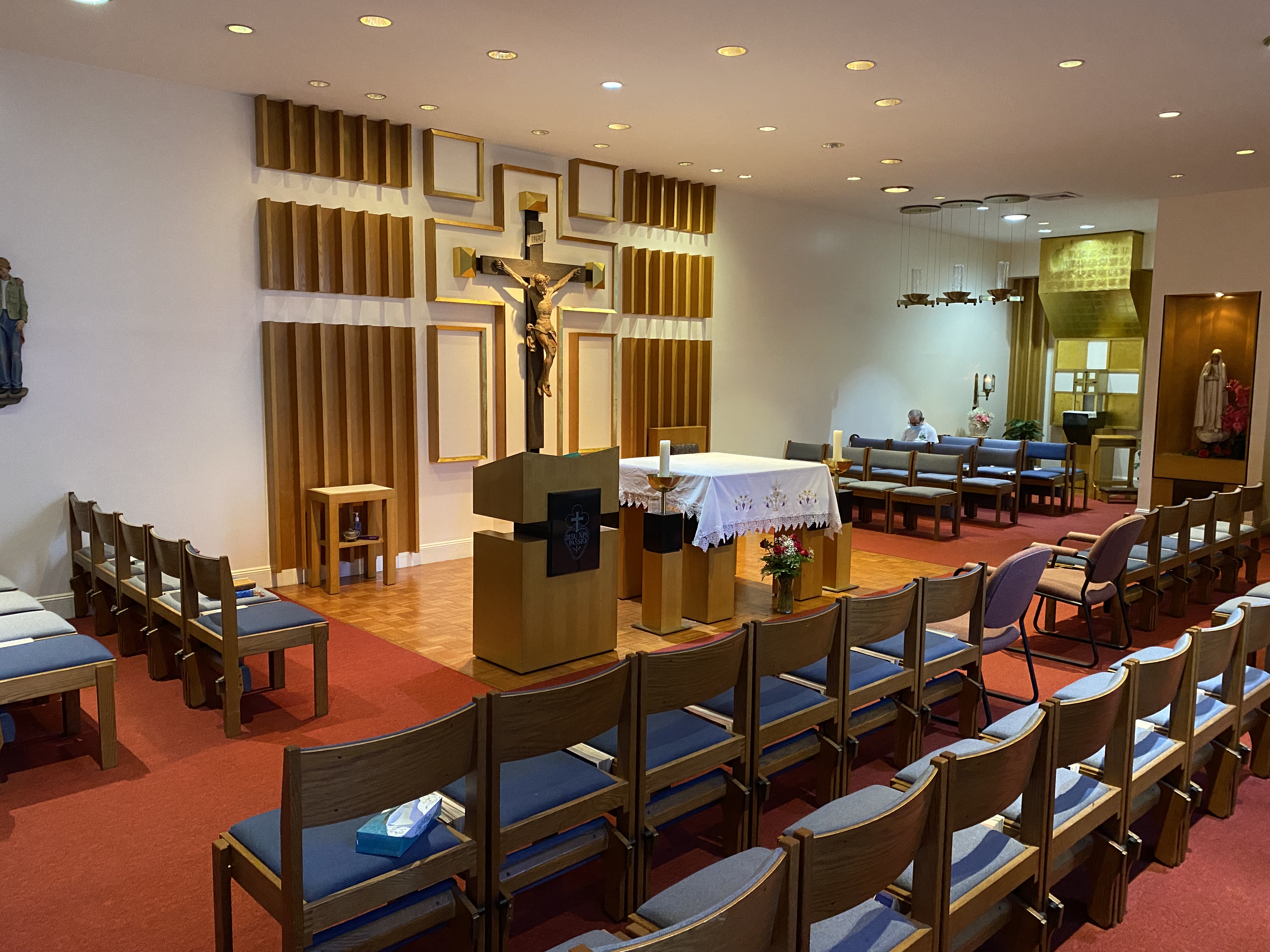
The liturgy is the most important way to explore our faith and grow in faith. It’s a catechism were called to follow through its feasts, its seasons, its prayers and the example of the saints. The chapel above is my present classroom.
Our recent feasts, for example. The Dedication of the Lateran Basilica in Rome (Nov 9). First of the great churches built after Constantine brought an end to Christian persecution in the 4th century. Why do we have churches anyway? We seem to be closing them in this part of the world, or going to them less and less.
Pope Leo (Nov 10) is called great because he led a church threatened by barbarian armies who were chopping into pieces the Roman world in the 5th century. Yet there he was firm as a rock in a storm. Does his feast tell us God always provides the leaders we need, especially in a storm?
Martin of Tours(Nov 11), the soldier who gave half of his cloak to a freezing beggar, later revealed to be Christ. Martin asks: what are you doing for the poor? November is a month we prepare for winter. Are we putting aside something for the poor?
Josephat (Nov 12) was a bishop seeking the unity of Orthodox and Roman Catholic Churches. He suffered martyrdom for his efforts. We’re challenged to work for the unity of our churches, keeping them big, not small.
Mother Cabrini ( November 13) a dynamic little Italian nun, championed poor Italian immigrants who came to the United Stats expecting streets paved in gold, but found hard cold cobblestones instead. Who’s championing immigrants today?
The saints are part of our catechism. They’re joined by daily readings from the scriptures that bring us the wisdom of the Old and New Testament. We bring them our questions, and they question and challenge us in return.
Above all, the liturgy brings us into the mystery of the death and resurrection of Jesus Christ.The liturgy is a school that has Jesus Christ as its Teacher and Lord. We are blessed.
Five women saints are remembered this week. Mother Cabrini, Margaret of Scotland, Gertrude, Elizabeth of Hungary and Rose Philippine Duchesne. Two of them, Mother Cabrini and Elizabeth of Hungary, are celebrated as memorials, the rest are optional memorials.
The distinction between memorial and optional memorial comes from the reform of our calendar after the 2nd Vatican Council which called for prioritizing the mysteries of Christ over the saints and for removing from the calendar any saints that cannot be historically verified.
It also recognized that some saints are more widely honored than others. Some are important for a region, local area or religious community, but may not have universal importance. Mother Cabrini is an important saint for the church in North and South America, for example, but not in Europe.
Elizabeth of Hungary is a memorial celebration because of her connection with an important nation in the western church. Margaret of Scotland is an optional memorial in our calendar, but I would bet she is a memorial celebration in the calendar of the church in Scotland and the British Isles.
I would also bet Gertrude, called Gertrude the Great, is a memorial in the calendars of the Germanic churches. Besides her influence in that world she is also a powerful witness as a theologian and mystic to the role of women in the Middle Ages.
Rose Philippine Duchesne was a missionary from France to the infant church in the USA. Women’s communities like hers were crucial for founding the church in our land.
(On All Souls Day I visited the grave of a friend of mine, Fr. Theodore Walsh, who died a few years ago, and afterwards I found this short reflection of his. He was a friend who always listened to me.)
A spiritual writer beautifully described a listening heart at prayer. “Here I am, Lord. I hear you knocking at my door, as each person or event comes across my life”. How may I grow into this listening person.
A listening heart, first of all, is a heart that is open; namely, open to the heart of God, open to the heart of another person, open to the heart of our world. As someone put it: “When you listen, check your worries at the door”.
Secondly, when we deeply listen, we are also touched by the other. We weep with those who weep, we rejoice with those who rejoice. We are listening not just to their words but also to their feelings.
Finally, a listener responds to the other. Listening is not passive but active. Sometime ago there was a middle age gentleman, who was single and had his own business. He was invited by friends on a pilgrimage. The first evening there was the rosary. During the service, a thought came to him which he never had before: “Be a Priest”. When he returned home, the thought remained with him. He sought the counsel of a priest. The priest encouraged the gentleman. In time he sold his business, his home and entered the seminary. Today he is a Passionist Priest. He had a listening heart. He was open to the word, he was touched by that word, and he responded fully to the word.
The art of listening can have many faces. For example it can be a way of ministry. How often a person might say to us: ‘Thank you for listening’.
Listening can also be a way of being ministered to. We are blessed to have a confidant or friend who is there for us.
Finally, listening is a way of prayer. How often we might see an elderly couple sitting quietly with each other. A beautiful image of the soul with God.
Speaking of prayer, we end the way we began. “Here I am, Lord. I hear your knocking at my door, as each person or event comes across my life”.
Mary, the Mother of Jesus, is our model for daily prayer. Every day about 20 of us gather in our chapel for morning prayer and Mass at 7:45 and evening prayer at 5 PM. The first prayer we say together before beginning the liturgy of the hours is the Angelus: “The angel of the Lord declared to Mary, and she conceived by the Holy Spirit…” The prayer recalls the announcement by the angel that God wished Mary to be the mother of his Son and Mary’s acceptance of the angel’s invitation. (Luke 1, 26-38)
That day in Nazareth would never be repeated, but it changed the way Mary lived afterwards. “The angel left her,”so St Luke’s gospel ends his story of their meeting, and no angel came again, the gospels say, but Mary carried that message of grace with her for the rest of her days. Everyday.
The angel’s message was meant for us also. God’s grace, the Lord is with us too. Everyday.
“How can this be?” Mary asks. Questions were always there in the days that followed the angels visit. Faith is never without them. Everyday.
Are we without them?
“Be it done to me according to your word,” Mary said. “Your will be done,” Jesus said in the daily prayer he prayed and taught. Simple words that bow before God, putting ourselves in God’s hands and the time and place that’s there. Everyday.
“The Word was made flesh and dwelt among us.” The Word made flesh dwells among us, who was hidden during his days in Nazareth, not clearly seen in the days of his ministry, abandoned in the days of his Passion and Death. Now, he is with us in the days of his resurrection, calling us to follow him. Everyday.
We say the Angelus everyday, our first prayer.
“Hail Mary, full of grace, the Lord is with you. Blessed are you among women and blessed is the fruit of your womb, Jesus. Holy Mary, Mother of God, pray for us sinners, now and at the hour of our death. Amen.
11 Sat St Martin of Tours, Rom 16:3-9, 16, 22-27/Lk 16:9-15
12 32n Sunday Wis 6:12-16/1 Thes 4:13-18 or 4:13-14/Mt 25:1-13
We’re coming to the end of Paul’s Letter to the Romans this week, the longest and most theological of his letters. In chapter 15 he speaks about his mission to Spain, (Friday) assuring the Romans he’s coming to Rome as a visitor, not to be part of their church. He hopes they’ll support him on his Spanish mission, so that he can bring the gospel to the whole world.
But Paul never gets to Spain; he will die in Rome.
We may find it strange that Paul in his letters doesn’t offer extensive references to incidents in Jesus’ life, such as his miracles, or quotations from his teaching or his parables. We do that as a matter of course in teaching or preaching about faith.
True, the gospels were not written when Paul wrote, likely in 56 to 58 from Corinth, but certainly the stories of Jesus’ life and summaries of his teaching were important in Christian preaching at the time. Why doesn’t Paul utilize them?
Does he see the gospel, especially the mystery of the death and resurrection of Jesus, as an immediate mystery, taking place now? The gospels bring us back to the time of Jesus, the events of his life and the words of his teaching. Paul saw them, not just as events and words of the past, but a mystery happening now. Jesus was not dead, but living in the world and in him. Now.
Is that why Paul’s letters are read with the gospels? So that we may understand they are happening now, in our time, in us?



 The Victor's Place