Today’s readings from the Old and New Testament complement one another, as the readings all through Advent do. Isaiah 35:1-10 speaks to Jewish exiles in Babylon, calling them to take a “holy way” through the wilderness to Jerusalem’s “holy mountain. Yet not just exiles in Babylon are called, God calls all nations to take the journey. All people, even the frailest, the weakest, are called to take it: the blind, the deaf, the lame, the fearful will take it, for God will strengthen them. The lame will leap “like a stag” and the “tongue of the mute will sing.”
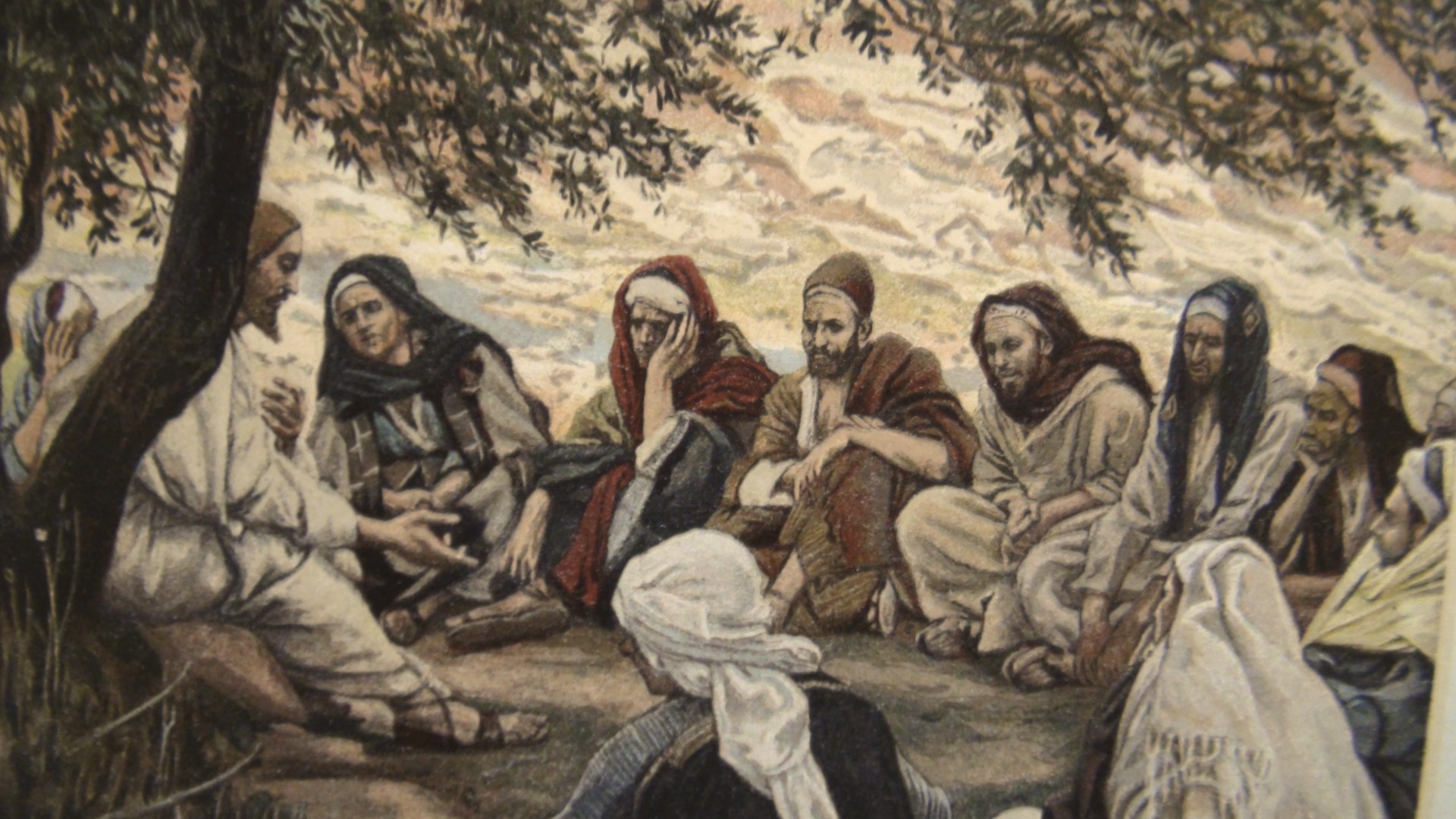
The paralyzed man brought to Jesus in the gospel and sent away singing and dancing, (Luke 5:17-26), is a symbol of a paralyzed world that Jesus invites to take this journey, and humanity’s hopes are fulfilled as well as the hopes of prophets and peoples of the Old Testament are fulfilled. Our hopes as well. God wishes to heal our paralyzed world. Isaiah’s vision isn’t small.
Our vision shouldn’t be small either. When we hear ourselves saying “They’re not going anywhere.” “They’ll never change.” “The world’s never going to change.” we need to listen to ourselves. We’re living in a cynical world. We shouldn’t let our hope become too small.
Let’s not forget those in the gospel who lowered the paralyzed man from the roof down to where Jesus was. They were people of hope, willing to chance it with someone who looked like he would never move his limbs again. We need more of their kind today.
“They will see the glory of the LORD, the splendor of our God. Strengthen the hands that are feeble, make firm the knees that are weak, Say to those whose hearts are frightened: Be strong, fear not! Here is your God, he comes to save you.Then will the eyes of the blind be opened, the ears of the deaf be cleared; Then will the lame leap like a stag,then the tongue of the mute will sing… A highway will be there, called the holy way; No one unclean may pass over it, nor fools go astray on it. No lion will be there, nor beast of prey go up to be met upon it. It is for those with a journey to make, and on it the redeemed will walk.”
The readings for the 1st week of Advent end today with Jesus going “to all the towns and villages, teaching in their synagogues, proclaiming the Gospel of the Kingdom, and curing every disease and illness.” His heart goes out to them.
And his heart goes out to us.
The towns and villages of Galilee won’t be the last places Jesus goes. We are called to go out with him for the hours we can. ( Matthew 9:35ff) As God’s harvest goes on, he calls others to join him and he empowers them.
As we end this first week of Advent, I’m grateful to those who so skillfully gave us after the 2nd Vatican Council the lectionary readings and prayers for this season. It just didn’t happen. Prayerful hands, steeped in the scriptures and the liturgy, humbly serving the church, gave them to us. Blessed are they.
I hope the liturgy, its readings and prayers, will be a treasure we appreciate more and more. It forms us in our faith and tells us how to live and it surprises us day by day. A renewed liturgy and a renewed understanding of the scriptures were goals of the 2nd Vatican Council, goals still to be fulfilled, I think.
I found this quote from Pius XI appropriate:
“For people are instructed in the truths of faith, and brought to appreciate the inner joys of religion far more effectually by the annual celebration of our sacred mysteries than by any official pronouncement of the teaching of the Church. Such pronouncements usually reach only a few and the more learned among the faithful; feasts reach them all; the former speak but once, the latter speak every year – in fact, forever. The church’s teaching affects the mind primarily; her feasts affect both mind and heart, and have a salutary effect upon the whole of man’s nature” (Encyclical Quas primas, 11 December 1925).”
Isaiah’s promise of a holy mountain will be fulfilled, our readings today say. The Messianic times arrive with the coming of Jesus Christ. In our first reading today, Isaiah renews the promise of a holy mountain to exiles, like those in the Middle East, Ukraine, Somalia, and like us.
Isaiah Promises…On this mountain, Yahweh will prepare for you a banquet rich in goodness. On this mountain, Yahweh will remove the veil of darkness covering God’s people. Death will be destroyed, you shall weep no more. You shall rejoice in your God on this mountain. (Isaiah 25:6-9)
When the Passionists came to New York City in 1924 they looked to Mary, the Mother of Jesus, to guide their new foundation. She’s there at the front door of our monastery. She has a prominent place with us. Her statue stands outside our church.
Window of the Immaculate Conception, Jamaica, NY
Mary’s in the great window in the back of our church announcing the mystery of the Immaculate Conception, the title of our monastery and parish. She is flanked by St. Catherine Laboure and St. Bernadette.
Mary appeared to St. Catherine Laboure in Paris in 1850 and to St. Bernadette at Lourdes in 1858. It was a troubled age, battered by the skepticism of the Enlightenment, the anti-religious activity of the French Revolution and the degradation to human dignity brought about by the Industrial Revolution.
Mary, free from original sin, brought the wisdom of God to that world. Her message was that God “scatters the proud and lifts up the lowly.” God’s wisdom is greater than the wisdom of this world.
Lourdes Grotto, Jamaica, NY
In the 1950s, as we faced continuing wars and the threat of nuclear war, we saw Mary’s appearance to Catherine Laboure and Bernadette a sign that God is still with us. Retreatants from our monastery retreat house memorialized Mary’s appearance at Lourdes by building a beautiful grotto in her honor in our garden. “All generations will call me blessed,” Mary said.
Today, we have a sign of Mary’s presence to our generation facing the threat of climate change– a Mary Garden, which we blessed on September 23, 2018
Mary Garden, Jamaica, NY
Mary Gardens originated in Europe following the Black Death, a pandemic that caused millions to die in Europe in the 14th century. Gardens in monasteries and churches, reminded people that God brings life, not death, from the earth.
The Mary Garden with its flowers, medicinal herbs and edible plants is a sign of the beauty, healing and nourishment God gives us on this earth. Mary presenting her Child stands in the midst of the garden, promising life and hope. “Make us worthy of the promises of Christ,” we pray. We have a small Mary Garden at the entrance of our chapel as we pray for the vision to see the beauty of God’s creation and the wisdom to care for it.
We have also repositioned our retreat house in the light of climate change and renamed it Thomas Berry Place, a non-profit center for spirituality, community empowerment, and ecological stewardship, in New York City. Father Thomas Berry (1914-2009) was a Passionist scholar who lived in our Passionist monastery in the 1960s and taught at Fordham University. Father Berry was an internationally recognized environmentalist who believed in taking steps to preserve the planet.
The current Passionists have embraced that goal.
“We are dedicated to serving those who are suffering. We also want to expand that to include helping a suffering planet,” said Father Jim O’Shea, C.P., the provincial for the Passionists for the Eastern U.S., Canada, Puerto Rico, and parts of the Caribbean. “Thomas said we need a new story.”
The Old Testament readings for the 1st week of Advent– all from Isaiah– are a message of universal salvation. Isaiah 2:1-5 (Monday) is the prophet’s classic announcement that all nations will stream to God’s mountain and listen for God’s instruction. “They will beat their swords into plowshares and their spears into pruning hooks.” Wars are over; the fragmentation destroying humanity comes to an end.
For Isaiah, the mountain of the Lord– site of the Jewish temple in Jerusalem– has a central place in God’s promise. All nations will come there; they will be fed a rich banquet (Wednesday), there the poor will triumph (Thursday), the blind will see (Friday); it’s the rock where people dwell in safety, where children play around the cobra’s den, and the lion and the lamb lie down together (Tuesday). The prophet’s poetic imagery in the readings for the 1st week of Advent is strikingly beautiful.
The gospels in the 1st week point to the Isaian prophecies fulfilled in Jesus Christ. The Roman centurion humbly approaching Jesus in Capernaum represents all the nations coming to him. Jesus feeds a multitude on the mountain. He gives sight to blind humanity, he affirms that his kingdom will be built on rock. He praises the childlike, who will enter the kingdom of heaven.
Matthew’s gospel, source of many of our Advent readings, portrays Jesus teaching on a mountain (Isaiah’s favorite symbol) and working great miracles there that benefit all who come. He is also the new temple, the new Presence of God, Emmanuel, God with us.
God works in time. The Jewish prophets knew this. However faithless their people, however dark and desolate their land, they believed God was at work. God’s kingdom was coming.
Christianity knows this, too. The sower’s seed grows in time; the field has a treasure to be found, servants have gifts to trade til their master’s return. God’s plan unfolds in time. “In the fullness of time God sent his Son.” (Galatians 4:4)
However, we get tired waiting and, like the servants in the parable, we fall asleep.
Feasts and seasons waken us. The four weeks of Advent and the days of Christmas and Epiphany waken us to the presence of God, who is within and around us. Advent begins a holy time. Let’s welcome it. “Today if you hear God’s voice, harden not your hearts.”
What message awakens us? Jesus Christ, God’s only Son, true God and true man, born of a woman, revealed to all people, has come to save our world. He came once and he will come again “to judge the living and the dead and his kingdom will have no end.”
We’re slow to know the mysteries of God, however. (Luke 24:25) Only little by little, as time goes by, does an awareness come that can” ransom the time being from insignificance.” (W.H. Auden)
What to look for in Advent and Christmas?
Mary of Nazareth, John the Baptist and the Prophet Isaiah point out the significance of Advent time and the great feasts of Christmas and Epiphany. Listen first to Isaiah, a priest in the temple in eighth century Jerusalem, when powerful Assyrian armies ravaged the kingdoms of Israel and Judah. In the worst of times he had a message of hope.
God came to him in a vision in the temple’s Holy of Holies (Isaiah 6) and Isaiah was overwhelmed by a Presence more powerful than any on earth. Human plans and schemes were not the answer, he realized; reliance on God was. No matter how bad the times, God is “Emmanuel,” “God with us.”
This was Isaiah’s message then, and it’s still his message today.
“I heard the voice of the Lord saying, ‘Whom shall I send? Who will go for us?’ ‘Here I am,’ I said; ‘send me!’” (Is: 6:8)
Isaiah’s prophecies pervade the Sundays and weekdays of Advent time, beginning with the first week. They may seem unreal to us, as they must have seemed to those who first heard them when Assyrian armies were laying waste to Palestine. Will all nations stream toward the mountain of the Lord’s house, laying down their arms of war and seeking wisdom? Will all peoples, all nations, all races ever live in harmony and peace?
John the Baptist, Mary of Nazareth and Joseph, her husband speak from the 2nd week of Advent till Christmas, announcing this mystery.
Today, in our splintered world, the promise of Advent seems an impossible dream, but this holy time revives and expands our hope, not just hope for ourselves and those dear to us, but hope for the whole world. God loves the world and sent his Son to save it. Hard to imagine, but God’s kingdom to come will bring our world and all creation peace.
Sin is behind the fragmentation of our world, but sin is destroyed by God’s grace. ‘The grace of God has appeared,” the Child born to us is our Savior and Lord. “He will come to judge the living and the dead, and his kingdom will have no end.” The peaceable kingdom, seemingly impossible, is not impossible for God.
Advent and Christmas time ends with the Feast of the Epiphany and the Baptism of Jesus, who manifests himself to the gentiles and calls all nations into his kingdom. Our calendar continues into Lent, Easter and Pentecost, where the great mysteries of God are further revealed.
Where did Advent and Christmas come from?
Where did Advent and the two great feasts expressing its meaning, Christmas and Epiphany, come from? “Advent” is a word revealing different aspects of God’s plan. It announces the birth of Christ in Bethlehem, born “in human likeness.’ His birth is also an epiphany, a revelation of God. Finally, Advent announces the final coming of the Kingdom of God through Jesus Christ.
In the Roman Catholic Church an Advent season preparing for the Feast of Christmas is first mentioned in Roman documents from the middle of the 6th century. Earlier sources from 336 cite only the Feast of Christmas, days for celebrating Lent, Easter, Pentecost and commemorations of martyrs and other saints, so the days of Advent were added afterwards to the Catholic calendar.
In our present calendar, Advent is the four weeks before Christmas. An expanded selection of readings and prayers focus on the twofold coming of Jesus Christ. This season is rich in customs and practices that bring out the significance of this season for even the least. The Advent wreath, the Christmas tree, the Christmas crib, the Christmas carols and music– all contribute to the beauty and meaning of the Advent season.
In a week that began with the Feast of Christ the King we’re reading from the Old and New Testament about the last days. It’s a world turned upside down, but we share in the kingly power of Jesus, even in floods, earthquakes, plagues and famines, when “awesome sights and signs will come from the sky.” (Luke 21,11) Our days even now can seem like the last days.
It’s no accident the Feast of Christ the King opens this week. By baptism we share in the kingly, priestly and prophetic power of Jesus, so it’s not enough just to hold on. We should face these days bravely, Jesus says, they’re a time to give testimony. Don’t worry about what words to say or what you are going to do: “I myself shall give you a wisdom that all your adversaries will not be able to refute.” Don’t worry, “not a hair of your head will be destroyed.”
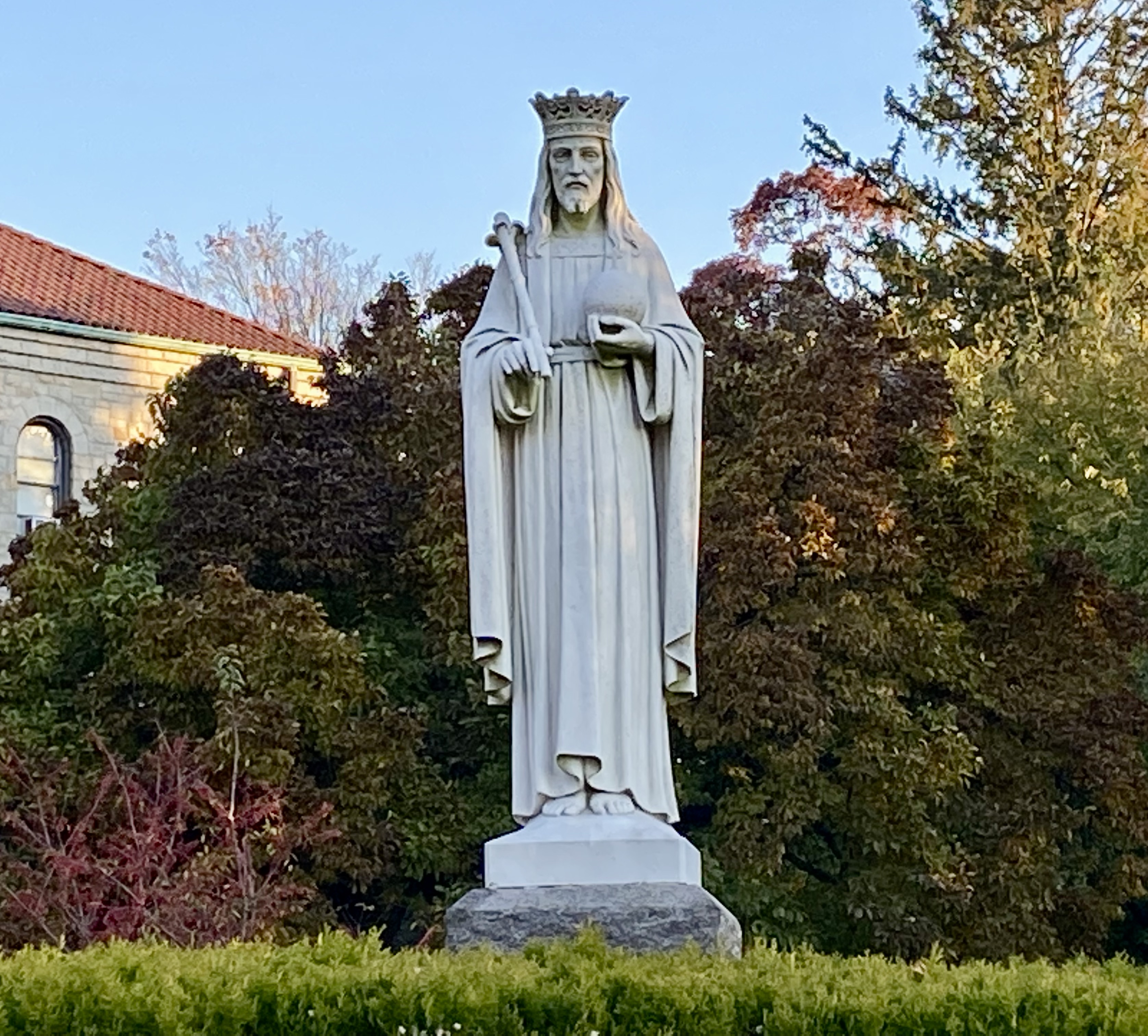
We have this majestic statue of Christ the King in our garden. Don’t forget, too, as the gospels for the Feast of Christ the King remind us, Jesus was king, priest and prophet on Calvary. He holds the world in his hands.
3 1st SUNDAY OF ADVENT Is 63:16b-17, 19b; 64:2-7/1 Cor 1:3-9/Mk 13:33-37
The church year ends this week with readings from the Book of Daniel and apocalyptic sections of St. Luke’s gospel about the future, the day of the Lord, when the kingdom of God finally comes and humanity and all creation reach the goal intended by God from the beginning. No easy readings for us who live now, even as wars, earthquakes and the cries of nature warn us of the fragile nature of creation.
Luke’s gospel is careful to remind his hearers against expecting an immediate coming of the kingdom. Use the one golden talent given to you. That will get you through.
The Book of Daniel brings us to Babylon and the three young Jewish exiles in the service of King Nebuchadnezzar. Daniel gives Nebuchadnezzar an unexpected picture of the future. His kingdom has clay feet; it will collapse and fall to the ground. The only kingdom that endures is God’s kingdom, a stone hewn from a mountain.




 The Victor's Place