The Lord’s Prayer is the norm for every prayer. That’s true, especially, for the Eucharistic Prayer in which we thank God, our Father, for blessing us “always and everywhere.” The Eucharistic Prayer is the Lord’s Prayer in another form.
As we do in the Lord’s Prayer, we call God “Our Father” at Mass and thank him for the blessings we receive as his children.
God’s blessings are symbolized in bread and wine. At Mass bread has the same manifold meaning it has in the Lord’s Prayer. “Give us this day our daily bread.” Daily Bread stands for the whole of creation, the bread of everything, It also stands for “the True Bread come down from heaven,” Jesus Christ.
Bread and wine are signs of God’s past and present blessings. They also promise of a new creation and new life to come.
In bread and wine, we bring to the Father everything that’s given to us. At Mass, Jesus Christ, our priest, takes them in his hands as he did at the Last Supper and gives them new meaning. Giving thanks to his Father he gives himself to us as God’s supreme Gift. “Take, eat and drink, this is my body; this is my blood.”
He gives us all the gifts of creation as well as the promise of a new creation surpassing this one. “God’s kingdom is coming,” he said and he himself is the way to it.
“Your will be done.” Jesus fulfilled God’s will when he came as God’s love “poured out” for the forgiveness of sins. In his death and resurrection we’re promised a way to a kingdom to come.
The Lord’s Prayer is at the heart of the Eucharistic Prayer. With Jesus we pray to Our Father in heaven, whose gifts are without measure. With Jesus we ask to do his will and work that his kingdom come. We receive Jesus Christ as our daily bread, our food and drink, our teacher and Lord. He is the shepherd who leads us through the temptations of this life.
After the Eucharistic Prayer said by the priest, we pray the Lord’s Prayer together, to prepare for receiving the Bread of Life.
We’re reading the dramatic account of the Passion of John the Baptist today on his feast, (Mark 6:14-29), which Mark places in his gospel after Jesus is rejected in his hometown of Nazareth. (Mark 6:1-6) The people of Nazareth wash their hands of Jesus, but Herod Antipas, who’s got his ear to the ground and agents everywhere, keeps his eye on him. Jesus was someone to be reckoned with.
Herod “had heard about Jesus, for his fame had become widespread and people were saying, ‘John the Baptist has been raised from the dead; that is why mighty powers are at work in him.’ Others were saying, ‘He is Elijah,’ still others, ‘He is a prophet like any of the prophets.’But when Herod learned of it, he said, ‘It is John whom I beheaded. He has been raised up.’”
John was put to death before Jesus. Herod “feared John, knowing him to be a righteous and holy man, and kept him in custody. When he heard him speak he was very much perplexed, yet he liked to listen to him.” (Mark 6:20) Some in his court even became followers of Jesus. Joanna, the wife of Herod’s steward, Chuza, followed Jesus to Jerusalem (Luke 8:3).
Others in Herod’s circle, however, became his enemies. Early on in his gospel Mark notes that the Pharisees seek out “Herodians”, some of Herod’s people, as allies to put Jesus to death. ( Mark 3,16) Then, there were Herod’s vengeful wife Herodias and her dancing daughter.
John’s passion foreshadows the passion of Jesus as the preface for today’s Mass states: “God willed that Saint John the Baptist should go ahead of your Son both in his birth and in his death.” Mark places John’s death in his gospel to indicate the rejection Jesus faced at Nazareth and other Galilean towns will culminate in his death. The powers that be decree it, even though some like Pontius Pilate and Herod himself do it hesitantly. Evil is at work.
John was arrested and imprisoned in Herod’s fortress of Macherius near the Dead Sea. His disciples scattered. He was beheaded and an innocent man died alone. “When his disciples heard about it, they came and took his body and laid it in a tomb,”
John’s death was also reported by a contemporary Jewish historian, Josephus. According to him Herod was alarmed at John’s popularity with the people and “decided to strike first and be rid of him before it led to an uprising.” ( Antiquities18.118) Jesus’ death resulted from of a simple pragmatic political decision.
Mark’s account of John’s death, is one of the great stories of literature. Our prayer at Mass calls John “ a Martyr for truth and justice” and asks God that “ we, too, may fight hard for the confession of what you teach.”
Truth and justice are endangered values today. John’s example is a timely one.
The preface for today’s Mass sums up why John is honored:
“In Saint John the Baptist, we praise your great glory, O God, for you consecrated him for a singular honor among those born of women.His birth brought great rejoicing; even in the womb he leapt for joy at the coming of human salvation. He alone of all the prophets pointed out the Lamb of redemption. And to make holy the flowing waters, he baptized the very author of Baptism and was privileged to bear him supreme witness by the shedding of his blood.”
Venerable Bede sees John’s death like the death of Jesus because they both embraced the same values. If John stayed silent about Herod’s conduct, he may have gained a few peaceful years of life, but he was more concerned with what God thinks than what powerful people think.
“His persecutor had demanded not that he should deny Christ, but only that he should keep silent about the truth. Nevertheless, he died for Christ. Does Christ not say: I am the truth?
“He preached the freedom of heavenly peace, yet was thrown into irons by ungodly men; he was locked away in the darkness of prison, though he came bearing witness to the Light of life.
“But heaven notices – not the span of our lives, but how we live them, speaking the truth.” (Bede, Homily)
In contrast, Herod noting only the opinion of his guests, gives in to Herodias’s vengefulness. Human sinfulness is on display in this banquet at court, which the artist (Above) describes so well. The women smugly presenting John’s head. The man pointing his finger at Herod and Herod denying it all. John’ eyes are still open, his mouth still speaks.
Wonderful line from Bede: “Heaven notices – not the span of our lives, but how we live them, speaking the truth.”
The memorial of the Passion of Saint John the Baptist complements the Solemnity of his birth, celebrated June 24, about six months before that of Christ. Our liturgical celebration of his martyrdom goes back to the dedication in the 5th century of a small basilica in Sebaste, Samaria that celebrates the discovery of his head. The feast was celebrated in 5th century France and 6th century Rome. In the 12th century Pope Innocent II had John’s head later transferred to Rome to the Church of Saint Sylvester in Capite.
St. Augustine was born in North Africa in 354 to Patricius, a pagan, and Monica, a fervent Christian. Monica, venerated as a saint, raised Augustine as a Christian, but he drifted away from that faith and practice, finding no wisdom in the Christian scriptures.
Intelligent, ambitious, and interested in everything the world had to offer, he found prestigious teaching positions in Rome and later in Milan, constantly searching for meaning in the philosophies of the day. For some years he lived with a woman with whom he had a son, Adeodatus.
In Milan, his mother Monica encouraged him to listen to the bishop Ambrose, who introduced him to the beauty and truth of the scriptures. Augustine was baptized and for more than 35 year was bishop of Hippo in Roman Africa, where he died on August 28, 430, as Vandal armies prepared to lay siege to the city.
Augustine’s many writings are treasured in the church. The classic account of his life, his Confessions, describes his discovery of how God was with him from life’s beginning till the present. He was thirsting for God and only God brings true happiness, he said. Augustine came to know God in an intimate way:
“Late have I loved you, O Beauty ever ancient, ever new, late have I loved you! You were within me, but I was outside, and it was there that I searched for you. In my unloveliness I plunged into the lovely things which you created. You were with me, but I was not with you. Created things kept me from you; yet if they had not been in you they would have not been at all. You called, you shouted, and you broke through my deafness. You flashed, you shone, and you dispelled my blindness. You breathed your fragrance on me; I drew in breath and now I pant for you. I have tasted you, now I hunger and thirst for more. You touched me, and I burned for your peace.”
“O eternal Truth, true Love, and beloved Eternity, you are my God, and for you I sigh day and night. As I first began to know you, you lifted me up and showed me that, while that which I might see exists indeed, I was not yet capable of seeing it. Your rays beamed intensely on me, beating back my feeble gaze, and I trembled with love and dread. I knew myself to be far away from you in a region of unlikeness, and I seemed to hear your voice from on high: ‘I am the food of the mature: grow, then, and you shall eat me. You will not change me into yourself like bodily food; but you will be changed into me’”
Here’s a biography of Augustine by Pope Benedict XVI
We remember a mother and her son this week, St. Monica and her son St. Augustine. I heard a song long ago that said: “A Mother’s Love’s a Blessing.” Augustine could have sung that song.
In his “Confessions,” he praised God for bringing him “late” to a faith he found beautiful; he also acknowledged a mother’s tears and prayers helped bring him to Jesus Christ. She was like the woman in the gospel. As she brought her dead son to be buried, she met Jesus. He saw her tears, stopped the funeral procession and raised her son to life.
“ I was like that son,” Augustine says. ‘I was dead. My mother’s tears won me God’s life.”
Like many women of her time, we don’t know much about Monica. She married a man named Patricius, a tough husband who put her down and went out with other women. They had three kids, but Augustine was special; she followed him, hoping be would be the person she knew he could be. Above all, she wanted him to have faith.
He was a hard son to deal with, smart, well educated, hooked on the “lovely things” about him, deaf to her advice, blind to the path she wanted him to take, but she followed him anyway, convinced God had something big for him to do, and she finally got her wish
Doesn’t she sound like many today? How many today love their kids, or their husbands or their wives or their friends, but worry they’ll get mixed up in the wrong things–not going to church, deaf to the gospel? But they stick by them anyway.
That’s not easy to do and so it’s good to remember Monica and the moving words to God Augustine wrote in his Confessions. Did he ever show them to her, I wonder?
“O beauty every ancient, O beauty ever new. Late have I have loved thee. You were within me, but I was outside, and it was there that I searched for you. In my unloveliness I plunged into the lovely things which you created. You were with me, but I was not with you. Created things kept me from you; yet if they had not been in you they would have not been at all. You called, you shouted, and you broke through my deafness. You flashed, you shone, and you dispelled my blindness. You breathed your fragrance on me; I drew in breath and now I pant for you. I have tasted you, now I hunger and thirst for more. You touched me, and I burned for your peace.”
Fittingly, the church celebrates Monica’s feast on August 27th, the day before her son’s.
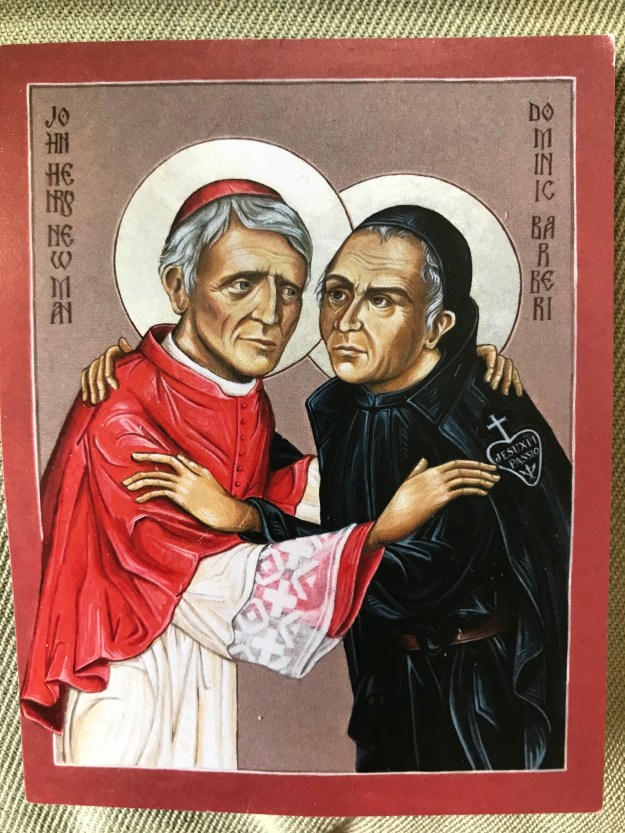
John Henry Newman (1801-1890), a prominent member of the Anglican Church, was canonized a saint by Pope Francis in Rome on October 13, 2019. Newman was received into the Catholic Church by the Italian Passionist, Blessed Dominic Barberi.
I’ve often wondered why Newman asked for Dominic to receive him into the church. Dominic, a Passionist missionary recently from Italy, was more than a zealous Catholic priest and religious. I think Newman saw in him something he treasured, namely his devotion to the mystery of the Passion of Jesus.
For Newman the mystery of the Cross interpreted everything. “The death of the Eternal Word of God made flesh is our great lesson how to think and how to speak of this world. His Cross has put its due value upon everything which we see.”
Shortly after his conversion Newman wrote “The Mystery of Divine Condescension.” (Discourses to a Mixed Congregation” 14) It’s a wonderful reflection on the mission of Jesus described by Paul the Apostle in his Letter to the Philippians, “Though he was in the form of God, Jesus did not deem equality with God something to be grasped at, but he emptied himself…” The reflection also reveals in a striking way Newman’s personal relationship to God.
He begins by considering at great length the mystery of God. God is beyond anything we know. God is infinitely beyond us. “There is a gulf between me and my great God. Yet, I’m a human being, I need someone who can weep with me, and rejoice with me, and in a way minister to me. How can I hope to find that in the Infinite and Eternal God.”
(God) is so far above us that the thought of Him does but frighten me; I cannot believe that He cares for me…I know that He is loving towards all His works, but how am I to believe that He gives to me personally a thought, and cares for me for my own sake? I am beneath His love; He looks on me as an atom in a vast universe. He acts by general laws, and if He is kind to me it is, not for my sake, but because it is according to His nature to be kind…”
My complaint is answered in the great mystery of the Incarnation,” Newman continues.
God discloses himself to us. God discloses himself, first of all, in nature. Nature is part of the mystery of divine condescension. Newman has a beautiful section in his reflection about finding God in nature.
But nature gives us only a glimpse of the glory of God. God’s condescension goes so much further. In the mystery of the Word made flesh, the Creator humbles himself to the creature.”Your God has taken on Him your nature.”
What form do we humans expect God to take? “Doubtless, you will say, He will take a form such as “eye hath not seen, nor ear heard of” before. It will be a body framed in the heavens, and only committed to the custody of Mary; a form of light and glory, worthy of Him, who is “blessed for evermore,” and comes to bless us with His presence….He will choose some calm and holy spot, and men will go out thither and find their Incarnate God. He will be tenant of some paradise, like Adam or Elias, or He will dwell in the mystic garden of the Canticles, where nature ministers its best and purest to its Creator.”
But, “the Maker of man, the Wisdom of God, has come, not in strength, but in weakness. He has come, not to assert a claim, but to pay a debt. Instead of wealth, He has come poor; instead of honour, He has come in ignominy; instead of blessedness, He has come to suffer. He has been delivered over from His birth to pain and contempt; His delicate frame is worn down by cold and heat, by hunger and sleeplessness; His hands are rough and bruised with a carpenter’s toil; His eyes are dimmed with weeping; His Name is cast out as evil.
He is flung amid the throng of men; He wanders from place to place; He is the companion of sinners. He is followed by a mixed multitude, who care more for meat and drink than for His teaching…And at length “the Brightness of God’s Glory and the Image of His Substance” is fettered, haled to and fro, buffeted, spit upon, mocked, cursed, scourged, and tortured. “He hath no beauty nor comeliness; He is despised and the most abject of men, a Man of sorrows and acquainted with infirmity;” nay, He is a “leper, and smitten of God, and afflicted”. And so His clothes are torn off, and He is lifted up upon the bitter Cross, and there He hangs, a spectacle for profane, impure, and savage eyes, and a mockery for the evil spirit whom He had cast down into hell.”
O Jesus, I cannot comprehend you more than I did, before I saw you on the Cross; but I have gained my lesson. I have before me the proof that in spite of your exalted nature, and the clouds and darkness which surround it, you can think of me with a personal affection. You have died, that I might live.
“Let us love God,” says your Apostle, “because He first loved us.” I can love you now from first to last, though from first to last I cannot understand you. As I adore you, O Lover of souls, in your humiliation, so will I admire you and embrace you in your infinite and everlasting power.”
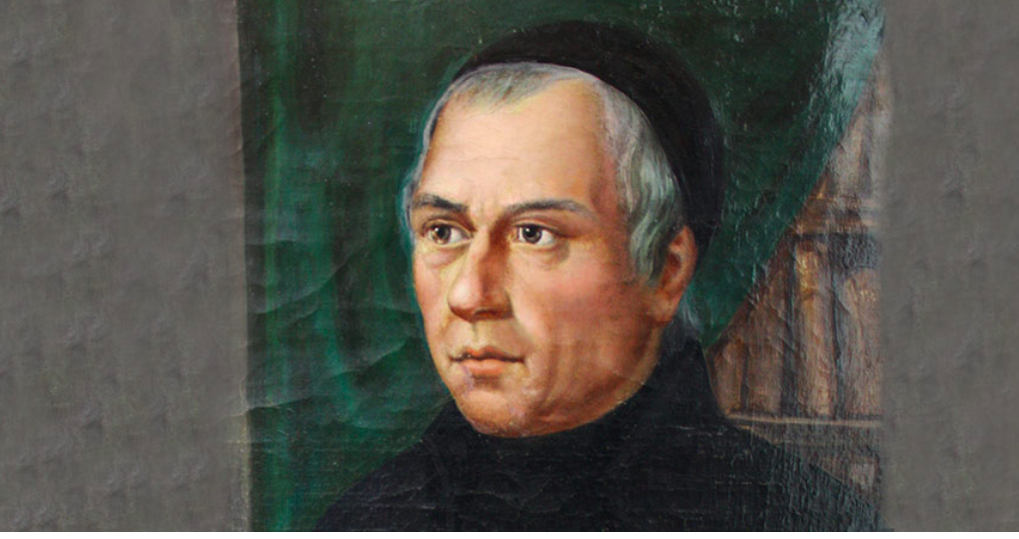
Blessed Dominic Barberi was born in Viterbo, Italy, on May 22, 1792. At 22, he gave up farming work and, called by God to religious life, he entered the Passionist congregation. Gifted with a good mind and heart, he was ordained a priest and devoted himself to teaching, preaching, spiritual direction and writing philosophical, theological, and spiritual treatises. His feast day is August 26.
In 1840, Dominic left Italy to bring the Passionist community to Ere, Belgium. Then, in 1842, he went to England and became a popular preacher of missions and retreats, establishing a Passionist retreat at Aston Hall, near Stone.
Blessed Dominic worked for the unity of the Church — a mission God called him to from his youth. He longed for the return of “separated brethren” to the Catholic Church — an expression coined by him. He anticipated by 150 years the present ecumenical movement based on love, dialogue, respect for conscience and mutual discernment.
Besides a desire to dialogue with other religious traditions, Dominic also wished to speak to the “lost sheep” of this world through preaching missions. Popular missions, stressing basic catechesis and devotional prayer, were then the primary way the Roman Catholic reached out to the peoples of Europe and also the Americas. Dominic preached countless missions in England, even though he spoke a broken English.
People found him intelligent, friendly, respectful, caring and a deeply spiritual man. The Anglican world found him a man of dialogue bringing the fresh air of a new religious springtime. Many Anglicans, John Henry Newman among them, turned to the Catholic Church through his example. Blessed Dominic received the profession of faith of the future Cardinal and now Saint John Henry Newman, then esteemed as “the Pope of the Protestants, their great spokesman, one of the most learned men of England”. For Newman Dominic was a good priest, learned and holy. He said he was Dominic’s “convert and penitent”.
Domenic died in Reading, near London, England on August 27, 1849. His grave in Sutton, St. Helens, England has become a place of pilgrimage for the English people. Pope Paul VI declared him “Blessed” on October 27, 1963 during Vatican II, calling him an example of ecumenism and describing him as an apostle of unity.
“Hear me, O coastlands, listen, O distant peoples. The Lord called me from birth, from my mother’s womb he gave me my name. He made me a sharp-edged sword.” (Is 49:1-2)
Lord, you sent Blessed Dominic to seek out the lost sheep of your flock by preaching your truth and witnessing to your love.
May we follow his example and build up the unity of your Church as a sign of faith and love. Through our Lord Jesus Christ, your Son, who lives and reigns with you in the unity of the Holy Spirit one God, for ever and ever.
! Thessalonians was written early on during Paul’s 2nd missionary journey with Silvanus and Timothy. Written about 20 years after the death and resurrection of Jesus, the letter is Paul’s first letter and the first writing of the New Testament.
Paul’s message to the people of Thessalonika can be summarized in a sentence. “ For if we believe that Jesus died and rose, so too will God, through Jesus, bring with him those who have fallen asleep” (Thes. 4:14)
In the letter Paul commends the Thessalonians, who are mostly Gentiles. They received Paul’s message through the power of the Holy Spirit, not just through Paul’s words. They are experiencing strong opposition from Jews as well as from their own people, who seem to portray Paul and his companions as religious peddlers trying to profit from a gullible audience.
Paul mentions the persecution going on in Judea. In this week’s gospel readings from Matthew Jesus denounces the scribes and Pharisees who oppose him in strong terms. Commentators believe Matthew’s gospel may well describe the opposition Jesus’ followers faced after his death and resurrection, rather than the opposition Jesus faced in his lifetime.
Is this why the compilers of our lectionary put these two readings together. Matthew’s gospel is a commentary on the opposition the Thessalonians face.
Paul assumes the final coming of Jesus will occur in his own lifetime, but the day is unknown. It will come as a “thief in the night.” ( 1 Thes 5: 1-2) The same theme is repeated in Matthew’s gospel this week.
Instead of focusing on the last days, Paul tells the Thessalonians to live today.
Like many Catholic religious communities in the western world my community, the Passionists, is shrinking in North American and Europe and growing elsewhere. I wonder why we’re not getting vocations.
Our readings this week at Mass – Paul’s First Letter to the Thessalonians and the Gospel of Matthew – make clear that Jesus and his followers were sharply opposed. Scholars say the gospel describe a time later on in Matthew’s community, after Jesus’ death and resurrection, but even so Jesus faced strong opposition in his day.
The letters to the Thessalonians describe the opposition Paul faced. Unfortunately, our lectionary readings, leaving out most references to that opposition, may cause us to lose sight of what Paul and his followers accomplished.
It’s true generally that when you don’t see the challenges and crosses people face, you don’t get to know them well. That’s true of individuals and groups– like the Passionists. Bumps on the road are part of your story.
Fr. Alessandro Ciciliani in a Passionist International Bulletin from Rome, The Congregation at the Time of the Canonization of St. Paul of the Cross 1867, describes some bumps on the road my community faced then. It’s a wonder we survived.
From our foundation in the 18th century by St. Paul of the Cross our survival was threatened. In Paul’s day, there was strong opposition to new religious communities in the church and in society. (The time was unfavorable to older religious communities too. In 1774, the Jesuits were suppressed) Humanly speaking, we shouldn’t have gotten started.
In our early days, the popes were strong allies, but shortly after the death of St. Paul of the Cross (1775) the papacy as an institution was severely weakened and almost disappeared. When Pope Pius VII died exiled by Napoleon in 1799, smart people predicted he was the last of the popes.
Threats to our survival continued in the 19th century. In his article Ciciliani describes the closure and seizure of most of our foundations in Italy shortly after St. Paul’s death. By 1850 we had three provinces and 27 houses in Italy. In the space of 20 years 21 of those houses were seized by the government, and the religious told to go home. Anticlerical laws issued by the Kingdom of Savoy and the Kingdom of Italy insisted that communities like ours weren’t needed; the new governments also saw properties and assets as sources of revenue for themselves.
“There was a lot of confusion among the religious and little hope for the future. Consequently there was a temptation to return to their families or look for accommodation with the diocesan clergy,” Ciciliani writes.
What’s surprising, though, were the creative thrusts emerging in the church and in our community in those dark days. In 1817, Pope Pius VII– the pope supposed to be the last – created the Propaganda Fidei, a papal arm that built up the church in South America and Asia, and in 1834 organized the church in North America.
In 1844 the Passionist, Blessed Dominic Barberi, began a vital mission in England. In 1861 4 Passionists arrived in Philadelphia and planted the community in North America. Other new missions were started and flourished. It was not the last gasp of survivors, but people dreamed new things. A dream was alive in them.
The scripture readings tell us the church grows in response to challenge and opposition. The history of my own community says the same. Father Ciciliani writes of the “terrible experience” my community faced in the 19th century, but ends by recalling that the mystery of the cross is terrible too, but it does not end in death; it brings life.
We’re leaving the Old Testament in our lectionary readings this week to read from Paul’s Letter to the Thessalonians, which may be the earliest writing of the New Testament. We’ll be reading from Thessalonians most weekdays till next Tuesday.
About four scripture readings in our morning and evening prayers are from Thessalonians, so this is a good time to deepen our understanding of this book of scripture.
We’re also leaving Matthew’s gospel the end of this week; next Monday we start reading from Luke’s Gospel on weekdays. Every year we repeat the gospels, the lectionary readings and celebrations of the saints. Why the repetition?
The liturgy calls for deep reading. Deep reading is different than the quick reading we do a lot of today. We’re looking for facts.
We need to take in more than facts, however. Deep reading recognizes we need time to understand. We learn little by little. We are slow learners. Besides, we forget. So we need deep reading.
Deep reading is how we learn from the gospels and other scriptures, from our prayers and from the lives of the saints. These are not sources we learn all at once. We learn from them today. “If today you hear his voice, harden not your hearts.” We learn from them today, and tomorrow.
The scriptures, our prayers, the lives of saints like Monica, Augustine, John the Baptist, whose feasts are celebrated this week, have something to tell us today. Along with the signs of the times, God speaks to us through them.



 The Victor's Place