Liturgical Prayers and Creation

In a recent interview, Pope Leo XIV wondered whether celebrating the Vatican II liturgy “ in a proper way” might help alleviate conflict in our church between advocates of the Traditional Mass and the Mass of Vatican II. 

What might “in a proper way” mean? 

Pope Leo will surely engage that subject at some future date, but he’s not likely to diverge from his predecessors, all of whom supported the liturgical changes that came  from Vatican II. He will certainly look at an important apostolic letter his predecessor Pope Francis wrote in June 29, 2022,  “Desiderio desideravi”, on the liturgical formation of the People of God.

Francis called the liturgical books promulgated by Pope Paul VI and Pope John Paul “the unique expression of the lex orandi of the Roman Rite.” (Motu Proprio, Traditionis custodes, art 1) In the light of that statement, Pope Leo would hardly change the status of the liturgy of Vatican II.

In Desiderio desideravi, Francis, quoting Pope Paul VI, describes the liturgy as the “‘first source of divine communion in which God shares his own life with us. It is also the first school of the spiritual life. The liturgy is the first gift we must make to the Christian people united to us by faith and the fervour of their prayers. It is also a primary invitation to the human race, so that all may now lift their mute voices in blessed and genuine prayer.’”

Pope Francis in Desiderio desideravi called for a liturgical formation beyond academic formation, a formation leading, not just to understanding, but above all to wonder. 

The modern challenge to the prayer of the church, Francis said, was that people today, not in all cultures to the same degree, “have lost the capacity to engage with symbolic action, which is essential to the liturgical action.” (Dd 27) He quotes from the German theologian Romano Guardini, an important source on the liturgy: “The first task of the work of liturgical formation: we must become once again capable of symbols.”

To engage in the liturgy we must follow the way of the Incarnation, Francis wrote. The sacramental way.“The Liturgy is done with things that are the exact opposite of spiritual abstractions: bread, wine, oil, water, fragrances, fire, ashes, rock, fabrics, colors, body, words, sounds, silences, gestures, space, movement, action, order, time, light.” (Dd 42)

All of creation manifests the love of God. All of creation serves the manifestation of the Word. Water, oil, bread and wine are essential to the prayer of the church. “The task is not easy because modern man has become illiterate, no longer able to read symbols; it is almost as if their existence is not even suspected.” (Dd 44)

“Above all we must reacquire confidence in creation.” (Dd 46) Pope Francis’ call for confidence in creation links the challenge of liturgical prayer with another great challenge of our time: the care of creation. In his encyclical Laudato si’ Pope Francis saw the need to view creation with fresh eyes. A greater appreciation of creation can lead to a greater appreciation of the church’s liturgy. Conversely, a greater involvement in the church’s liturgy “in a proper way” can help restore the way we see creation.

Liturgical spirituality and creation spirituality converge.

                                                                                                                                                                                                                                                                                                                                                                                                                                                                                                                                                                                                                                                                                                                                                                                                                                                                                                                                                                                                                                                                                                                                                                                                                                                                                                                                                                                                                                                                                                                                                                                                                                                                                                                                                                                                                                                                                                                                                                                                                                                                                                                                                                                                                                                                                                                                                                                                                                                                                                                                                                                                                                                                                                                                                                                                                                                                                                                                                                                                                                                                                                                                                                                                                                                                                                                                                                                                                                                                                                                                                                                                                                                                                                                                                                                                                                                                                                                                                                                                                                                                                                                                                                                                                                                                                                                                                                                                                                                                                                                                                                                                                                                                                                                                                                                                can increase our appreciation of creation.
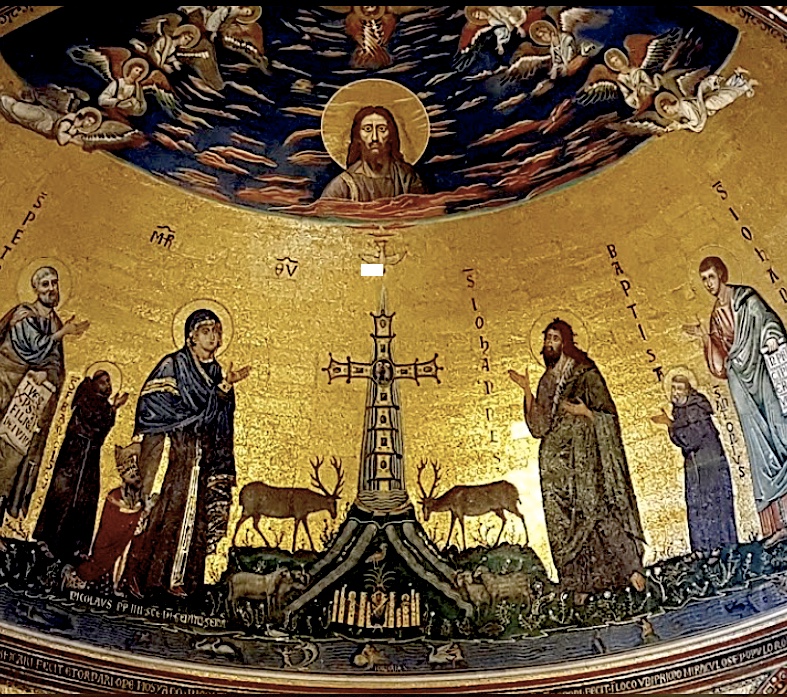
The Yearning of the Deer: Romans 8: 18-24

“Creation awaits with eager expectation the revelation of the children of God.” It “groans in labor pains” until that day comes, when there will be a “new heaven and a new earth.” Creation will be renewed, not destroyed. It’s linked to our destiny, St. Paul writes in his Letter to the Romans. (Romans 8: 18-24)

Paul’s message is found in the Apostles’ Creed: “I look forward to the resurrection of the body and the life of the world to come.” Creation shares in the glory of a world to come.

Deer approach the Cross in the great mural in the church of St. John Lateran in Rome.(above) They’re not just representing our thirst for God. “Like the deer that longs for running streams, so my soul thirsts for you, my God.” (Psalm 4) The Spirit calls living creatures and inanimate creation to share in the promise made to us. Creation “groans” and shares in “the sufferings of the present time”, as it waits for the promise to be fulfilled.

The Jewish scriptures, especially the psalms, recognize God’s promise to creation, often inviting the earth to sing with us:

“Cry out with joy, all the earth. 

Serve the Lord with gladness. 

Come before him singing for joy.”  (Psalm 100)

Saints Simon and Jude: October 28

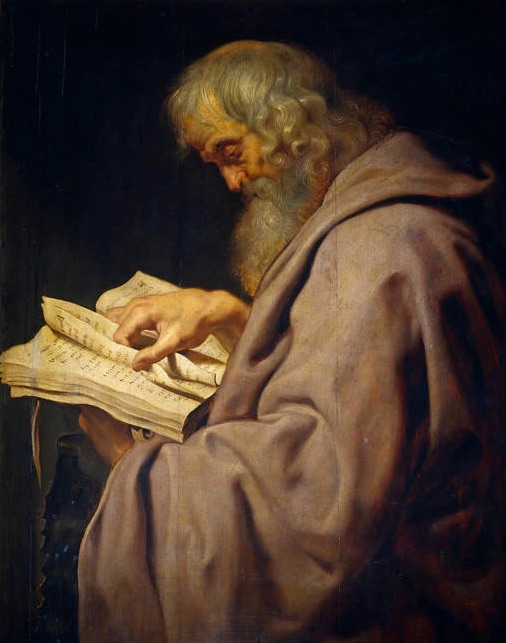
Simon Rubens
St. Jude LaTour

Saints Simon and Jude, whose feast we celebrate October 28, are mentioned only a few times in the New Testament list of apostles,  tenth and eleventh respectively. (Mark 3,13-19, Luke 6,12-16)

Simon is called  `the Zealot,’ either because he was zealous for the Jewish law or because he was a member of the Zealot party, which in the time of Jesus sought to overthrow Roman domination by force.

Some of Jesus’ followers,  the Gospels indicate, were hardly pacifists. Peter was ready to use his sword in the garden of Gethsemani when the temple guards came to seize Jesus;  James and John told Jesus to call down fire from heaven on the hostile Samaritans whom they met on their journey to Jerusalem. So did Simon have thoughts of revolution when he answered Jesus’ call ?

Jude, called “Thaddeus” to distinguish him from Judas Iscariot, may be the brother of James, the son of Alphaeus, some interpreters of the Gospel say. If that’s so, he’s also a relative of Jesus. He may be the author of the Epistle of Jude in the New Testament.

Early Christian traditions – all difficult to prove historically – locate the ministry of these apostles in places as far apart as Britain and Persia; one important legend from 3rd century Syria says they were apostles to Syria. If so, we ask their intercession for that troubled place today.

Knowing little about  Simon and Jude may be a good thing, because then we have to look to their mission to know them – they were apostles. Even if we don’t know exactly where each of them went, they were apostles. The mission of the apostles was to follow Jesus. “ As the Father has sent me, so I send you.” Jesus says in the Gospel of John. He also said, “I have come down from heaven, not to do my own will, but the will of him who sent me.”

God made his will known to the apostles in due time. They didn’t decide what to do or where to go by themselves. They knew God’s will day by day, as we do.  So often, it was unexpected and perhaps not what they planned. Simon had revolutionary thoughts. This was a revolution of another kind. Jude followed his cousin. He found himself in a family of another kind.

“Your will be done,” we say in the Lord’s Prayer. That’s an apostle’s prayer. We try to make it our prayer too.

Romans 8:12-17

We’re reading Paul’s Letter to the Romans– his most important letter– for almost four weeks at Mass. Paul writes to a Jewish-Christian community in Rome to establish his credentials as an apostle of Christ and to enlist their help for a journey he wants to make to Spain. It’s a community of Jewish and Roman converts trying to reconcile Jewish law and tradition with faith in Christ, so the letter takes on that question at length. 

It can be hard to follow. We need to remember the letter is based on Paul’s basic teaching, the common creed of the church. Today’s reading (Romans 8: 12-17), for example, is a beautiful reflection on the mission of the Holy Spirit. The Spirit leads us to call God, the creator of heaven and earth, “Abba, Father!” We are God’s adopted children, “joint heirs with Christ” called to share in his glory, “if only we suffer with him.” 

Tomorrow’s reading continues this teaching as it applies to creation. “Creation awaits with eager expectation the revelation of the children of God.” It “groans in labor pains” until that day comes when there will be a “new heaven and a new earth.” Just as we await the fruit of our adoption, creation waits to share in our adoption in “the redemption of our bodies.” 

All creation groans in labor pains, shares a common suffering,  waits for the Spirit to fulfill his promise. Creation has a share in the resurrection of Christ. 

This is teaching about creation you won’t get from science. We have it from faith. It’s an important teaching for us today. It’s important, too, to recognize it’s is not just Paul’s personal teaching. He’s preaching from the basic teaching of the church.

Paul speaks of creation as he begins his Letter to the Romans.  “Ever since the creation of the world, God’s invisible attributes of eternal power and divinity have been able to be understood and perceived in what he has made.” Creation reveals God to us, yet human beings turn from the God of creation, creating gods of their own.

Paul’s words are a timely commentary on climate change today as we continue to put national and personal interests, our oil fields and coal mines and life-styles above the well being of our earth. His teaching on creation is a basic teaching that needs to be heard.

Romans 6-8: Christ, our Savior

Does the abundance of God’s grace mean we don’t need to worry about sin? Grace conquers sin, so we don’t have to worry about sinful ways? In our readings this week from his Letter to the Romans , St. Paul answers that question:

“What then? Shall we sin because we are not under the law
but under grace?
Of course not!” (Romans 6)

In Baptism we enter into the saving mystery of the death and resurrection of Jesus Christ. We have the promise of that mystery, but not yet its fulfillment. From his own experience Paul writes “ I take delight in the law of God, in my inner self,  but I see in my members another principle at war with the law of my mind, taking me captive to the law of sin that dwells in my members. Miserable one that I am!
Who will deliver me from this mortal body?
Thanks be to God through Jesus Christ our Lord.” (Romans 7)

Jesus Christ is not a distant Savior, a figure of the past. The one who delivers us from our frail mortal nature, is “Christ in you. Although the body is dead because of sin, the spirit is alive because of righteousness.
If the Spirit of the one who raised Jesus from the dead dwells in you,
the one who raised Christ from the dead
will give life to your mortal bodies also,
through his Spirit that dwells in you.” (Romans 8)

Pope St. John Paul II: October 22

 Today we remember Pope St. John Paul II. We expect all the popes to be holy and saintly, but they’re not, statistics say. There have been 266 popes, but only 95 are remembered as saints, blessed or servants of God. Furthermore, 52 of the popes who are saints are from the first 5 centuries of the church, most of them were martyrs. 

Only 2 popes have been canonized since the 16th century until the recent canonizations of Popes John XXIII, John Paul II and Paul VI.  Why were these popes canonized? Each was a holy man who played a major role in the Second Vatican Council, a major event in the Catholic Church, which took place from 1962-65 and still inspires its life today. 

What was Pope St. John Paul II’s role in that council? The first reading and responsorial psalm for his feast tell us:

Pope John Paul was a missionary who brought the message of Vatican II to the world:   “How beautiful upon the mountains are the feet of him who brings glad tidings…” He had a prophet’s role, the first reading from Isaiah says. He fulfilled what Psalm 96 called for: “Proclaim God’s marvelous deeds to all the nations.” 

John Paul II was a global pope. Inspired by the Second Vatican Council’s call for a church engaged in the world, he made 104 apostolic journeys to all parts of the globe. It was a world increasingly interconnected, with nations and religions in daily contact with one another. He visited mosques and synagogues and Buddhist temples, as well as his own faithful.  He reached out to Protestants and separated Christian churches of the east. As the voice of the Catholic Church, he engaged the world, in the spirit of Vatican II.

John Paul II was a charismatic bishop who became pope as new communications  were creating a world wide audience and new political movements, like that in his native Poland, caught the attention of people everywhere. 

Within his own church, Pope John Paul canonized more saints, from different countries and backgrounds, than any pope before him had done. The Second Vatican Council taught that holiness could be found everywhere.  

The three popes, John XXIII, Paul VI and John Paul II had different gifts, but all saw the Second Vatican Council as the path the church should follow. That’s the way they described the way ahead – a path, a way often unmarked, a winding road where the end is not clearly seen. Still, a path is God’s way, who leads the blind on their journey and strengthens the weak till they reach their home. 

BIOGRAPHY HERE. 

The Master’s Coming is Delayed

For Paul the apostle, writing to the Romans about 58 AD and put to death about the year 62,  the master of the house, Jesus Christ, is coming soon. 

Luke, a disciple of Paul, writing his gospel about the year 80-90, had to deal with the delay in the coming of Jesus the faithful of his time faced. Why was the great promise they were expecting delayed? He deals with that question in his gospel today. ( Luke 12:39-48)

The servant who is blessed keeps watch through the night without concern for what hour his master arrives, Luke writes.  Whenever his master knocks, his servant is there to welcome him. The master comes at “an unexpected day and at an unknown hour.”  

” Luke accordingly shifts the early Christian emphasis away from the expectation of an imminent parousia to the day-to-day concerns of the Christian community in the world. He does this in the gospel by regularly emphasizing the words “each day” (Lk 9:23; cf. Mk 8:34; Lk 11:3; 16:19; 19:47) in the sayings of Jesus. Although Luke still believes the parousia to be a reality that will come unexpectedly (Lk 12:38, 4546), he is more concerned with presenting the words and deeds of Jesus as guides for the conduct of Christian disciples in the interim period between the ascension and the parousia and with presenting Jesus himself as the model of Christian life and piety.” ( Commentary NAB )

It’s interesting how closely related are our readings from the Letter to the Romans and the Gospel of Luke. Some today search for signs of the last days in new visions and revelations; some see the question better left to science. 

Luke’s message is best.

Prayer and Desire

The readings at Mass for the 29th and 30th Sundays this year C are about Jesus’ teaching on prayer. St. Augustine’s Letter to Proba, an extensive commentary on prayer for a Roman woman, is also read during this time in our liturgy. 

“Jesus who is true life itself taught us to pray not in many words as though speaking longer could gain us a hearing. After all, we pray to one who, as the Lord himself tells us, knows what we need before we ask for it.

  Why he should ask us to pray, when he knows what we need before we ask him, may perplex us if we do not realise that our Lord and God does not want to know what we want (for he cannot fail to know it), but wants us rather to exercise our desire through our prayers, so that we may be able to receive what he is preparing to give us. 

His gift is very great indeed, but our capacity is too small and limited to receive it. That is why we are told: Enlarge your desires, do not bear the yoke with unbelievers.”  (Letter to Proba)

Prayer enlarges, nourishes, and supports the desire for God that’s within us, Augustine says. God “knows what we need before we ask for it.”

The Gift of Grace: Romans 5

“If by that one person’s transgression the many died,
how much more did the grace of God
and the gracious gift of the one man Jesus Christ
overflow for the many.
For if, by the transgression of the one,
death came to reign through that one,
how much more will those who receive the abundance of grace
and the gift of justification
come to reign in life through the one Jesus Christ.” Romans 5.

Paul reminds us of the abundance of grace we have received in Jesus Christ in our reading from the Romans today. Sin brought death into the world through Adam, grace is a gift that brings much more life into the world through Christ. Adam cannot be compared to Jesus Christ; the gift of grace brought by Jesus is infinitely more than the sin of our world.

Is that the way we see it though? Our eyes may see darkness rather than light. Paul’s repeated claim for the power of grace in this reading seems to indicate he recognizes our poor vision for seeing God’s grace in our world.

We can search for alternate ways, some political movement, some religious resource, science perhaps, to make things right, in place of the righteousness of God. The Letter to the Romans guides us back to the plan of God, the mystery of Jesus Christ, who died and rose again, and sent the Spirit, the “Giver of Life” to us.