November Sky

Yesterday morning
thick clouds of lightest gray
to darkest and threatening
hung low in the cold sky,
giving notice that pounding rain
was on its way, as predicted.

This morning
long scarves of thin white clouds
stream across a light blue sky
heading east, blown by the
insistent west wind’s fingers
that pluck gold from maple branches,
making leaves fly and swirl in a wild dance,
until exhausted, they fall,
and settle onto piles of gold that lie
beneath the almost bare trees.

It’s not surprising
that Autumn’s nickname
is Fall.

Gloria Ziemienski
November 10, 2018

Readings for the 32nd Week b


November 11 SUNDAY THIRTY-SECOND SUNDAY IN ORDINARY TIME
1 Kgs 17:10-16/Heb 9:24-28/Mk 12:38-44 or 12:41-44 (155)

12 Monday Saint Josaphat, Bishop and Martyr
Memorial
Ti 1:1-9/Lk 17:1-6 (491)

13 Tuesday USA: Saint Frances Xavier Cabrini, Virgin
Memorial
Ti 2:1-8, 11-14/Lk 17:7-10 (492)

14 Wednesday
Ti 3:1-7/Lk 17:11-19 (493)

15 Thursday
[Saint Albert the Great, Bishop and Doctor of the Church]
Phlm 7-20/Lk 17:20-25 (494)

16 Friday
[Saint Margaret of Scotland; Saint Gertrude, Virgin]
2 Jn 4-9/Lk 17:26-37 (495)

17 Saturday Saint Elizabeth of Hungary, Religious
Memorial
3 Jn 5-8/Lk 18:1-8 (496)

32nd Sunday b: God Notices

For this week’s homily please play the video below.

Does God Get Your Vote?


Elections are going on today in the USA and  so how should people of faith engage in politics? The Book of Samuel tells us about politics in ancient Israel. “Appoint a king over us, as other nations have, to judge us,” the elders of Israel say to Samuel at Ramah. “We too must be like all the nations, with a king to rule us, lead us in warfare, and fight our battles.”

The Prophet Samuel is a reluctant king maker, however. He’s wary about kings and recognizes the dark side of political power.

“He will take your best fields, vineyards, and olive groves, and give them to his servants. He will tithe your crops and grape harvests to give to his officials and his servants. He will take your male and female slaves, as well as your best oxen and donkeys, and use them to do his work. He will also tithe your flocks. As for you, you will become his slaves.”

I suppose the advice we could take from this is: Don’t let people who govern have too much power. In a democratic society like ours that means being a well-informed and engaged citizen.  Know what’s going on and vote. It’s our duty as well as our right. As we go to cast a ballot–and how many will?– what about the common good? The good God wants?

There’s another piece of advice we can also hear in the Book of Samuel.  God complains to the prophet that the peoples’ demand for a king rejects God’s kingship. Some today might agree that politics is just for us humans; God has nothing to do with it.

But is God beyond the messy political world and has nothing to do with it?   Is it all about public opinion and counting heads? Or do we have to ask for God’s help with the way our world is run? The worse thing we can do is leave God out of it.

O God, come to our assistance. O Lord, make haste to help us.

Have This Mind in You

Our first reading at Mass this week is taken mostly from Paul’s Letter to the Philippians, which he wrote from imprisonment, either in Rome, Ephesus or Caesaria. During his ministry Paul had his share in being imprisoned, as his letters and the Acts of the Apostles mention, and that experience and others like it caused him to see his own suffering in the light of the sufferings of Christ.

He advised the Philippians–and us as well– to do the same thing:
“For to you has been granted, for the sake of Christ, not only to believe in him but also to suffer for him.Yours is the same struggle as you saw in me and now hear about me.” (Philippians 1, 29-39)

Have the same mind that is in Christ Jesus, Paul writes in an important passage, probably quoting an early Christian hymn, which we read on Monday:

“Have among yourselves the same attitude that is also yours in Christ Jesus,”
Who though he was in the form of God, did not regard equality with God something to be grasped. Rather, he emptied himself, taking the form of a slave, coming in human likeness; and found human in appearance, he humbled himself, becoming obedient to death, even death on a cross. Because of this, God greatly exalted him and bestowed on him the name that is above every name, that at the name of Jesus every knee should bend, of those in heaven and on earth and under the earth, and every tongue confess that Jesus Christ is Lord, to the glory of God the Father. (Philippians 2, 6-10)

Paul looks upon the sufferings of Christ, not by way of speculation but, first of all, to understand his own experience. For the same reason this passage from Philippians is found frequently in the liturgy of the hours, the church’s prayer for everyday– each Sunday at evening prayer, at evening prayer on Christmas, on Good Friday, Holy Saturday and in the prayers for the dead.

Each day we’re called to have the mind of Jesus Christ, to follow him in our human likeness, to accept the cross that’s ours, to become like him till death, and then to share in his glory. Commentators on the Letter to the Philippians call it a “Letter of Joy.” That’s what following Jesus Christ should bring us.That’s what Jesus promised those who follow him.


Readings for the 31 Week: b


November 4 SUNDAY THIRTY-FIRST SUNDAY IN ORDINARY TIME
Dt 6:2-6/Heb 7:23-28/Mk 12:28b-34 (152)

5 Monday
Phil 2:1-4/Lk 14:12-14 (485)

6 Tuesday
Phil 2:5-11/Lk 14:15-24 (486)

7 Wednesday
Phil 2:12-18/Lk 14:25-33 (487)

8 Thursday
Phil 3:3-8a/Lk 15:1-10 (488)

9 Friday The Dedication of the Lateran Basilica
Feast
Ez 47:1-2, 8-9, 12/1 Cor 3:9c-11, 16-17/Jn 2:13-22 (671)

10 Saturday Saint Leo the Great, Pope and Doctor of the Church
Memorial
Phil 4:10-19/Lk 16:9-15 (490)

31st Sunday b: A Scribe Hears


At this point in our Sunday readings from Mark’s gospel, Jesus and his disciples have reached Jerusalem on their journey from Galilee. They’ve come up from Jericho with a sizable crowd, and they arrive at Bethany just outside the city. Then, Jesus enters Jerusalem, riding on a donkey and praised by the crowds.

But not everybody welcomes him. Mark’s gospel says he cleanses the temple and calls for making it a house of prayer instead of a den of thieves. That, of course, causes a reaction from Jerusalem’s religious leaders, the scribes and chief priests, who want to put him to death but can’t do anything because the people support him.

So they attack Jesus by words. “What’s your authority, what’s your credentials for doing these things? They’re smart, they try to trap him by difficult questions. Should we pay taxes to Caesar? What about a woman who has had seven husbands– whose wife is she in heaven? They try to kill him with questions.

But then Mark’s gospel, which we hear today, interrupts those questions by introducing a scribe who’s impressed by Jesus’ answers and sincerely wants to listen to him. “What’s the greatest commandment?” He asks.

“Love God and love your neighbor,” Jesus says. Simple words the scribe has heard before, he’s heard them many times before, but suddenly he hears them now, in a new way.

Maybe that’s what Mark’s gospel wants to tell us. The message of Jesus is simple, but we can hear it again and again, and it’s always new. It’s simple, but it keeps making sense of everything. It’s simple, but it should informs everything we do. It should cut through the pretense, the games we play, the selfishness, the politics–everything else, everything is to be done with love.

St. Paul said that in his Letter to the Corinthians. “If I don’t have love, everything else is meaningless.

The scribe must have realized that as he talked to Jesus. He must have seen love in the one before him. So should we

Like the Deer

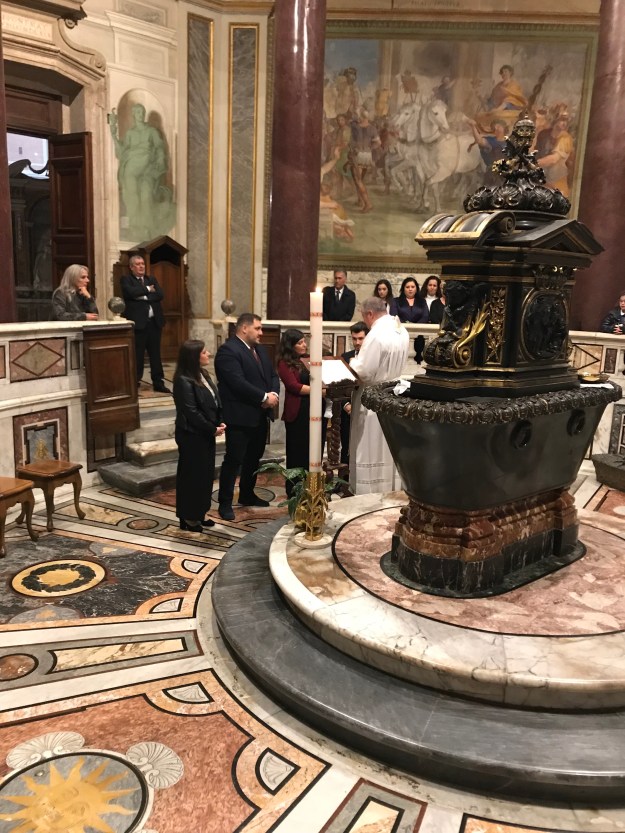
Yesterday some visitors and I visited the baptistery of Saint John Lateran in Rome, one of the oldest and important in Christianity. A baby, Tomasso, was being baptized where generations before hm became Christians. Suddenly, the old building came alive as visitors, some his family, some like us, looked on.

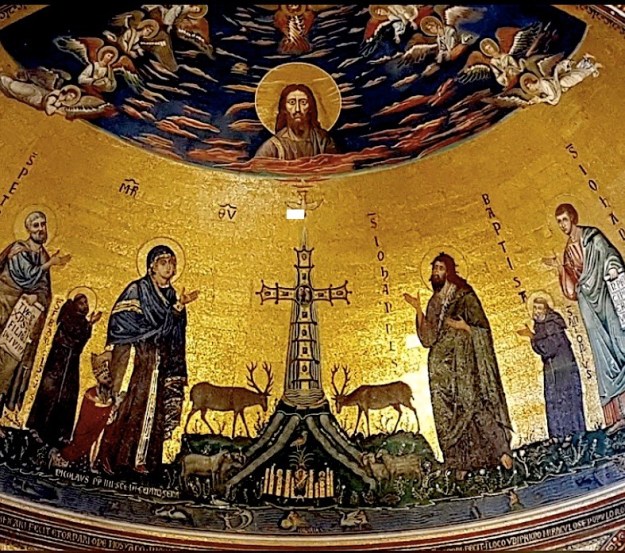
There’s a statue in the baptistery of a deer drinking from a fount of water. Deer are portrayed drinking water flowing from the cross in the mosaic in the apse the church.

In this morning’s morning prayer Psalm 42 began, “Like the deer that yearns for running streams, so my soul is yearning for you, my God.

Tomasso has a lifelong yearning for God and on a lifelong journey that will only be satisfied when he meets God:
“My soul is thirsting for you, my God,
When can I enter and see the face of God.”

His journey won’t be easy.”My tears have become my bread, by night and by day, as I hear it said all the day long, ‘Where is your God?’”

But “By day the Lord will send his loving kindness,
By night I will sing to him, the God of my life.”

So Tomasso and all of us:
”These things will I remember,
as I pour out my soul…
Why are you cast down, my soul,
Why groan within me?
Hope in God, I will praise him still,
My savior and my God.”

To Pray is to Hope

Prayer is more than looking for something, like a cure for sickness or getting a job., In prayer we search  for something we do not even understand. It’s a hope we have for something beyond anything we know, St.Augustine writes to Proba, a woman asking him about prayer.

“There is one thing I ask of the Lord. This I seek: to dwell in the house of the Lord for years to come. To gaze on the loveliness of the Lord…” The psalms express that hope..

We have an “instructed ignorance,” the saint says, and the Spirit of God helps us in our weakness.

“The Spirit pleads for the saints because he moves the saints to plead… to plead with sighs too deep for words by inspiring in them a desire for the great and as yet unknown reality that we look forward to with patience. How can words express what we desire when it remains unknown? If we were entirely ignorant of it we would not desire it; again, we would not desire it or seek it with sighs, if we were able to see it.”

Readings for the 30th Week of the Year: b


October 28th SUNDAY THIRTIETH SUNDAY IN ORDINARY TIME
Jer 31:7-9/Heb 5:1-6/Mk 10:46-52 (149)

29 Monday
Eph 4:32—5:8/Lk 13:10-17 (479)

30 Tuesday
Eph 5:21-33 (480) or 5:2a, 25-32 (122)/Lk 13:18-21 (480)

31 Wednesday
Eph 6:1-9/Lk 13:22-30 (481)

November 1 Thursday ALL SAINTS
Solemnity [Holyday of Obligation]
Rv 7:2-4, 9-14/1 Jn 3:1-3/Mt 5:1-12a (667)

2 Friday The Commemoration of All the Faithful Departed (All Souls’ Day)
Wis 3:1-9/Rom 5:5-11 or Rom 6:3-9/Jn 6:37-40

3 Saturday
[Saint Martin de Porres, Religious; BVM]
Phil 1:18b-26/Lk 14:1, 7-11 (484)