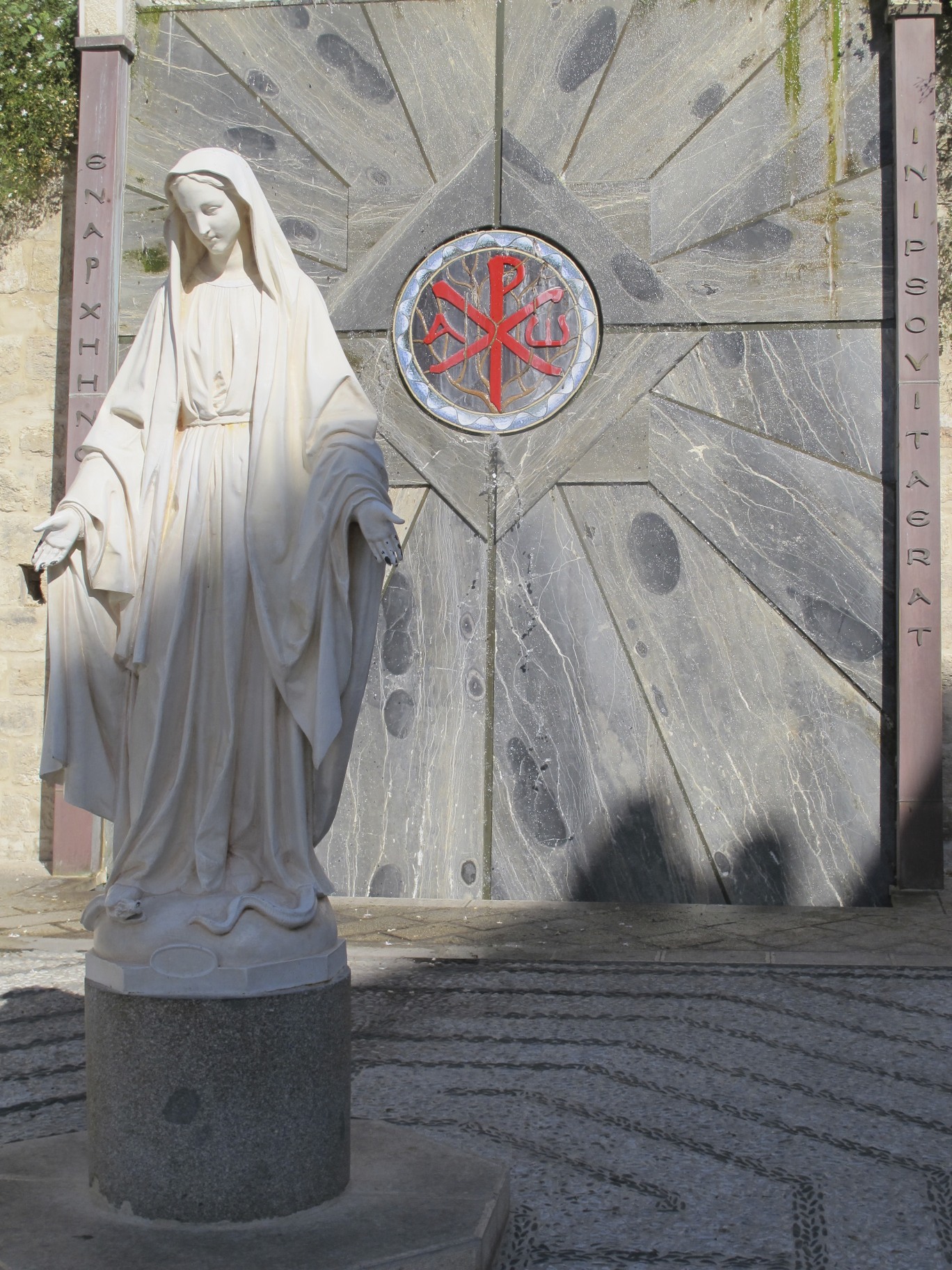
We tend to see the mystery of the Immaculate Conception, which says that Mary was preserved from original sin from conception, as a gift just for her and not affecting us at all, a gift that makes her unlike us.
St. Anselm, the 12th century monk, later archbishop of Canterbury, sees it differently. Mary shows us what being human and being part of God’s creation was meant to be. She’s the first to be blessed by Jesus Christ, her son. All of us, yes creation itself, benefit from the gift:
“Blessed Lady, sky and stars, earth and rivers, day and night – everything that is subject to our power or use – rejoice that through you they are in some sense restored to their lost beauty and are endowed with inexpressible new grace. All creatures were dead, as it were, useless to us or for the praise of God, who made them. The world, contrary to its true destiny, was corrupted and tainted by human acts of idolatry. Now all creation has been restored to life and rejoices.
“The universe rejoices with new and indefinable loveliness. Not only does it feel the unseen presence of God, its Creator, it sees God openly, working and making it holy. These great blessings spring from the blessed fruit of Mary’s womb.
“Through the fullness of the grace given you, dead things rejoice in their freedom, and those in heaven are glad to be made new. Through the Son who was the glorious fruit of your virgin womb, just souls who died before his life-giving death rejoice as they are freed from captivity, and the angels are glad at the restoration of their shattered domain.
“Lady, full and overflowing with grace, all creation receives new life from your abundance. Virgin, blessed above all creatures, through your blessing all creation is blessed, not only creation from its Creator, but the Creator himself has been blessed by creation.”
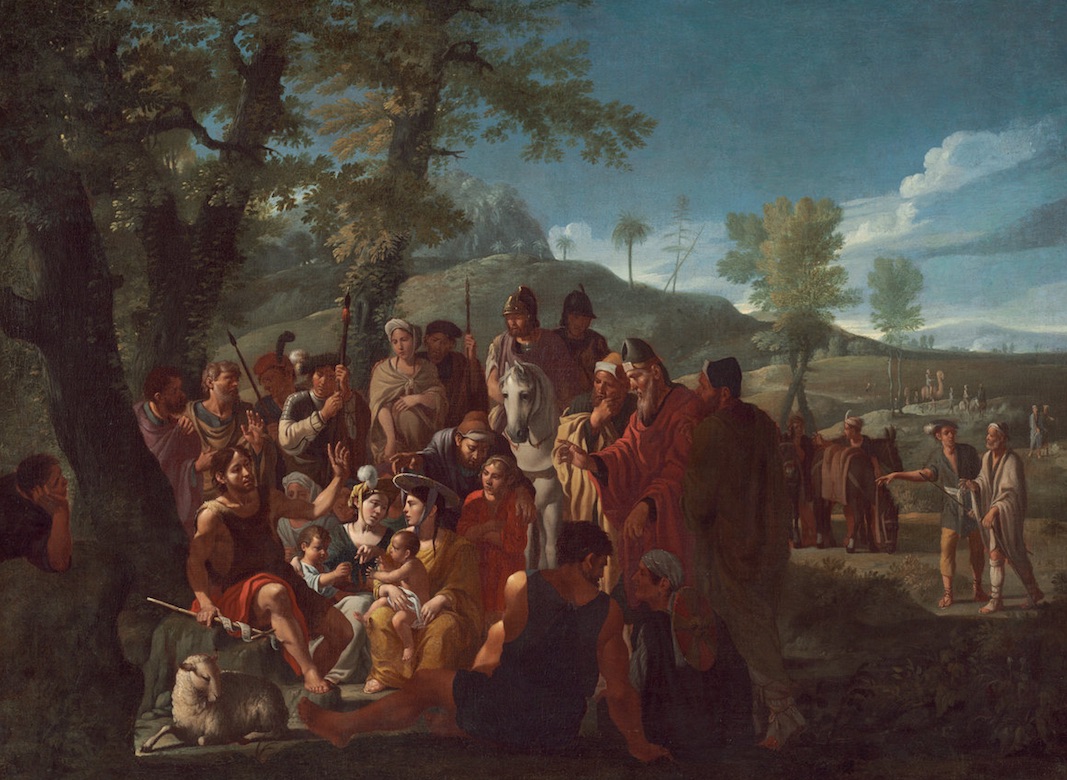
Come to God’s holy mountain,, Isaiah, the prophet of Advent says, guides will show the way. “Behold, I send my messenger ahead of you, to prepare your way.” Mark 1, 1. John the Baptist appears in the desert promising forgiveness to those washing in the waters of the Jordan River.
The waters of Jordan prepare for the waters of baptism. Let’s bless ourselves with water, when we can.
The Old Testament readings this 2nd week of Advent, mostly from Isaiah, describe a desert journey, but the desert blooms and a highway will be there. (Monday) God will speak tender, comforting words to his people on the way. (Tuesday) Those who hope in him will renew their strength, soaring on eagle’s wings. (Wednesday) Though we are as insignificant as a worm, God holds us in his hands and says:“Fear not; I am with you.” (Thursday) God is our teacher and shows us the way to go. (Friday) On the way, prophets like Elijah accompany us. (Saturday)
Jesus is our way, our heavenly guide,the weekday gospel readings say. He healed and forgave the paralyzed man– symbol of a paralyzed humanity– who was lowered through the roof into the house in Capernaum. (Monday) Like a good shepherd he searches for and finds the stray sheep. (Tuesday) “Come to me all who are weary, ” he says. (Wednesday) He sends us prophets and guides like John the Baptist and Elijah.( Thursday) Though rejected like John the Baptist, Jesus still teaches. (Friday)
He will save us, even though unrecognized like John and Elijah. (Saturday)
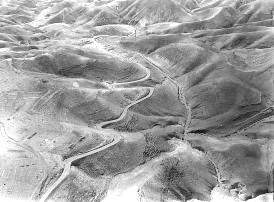
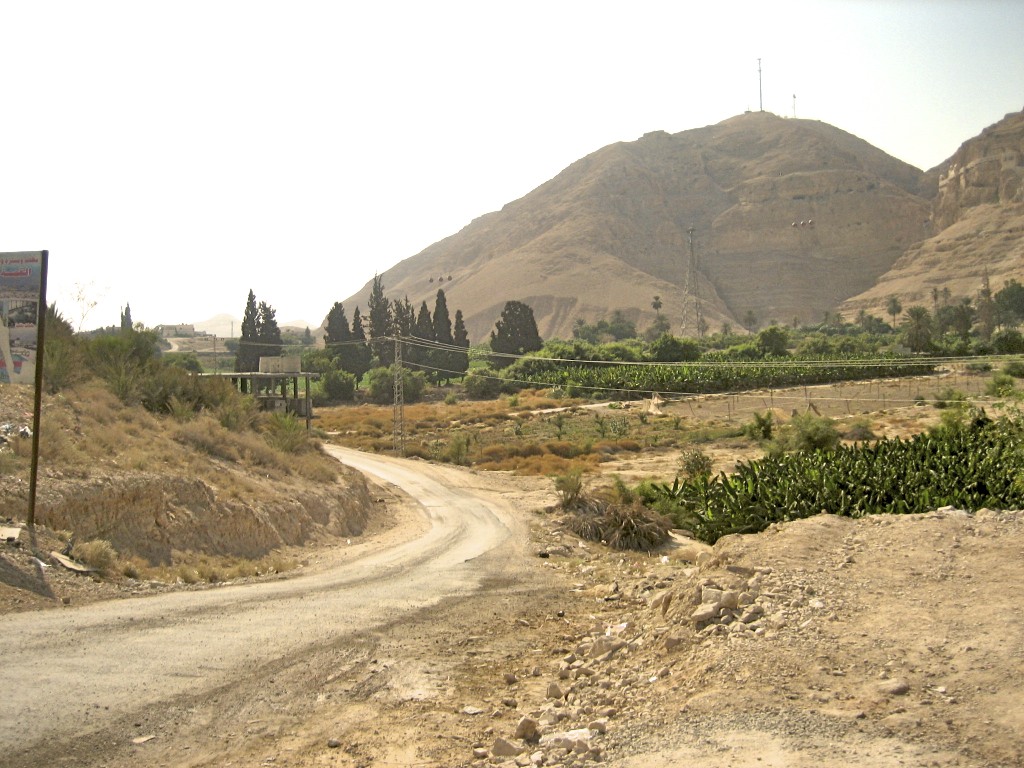
In the time of Jesus pilgrims from Galilee came up to Jerusalem a number of ways. Many came down the Jordan Valley, a journey of 90 miles. When they reached the city of Jericho they turned eastward onto a steep, winding road that ascended for 3500 feet and 15 miles to the city of Jerusalem. A picture taken from an airplane in the 1930s shows that winding, climbing road through the desert. It had to be the hardest part of their journey.
Now travelers go that route in air-conditioned buses. It took ancient travelers four days. Not it’s a few hours.
The bible sees the journey to Jerusalem, especially the last part up that steep winding desert road as a symbol of our journey to God. We’re pilgrims on our way, The way’s still hard, even with air-conditioned buses.
John the Baptist preached where that winding, climbing road began. His father, Zachariah, a priest in the temple in Jerusalem, told him at his birth: “You, my child shall be called a prophet of the most high, for you will go before the Lord to prepare his way.” (Luke 1)
John invited weary pilgrims into the refreshing waters of the Jordan river, that they might be strengthened for the journey.
Last week readings warned about falling asleep through complacency and laziness. This week readings remind us the day by day journey can tire us, Life can wear us out, even a life doing good.
Then, unexpected things, like sickness, failures and disappointments, come along, robbing our energy. The parable of the Good Samaritan happened on this road to Jerusalem. Unexpected things happen.
John the Baptist, and the Prophet Isaiah before him, spoke to weary pilgrims. “‘Comfort, give comfort to my people,’ says the Lord…They spoke words of hope to those on the way:
With God’s help, the winding, climbing, wearying road becomes a highway; every valley filled in, every mountain and hill made low, the rugged land made plain, the crooked way straight.
The Lord is ” a shepherd feeding his flock, in his arms he gathers the lambs, carrying them in his bosom and leading the ewes with care.” (Isaiah 40: 1-5,9-11) So don’t be afraid.
Advent is a beautiful season. “Go up with joy to the house of the Lord.”
One of my most beloved Psalms (Ps. 84) , speaks of the joy of going to the Temple of the Lord, because He is present there. The second stanza reads: “Blessed are those who find refuge in You,/ in their hearts are pilgrim roads./ as they pass through the Baca Valley , they find spring water to drink./ The early rain covers it with blessings./ They will go from strength to strength and see God in Zion.”
Over the last few weeks the Responsorial Psalms have also expressed this feeling of almost unbound happiness. Psalm 98 sings : “The Lord comes to rule the earth with justice./ Sing praise to the Lord with the harp,/ with the harp and melodious song/ with trumpets and the sound of the horn./ Sing joyfully before the King, the LORD.”
On the feast of Christ the King, and on the First Sunday of Advent we read psalm 122: “I rejoiced because they said to me,/ ‘we will go up to the house of the Lord.’/ And now we have set foot/ within your gates, O Jerusalem./ Jerusalem, built as a city/ with compact unity. To it the tribes go up, / the tribes of the LORD.”
On the first day of our pilgrimage in Jerusalem, I was already drained, both mentally and physically, by the middle of the day. We had started by walking a long distance from the Jaffa Gate of the old walled city, to the Church of the Holy Sepulcher. The experiences at the sites of Golgotha and the Tomb of Jesus had been long and intense, with no chance to sit down. We walked an even longer distance to St. Stephen’s Gate (where this saint was martyred), picked up our olive-wood crosses and trudged all the way back uphill to the Holy Sepulcher, through heavily crowded alleyways, with shops of all kinds, and dozens of pilgrim groups competing for prayer space at each Station of the Cross.
By the time we got to the last Station, under a hot sun, I could not even make out the words of the priest. My feet were going into cramps; so was my back. I even dared to pray, “Beloved Lord, is this what You mean by my sharing in Your sufferings?”
I was ready to go back to the hotel and put my jet-lagged body to sleep, when our guide told us that we were to walk to the Western Wall, in the Jewish Quarter, on the opposite corner of the Old City, where the bus would then pick us up. So we dragged our feet through more winding alleyways and markets, until we got to the line at the tunnel where the entrance and the security checkpoint was located. This was not easy for me, but on my last trip to the Holy Land I never had a chance to visit this great space, where people worship at the huge wall that is all that remains of the ancient, sacred Jewish Temple. So, even though I could hardly keep my body moving, I was not about to miss this chance.
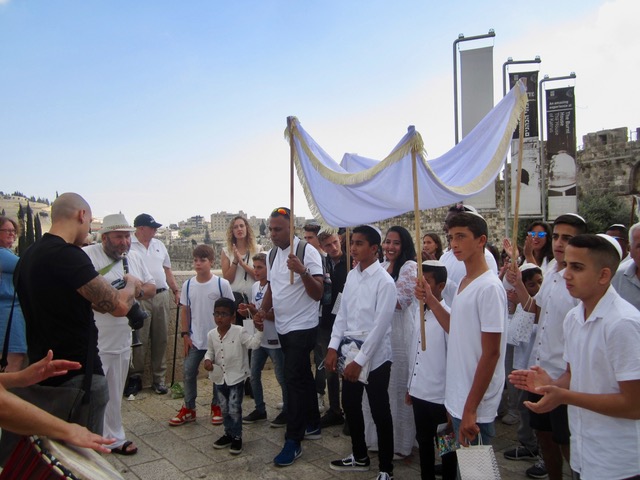
We emerged from the large tunnel and found ourselves in a vast open area, so large that the people in the huge multitude had decent space to move about. And move about they did. The activity, the energy within the place was contagious and my fatigue suddenly disappeared. The high and wide retaining wall of the elevated Temple Mount loomed before us. I had expected a quiet, solemn, environment ( the “Wailing” Wall), filled with morose, bearded old men clad in black, rocking in quiet prayer.
Instead, the atmosphere felt more like that of a Rock-n-roll festival. Most of the people were in their 40’s or younger. Most of them were dressed in white, or light colors, wearing shining white yarmulkes. There were teenagers all over the place.
I went to the sprawling men’s side, making my way to the Wall. A sort of palisade separated this area from the women’s side. Every foot of the palisade was taken up by women and girls, who had climbed up and were waving, cheering, and calling out what I later realized were names. Cloth canopies held by four poles at each corner moved throughout the crowd. There were men all over, singing, or playing trumpets, shofars, drums, clarinets, and saxophones, which could scarcely be heard in the din all around. I was suddenly struck by the Holy Spirit that rained invisibly and powerfully upon this holy place and all of us.The feeling was overwhelming. I shook my head. I laughed. I sang. I felt like a kid!
I finally made it to the huge stones of the limestone wall, but every time I was about to approach and slip my little paper (full of prayers for so many people) in the space between two stones, a young teenager would slip in front of me and begin to pray and move vigorously at the spot. I finally got a place to pray, and pray I did. Wow!
Singing to myself the songs from my prayer group, I wound my way back to the meeting place of our group, and when I looked at the beaming faces of my fellow pilgrims I was reminded of another Psalm.Psalm 126: “ When the Lord restored the captives of Zion,/ we thought we were dreaming./ Then our mouths were filled with laughter;/ our tongues sang for joy./ Then it was said among the nations,/ the Lord has done great things for them.” (vv: 1-2) We who had been so tired left the place as if dancing…..I love You. I love You, Holy Spirit, God of Light and Joy!
I approached our rather curt guide and asked him what was going on. He answered, “ Bar-mitzva Day. Thursdays they come to celebrate Bar-mitzva.” I realized the place had been filled by families that were welcoming their young men into their community of the People of God. We had been in the middle of a feast.
Then, as we crossed the bridge over the excavations of the ruins of the “City of David” (yes, the one in the Second Book of Samuel), we encountered family after family coming into the area. Musical instruments played. Mothers walked proudly. Fathers and sons held up the poles. Under each canopy a young man walked with his head up high. These boys looked like young Davids, young warriors (which in a few years they would become, as they were enrolled in military duty). I wished them well. I prayed for them.
Psalm 122 ends like this: “ Pray for the peace of Jerusalem!/ May those who love you prosper!/ May peace be within your walls,/ prosperity in your buildings/ because of my brothers and friends/ I will say, “Peace be within you!’/ Because of the house of the Lord, our God, / I will pray for your good.”
In the Old Testament readings, the Prophet Isaiah speaks as a fierce Assyrian army heads towards Jerusalem. Bad times ahead, but the prophet sees something else. All nations are streaming to God’s mountain.
The nations will come to God’s mountain, Jerusalem, where the temple stands, the prophet says. They’ll be fed a rich banquet (Wednesday), the poor will triumph (Thursday), the blind will see (Friday). Safe on this rock, children play around the cobra’s den, and the lion and the lamb lie down together (Tuesday). The prophet challenges us to see our world in another way.
In the gospels Jesus Christ fulfills the Isaian prophecies. The Roman centurion, humbly approaching Jesus in Capernaum, represents all nations approaching him. (Monday) Jesus praises the childlike; they will enter the kingdom of heaven.(Tuesday) He feeds a multitude on the mountain.(Wednesday) His kingdom is built on rock.(Thursday) He gives sight to the blind to find their way. (Friday)
Many Advent readings in these early weeks of Advent are from the gospel of Matthew, who portrays Jesus teaching on a mountain (Isaiah’s favorite symbol). His miracles affect all. Jesus is the new temple, the Presence of God, Emmanuel, God with us. He brings hope beyond human hope.
 The Victor's Place