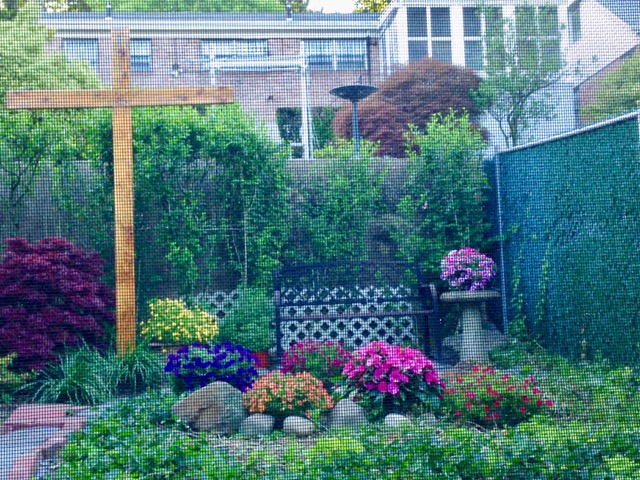
Rich Soil


 The Gospel (Mat 13: 1-23)  for the 15th Sunday in Ordinary Time can be reflected upon in so many ways. There is always something new that a seeker can find in it, if it is the Will of the Sower.    

 We have a small space behind our house. Almost half of it was covered by these tall evergreen bushes that took up so much room. Finally, we convinced ourselves to have them cut. It really hurt. What was left behind looked like part of an abandoned lot, a wasteland, horrible. During this spring of confinement, my wife and I decided to come up with some sort of garden in this backyard. We tried to help the English ivy to come back and cover some of the space. We placed in the middle a bunch of little flowering plants from the grocery store. It was an improvement, but oh, what back-breaking work! There were few rocks there, but these stumps and thick roots made it almost impossible to plant anything new. And the weeds! Some were painfully thorny and hard to remove. The others would spring right back, and in three days they were once more choking the ivy and attacking the flowers. Boy, was it frustrating.   

 Time and again, this situation would remind me of Jesus’ parable of the sower. Farming, and even gardening, are about so much more than just planting. Making that soil receptive is such a challenge. Suddenly, this experience and this parable made me think about the “most important thing” we do as Christians, which is to pray. Our Lord is constantly inviting us to be with Him in prayer. When you believe in Him, His promptings, what St. Paul of the Cross calls “love darts,” fall upon the soil of our hearts like gentle dew, sacred “manna”, seeds that can germinate into the most wondrous moments of intimacy with the Word of God. 

   However, we have all these impediments: “No, no, I don’t have the time. Gotta do this, gotta do that!” And when we finally find the time, all these weeds and stones get in the way: body aches, itchiness, sleepiness, noisy lawn mowers, some young person blasting “ Raggeton”  rap from his car parked out front, and so on. Then, when there is relative comfort and silence outside, there is the noise inside, what Fr. Ignacio Larrañaga calls “this mass of unruly thoughts” choking up our concentration on our God. Then, sometimes, there is that sense of guilt, that sense of unworthiness. It is so easy to just give up, stand up, and walk away from that moment of prayer that just a few moments before we were craving so much.   

 Fortunately, we must not forget Who is the One that longs the most for that encounter. He is the One that gently, somehow, clears our eyes and ears of faith so we can “see and hear.” The ruined, weed-covered yard turns into a fruitful garden, an image of that original Garden of intimacy with the Beloved. He helps us to remove the stumps, the weeds, the thorns, to turn the hard earth. He works with us to create that fruitful place, a soul that longs each day to be more and more like Him. Then we can begin to try, and carry out our Christian mission.

As my friend Matthew, who leads our virtual meetings, says : “Without prayer you can’t do anything.”      Every once in a while I would like to share my favorite prayers with you, dear readers.  These “prayers” are actually promptings, from the writings of very holy people who have helped me to clear out those weeds and be with God.     Enjoy this challenging summer as best as you can, with the help of our God. I hope you appreciate and smell the flowers.  Pray, pray, pray!
Orlando Hernández

Mother of Holy Hope

The Passionists have always honored Mary, the Mother of Jesus, under the title of Mother of Holy. It was a devotion promoted in a special way by the great missionary, Father Thomas Struzzieri, who later became a bishop. He carried a picture of our Mother of Holy Hope with him on missions. This picture was reproduced in the community as a reminder of Mary’s assistance in our spiritual needs.

 The Blessed Virgin is a model and support of our hope. She remains so. Her feast is celebrated by the community on July 9th.

 “One title that belongs rightly to Mary is that of Mother of Holy Hope.  Hope is that virtue that anchors the ship of our soul in the stormy sea of this troubled world. It is a comfort left to us after the fall of Adam, a support in our weakness encouraging us to practice all the virtues.

 Theologians say hope is a virtue planted in us by God enabling us to confidently expect eternal life and all that leads to it. Since Mary was hopeful to an heroic degree, she is appropriately called Mother of Holy Hope.

Though endowed with extraordinary graces and unstained by original sin, Mary never counted on any resource of her own. Rather, she knew God is the author of every good thing and the source of everything. She confided in God fleeing from persecution from her own country. She hoped in God even when she saw her divine Son die on cross and his disciples left him.

She stayed firm in what seemed like disaster, and strengthened those discouraged who turned to her as to a mother. She encouraged the weak, lifted up the fallen and urged the strong to ever greater trust.

We must not think Mary is not our mother now.  No! Even now, enthroned in glory, she reaches with a mother’s hand to those who go to her. She is always a mother of holy hope.”

Blessed Dominic Barberi. CP

Lord God,

you have given us the Blessed Virgin Mary as mother of our hope.

Under her protection,

may we pass through this uncertain world with our hopes fixed on heaven

and so enter into your kingdom.

We ask this through our Lord Jesus Christ, your Son, who lives and reigns with you and the Holy Spirit, one God, for ever and ever.

Hail Mary, Mother of Hope

“Blessed are you, 0 Mary, because you trusted that the Lord’s

words to you would be fulfilled.” (Lk 1:45)

The Hail Mary, a favorite Catholic prayer, is a good prayer for today because it nourishes something we need now– hope

It’s found in its earliest form in medieval times. Christians approached Mary, the mother of Jesus, with only the Angel Gabriel’s greeting to her at Nazareth, from St. Luke’s gospel:

Hail Mary, full of grace, the Lord is with you.

Over time, the greeting of her cousin Elizabeth, also in St. Luke’s gospel, was added:

Blessed are you among women and blessed is the fruit of your womb. (Luke 1:28-42)

Finally, in the 15th century, the remainder of the prayer appears:

Holy Mary, Mother of God,

pray for us sinners,

now, and at the hour of our death. Amen.

God’s favor rests on you, Mary, the angel said. God’s favor promised her a part in a great mystery and Mary trusted God’s word to her would be fulfilled. She brought God’s Son into the world and witnessed his life, death and resurrection. She kept the joys, sorrows and glories of those mysteries in her heart. She makes them known to us now. 

Mother of Jesus, Mother of God, she is our mother too. We share her with the disciple who received her as mother on Calvary when Jesus said: “Behold, your mother.” (John 19: 25-27) She who brought the needs of a newly married couple at Cana in Galilee to Jesus then, brings our cares to him now.

Our cares small and great. “They have no wine,” she told Jesus at Cana in Galilee, and a young couple was quietly saved from embarrassment. (John 2:1-12)  “How can this be?”, she asked the angel who invited her to be the mother of Jesus. Only slowly were the great mysteries of God, the Father and Creator, revealed to her. Now, she helps us know these mysteries and to trust in the promises they bring.

The Rosary, a prayer going back to the 16th century, is a “School of Mary”. It begins with the Apostles’ Creed: “I believe in God, the Father Almighty, Creator of heaven and earth.” Each decade of the Rosary starts with the Our Father, a prayer Jesus taught his disciples. As the decades are prayed, the mysteries of Jesus life, death and resurrection are recalled. A good  prayer for our time.

“How can this be?” was Mary’s question to the angel. It was not a question answered quickly, for she was only told so much. She was to believe in God, Creator of heaven and earth, and the overshadowing Spirit. “Be it done to me according to your word,” was her answer.

Then, “the angel left her”, with no timetable, no detailed plan, no glimpse into what was to come. So much of the future was unknown to her. She was called to believe in God, Creator of all that’s good and the Spirit always at work. She trusted that the Lord’s words to her would be fulfilled.

We’re facing an unknown future today, in this worldwide pandemic, aren’t we? What will life be? What’s the world going to be ? 

Our situation now, full of questions and with few answers, may not be far from hers then. Mary teaches us to believe and to trust.  “Pray for us, O Holy Mother of God, that we may be made worthy of the promises of Christ.”

Today, the Passionists celebrate the Feast of Mary, Mother of Holy Hope.

Father, Creator of heaven and earth,

may we who honor the Mother of our hope 

come to share with her

the blessings that are our hope.

Through Christ our Lord.

Learning in Bad Times

I find myself turning away from the news on television these days. I don’t think I’m the only one. The pandemic only seems to be getting worse, and we’re getting worse with it.

So we turn to the Good News.

I’m finding the Gospel of Matthew, which we’re reading these weekdays and on Sundays, helpful. It was written for people struggling with bad times.

The bad times were around the year AD 90 when the followers of Jesus in Galilee were reeling from the attacks of a resurgent Judaism. Those attacks are described in Chapters 10-12 of Matthew’s gospel.

Instead of closing their eyes and hanging on tight, Jesus tells his disciples to open their eyes and their ears, because there’s something for them to learn. “Blessed are your eyes, because they see and your ears because they hear. Many prophets and righteous people longed to see what you see but did not see it and hear what you hear and did not hear it”  (Matthew 13:16-17). He says that as he teaches them in parables.

Bad times can be the best times to learn. Some of the best things we know; some of the best insights we have;  some of the most creative thoughts may come in bad times. God doesn’t stop speaking or teaching in bad times; God sows seeds and opens new avenues. New treasures, new pearls are there to be discovered in the ground we walk over and the jumble of things that seem to overwhelm us.

We will be reading soon the parables of the treasure hidden in the field and the pearl of great price and the net that pulls up a bewildering variety of things from the sea.  It’s a message continued in the mystery of the Passion of Jesus. The disciples saw only death and failure there at first, but then they saw treasures in the wounds, the blood and water that flowed from his side, the words he said.

We don’t have to turn away from bad times. They’re times to keep your eyes and ears open, Jesus says. Like his first disciples, we should pray, not for blinders, but for “understanding hearts.”

14th Sunday a: Come to Me


For this week’s homily, please watch the video below.

Your Kingdom come on earth

The wise St. Teresa of Avila says, “We’re people who don’t feel rich until we feel the money in our pocket.” So, we have to pray, “Your kingdom come… on earth.”

We’re earthy people with our feet on the ground, today’s ground. We find it hard to pray: “Give us whatever is good for us.” We find it hard to grasp that God’s kingdom is coming with blessings far beyond what we ask for.

We’re earthy people. We find the prayer of Jesus in the garden hard to imitate: “Not my will, but yours be done.”

“But you know us, my Lord, and you know that we have not given ourselves up to the will of your Father as completely as you did. For us, it is best to pray for specific things…or else we won’t accept what God chooses to give us (even if it is far better than what we asked for) because it’s not exactly what we asked for.”

So we pray that God’s kingdom come “on earth” –for my cousin’s friend who’s paralyzed, for Dennis, Joan, Camille, Mary, and Betty who lost their jobs, for the disturbed woman who visits our garden, for our President and our country, for Vincent in the hospital.” Our prayer is about “specific things” because we live our lives in them; we only know through what we see and feel and experience.

And so, “the good Jesus places these two petitions – Hallowed be thy name and Thy kingdom come next to each other, so that we can understand what we are asking for and why it is important to beg for it and to do all we can to please the one who is able to give it to us.”

The petitions lead us to the prayer of Jesus, “your will be done.”

A wise woman, St. Teresa. No wonder she’s a Doctor of the Church. (The Way of Perfection)

13th Sunday of the Year: a – Life’s a Gift

For this week’s homily please watch the video below.

An Immense Sea

View_of_Cliffs_of_Moher
Cliffs of Moher, Ireland

Did St. Gregory of Nyssa ever stand at a place like this? He must have:

“The feelings that come as one stands on a high mountain peak and looks down onto some immense sea are the same feelings that come to me when I look out from the high mountain peak of the Lord’s words into the incomprehensible depths of his thoughts.

“When you look at mountains that stand next to the sea, you will often find that they seem to have been cut in half, so that on the side nearest the sea there is a sheer drop and something dropped from the summit will fall straight into the depths. Someone who looks down from such a peak will become dizzy, and so too I become dizzy when I look down from the high peak of these words of the Lord: Blessed are the pure in heart, for they shall see God.
“These words offer the sight of God to those whose hearts have been purified and purged. But look: St John says No-one has seen God. The Apostle Paul’s sublime mind goes further still: What no man has seen and no man can see. This is the slippery and crumbling rock that seems to give the mind no support in the heights. Even the teaching of Moses declared God to be a rock that was so inaccessible that our minds could not even approach it: No-one can see the Lord and live.
“To see God is to have eternal life – and yet the pillars of our faith, John and Paul and Moses, say that God cannot be seen. Can you understand the dizziness of a soul that contemplates their words? If God is life, whoever does not see God does not see life. If the prophets and the Apostle, inspired by the Holy Spirit, attest that God cannot be seen, does this not wreck all the hopes of man?
 “It is the Lord who sustains our floundering hope, just as he sustained Peter when he was floundering in the water, and made the waters firm beneath his feet. If the hand of the Word stretches out to us as well, and sets us firm in a new understanding when these speculations have made us lose our balance, we shall be safe from fear, held safe in the guiding hand of the Word. Blessed, he says, are those who possess a pure heart, for they shall see God.”

Conversion

Conversion

I would like to spend the day on the slope

of a mountain, listening to a parable

about a lost sheep or a blighted vineyard

For months my only companion would be this story

and the more I told it to myself

the clearer everything would become

Then, I would remove my helmet of opinion

and walk into the public streets

revealing the soft brown mushroom of my new head

I would repeat the story to small groups of men

drawing illustrations in the sand with a stick.

I would leave them murmuring in a circle.

And late at night when the cold wind found

the chinks in my house 

and disturbed the candle stub next to my bed.

I would hear the story told by the tongues of flame

and watch the shadows of my former self

flicker on the low ceiling and the walls of stone.

Billly Collins

 “The Art of Drowning”

Readings for the 10th Week in Ordinary Time

7 SUN THE MOST HOLY TRINITY (Solemnity)
Ex 34:4b-6, 8-9/2 Cor 13:11-13/Jn 3:16-18

8 Mon Weekday
1 Kgs 17:1-6/Mt 5:1-12 

9 Tue Weekday [Saint Ephrem, Deacon and Doctor of the Church]
1 Kgs 17:7-16/Mt 5:13-16

10 Wed Weekday
1 Kgs 18:20-39/Mt 5:17-19

11 Thu Saint Barnabas, Apostle (Memorial)
Acts 11:21b-26; 13:1-3/Mt 5:20-26

12 Fri Weekday
1 Kgs 19:9a, 11-16/Mt 5:27-32

13 Sat Saint Anthony of Padua, Priest and Doctor of the Church (Memorial)
1 Kgs 19:19-21/Mt 5:33-37 

14 SUN THE MOST HOLY BODY AND BLOOD OF CHRIST (Solemnity of Corpus Christi)
Dt 8:2-3, 14b-16a/1 Cor 10:16-17/Jn 6:51-58