A feast of an apostle makes us ask: How did the apostles do what they did, venture so far, weak as they were? St. John Chrysostom gives this answer for today’s feast of Bartholomew, the apostle.
“How could twelve uneducated men, who lived on lakes and rivers and wastelands, get the idea for such an immense enterprise? How could men who perhaps had never been in a city or a public square think of setting out to do battle with the whole world?
That they were fearful, timid men, the evangelist makes clear; he did not reject the fact or try to hide their weaknesses. Indeed he turned these into a proof of the truth. What did he say of them? That when Christ was arrested, the others fled, despite all the miracles they had seen, while he who was leader of the others denied him!
How then account for the fact that these men, who in Christ’s lifetime did not stand up to the attacks by the Jews, set forth to do battle with the whole world once Christ was dead – if, as you claim, Christ did not rise and speak to them and rouse their courage?
Did they perhaps say to themselves: “What is this? He could not save himself but he will protect us? He did not help himself when he was alive, but now that he is dead he will extend a helping hand to us? In his lifetime he brought no nation under his banner, but by uttering his name we will win over the whole world?”
Would it not be wholly irrational even to think such thoughts, much less to act upon them? It is evident, then, that if they had not seen him risen and had proof of his power, they would not have risked so much.”
Our liturgical calendar this week, like other weeks, takes us to distant times and places. On Monday it took us to 3rd century Rome for the martyrdom of Lawrence the Deacon; Tuesday to 13th century Assisi with St. Clare; Friday it takes us to a German concentration camp during the 2nd World War with Maximilian Kolbe, and Saturday to 1st century Jerusalem where Mary is assumed into heaven. The feasts of the saints take us continually to distant times and places.
Our scripture readings do it too. The Prophet Ezekiel, our first reading this week, takes us to Babylon where the Jews are trapped in exile. The gospel readings, of course, always take us to times and places of Jesus’ life, death and resurrection.
We’re reminded, I suppose, that God’s presence is “always and everywhere”. There’s no time or place when God is not present. There is no circumstance where God does not give life.
We give thanks for that in the Eucharist.
We need that perspective today especially when life seems stuck in the grips of a pandemic.
God who is present “always and everywhere” is with us now. Our prayers tell us that; we need to listen to them.
“Glory to the Father and to the Son and to the Holy Spirit. As it was in the beginning is now and will be forever. Amen.”
Little prayers are just that–the small, taken-for-granted prayers we pray all the time. Like “Amen.” How many times do we say that word in prayer? Usually we end all our prayers with it.
What does it mean? I suppose we could say it means “yes” in English. “Si” in Spanish or Italian. “Ya” in German. If you look it up in the dictionary, you find it traced back into the Greek and then to the Hebrew. Amen means “so be it”; a strong “yes,” and it’s been part of the language of our faith for centuries.
Here we are in the 21st century using a word generations before us have used; we draw on the faith of generations before us to say, “Yes, I believe,” “Amen” to God’s word to us and our word to God.
“The Lord be with you,” “And with your spirit.” Another little prayer, wishing that God be with us and bring us together in faith. We can trace that little prayer back generations too.
Little prayers can give us a way to express what we can hardly put into words or understand. Besides words, they can also be simple gestures, like the Sign of the Cross; they can be moments of listening or seeing and waiting in silent attention before God.
Psalm 123 describes a servant waiting and watching before her mistress.
“To you I lift up my eyes, you who dwell in the heavens. My eyes like the eyes of slaves On the hand of their lords. Like the eyes of a servant On the hand of her mistress, So our eyes are on the Lord our God Till he show us his mercy.”
Little prayers can be a cry or even tears. You often hear that kind of prayer in the psalms:
“I cried to you, Lord, and you heard me,” the psalmist says in Psalm 30.
Remember the simple cry of the Canaanite woman: “Have pity on me, Son of David…Please, Lord” (Matthew 15:21).
Little prayers are important, they’re not little at all.
Dear readers. I hope that you don’t mind that I try and share my “God experiences” with you. That’s what I do with my grandchildren when they ask me about God and prayer. They are each having a hard time with their faith, specially during these last few months. So I share stories like these with them.
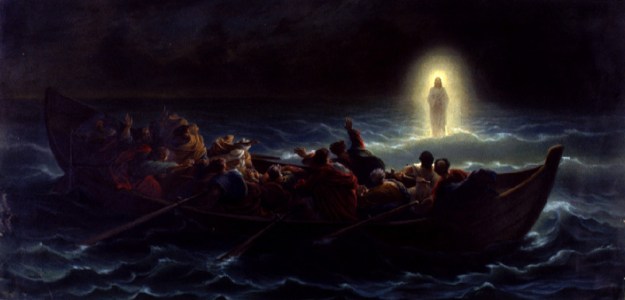
The Gospel for the Nineteenth Sunday in Ordinary Time (Matthew 14:22-33) recounts the powerful story of Jesus walking on the water to rescue His disciples. On August 3rd, 2020, on this blog, Gloria M. Chang wrote a wonderful reflection on this Gospel. I was especially impressed by the beautiful painting she showed us: “Jesus Walking on the Sea,” by Amedee Varin.
I had never realized that between the hours of 3:00AM and 6:00AM (“the fourth watch”) the Apostles on that boat must have been rowing and bailing water in total darkness. The painting portrays Jesus as a nebulous, luminous figure in the distance across the waves, the only source of light, defining everything in the picture.
He looks a little scary to me, indeed like a ghost. The “terrified” Apostles really needed to hear those words from our Lord: “Take courage; it is I; do not be afraid.” Don’t we all? But Peter was still not sure: “Lord IF it is You…..” Many years later this wonderful saint would write, “we possess the prophetic message that is altogether reliable. You will do well to be attentive to it, as to a lamp shining in a dark place…”
My most powerful, pivotal experiences of Jesus have always reminded me of this Gospel story and this passage in 2Peter. That blessed day I first believed in Him, I saw Him in as a blinding light radiating from a risen host during a Catholic Mass. I had to close my eyes, and, nobody can convince me otherwise, I saw Him in the turbulent darkness of my tormented mind, looking a lot like His depiction in the painting by Varin. I did not know Him like Peter did, so I could not help but to keep my mouth shut as He got closer and I felt Him saying, “I love you; you’re Mine. I will never let you go.”
A few years later, during a Life In The Spirit Seminar, that distant, ghostly light came to me once again in a most powerful way. About 300 people were assembled in a school cafeteria/gym. The presenter had the lights turned off, and the many assistants started to pray over us in tongues. The young guy in the music ministry played eerie, dissonant notes, on his electric guitar. The presenter asked us to close our eyes and imagine, in the darkness, a distant shining light that that became larger and larger as it came closer to each one of us. He told us, “This is Jesus, our Lord, let Him in.” The light became extremely bright, and there, on the tiled floor(in my mind’s eye?), I saw Jesus kneeling almost naked before me. He had all the wounds of His Passion. He was so bloody, and there was such sorrow in his eyes as He stared straight at me. My heart was broken. He raised His arms in my direction. I held Him and tried to help Him up, but He embraced me right back and sprung up. There was such love in His piercing eyes as He raised me up, up, up, into the Heavenly arms of His Father. The lights in the place were suddenly back on, and there I was, dazed and tearful, standing somewhere in the meeting hall. Wow!
I have never had any other experiences quite like these two, but when I suffer from insomnia at 3;00AM in my bed, I look for Him in the darkness and turbulence of my worries. I feel that My Lord eventually comes and helps me to fall asleep, patiently teaching me once again to slowly pray the Our Father with Him. I truly believe that He does that for all of us.
The prayer meeting, the Liturgy, the verbal prayer, the meditation, the beauty of nature, are vehicles that lead us across the waters of our mind in search of God, but in the end, I believe that the Lord is the One who draws us, beyond all those wonderful experiences, into a one-to-one, intimate encounter. As Christians, this is what we always yearn and strive for. It certainly does not happen to me all the time, but I keep on trying. In the meantime, it is the faith that God has lovingly given me that keeps me rowing in the dark.
My 21-year old grandson tells me sadly that he still prays every night, “just in case God is real,” hoping to find again that feeling that he had when he was little. I encourage him to keep on trying. God is always with him, even if he does not sense Him. One of these nights he might just get a big, wonderful, awesome surprise!
Beloved Lord. Please help all those who seek you in the dark. Be their light!
Praying the Hail Mary, we ask Mary the Mother of Jesus to lead us to God. The prayer’s earliest form developed in the middle ages with the simple greeting of the angel Gabriel at Nazareth, from St. Luke’s gospel:
Hail Mary, full of grace, the Lord is with you.
You are favored by God, the angel announces to her. She brought Jesus Christ into the world. That message continues through the ages and is reflected in us. Like her, we are favored by God and called to bring God’s Son into the world. God’s promise of grace to Mary echoes in God’s promise to us. As promised to Mary, God will be with us.
Over time her cousin Elizabeth’s greeting to Mary, also recorded in St. Luke, was added to the prayer: Blessed are you among women and blessed is the fruit of your womb.
Finally by the 15th century, the remainder of the prayer appeared: Holy Mary, mother of God, pray for us sinners now and at the hour of our death.
The prayer asks Mary, full of the grace of her Son, to intercede for us sinners now and at the hour of our death. She is a model for believers and she knows what it means to believe. She who knew her Son so well, can teach us the way to him.
On Calvary Jesus entrusted her to us as a mother when he said to his disciple “Behold your mother.” Ever since, she brings Christ into this world. She knew Jesus from the beginning and witnessed his life, death and resurrection. She helps us to know him. She also knows our needs. Aware of the needs of the newly married couple at Cana in Galilee, she approached Jesus, her Son. She is aware of our needs too.
By the end of the 16th century the practice of saying 150 Hail Marys in series or decades of 10 became popular among many ordinary Christians. Helped by her they remembered the life, death and resurrection of Jesus. That practice of prayer is known now as the Rosary.
Mary is a model of faith for Christians. When the angel Gabriel came to her, she believed the words he spoke even to the dark test of Calvary. She helps the family of believers on their journey to believe..
The Hail Mary and the Rosary are blessed prayers, simple and profound. They’re not beyond anyone’s reach; their repetition brings peace to the soul. They draw us into the joys, sorrows and glory of Jesus, the world Mary knows so well. We hope to “imitate what they contain and obtain what they promise, through Christ, Our Lord. Amen”
We will be celebrating the Feast of the Assumption of Mary this month..
The Gospel for the 18th Sunday in Ordinary Time (Mt 14: 13-21) recounts the story of how our Lord miraculously fed thousands of hungry people. Here are some thoughts on how this Gospel has FED me over the last few days. A friend pointed out that this Gospel illustrates how great God is and how little we are. We come to Him with almost nothing to offer and the Loving One does wonders with it, like He did with the mere five loaves and two fish that the disciples had.
We pray, we intercede for so many others. We express our concern, like the disciples did for all those hungry people. Often the answer to our prayer is similar to what our Lord says:“Give them some food yourselves.” We think we have so little to give, especially during this pandemic. The little bit of love, attention, or support that we can give to alleviate the spiritual hunger of others, even in a phone call, can be amplified a thousand-fold if we just give it with love and acknowledge that this Love is God Himself. An explosion of grace can suddenly take place.
This week we took a risk again, and we visited our 98 year old friend Alicia in her home. She has lost so many faculties, and grows weaker every week. She asks on the phone, “ I miss you; when can I see you, my beloved friends?” So we go and sit next to her and just listen to her thoughts and memories, some happy, some bitter. We play old romantic Latin songs that we bring in our iPod. And then we pray.
She usually initiates our God talk and praise. This week she was especially animated and happy to see us and just thanked God again and again, for this moment, for this extra day of life, for her family, for her faith, and most of all, for the love God has shown her.
Our luminous moment was interrupted by the social worker, who came in for his monthly interview. Alicia can hardly see or hear but she was very attentive to the questions that he gave her: “ How are you feeling?” Her answer: “ I feel only joy in the presence of my loving God,” ( no complaints about her physical problems). The second question was, “ How are you eating?” She just said, “fine”, so the social worker tried a different tack : “ What is the food that you enjoy the most?”
She struck us with the light of her answer: “ My favorite food is the constant heavenly Manna that my loving Father let’s fall upon me. I am so blessed!”
Wow! My wife and I, even the caretaker and the interviewer, felt something extremely special, and for a few seconds there was this bright silence in the room! Tears came to my eyes. I knew it was the power of the Holy Spirit, alive in the heart of this Godly woman. We had actually gone to her house reluctantly and afraid because of the virus, and here God multiplies our meager offering into a heavenly moment!
“ Give us this day our daily bread,” Jesus teaches us to pray, and to make this prayer come alive through service. That day we got a powerful dose of that Daily Bread of Life that our Lord loves to give us.
Yes, He provides us with food for our bodies and our souls. I wrote last time that I would share with you some of my favorite prayer-meditations. This year we are celebrating the 300th Anniversary of the founding of the Passionist Order by our patron, St. Paul of the Cross. Here is some of his advice on how to pray. It goes very well with the message of the Gospel we were reflecting upon. He writes:
“Let the immense Good rest in your soul. God in you and you in God. A divine work. I don’t know how to say it, but God feeds on your spirit and your spirit feeds on the Spirit of God. My food is Christ and I am His.” (Letter 752- 5/25/1751)
This prayer is short and simple, but sometimes I can spend over a half-hour in this delightful state. It is a wonderful “ spiritual communion prayer.” I am fascinated at the thought that God cares to actually taste me as my spirit dissolves into that vast, “immense Good”.
Even before I pray, I pray! I pray that I might feel just a little of what Psalm 131 expresses so beautifully:
“Lord, My heart is not proud; nor are my eyes haughty. I do



 The Victor's Place
