How Bad Can It Get

The Disciples’ Unbelief Charter

The gospel is supposed to be life at its best, but it also presents life at its worst. What’s worse than being a lamb among wolves? Than living with people who don’t support you and in fact hate you? Than having people beat you with whips? Than having your own brothers and sisters turn against you? Than having people throw you out of town?

Can it get worse than that? You’ll experience all these things, Jesus says in today’s gospel to the Twelve and those who go out with them.

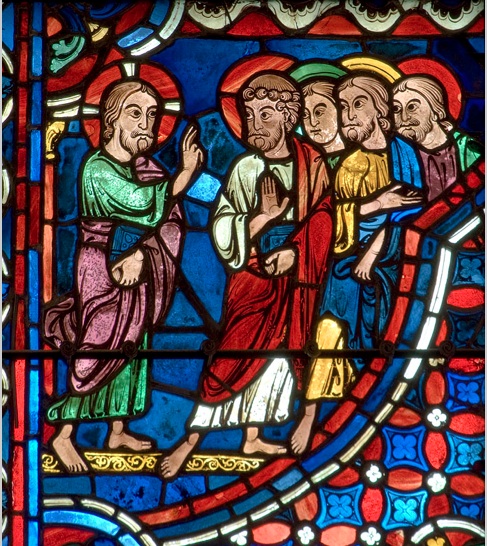
Today’s gospel from Matthew is part of the commissioning of disciples whom Jesus sends as heralds of the kingdom of heaven. They have power to “cure the sick, raise the dead, cleanse lepers and drive out demons.” Great powers. But that’s not all. They must exercise these powers in the real world.

We can’t forget we live in the real world that Jesus describes in today’s gospel. His way of living in this world is unique. He doesn’t send out armed divisions or powerful super salespeople, but vulnerable lambs. Yet, his lambs are stronger than wolves. Don’t be awed by governors and kings or crushed by adversity or rejection, Jesus says. Just listen to the “Spirit of your Father speaking in you,” and you’ll have wisdom enough.

Even if you’re thrown out of one town, another town waits for the coming of the Son of Man. The real world is not as strong as it seems.

We Are Sent

by Orlando Hernandez

The Gospels from Wednesday to Saturday of the 14th Week in Ordinary time all deal with Jesus’ words in the tenth chapter of Matthew’s Gospel. Our Lord instructs His Apostles on their Mission and what it entails. 


    In the previous chapter (Mt 9: 35-38) Jesus has been moved to pity for the people He has come to teach and heal. Even in our present time, as back then, his Heart is filled with sorrow and compassion for humanity because we seem so “troubled and abandoned, like sheep without a shepherd.” Are we to join Him in crying, “My God, my God, why have You abandoned me?” I would rather try to stand up straight and cry out, even in my moments of desolation: “Resurrected Divine One, I trust in You!”


    The Biblical Jesus must have accepted that this harvest of hungry souls was too much, even for Him. The Kingdom of love and salvation would require recruitment of more “laborers for the harvest” to help Him guide Humanity to Him. So in chapter 10, Jesus turns twelve of His disciples (Latin: “pupils”) into Apostles (Gk: “messengers,” “apo”: off, “stellein”: send), to be “sent off”, to teach His Message and help Him heal the world. They are listed each by name. We see that they are individual persons, imperfect human beings, like all of us. We can relate to them, try to imagine what each one of them was like, even now when we venerate them as Saints. Ready or not, Our Lord sent them off to their own people, to proclaim this “Kingdom of Heaven.”


    I always hope that I am a “disciple” of Christ, learning from Him, being with Him every day, but I just cannot dare to call myself “apostle.”   No, only priests, theologically trained preachers, healers and missionaries deserve this title. But, upon reading chapter 10, I feel as if Jesus is talking to me, inviting me to go out and bring this message of love and healing to the world, precisely at a moment when my discipleship is not going so well and my soul is in turmoil. I feel called to start, as always, with those nearest to me, family, friends, acquaintances, people I run into. What can I say to them? How can I become a living, talking Gospel? Is He really sending me? Is He grabbing me and shaking me out of my stupor, saying, “I need you NOW!”


    Over the last few days I have read a number of spiritual writers who in different ways seem to be saying that this Apostolic mission has been lovingly given to each one of us by God, as our true journey in life: “Before I formed you in the womb I knew you, before you were born I dedicated you, a prophet to the nations I appointed you “(Jer 1:5). It makes sense, when we see the incredible power of newborn babies to bring joy, gratitude, and healing to those around. The deep mystery of Love seems to emanate from them as they grow up around us. But eventually they seem to lose this gift as the roughness of life begins to hurt them more and more and they become “troubled and abandoned” like most of us. The laborers for the harvest become fewer and fewer.  


    But the Invitation is still there, whispering within us. For His own reasons, Our Lord blesses some of us with a louder calling. The gift and grace of this invitation is the luminous Presence of our God, Who gives us the unexpected wisdom and strength to attempt the things that Jesus demands of us: to proclaim Him, to go out into the road of life and bring healing and salvation to others, beginning with our very selves. Only in abundant prayerful contact with our Lord, knowing that He is always with us, can we gain the peaceful attitude to go out as “lambs among wolves,” or “as simple as doves” in a beautiful but often hostile world.  Only by following His example can we attain the humility and freedom to let go of so many luxuries and things that encumber us on our way. Only through Him can we become trusting and dependent on the kindness of other human beings as we “enter their house” and share our peace with them. It seems to me that only in the power of this Divine invitation to mutual understanding, compassion, and trust, can we begin to find healing and truly preach the Gospel to each other. 


    Not every one will be that “nice” to us. Again, only by prayer and constant reminder by our God that we are His beloved children, can we bear the dust of rejection, the scourge of hate, the mistrust of a wounded world, and not become discouraged, cynical, or indifferent in our quest for souls to love. That is our mission, to love, no matter what. Quietly, in trust and meekness, can we hear in the darkness the whisper of the Spirit, Who tells us “Do not be afraid.”, and infuses us with the desire and courage to proclaim, as if “on the rooftops”, before our oppressors, before the powerful and those oppressed and bitter, at the top of our lungs, that we are so intimately known by the Infinite Power Who loves us so much as to count every hair in our heads, every chemical reaction in every one of our cells, every hope or dream, shining or broken, within our souls. 


    How to begin?  We all have our ways; I am confident of that. As for myself, yesterday I did the best I could. It has been getting harder for me to feel comfortable with my grand children. They seem more detached, cynical, argumentative, and mistrustful of their elders (may God deliver me from judging!). But I know that I love them with a crazy love that fills me with gratitude. So my wife and I ( we go out “in pairs”) decided, even though we were not in our best moods, to take all four of them to the movies. It turned out fine. They did not fight or seem bored, and gave me a surprising amount of joy. On our way back to the car I got the urge to tell them: “Listen, I just paid for your movie and for your snacks, so you have to humor me. I’m gonna pray over each of you. Think really hard about something that is bothering you or hurting you, in your body, or in your heart.  Don’t tell us what it is; just think about it really hard. I will pray for God to free you from it. OK?


    So I went individually to each one of them, laid my hands on their shoulders, and reminded them of how much God loved them. I told them to feel that love and asked for the power of God to heal that problem or hurt, IN THE NAME OF JESUS. Later I asked each one of them if they had just been putting up with me or if they were really concentrating on the prayer. Each one, from the ten-year old to the seventeen-year old, seemed very serious when they remembered the moment and the thing they had been praying for. This is the first time I ever did something like this with them. Too little too late? Nothing is too little with God, nor is it ever too late. Blessed be Your Name, Beloved.
Life-giving Water

In his recent letter “Desiderio Desideravi” Pope Francis describes  the Eucharist, the sacraments and the liturgy as signs of the presence of Christ. They’re signs in which we encounter Christ, who came among us by becoming flesh, human flesh from the Virgin Mary, but also flesh from creation itself.

Water, for example,  is a sign from creation that Jesus uses to bring us into the mystery of his death and resurrection. At his baptism, he entered water with its power to cleanse and give life.

From the beginning, “God created water with Baptism in mind,” Pope Francis writes. Baptism is not “a mental adhesion to his thought or agreeing to a code of conduct imposed by him.” Rather, water is a holy sign that plunges us into the mystery of the Incarnation. Through the presence and action of the Spirit, it makes possible for us to die and rise with Christ. (12)

The prayer for the blessing of baptismal water reveals  that God created water precisely with Baptism in mind. This means that when God created water, he was thinking of the Baptism of each one of us, and this same thought accompanied him all throughout his acting in the history of salvation every time that, with precise intention, he used water for his saving work.

 It is as if after having created water in the first place, he had wanted to perfect it by making it eventually to be the water of Baptism. It was thus that he wanted to fill it with the movement of his Spirit hovering over the face of the waters (Ge 1:2) so that it could contain hidden within the power to sanctify. He used water to regenerate humanity through the flood (Ge 6:1-9,29). He controlled it, separating it to open the way of freedom through the Red Sea (cf. Ex 14). He consecrated it in the Jordan, plunging into it the flesh of the Word soaked in the Spirit. (cf. Ma 3:13-17; Mk 1:9-11; Lk 3:21-22) 

At the end he blended it with the blood of his Son, the gift of the Spirit inseparably united with the gift of the life and death of the Lamb slain for us, and from his pierced side he poured it out over us. (Jn 19:34) And it is into this water that we have been immersed so that through its power we can be inserted into the Body of Christ and with him rise to immortal life. (cf. Ro 6:1-11)” (13)

The pope speaks later in his letter of the loss of a symbolic sense in our western world, which affects the way we see sacraments, especially the Eucharist. It also affects the way we see our environment.  Symbols like water, bread, wine are seen only from a personal or scientific view. “How much water should I drink each day?” “What’s its scientific make-up?” “How can we control it to benefit our cities and ourselves?

Water is more than that.

14th Week of the Year: Readings and Feasts

JULY 4 Mon Weekday ( Independence Day) Hos 2:16, 17c-18, 21-22/Mt 9:18-26

or, for Independence Day, any readings from the Mass “For the Country or a City” 

5 Tue Weekday [St Anthony Zaccaria, Priest; USA: St Elizabeth of Portugal]

Hos 8:4-7, 11-13/Mt 9:32-38 

6 Wed Weekday [St Maria Goretti, Virgin and Martyr] Hos 10:1-3, 7-8, 12/Mt 10:1-7 

7 Thu Weekday Hos 11:1-4, 8e-9/Mt 10:7-15 

8 Fri Weekday Hos 14:2-10/Mt 10:16-23

9 Sat Weekday [Saint Augustine Zhao Rong, Priest, and Companions, Martyrs]

Is 6:1-8/Mt 10:24-33 

10 SUN 15TH SUNDAY IN ORDINARY TIME Dt 30:10-14/Col 1:15-20/Lk 10:25-37 

Recently in his exhortation on the liturgy,  Pope Frances called for Christians to “rediscover the meaning of the liturgical year…The church year offers us the possibility of growing in our knowledge of the mystery of Christ, immersing our life in the mystery of His Death and Resurrection, awaiting his return in glory. This is a true ongoing formation. Our life is not a random chaotic series of events, one following the other. It is rather a precise itinerary which, from one annual celebration of the His Death and Resurrection to the next, conforms us to Him, as we await the blessed hope and the coming of our Saviour, Jesus Christ.” Desiderio Desiderarvi [24]

I hope to comment on his letter this week.

Someone is setting off fireworks in our neighborhood before July 4. That civil holiday is tomorrow, a good time to pray for our country now in political and economic turmoil and get our bearings through it all. 

Our first readings this week are mostly from Hosea. 

“DESIDERIO DESIDERAVI”

A few days ago, June 29th, Feast of Saints Peter and Paul, Pope Francis issued a letter on the liturgy and, in particular, the mystery of the Holy Eucharist. The letter’s title in Latin “Desiderio desiderata”, is taken from the words Jesus first spoke to his disciples in St. Luke’s gospel the night before he died. 

“I have earnestly desired to eat this Passover with you before I suffer.” (Lk 22:15) What Jesus did at the Last Supper was what he desired to do, the pope stresses. It didn’t come from his disciples, who were arguing then among themselves about who was the greatest. What Jesus did at the supper table came from his loving desire to remain with them and with us. 

What he did at the Last Super also expresses the love and desire of the Holy Trinity, Father, Son and Holy Spirit. God desires communion, not just with those at the Last Supper, but all who would come after them. In the Eucharist and the other sacraments, God also reveals a desire for deeper communion with all creation. “ The world still does not know it, but everyone is invited to the supper of the wedding of the Lamb. (Re 19:9) 9

The great gift Jesus made at the Last Supper was expressed further the next day when he died on the cross and gave his life for all. Yet, his disciples failed to recognize his gift then as they failed to recognize his gift the night before. On Good Friday, they turned away from what they saw. 

God reveals himself in the mysteries of the Eucharist and the Cross. They are essential mysteries of his Incarnation. Jesus humbled himself to come among us, and he reveals himself in the humble signs of bread and wine and the mystery of the cross. 

“Only a few hours after the Supper, the apostles could have seen in the cross of Jesus, if they could have borne the weight of it, what it meant for Jesus to say, ‘body offered,’ ‘blood poured out.’” The mystery of the cross is found in every Eucharist and every sacrament.

When Jesus rose from the dead, he revealed himself to his disciples through these same mysteries. When he walked with his disciples to Emmaus; when he met his disciples who had gone fishing on the Sea of Galilee, he broke bread and opened their eyes.  “It heals them from the blindness inflicted by the horror of the cross, and it renders them capable of ‘seeing’ the Risen One, of believing in the Resurrection.”

Jesus reveals God’s love in these mysteries. He is really present in the Eucharist, and we are guaranteed the possibility of encountering him here. 

“ For us a vague memory of the Last Supper would do no good,” the pope writes, “We need to be present at that Supper, to be able to hear his voice, to eat his Body and to drink his Blood. We need Him. In the Eucharist and in all the sacraments we are guaranteed the possibility of encountering the Lord Jesus and of having the power of his Paschal Mystery reach us. The salvific power of the sacrifice of Jesus, his every word, his every gesture, glance, and feeling reaches us through the celebration of the sacraments.

 I am Nicodemus, the Samaritan woman at the well, the man possessed by demons at Capernaum, the paralytic in the house of Peter, the sinful woman pardoned, the woman afflicted by hemorrhages, the daughter of Jairus, the blind man of Jericho, Zacchaeus, Lazarus, the thief and Peter both pardoned. The Lord Jesus who dies no more, who lives forever with the signs of his Passion [2] continues to pardon us, to heal us, to save us with the power of the sacraments. It is the concrete way, by means of his incarnation, that he loves us. It is the way in which he satisfies his own thirst for us that he had declared from the cross.” (Jn 19:28) 11

We recognize the figures from the gospel the pope cites– Nicodemus, the Samaritan woman, the paralytic in Capernaum, Zacchaeus the tax collector from Jericho, the thief on the cross, Peter the apostle. They were far from perfect. Like his disciples at the supper table, they were part of an imperfect world, yet Jesus desired to be with them. 

 Later in his exhortation, Pope Francis offers an important quotation from Pope St. Paul VI:

“God must hold first place; prayer to him is our first duty. The liturgy is the first source of divine communion in which God shares his own life with us. It is also the first school of the spiritual life. The liturgy is the first gift we must make to the Christian people united to us by faith and the fervour of their prayers. It is also a primary invitation to the human race, so that all may now lift their mute voices in blessed and genuine prayer and thus may experience that indescribable, regenerative power to be found when they join us in proclaiming the praises of God and the hopes of the human heart through Jesus Christ and in the Holy Spirit”.        

https://www.vatican.va/content/francesco/en/apost_letters/documents/20220629-lettera-ap-desiderio-desideravi.html


13th Week of the Year: Readings and Feasts

JUNE 27 Mon Weekday [St Cyril of Alexandria, Bishop and Doctor of the Church]

Am 2:6-10, 13-16/Mt 8:18-22 

28 Tue St Irenaeus, Bishop and Martyr Memorial Am 3:1-8; 4:11-12/Mt 8:23-27 

29 Wed St PETER AND PAUL, Solemnity

Acts 12:1-11/2 Tm 4:6-8, 17-18/Mt 16:13-19 

30 Thu Weekday ( First Martyrs of the Roman Church] Am 7:10-17/Mt 9:1-8

Feast of the Precious Blood, Heb 7: 11-17/Mk 14:12-24 

1 Fri Weekday [USA: St Junípero Serra, Priest] Am 8:4-6, 9-12/Mt 9:9-13

2 Sat Weekday Am 9:11-15/Mt 9:14-17 

JULY 3 SUN FOURTEENTH SUNDAY IN ORDINARY TIME

Is 66:10-14c/Gal 6:14-18/Lk 10:1-12, 17-20 or 10:1-9 

We’re reading from the Book of Amos this week, the farmer who became a prophet.

Cyril of Alexandria (Monday) and Irenaeus ( Tuesday) were early saints who helped define the faith we believe in as Christians. On Wednesday we celebrate the founders of our church, Peter and Paul, who were put to death in Rome during Nero’s persecution. That feast is followed onThursday by the remembrance of the unknown number of martyrs who died in the same persecution

On Saturday we celebrate one of the founders of the church in America, Juniper Serra.

The weekday gospel readings from Matthew describe Jesus gathering disciples after preaching on the mount, and the beginning of the opposition to him. 

13th Sunday c: Following Jesus Christ

For this week’s homily, please play the video below.

My Passionist Reflections on the Sacred Heart

                                                                                          By Orlando Hernandez

     The other day I came across an article that said that the Traditional Passionist Mission Prayer was actually written by the beloved St. Gabriel Possenti.

I was glad to read that. This prayer alludes to the Sacred Heart of Jesus and His incredible mercy upon us sinners:

     “You (Jesus) have loved me with an infinite love, and I have taken advantage of that Love to sin the more against You. Yet my ingratitude has but pierced Your Sacred Heart, and upon me has flowed Your Precious Blood. Lord Jesus, let Your Blood be upon me, not for a curse, but for a blessing. Lamb of God, You take away the sins of the world, have mercy on me. Amen.”

     It always leaves me feeling somewhat guilty, and rightfully so, but I must not forget the incredible beauty, goodness, and absolute Life that is contained in that Saving Blood. 

     This Monday I was pruning some vines in my garden with a hand clipper and accidentally cut into my index finger. I went to the door of the house to stop the bleeding with some paper towels but the door was locked and I had to wait for my wife to open it for me. During those long seconds I marveled at the amount of the precious red stuff that I was shedding. It was running down my fingers and hand. There were blood stains all over the concrete floor, and running down the door. Wow! This was part of me flowing out of my body; it was alive, being pumped by my accelerated heart. Suddenly the memory of the Passionist Prayer came to me. Our Lord bled so much more for us. His Blood was alive, holy, powerful, healing and saving. And yet, His was also human blood (the plasma, the cells) like mine! I actually smiled, bemused, in gratitude to our Beloved Jesus, giver of life. All anxiety was gone. I went into the house and stopped the bleeding with some paper towels. My Lord never had that chance. This incident led me to pray upon and meditate on the devotion to Jesus’ Sacred Heart.

     It seems that my patron saint, St. Paul of the Cross, was well acquainted with the story of Sister Margaret Mary Alacoque and her devotions to the Sacred Heart of Jesus. He often referred to this in his writings as a way into deep prayer and mystical experience, which eventually leads to the practice of love of neighbor: 

     “ Never stop placing yourself in the Holy of Holies, which is the most pure Heart of Jesus. Love Him with the love of His own heart.” And, “Continually drink in the love of Jesus at the fountain of His most sweet Heart. You cannot pass on to the contemplation of the Infinite and Immense Divinity, without entering through the door of the Divine humanity of Jesus, especially by imitating His most sublime virtues.”

     These encouragements led me into different prayers throughout the week. But the devotion that most touched me was this: “Above all I recommend interior solitude, and I pray you to fly in spirit to the dear Heart of Jesus. Once there lock yourself inside with the Gold Key of God’s love, placing that precious key on the most pure Heart of Mary most holy, Mother of Sorrows.”

     Upon reading this I fell into a meditation where I stood next to the Blessed Mother before the Cross of Jesus, immediately after the spear had been thrust into His side. “In spirit”, as St. Paul had said, Mary takes me by the hand up the still living stream of blood and water flowing from the ghastly wound, towards the cut on His Heart. She hands me the flaming Key of the Spirit of Love so I may enter within. There’s no time to feel unworthy or afraid. Inside this vast “Holy of Holies” a multitude of images flow: the warm endless sea of Papa’s love surrounds me, the infinite life and mercy of the Divine, sheltering the whole planet Earth, every living and non-living thing, every atom, every particle, the planets, the galaxies, billions of them, all within the Heart of Love of the unfathomable God. Everything else is beyond words. All I know is that He loves me, and man, I love Him back! Thank You, thank You, Beloved! Grant me the will, the strength, and the wisdom to share Your Love with the world.

     More advice from St. Paul of the Cross: “Plunge yourself completely into the bottomless abyss of Divine Love and into the red sea of the Most Holy Passion of Jesus. This sea is born of the infinite Love of God. Walk always in greater simplicity, humility, hiddenness , leaving yourself in holy freedom to walk towards God as He draws you in prayer.”

Daily Prayer

We celebrate the feast of St. Thomas More today, June 22. Holbein’s painting of More and his family, holding their books, portrays a family that prized learning and prayer. More made sure his daughters were well-educated.

Some of those books, I would guess, are their prayerbooks, not unusual in those days. Daily prayer is part of Catholic life and prayerbooks with psalms, prayers and personal reflections were important to those who could read and afford them.

In these uncertain days, are we being called to daily, personal prayer? Prayerbooks (and blogs) may becoming more important for us, as Sunday Mass and parish based sacraments become weaker. So thank you, More and your family, for reminding us what we might do at home.

The prayer Jesus taught his disciples, the Our Father, was a daily prayer, one of the ways we get ready for what God sends each day. We’re children of God and should act like God’s children each day.

We need to live each day with large vision, doing our part that God’s kingdom come, “on earth as it is in heaven.” We need “daily bread” of all kinds. We’re part of a messy world that’s torn apart by selfishness and smallness and pride. “Forgive us our trespasses, as we forgive those who trespass against us.” We need light to go by the right path. “Deliver us from evil” and guide us to do good.

I don’t think St. Thomas More could have lived so heroically in the world he lived in without daily prayer. It brings vision and grace to us; it’s daily bread.